


Anybody have a pullilng problem with RT-615 ?


Thread Starter
Honda-Tech Member
Joined: Sep 2004
Posts: 271
Likes: 5
From: NC, USA
 Anybody have a pullilng problem with RT-615 ?
On my second set of 615's and after the 1st rotation I'm getting a pull. Similar thing happened with my first set, but not this early... I rotate front to back and swap the rears onto front (swapping sides).
Anybody else have similar problems with these tires or with this method ?
Anybody else have similar problems with these tires or with this method ?

Honda-Tech Member
Joined: Aug 2004
Posts: 12,098
Likes: 1
From: blavica
Now mine isn't DD, but I've run the 615's for the past year and have yet to have this problem at all.
Are you swapping them to opposite sides? Should be LF to LR and RF to RR moving the tires forward and backwards, not side to side.
Are you swapping them to opposite sides? Should be LF to LR and RF to RR moving the tires forward and backwards, not side to side.
 Re: Anybody have a pullilng problem with RT-615 ? (itrdave)
I'v rotated my set of 615's about every 3k (oil change interval.) I'm at about 9k on the tires and I have zero pull issues. I'm assuming the car was aligned with the purchase of the tires without any incidents?


Trending Topics
Thread Starter
Honda-Tech Member
Joined: Sep 2004
Posts: 271
Likes: 5
From: NC, USA
Re: Anybody have a pullilng problem with RT-615 ? (Chris N)
My alignment is, and has been good... The problem comes and goes as tires are rotated, so it's definitely the tires.
I have always rotated in that pattern - LF to LR, RF to RR, LR to RF, RR to LF (so rears are swapping sides as they go to front) - believe Honda recommends this pattern for non-directional tires.
I have never had any pulling problems with several other types of tires incluiding RT-215's. Maybe the 615's don't like swapping sides like the others...
I have always rotated in that pattern - LF to LR, RF to RR, LR to RF, RR to LF (so rears are swapping sides as they go to front) - believe Honda recommends this pattern for non-directional tires.
I have never had any pulling problems with several other types of tires incluiding RT-215's. Maybe the 615's don't like swapping sides like the others...
Honda-Tech Member
Joined: Aug 2004
Posts: 12,098
Likes: 1
From: blavica
Re: Anybody have a pullilng problem with RT-615 ? (itrdave)
<TABLE WIDTH="90%" CELLSPACING=0 CELLPADDING=0 ALIGN=CENTER><TR><TD>Quote, originally posted by itrdave »</TD></TR><TR><TD CLASS="quote">My alignment is, and has been good... The problem comes and goes as tires are rotated, so it's definitely the tires.
I have always rotated in that pattern - LF to LR, RF to RR, LR to RF, RR to LF (so rears are swapping sides as they go to front) - believe Honda recommends this pattern for non-directional tires.
I have never had any pulling problems with several other types of tires incluiding RT-215's. Maybe the 615's don't like swapping sides like the others...</TD></TR></TABLE>
That may very well be your problem. The 615's are directional tires and as such need to be rotated in that manor. Your changing the direction of the tires by taking the RR and putting it on the LF.
I have always rotated in that pattern - LF to LR, RF to RR, LR to RF, RR to LF (so rears are swapping sides as they go to front) - believe Honda recommends this pattern for non-directional tires.
I have never had any pulling problems with several other types of tires incluiding RT-215's. Maybe the 615's don't like swapping sides like the others...</TD></TR></TABLE>
That may very well be your problem. The 615's are directional tires and as such need to be rotated in that manor. Your changing the direction of the tires by taking the RR and putting it on the LF.

Honda-Tech Member
Joined: Jul 2005
Posts: 12,299
Likes: 0
From: selling YOU a Honda or Acura
Re: Anybody have a pullilng problem with RT-615 ? (Dave_B)
I'm on my 3rd set. Have yet to encounter this problem.
edit:615's are not directional they only tell you "outside or inside."
edit:615's are not directional they only tell you "outside or inside."
Honda-Tech Member
Joined: Aug 2004
Posts: 12,098
Likes: 1
From: blavica
Re: Anybody have a pullilng problem with RT-615 ? (get RIGHT)
<TABLE WIDTH="90%" CELLSPACING=0 CELLPADDING=0 ALIGN=CENTER><TR><TD>Quote, originally posted by get RIGHT »</TD></TR><TR><TD CLASS="quote">I'm on my 3rd set. Have yet to encounter this problem.
edit:615's are not directional they only tell you "outside or inside."</TD></TR></TABLE>
Ok... inside/outside... same thing.. sorta...
edit:615's are not directional they only tell you "outside or inside."</TD></TR></TABLE>
Ok... inside/outside... same thing.. sorta...


Moderator

Joined: May 2001
Posts: 12,232
Likes: 5
From: Browns Summit, NC, USA
Re: Anybody have a pullilng problem with RT-615 ? (jetydosa)
inside of the tire is probablyworn pretty good....if you are lowered at all the car will react violently to this situation.

H-T Order of Merit
Joined: Jan 2000
Posts: 23,478
Likes: 2
From: Chicago
Re: Anybody have a pullilng problem with RT-615 ? (chad)
The RT-615 is NOT directional. It is asymmetric.
<u>Directional Tires</u>
The Yokohama ES100 is a good example of a directional tire:

Directional tires are designed to rotate in a specific direction - usually, so that in rain, water is channeled from the center of the tread to both outer edges as the car travels in a forward direction. Directional tires have an arrow on the sidewall to indicate the direction in which the tires should rotate when the car goes forward.
When a directional tire is mounted on the wheel, it is done so that it can be used on one side of the car. The arrow shows whether the tire is mounted as a left tire or a right tire. Usually, directional tires are only rotated front to back on the same side of the car. If you wanted to move it to the other side of the car, for best rain performance, you should "flip" the tire on the rim in order to maintain the proper directionality.
<u>Asymmetric tires</u>
The Falken Azenis RT-615, and its RT-215 predecessor pictured here:
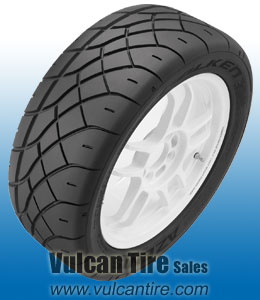
have an asymmetric construction. Tires designed for maximum performance on dry pavement are typically designed this way, with larger tread blocks on the outside edge of the tread than the inside, to help to maximize cornering ability. Asymmetric tires have markings on the sidewall indicating whether each side should face in or out.
When an asymmetric tire is mounted on the wheel, as long as the proper side faces out, it can be used on either side of the car. You can (and should) rotate the tires from one side of the car to the other, without dismounting them from the rims.
<u>Directional and Asymmetric Tires</u>
A few tires are both directional and asymmetric. Such tires are designed to be used on one specific side of the car, and you need to order different tires, with different part numbers, for a "left tire" or a "right tire".
<u>Pulling</u>
As for the pulling problem, the most likely cause is an alignment problem. Often, even if you think that your car is properly aligned, it isn't. Other, less likely causes of pulling include a suspension problem (e.g. bent control arm, worn bushings, worn shocks, etc) or a defective tire. Pulling is not caused by the way you rotated your tires (which is proper, for the RT-615).
<u>Directional Tires</u>
The Yokohama ES100 is a good example of a directional tire:
Directional tires are designed to rotate in a specific direction - usually, so that in rain, water is channeled from the center of the tread to both outer edges as the car travels in a forward direction. Directional tires have an arrow on the sidewall to indicate the direction in which the tires should rotate when the car goes forward.
When a directional tire is mounted on the wheel, it is done so that it can be used on one side of the car. The arrow shows whether the tire is mounted as a left tire or a right tire. Usually, directional tires are only rotated front to back on the same side of the car. If you wanted to move it to the other side of the car, for best rain performance, you should "flip" the tire on the rim in order to maintain the proper directionality.
<u>Asymmetric tires</u>
The Falken Azenis RT-615, and its RT-215 predecessor pictured here:
have an asymmetric construction. Tires designed for maximum performance on dry pavement are typically designed this way, with larger tread blocks on the outside edge of the tread than the inside, to help to maximize cornering ability. Asymmetric tires have markings on the sidewall indicating whether each side should face in or out.
When an asymmetric tire is mounted on the wheel, as long as the proper side faces out, it can be used on either side of the car. You can (and should) rotate the tires from one side of the car to the other, without dismounting them from the rims.
<u>Directional and Asymmetric Tires</u>
A few tires are both directional and asymmetric. Such tires are designed to be used on one specific side of the car, and you need to order different tires, with different part numbers, for a "left tire" or a "right tire".
<u>Pulling</u>
As for the pulling problem, the most likely cause is an alignment problem. Often, even if you think that your car is properly aligned, it isn't. Other, less likely causes of pulling include a suspension problem (e.g. bent control arm, worn bushings, worn shocks, etc) or a defective tire. Pulling is not caused by the way you rotated your tires (which is proper, for the RT-615).

Thread Starter
Honda-Tech Member
Joined: Sep 2004
Posts: 271
Likes: 5
From: NC, USA
Re: (94rs-turbo)
Car was pulling to the right. I just swapped the front wheels and there is a very slight pull to the left - difference could just be that most of the roads I drive are crowned to the right - even left lanes usually.


Honda-Tech Member
Joined: Oct 2003
Posts: 14,394
Likes: 0
From: Armed and Ready
Re: Anybody have a pullilng problem with RT-615 ? (Doespike)
<TABLE WIDTH="90%" CELLSPACING=0 CELLPADDING=0 ALIGN=CENTER><TR><TD>Quote, originally posted by Doespike »</TD></TR><TR><TD CLASS="quote">Can always count on Ken for in-depth information 
 </TD></TR></TABLE>
Hell yeah.
</TD></TR></TABLE>Hell yeah.

Honda-Tech Member
Joined: Sep 2004
Posts: 15,427
Likes: 0
From: Boost > NA
Re: Anybody have a pullilng problem with RT-615 ? (Doespike)
<TABLE WIDTH="90%" CELLSPACING=0 CELLPADDING=0 ALIGN=CENTER><TR><TD>Quote, originally posted by Doespike »</TD></TR><TR><TD CLASS="quote">Can always count on Ken for in-depth information </TD></TR></TABLE>
Haha. True.
</TD></TR></TABLE>Haha. True.


Honda-Tech Member
iTrader: (6)
Joined: Aug 2003
Posts: 6,139
Likes: 0
From: In Texas watching out for the Fuzz, US
Re: Anybody have a pullilng problem with RT-615 ? (migs)
<TABLE WIDTH="90%" CELLSPACING=0 CELLPADDING=0 ALIGN=CENTER><TR><TD>Quote, originally posted by migs »</TD></TR><TR><TD CLASS="quote">The tire has a shifted belt inside of its structure. Its basically defective. When I worked in the tire business, it was prorated.</TD></TR></TABLE>
true that, hell mike gave me his r615's and one had a tire pull
true that, hell mike gave me his r615's and one had a tire pull

Honda-Tech Member
Joined: Feb 2002
Posts: 700
Likes: 0
From: Boost, 12psi
No problems with my Azenis 615.
I think the tire is probably defective and is slightly cone shaped, exhibiting "radial pull".
I've had tires like that, drove fine in one orientation then after a rotation or a switch around, it would pull to one side.
Go return it and get another one if you can.
I think the tire is probably defective and is slightly cone shaped, exhibiting "radial pull".
I've had tires like that, drove fine in one orientation then after a rotation or a switch around, it would pull to one side.
Go return it and get another one if you can.
Honda-Tech Member
Joined: Aug 2004
Posts: 12,098
Likes: 1
From: blavica
Re: Anybody have a pullilng problem with RT-615 ? (nsxtasy)
<TABLE WIDTH="90%" CELLSPACING=0 CELLPADDING=0 ALIGN=CENTER><TR><TD>Quote, originally posted by nsxtasy »</TD></TR><TR><TD CLASS="quote">
When an asymmetric tire is mounted on the wheel, as long as the proper side faces out, it can be used on either side of the car. You can (and should) rotate the tires from one side of the car to the other, without dismounting them from the rims.
</TD></TR></TABLE>
Ken, can you give me a reason why? I have always, and will continue regardless of directional or not, to rotate from front to rear, not side to side. I see no benifit or defintely not a reason why I should rotate them in this manor?
When an asymmetric tire is mounted on the wheel, as long as the proper side faces out, it can be used on either side of the car. You can (and should) rotate the tires from one side of the car to the other, without dismounting them from the rims.
</TD></TR></TABLE>
Ken, can you give me a reason why? I have always, and will continue regardless of directional or not, to rotate from front to rear, not side to side. I see no benifit or defintely not a reason why I should rotate them in this manor?