


Coil Frying and some Ignition Discussion


Thread Starter
Honda-Tech Member
Joined: Mar 2004
Posts: 15,050
Likes: 3
 Coil Frying and some Ignition Discussion
Some of you may remember me making a thread a while back about how my car was frying ignition coils non-stop. Well, despite my best efforts, it still has not stopped. I'll give the full story of my ignition situation as I think some part of it is at fault for this problem.
I bought a 96 lude and put an obd1 h22 in it. I had two choices at the time, either swap oil pumps and use the obd2 system, or wire the jdm internal coil dist. with all the sensors inside to work with the h23 harness. I chose the latter.
It ran fine for probably a year, then I decided that I may as well replace the rotor button and cap. I do that, drive it to work fine, then when I come out later to start it up, she won't crank. After much searching and such I find out it is the coil at fault. Through this crap I swap out the ICM and a few other parts in trying to find the problem. It runs fine again for some number of months.
I had installed MSD spark plug wires on the car a few months later maybe, and then one day I was getting my VTAK on and I revved to the top of 2nd gear, then my car shuts off, I coast to a stop, pop the hood, and find the 2nd spark plug wire completely popped off and dangling, then the coil is dead again. Same thing happens a few months later getting onto the highway with the birdman one day.
Then I switch out to NGK plug wires, the wire popping off problem is gone, but now the coil will just randomly die.
I've probably gone through at least 8 ignition coils in this car, and I'm getting sick of it.
One thing I must say is this, the car was an auto when I bought it, and at my young age of 16, I was working on it one day, and was going to cut off the ecu connector for all the auto trans stuff, and use the pins to wire in vtak the right way, instead of splicing into my obd2->1 harness, I was going to pin vtak into the obd2 clips. So its the night before senior prom in high school, and I've had a couple , not a lot or anything...
Anyways, I grab my snips, grab the connector, and go to cut it, and my friend walks up and says something to me, I look up, reply, then go back to cut it off. So I cut it off, and commense breaking the connector with a set of pliers to get the pins out.
I look again, holy ****, I cut off the damn "C" clip, not the AT one,
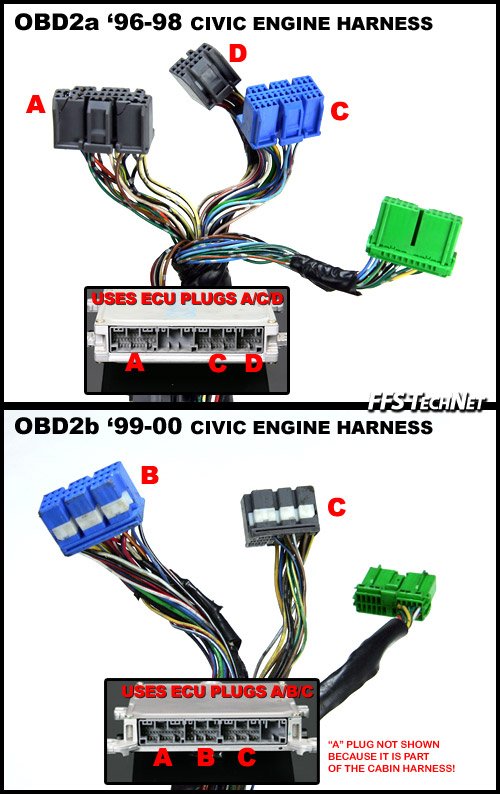
So I bust out my soldering iron and some heat shrink and I solder every damn one of those wires back on, and then from me trying to break the clip, I had cut off a corner off it, and there are two wires that I now have to manually place on their pin, and hope they stay put, they're C23 and C25. C23 is IP+ and C25 is VS+. On the diagram I used, it says C24 should be IP- and VS-. I don't have a C24, or I lost it in the cutting process, that I need to further investigate. So C23 is power to the ECU, C24 is supposed to be a 2.5v reference, and C25 is the VS cell voltage, which I have no idea what that is.
http://www.ff-squad.com/tech/w...8.jpg
there is the diagram, its a huge pic so I linked it instead. BTW, the FAQ here says 96 preludes use the same wiring as 97+ ludes, and that is totally wrong. Its the same as any 96-98 civic or 'teg though.
So a few weeks ago I pull out the ecu adapter harness to find one of the IP+ wires to the ecu slightly burnt and popped out of its pinhole in the connector some, presumably the same C23 wire above, but I didn't check well. I assumed that was the problem and thought I was done with this ****. Nope.
The coils that burnt out originally had too low resistance between the positive terminal and the output, the one that I pulled out of my car an hour ago had too low resistance from the positive terminal to the negative. F'n A.
I assume that there is some problem somewhere in that wiring ordeal, though I did have an interesting discussion with my dad the other day on ignition stuff so I figured I'd ask.
He said on some older stuff, like back when he was a mechanic, that ignitions got high voltage on cranking, then a bit lower during running conditions to keep the coil cool. Is this true of hondas? As it is now, I just ran the +12v blk/yel that supplied the external coil to the blk/yel that goes into the dist.
Thanks guys, I know its a read but I appreciate the help.
Matt
I bought a 96 lude and put an obd1 h22 in it. I had two choices at the time, either swap oil pumps and use the obd2 system, or wire the jdm internal coil dist. with all the sensors inside to work with the h23 harness. I chose the latter.
It ran fine for probably a year, then I decided that I may as well replace the rotor button and cap. I do that, drive it to work fine, then when I come out later to start it up, she won't crank. After much searching and such I find out it is the coil at fault. Through this crap I swap out the ICM and a few other parts in trying to find the problem. It runs fine again for some number of months.
I had installed MSD spark plug wires on the car a few months later maybe, and then one day I was getting my VTAK on and I revved to the top of 2nd gear, then my car shuts off, I coast to a stop, pop the hood, and find the 2nd spark plug wire completely popped off and dangling, then the coil is dead again. Same thing happens a few months later getting onto the highway with the birdman one day.
Then I switch out to NGK plug wires, the wire popping off problem is gone, but now the coil will just randomly die.
I've probably gone through at least 8 ignition coils in this car, and I'm getting sick of it.
One thing I must say is this, the car was an auto when I bought it, and at my young age of 16, I was working on it one day, and was going to cut off the ecu connector for all the auto trans stuff, and use the pins to wire in vtak the right way, instead of splicing into my obd2->1 harness, I was going to pin vtak into the obd2 clips. So its the night before senior prom in high school, and I've had a couple
, not a lot or anything... Anyways, I grab my snips, grab the connector, and go to cut it, and my friend walks up and says something to me, I look up, reply, then go back to cut it off. So I cut it off, and commense breaking the connector with a set of pliers to get the pins out.
I look again, holy ****, I cut off the damn "C" clip, not the AT one,
So I bust out my soldering iron and some heat shrink and I solder every damn one of those wires back on, and then from me trying to break the clip, I had cut off a corner off it, and there are two wires that I now have to manually place on their pin, and hope they stay put, they're C23 and C25. C23 is IP+ and C25 is VS+. On the diagram I used, it says C24 should be IP- and VS-. I don't have a C24, or I lost it in the cutting process, that I need to further investigate. So C23 is power to the ECU, C24 is supposed to be a 2.5v reference, and C25 is the VS cell voltage, which I have no idea what that is.
http://www.ff-squad.com/tech/w...8.jpg
there is the diagram, its a huge pic so I linked it instead. BTW, the FAQ here says 96 preludes use the same wiring as 97+ ludes, and that is totally wrong. Its the same as any 96-98 civic or 'teg though.
So a few weeks ago I pull out the ecu adapter harness to find one of the IP+ wires to the ecu slightly burnt and popped out of its pinhole in the connector some, presumably the same C23 wire above, but I didn't check well. I assumed that was the problem and thought I was done with this ****. Nope.
The coils that burnt out originally had too low resistance between the positive terminal and the output, the one that I pulled out of my car an hour ago had too low resistance from the positive terminal to the negative. F'n A.
I assume that there is some problem somewhere in that wiring ordeal, though I did have an interesting discussion with my dad the other day on ignition stuff so I figured I'd ask.
He said on some older stuff, like back when he was a mechanic, that ignitions got high voltage on cranking, then a bit lower during running conditions to keep the coil cool. Is this true of hondas? As it is now, I just ran the +12v blk/yel that supplied the external coil to the blk/yel that goes into the dist.
Thanks guys, I know its a read but I appreciate the help.
Matt


Thread Starter
Honda-Tech Member
Joined: Mar 2004
Posts: 15,050
Likes: 3
bump. Did some reading, the coil always should be at +12v so that is not the problem.
I noticed that the wire coming off the negative coil terminal and going to the ICM was getting hot, like the rubber shielding and such was slightly melted.
I noticed that the wire coming off the negative coil terminal and going to the ICM was getting hot, like the rubber shielding and such was slightly melted.

Honda-Tech Member
Joined: May 2006
Posts: 1,989
Likes: 0
From: upstate NY
Re: (mgags7)
i assume you already checked the voltage while the car is running to make sure it is actually getting enough power to the coil?
<TABLE WIDTH="90%" CELLSPACING=0 CELLPADDING=0 ALIGN=CENTER><TR><TD>Quote, originally posted by mgags7 »</TD></TR><TR><TD CLASS="quote">As it is now, I just ran the +12v blk/yel that supplied the external coil to the blk/yel that goes into the dist.</TD></TR></TABLE>
so you bypassed the power to the coil and are going straight to the dizzy?
<TABLE WIDTH="90%" CELLSPACING=0 CELLPADDING=0 ALIGN=CENTER><TR><TD>Quote, originally posted by mgags7 »</TD></TR><TR><TD CLASS="quote">As it is now, I just ran the +12v blk/yel that supplied the external coil to the blk/yel that goes into the dist.</TD></TR></TABLE>
so you bypassed the power to the coil and are going straight to the dizzy?
Thread Starter
Honda-Tech Member
Joined: Mar 2004
Posts: 15,050
Likes: 3
well its internal coil now, so the old external coil power is powering both the dizzy and the internal coil.
I'll check again to make sure on the first question, but I'm 90% I already checked that.
thanks
I'll check again to make sure on the first question, but I'm 90% I already checked that.
thanks
Trending Topics

Honda-Tech Member
Joined: Nov 2002
Posts: 3,969
Likes: 6
From: northern DRUNKit, ma
Re: Coil Frying and some Ignition Discussion (mgags7)
check your battery voltage for ***** and giggles, also rev the car and see if voltage going up really high or drops really low (rev the **** out of it, you need to be sure the regulator is doing its job). if your voltage regulator is acting up, one thing that can cook from over voltage, especailly at higher rpm is the coil.
Thread Starter
Honda-Tech Member
Joined: Mar 2004
Posts: 15,050
Likes: 3
I'll definitely do that Tom, thanks, I hadn't really thought of that.
It does seem to be correspondent to RPM, it started happening more after the final drive change and it definitely fries after highway driving more often than not.
It does seem to be correspondent to RPM, it started happening more after the final drive change and it definitely fries after highway driving more often than not.

Honda-Tech Member
Joined: Feb 2002
Posts: 2,072
Likes: 0
From: land of the sheep, home of the hypocrite
Re: (mgags7)
Won't you get a battery light for over/under voltage? Not sure, otherwise I'd say it has to be the ICM in the distributor. That is basically the only other component in that circuit. That part is the same for internal/external coils I think, but couldn't hurt to swap it and check its other connections. Could also switch to an MSD system, but that is kinda like fixing a transmission by trading the whole car in on a new one.
Thread Starter
Honda-Tech Member
Joined: Mar 2004
Posts: 15,050
Likes: 3
The battery light turns on as it should when the engine dies when the coil goes.
Do you think the ICM could be functioning though killing the coil at the same time?
I might just buy a whole new dizzy off someone on here. I'd rather not go the MSD route, I'm trying to get this car back to good, stock running condition.
Anyone have any input on whether obd2 computers have a conflict with obd1 distributors? Whats that all about the obd2 being able to adjust base timing or something...that seems like a false rumor.
Thanks
Do you think the ICM could be functioning though killing the coil at the same time?
I might just buy a whole new dizzy off someone on here. I'd rather not go the MSD route, I'm trying to get this car back to good, stock running condition.
Anyone have any input on whether obd2 computers have a conflict with obd1 distributors? Whats that all about the obd2 being able to adjust base timing or something...that seems like a false rumor.
Thanks
Thread Starter
Honda-Tech Member
Joined: Mar 2004
Posts: 15,050
Likes: 3
Re: (bluedlude)
<TABLE WIDTH="90%" CELLSPACING=0 CELLPADDING=0 ALIGN=CENTER><TR><TD>Quote, originally posted by bluedlude »</TD></TR><TR><TD CLASS="quote">i dont know for sure, but wont the OBD2 ECU be looking for the crank position sensor? </TD></TR></TABLE>
yes
the obd1 system has all the sensors in the dist.
the obd2 system has one in the dizz and two at the oil pump
I wired them all to the dizzy using a little jumper harness I made and the stock obd2 engine harness.
yes
the obd1 system has all the sensors in the dist.
the obd2 system has one in the dizz and two at the oil pump
I wired them all to the dizzy using a little jumper harness I made and the stock obd2 engine harness.
Thread Starter
Honda-Tech Member
Joined: Mar 2004
Posts: 15,050
Likes: 3
Ok now we're getting somewhere.
With the engine off the thing gets 11.8v so basically battery (12v) voltage.
I crank it up, its reading about 13.8v , which I belive to be way too high.
Now, the voltage regulator isn't completely toast, because even revving the **** out of it does not cause it to go higher than that. But I do think this is too high, I think I'm gonna go test my friend's teg real quick to see what his does.
With the engine off the thing gets 11.8v so basically battery (12v) voltage.
I crank it up, its reading about 13.8v , which I belive to be way too high.
Now, the voltage regulator isn't completely toast, because even revving the **** out of it does not cause it to go higher than that. But I do think this is too high, I think I'm gonna go test my friend's teg real quick to see what his does.
Honda-Tech Member
Joined: Nov 2002
Posts: 3,969
Likes: 6
From: northern DRUNKit, ma
Re: (flyrod)
<TABLE WIDTH="90%" CELLSPACING=0 CELLPADDING=0 ALIGN=CENTER><TR><TD>Quote, originally posted by flyrod »</TD></TR><TR><TD CLASS="quote">Won't you get a battery light for over/under voltage? </TD></TR></TABLE>
im not sure.. know the ecu keeps tabs on load hence the possible electronic load detector code. I don't know what controls the BAT light, I was under the assumption the battery light was only on when there was no charge being received from the altornator.
There are only a few things than can really kill a coil that i can think of other than just plain componet failure. If you have to much voltage you can quickly cook the coil, if you have too much dwell, or if the coil is discharging without enough load. im sure there are many other causes of failure, but im not coil expert. Since your runing a stock ECU (?? right? )you should have anyway to change the dwell times of the coil firing. you have already expericned the not enough load when you plug wire poped off, and the only other is an over voltage to the coil.
<TABLE WIDTH="90%" CELLSPACING=0 CELLPADDING=0 ALIGN=CENTER><TR><TD>Quote, originally posted by mgags7 »</TD></TR><TR><TD CLASS="quote"> Whats that all about the obd2 being able to adjust base timing or something...that seems like a false rumor.
Thanks</TD></TR></TABLE>
never heard that one, the only thing that should change the timing is the ECU, or you by turning the dizzy.
im not sure.. know the ecu keeps tabs on load hence the possible electronic load detector code. I don't know what controls the BAT light, I was under the assumption the battery light was only on when there was no charge being received from the altornator.
There are only a few things than can really kill a coil that i can think of other than just plain componet failure. If you have to much voltage you can quickly cook the coil, if you have too much dwell, or if the coil is discharging without enough load. im sure there are many other causes of failure, but im not coil expert. Since your runing a stock ECU (?? right? )you should have anyway to change the dwell times of the coil firing. you have already expericned the not enough load when you plug wire poped off, and the only other is an over voltage to the coil.
<TABLE WIDTH="90%" CELLSPACING=0 CELLPADDING=0 ALIGN=CENTER><TR><TD>Quote, originally posted by mgags7 »</TD></TR><TR><TD CLASS="quote"> Whats that all about the obd2 being able to adjust base timing or something...that seems like a false rumor.
Thanks</TD></TR></TABLE>
never heard that one, the only thing that should change the timing is the ECU, or you by turning the dizzy.
Honda-Tech Member
Joined: Nov 2002
Posts: 3,969
Likes: 6
From: northern DRUNKit, ma
Re: (mgags7)
<TABLE WIDTH="90%" CELLSPACING=0 CELLPADDING=0 ALIGN=CENTER><TR><TD>Quote, originally posted by mgags7 »</TD></TR><TR><TD CLASS="quote">Ok now we're getting somewhere.
With the engine off the thing gets 11.8v so basically battery (12v) voltage.
I crank it up, its reading about 13.8v , which I belive to be way too high.
Now, the voltage regulator isn't completely toast, because even revving the **** out of it does not cause it to go higher than that. But I do think this is too high, I think I'm gonna go test my friend's teg real quick to see what his does.</TD></TR></TABLE>
11.8 is pretty low for a key off battery possition, get a new battery.
With the engine off the thing gets 11.8v so basically battery (12v) voltage.
I crank it up, its reading about 13.8v , which I belive to be way too high.
Now, the voltage regulator isn't completely toast, because even revving the **** out of it does not cause it to go higher than that. But I do think this is too high, I think I'm gonna go test my friend's teg real quick to see what his does.</TD></TR></TABLE>
11.8 is pretty low for a key off battery possition, get a new battery.
Thread Starter
Honda-Tech Member
Joined: Mar 2004
Posts: 15,050
Likes: 3
well guys that was not the problem, my roommate's completely stock integra just read the exact same.
It is on a stock obd2 ecu now..
I was hoping that timing rumor was in fact a rumor, thanks tom.
I know a good bit about the coil, it is basically a transformer, so if the primary winding (first inductor) has too low resistance what is the problem?
btw the teg was 11.8 before cranking too...
It is on a stock obd2 ecu now..
I was hoping that timing rumor was in fact a rumor, thanks tom.
I know a good bit about the coil, it is basically a transformer, so if the primary winding (first inductor) has too low resistance what is the problem?
btw the teg was 11.8 before cranking too...
Honda-Tech Member
Joined: Nov 2002
Posts: 3,969
Likes: 6
From: northern DRUNKit, ma
Re: (mgags7)
<TABLE WIDTH="90%" CELLSPACING=0 CELLPADDING=0 ALIGN=CENTER><TR><TD>Quote, originally posted by mgags7 »</TD></TR><TR><TD CLASS="quote">
I know a good bit about the coil, it is basically a transformer, so if the primary winding (first inductor) has too low resistance what is the problem?
btw the teg was 11.8 before cranking too...</TD></TR></TABLE>
weird, most all my batterys are 12.5ish +
every peice of wire has a resistance, if the resistance reads lower than the helms spec, that means there is now a short in the primary winding. a short has a shorter path to travel and hence resistance will be lower. also explains why it doesn't work any more, there is alot less inductor to induce a current in the secondary winding.
well atleast you know its not voltage releated. Im wondering if something somewhere in you ecu, ICM, or dizzy is causing to much dwell. if dwell is slightly too long in all rpms, it won't cook the coil down low because it has time to "rest" , but if dwell has changed, then in high rpms the coil is practically almost in an always on state.. these issues are always tough.
i would try a new dizzy first, which replaces the ignitor and all the guts, and run the OBD of the computer to be safe.
i have mixed obd1 and obd2 dizzy parts and the obd1 computer was not happy. i never tried all obd2 on obd1 computer..
I know a good bit about the coil, it is basically a transformer, so if the primary winding (first inductor) has too low resistance what is the problem?
btw the teg was 11.8 before cranking too...</TD></TR></TABLE>
weird, most all my batterys are 12.5ish +
every peice of wire has a resistance, if the resistance reads lower than the helms spec, that means there is now a short in the primary winding. a short has a shorter path to travel and hence resistance will be lower. also explains why it doesn't work any more, there is alot less inductor to induce a current in the secondary winding.
well atleast you know its not voltage releated. Im wondering if something somewhere in you ecu, ICM, or dizzy is causing to much dwell. if dwell is slightly too long in all rpms, it won't cook the coil down low because it has time to "rest" , but if dwell has changed, then in high rpms the coil is practically almost in an always on state.. these issues are always tough.
i would try a new dizzy first, which replaces the ignitor and all the guts, and run the OBD of the computer to be safe.
i have mixed obd1 and obd2 dizzy parts and the obd1 computer was not happy. i never tried all obd2 on obd1 computer..

Honda-Tech Member
Joined: Aug 2002
Posts: 11,001
Likes: 2
From: Boca Raton, FL
Re: (prelittlelude)
<TABLE WIDTH="90%" CELLSPACING=0 CELLPADDING=0 ALIGN=CENTER><TR><TD>Quote, originally posted by prelittlelude »</TD></TR><TR><TD CLASS="quote">
im not sure.. know the ecu keeps tabs on load hence the possible electronic load detector code. I don't know what controls the BAT light, I was under the assumption the battery light was only on when there was no charge being received from the altornator.</TD></TR></TABLE>
It comes on under 11.0v.
<TABLE WIDTH="90%" CELLSPACING=0 CELLPADDING=0 ALIGN=CENTER><TR><TD>Quote, originally posted by prelittlelude »</TD></TR><TR><TD CLASS="quote">There are only a few things than can really kill a coil that i can think of other than just plain componet failure. If you have to much voltage you can quickly cook the coil, if you have too much dwell, or if the coil is discharging without enough load. im sure there are many other causes of failure, but im not coil expert. Since your runing a stock ECU (?? right? )you should have anyway to change the dwell times of the coil firing. you have already expericned the not enough load when you plug wire poped off, and the only other is an over voltage to the coil. </TD></TR></TABLE>
The charging and discharging is mosty done by the ICM (other the signal from the ECU). ICM is just a high speed relay.
Odds are when you had the plug pooping problem, you hurt your ICM. If the ICM is bad, it will fry coils like whoa.
Hope that helps
im not sure.. know the ecu keeps tabs on load hence the possible electronic load detector code. I don't know what controls the BAT light, I was under the assumption the battery light was only on when there was no charge being received from the altornator.</TD></TR></TABLE>
It comes on under 11.0v.
<TABLE WIDTH="90%" CELLSPACING=0 CELLPADDING=0 ALIGN=CENTER><TR><TD>Quote, originally posted by prelittlelude »</TD></TR><TR><TD CLASS="quote">There are only a few things than can really kill a coil that i can think of other than just plain componet failure. If you have to much voltage you can quickly cook the coil, if you have too much dwell, or if the coil is discharging without enough load. im sure there are many other causes of failure, but im not coil expert. Since your runing a stock ECU (?? right? )you should have anyway to change the dwell times of the coil firing. you have already expericned the not enough load when you plug wire poped off, and the only other is an over voltage to the coil. </TD></TR></TABLE>
The charging and discharging is mosty done by the ICM (other the signal from the ECU). ICM is just a high speed relay.
Odds are when you had the plug pooping problem, you hurt your ICM. If the ICM is bad, it will fry coils like whoa.
Hope that helps

Honda-Tech Member
Joined: Aug 2002
Posts: 12,464
Likes: 0
From: NOR CAL
Re: (Turbogixxer)
<TABLE WIDTH="90%" CELLSPACING=0 CELLPADDING=0 ALIGN=CENTER><TR><TD>Quote, originally posted by Turbogixxer »</TD></TR><TR><TD CLASS="quote">
It comes on under 11.0v.
The charging and discharging is mosty done by the ICM (other the signal from the ECU). ICM is just a high speed relay.
Odds are when you had the plug pooping problem, you hurt your ICM. If the ICM is bad, it will fry coils like whoa.
Hope that helps</TD></TR></TABLE>
TG to the rescue
It comes on under 11.0v.
The charging and discharging is mosty done by the ICM (other the signal from the ECU). ICM is just a high speed relay.
Odds are when you had the plug pooping problem, you hurt your ICM. If the ICM is bad, it will fry coils like whoa.
Hope that helps</TD></TR></TABLE>
TG to the rescue

Honda-Tech Member
Joined: Oct 2002
Posts: 597
Likes: 1
From: Raleigh, NC, USA
Re: (mgags7)
<TABLE WIDTH="90%" CELLSPACING=0 CELLPADDING=0 ALIGN=CENTER><TR><TD>Quote, originally posted by mgags7 »</TD></TR><TR><TD CLASS="quote">
I crank it up, its reading about 13.8v , which I belive to be way too high.
</TD></TR></TABLE>
12 volt batteries are composed of (6) 2 volt cells linked together in series. A good charge/Float voltage is 2.25 volts per cell, or 13.5v. I wouldn't think 13.8 would be too far out of line.
I crank it up, its reading about 13.8v , which I belive to be way too high.
</TD></TR></TABLE>
12 volt batteries are composed of (6) 2 volt cells linked together in series. A good charge/Float voltage is 2.25 volts per cell, or 13.5v. I wouldn't think 13.8 would be too far out of line.
Thread Starter
Honda-Tech Member
Joined: Mar 2004
Posts: 15,050
Likes: 3
Mike, the battery itself is charged to 11.8v I believe, I don't think the pre-crank dizzy voltage is regulated, though I'm not sure. I was assuming that the 13.8v was from the alternator.
Thanks for the info
I'm off to buy a new dizzy.
Thanks for the info
I'm off to buy a new dizzy.
Honda-Tech Member
Joined: Oct 2002
Posts: 597
Likes: 1
From: Raleigh, NC, USA
Re: (mgags7)
<TABLE WIDTH="90%" CELLSPACING=0 CELLPADDING=0 ALIGN=CENTER><TR><TD>Quote, originally posted by mgags7 »</TD></TR><TR><TD CLASS="quote">Mike, the battery itself is charged to 11.8v I believe, I don't think the pre-crank dizzy voltage is regulated, though I'm not sure. I was assuming that the 13.8v was from the alternator.
Thanks for the info
I'm off to buy a new dizzy.</TD></TR></TABLE>
Right, 11.8 is what the battery is resting at (nothing coming from the alternator). ~13.5v is what I would imagine a healthy alternator would be cranking out after the regulator.
I had a friend who's regulator went bad after he decided to powerwash his motor. The 18 volts his alt put out after that messed a few things up.
Thanks for the info
I'm off to buy a new dizzy.</TD></TR></TABLE>
Right, 11.8 is what the battery is resting at (nothing coming from the alternator). ~13.5v is what I would imagine a healthy alternator would be cranking out after the regulator.
I had a friend who's regulator went bad after he decided to powerwash his motor.
The 18 volts his alt put out after that messed a few things up.
Thread Starter
Honda-Tech Member
Joined: Mar 2004
Posts: 15,050
Likes: 3
Re: (prelittlelude)
<TABLE WIDTH="90%" CELLSPACING=0 CELLPADDING=0 ALIGN=CENTER><TR><TD>Quote, originally posted by prelittlelude »</TD></TR><TR><TD CLASS="quote">
weird, most all my batterys are 12.5ish +
every peice of wire has a resistance, if the resistance reads lower than the helms spec, that means there is now a short in the primary winding. a short has a shorter path to travel and hence resistance will be lower. also explains why it doesn't work any more, there is alot less inductor to induce a current in the secondary winding.
well atleast you know its not voltage releated. Im wondering if something somewhere in you ecu, ICM, or dizzy is causing to much dwell. if dwell is slightly too long in all rpms, it won't cook the coil down low because it has time to "rest" , but if dwell has changed, then in high rpms the coil is practically almost in an always on state.. these issues are always tough.
i would try a new dizzy first, which replaces the ignitor and all the guts, and run the OBD of the computer to be safe.
i have mixed obd1 and obd2 dizzy parts and the obd1 computer was not happy. i never tried all obd2 on obd1 computer..</TD></TR></TABLE>
Tom, are you an EE or something?
I didn't want to get all EE techinical up in hurr, but yeah, those wires that form the first coil experience what they call a spark "tunnel" that burns out the dielectric and makes the coil more like a big bunch of continuous wire rather than an inductor, so the turns ratio of the transformer is altered and the voltage gain is seriously reduced, I wish I had a lab scope so I could see what it was really putting out even after it "dies".
Either way, I'm gonna pick up a new dist. and see if that changes things. I'll let you guys know.
In the meantime, if anyone sees a '96 lude part out or knows of anywhere that I can get some obd2 ecu connectors, let me know, I'd like to get that fixed.
Anyone with a 96 lude, if you could take a pic of the blue ecu connector from the back, in high res, I would REALLY appreciate it.
Thanks guys
weird, most all my batterys are 12.5ish +
every peice of wire has a resistance, if the resistance reads lower than the helms spec, that means there is now a short in the primary winding. a short has a shorter path to travel and hence resistance will be lower. also explains why it doesn't work any more, there is alot less inductor to induce a current in the secondary winding.
well atleast you know its not voltage releated. Im wondering if something somewhere in you ecu, ICM, or dizzy is causing to much dwell. if dwell is slightly too long in all rpms, it won't cook the coil down low because it has time to "rest" , but if dwell has changed, then in high rpms the coil is practically almost in an always on state.. these issues are always tough.
i would try a new dizzy first, which replaces the ignitor and all the guts, and run the OBD of the computer to be safe.
i have mixed obd1 and obd2 dizzy parts and the obd1 computer was not happy. i never tried all obd2 on obd1 computer..</TD></TR></TABLE>
Tom, are you an EE or something?
I didn't want to get all EE techinical up in hurr, but yeah, those wires that form the first coil experience what they call a spark "tunnel" that burns out the dielectric and makes the coil more like a big bunch of continuous wire rather than an inductor, so the turns ratio of the transformer is altered and the voltage gain is seriously reduced, I wish I had a lab scope so I could see what it was really putting out even after it "dies".
Either way, I'm gonna pick up a new dist. and see if that changes things. I'll let you guys know.
In the meantime, if anyone sees a '96 lude part out or knows of anywhere that I can get some obd2 ecu connectors, let me know, I'd like to get that fixed.
Anyone with a 96 lude, if you could take a pic of the blue ecu connector from the back, in high res, I would REALLY appreciate it.
Thanks guys