


Charcoal Canister Answers- Yes, I searched


Thread Starter
Honda-Tech Member
Joined: Oct 2003
Posts: 1,299
Likes: 0
From: Coming to a Campus Near You!
 Charcoal Canister Answers- Yes, I searched
I am so tired of sorting through the archives and reading conflicting performance claims and opposite advice regarding the removal of the infamous charcoal canister. Let's clear this up once and for all:
Photo stolen:
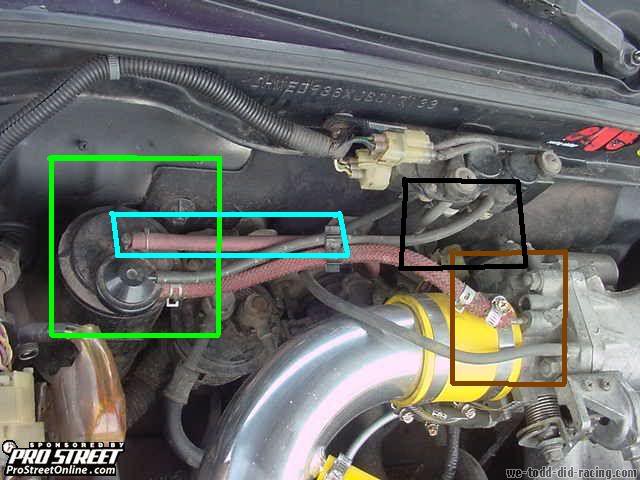
The Yellow box (Green) = Charcoal Canister- (Remove this?)
The White box (Aqua blue) - Fuel vapor line- ("Let it hang to vapor fuel" is the most common advice. There has to be other, better ways.)
The RED box (darkish brown)- Throttle body - (Plug this off?)
The Black box (Black) - (Plug it off?)
Questions:
- Is there legitimate evidence that removal of the canister positively impacts performance (or vice-versa)?
- Is there legitimate evidence that removing the canister will adversely affect gas mileage?
Any and all input is very welcome
Photo stolen:
The Yellow box (Green) = Charcoal Canister- (Remove this?)
The White box (Aqua blue) - Fuel vapor line- ("Let it hang to vapor fuel" is the most common advice. There has to be other, better ways.)
The RED box (darkish brown)- Throttle body - (Plug this off?)
The Black box (Black) - (Plug it off?)
Questions:
- Is there legitimate evidence that removal of the canister positively impacts performance (or vice-versa)?
- Is there legitimate evidence that removing the canister will adversely affect gas mileage?
Any and all input is very welcome


Honda-Tech Member
Joined: Dec 2005
Posts: 1,748
Likes: 1
From: San Ramon/Pleasanton, CA, USA
Re: Charcoal Canister Answers- Yes, I searched (Wilky)
It doesn't hurt performance at all. No effect at all.
All it is designed to do is hold fuel vapors so they don't get released to the atmosphere.
You need to leave the vent solenoid plugged in electrically to avoid the dreaded check engine light.
Just let the vapor hose from the tank hand down and if you want to put a breather filter on the end. Or just a piece of foam will be enough.
All it is designed to do is hold fuel vapors so they don't get released to the atmosphere.
You need to leave the vent solenoid plugged in electrically to avoid the dreaded check engine light.
Just let the vapor hose from the tank hand down and if you want to put a breather filter on the end. Or just a piece of foam will be enough.

Honda-Tech Member
Joined: May 2004
Posts: 236
Likes: 0
From: Mesa, AZ, USA
Re: Charcoal Canister Answers- Yes, I searched (thesmogman)
i think the problem im having with my car is because i dont have my can properly hooked up
i have a 91 crx si with an 0bd2 gsr. long story short i had to kinda "rig" a charcoal can up to get through emmisions. now if i dont de-pressurize (release the gas cap) every night the pressure in the tank will cause it to not start.
i have a 91 crx si with an 0bd2 gsr. long story short i had to kinda "rig" a charcoal can up to get through emmisions. now if i dont de-pressurize (release the gas cap) every night the pressure in the tank will cause it to not start.

Junior Member
Joined: Feb 2007
Posts: 639
Likes: 0
From: Seattle, USA
Re: Charcoal Canister Answers- Yes, I searched (Wilky)
Why would you want fuel to be vaporing into the engine bay? I don't understand that at all. Also, prepare for a monster pressure release whenever you open your fuel cap.

Honda-Tech Member
Joined: Feb 2002
Posts: 1,210
Likes: 4
From: MIAMI
Re: Charcoal Canister Answers- Yes, I searched (Ermil)
I removed mine with NO effect on performance or gas mileage.
My plug for the solenoid is disconnected and I do not have a CEL.
With the canister and solenoid removed, the gas tank is free to vent whenever. by default, there is no solenoid in place to block and build up pressure, so I have not noticed any buildup in pressure.
honestly, try it out yourself and make up your own mind. It only takes a few minutes to remove and re-install it.
Modified by gringo7718 at 11:06 PM 6/11/2007
My plug for the solenoid is disconnected and I do not have a CEL.
With the canister and solenoid removed, the gas tank is free to vent whenever. by default, there is no solenoid in place to block and build up pressure, so I have not noticed any buildup in pressure.
honestly, try it out yourself and make up your own mind. It only takes a few minutes to remove and re-install it.
Modified by gringo7718 at 11:06 PM 6/11/2007

Honda-Tech Member
Joined: Aug 2004
Posts: 3,366
Likes: 0
From: Charleston, SC - Myrtle Beach, SC
Re: Charcoal Canister Answers- Yes, I searched (Ermil)
<TABLE WIDTH="90%" CELLSPACING=0 CELLPADDING=0 ALIGN=CENTER><TR><TD>Quote, originally posted by Ermil »</TD></TR><TR><TD CLASS="quote">Also, prepare for a monster pressure release whenever you open your fuel cap.</TD></TR></TABLE>
I can vouch for that.
I almost got sucked in last time I filled up.
I can vouch for that.
I almost got sucked in last time I filled up.
Trending Topics

Stouts 'n' Scotch
Joined: Jul 2006
Posts: 5,383
Likes: 0
From: Milwaukee, WI
Re: Charcoal Canister Answers- Yes, I searched (Ermil)
<TABLE WIDTH="90%" CELLSPACING=0 CELLPADDING=0 ALIGN=CENTER><TR><TD>Quote, originally posted by Ermil »</TD></TR><TR><TD CLASS="quote">Also, prepare for a monster pressure release whenever you open your fuel cap.</TD></TR></TABLE>
So..... if I get a monster pressure release when I release my gas cap, is my charcoal canister going bad?
(Don't mean to thread jack)
So..... if I get a monster pressure release when I release my gas cap, is my charcoal canister going bad?
(Don't mean to thread jack)
Honda-Tech Member
Joined: Feb 2002
Posts: 1,210
Likes: 4
From: MIAMI
Re: Charcoal Canister Answers- Yes, I searched (doitdub)
<TABLE WIDTH="90%" CELLSPACING=0 CELLPADDING=0 ALIGN=CENTER><TR><TD>Quote, originally posted by Ermil »</TD></TR><TR><TD CLASS="quote"> Also, prepare for a monster pressure release whenever you open your fuel cap.</TD></TR></TABLE>
Do you have any evidence that removing the charcoal canister and solenoid directly relates to an increase in pressure in the fuel tank?
It is my understanding that with the canister/solenoid removed, the tank is free to vent.
With the canister/solenoid in place it will trap the vapors, containing the pressure in the tank.
Do you have any evidence that removing the charcoal canister and solenoid directly relates to an increase in pressure in the fuel tank?
It is my understanding that with the canister/solenoid removed, the tank is free to vent.
With the canister/solenoid in place it will trap the vapors, containing the pressure in the tank.

Thread Starter
Honda-Tech Member
Joined: Oct 2003
Posts: 1,299
Likes: 0
From: Coming to a Campus Near You!
Re: (ian1006)
Just to clarify:
I am running the original d16a6 NA, obd-0.
Any feedback on the gas mileage? I understand the logic behind the idea that removing the canister would hurt gas mileage due to the fact that the vapors that were once being fed back into the intake manifold are now going to open air. Those vapors cool the intake a bit, from what I understand, and likely have some fuel value.
Any thoughts?
I am running the original d16a6 NA, obd-0.
Any feedback on the gas mileage? I understand the logic behind the idea that removing the canister would hurt gas mileage due to the fact that the vapors that were once being fed back into the intake manifold are now going to open air. Those vapors cool the intake a bit, from what I understand, and likely have some fuel value.
Any thoughts?

Junior Member
Joined: Dec 2006
Posts: 296
Likes: 0
From: Salt Lake City, UTAH, USA
Mine is removed. the vent line is plugged. it makes a huge pressure let off when the tank is empty and its hot out. and the fuel pressure rises untill i let out the pressure. no check engine lights. its been like this on 2 of my crxs.
 Re: Charcoal Canister Answers- Yes, I searched (Wilky)
This is how I have mine:
Remove everything in red, and run one line from map to TB (blue)
1. Remove charcoal canister and the line thats running to the TB
2. No need to plug the charcoal line no the TB
3. Remove line coming from the firewall, that will just evaporate into your engine bay.
4. Run just one line from the map sensor to the TB (circled in blue)

Remove everything in red, and run one line from map to TB (blue)
1. Remove charcoal canister and the line thats running to the TB
2. No need to plug the charcoal line no the TB
3. Remove line coming from the firewall, that will just evaporate into your engine bay.
4. Run just one line from the map sensor to the TB (circled in blue)
Honda-Tech Member
Joined: Dec 2005
Posts: 1,748
Likes: 1
From: San Ramon/Pleasanton, CA, USA
Re: (Wilky)
The only time the canister is purging is when you are cruising. It does not open the vent until then.
No effect on gas mileage. ( . )
It is just for keeping the vapors out of the atmosphere.
No effect on gas mileage. ( . )
It is just for keeping the vapors out of the atmosphere.
Thread Starter
Honda-Tech Member
Joined: Oct 2003
Posts: 1,299
Likes: 0
From: Coming to a Campus Near You!
Re: Charcoal Canister Answers- Yes, I searched (HBK)
<TABLE WIDTH="90%" CELLSPACING=0 CELLPADDING=0 ALIGN=CENTER><TR><TD>Quote, originally posted by HBK »</TD></TR><TR><TD CLASS="quote">This is how I have mine:
Remove everything in red, and run one line from map to TB (blue)
1. Remove charcoal canister and the line thats running to the TB
2. No need to plug the charcoal line no the TB
3. Remove line coming from the firewall, that will just evaporate into your engine bay.
4. Run just one line from the map sensor to the TB (circled in blue)
</TD></TR></TABLE>
I don't mean to resurrect this, but I have a question:
If I need to run a line from the throttle body outlet (blue box) to the map, where does it need to go? Do I need to "T" it inline? They are different size outlets; How do I solve this?
Remove everything in red, and run one line from map to TB (blue)
1. Remove charcoal canister and the line thats running to the TB
2. No need to plug the charcoal line no the TB
3. Remove line coming from the firewall, that will just evaporate into your engine bay.
4. Run just one line from the map sensor to the TB (circled in blue)
</TD></TR></TABLE>I don't mean to resurrect this, but I have a question:
If I need to run a line from the throttle body outlet (blue box) to the map, where does it need to go? Do I need to "T" it inline? They are different size outlets; How do I solve this?
Thread Starter
Honda-Tech Member
Joined: Oct 2003
Posts: 1,299
Likes: 0
From: Coming to a Campus Near You!
Re: Charcoal Canister Answers- Yes, I searched (HBK)
<TABLE WIDTH="90%" CELLSPACING=0 CELLPADDING=0 ALIGN=CENTER><TR><TD>Quote, originally posted by HBK »</TD></TR><TR><TD CLASS="quote">This is how I have mine:
Remove everything in red, and run one line from map to TB (blue)
1. Remove charcoal canister and the line thats running to the TB
2. No need to plug the charcoal line no the TB
3. Remove line coming from the firewall, that will just evaporate into your engine bay.
4. Run just one line from the map sensor to the TB (circled in blue)
</TD></TR></TABLE>
I don't mean to resurrect this, but I have a question:
If I need to run a line from the throttle body outlet (blue box) to the map, where does it need to go? Do I need to "T" it inline? They are different size outlets; How do I solve this?
Remove everything in red, and run one line from map to TB (blue)
1. Remove charcoal canister and the line thats running to the TB
2. No need to plug the charcoal line no the TB
3. Remove line coming from the firewall, that will just evaporate into your engine bay.
4. Run just one line from the map sensor to the TB (circled in blue)
</TD></TR></TABLE>I don't mean to resurrect this, but I have a question:
If I need to run a line from the throttle body outlet (blue box) to the map, where does it need to go? Do I need to "T" it inline? They are different size outlets; How do I solve this?

Honda-Tech Member
Joined: Oct 2005
Posts: 227
Likes: 0
From: Bakersfield, CA, USA
by removing the charcoal canister you will make your drivability worse (bucking while at a steady speed). and why would anyone want fuel vapor to escape into the engine bay? the only benefit i could see from this is just so its not there and it looks prettier? and the loss of weight and at what 5lbs?
for the longest time i couldnt figure out why my driveability of my '89 si was so bad, so after like 6 months, i decided to figure it out, my charcoal canister was gone, i got on at a junkyard, hooked it up and it drove perfect, and i noticed that it gained a couple of mpg too, before i was averaging 24-26 mpg, after the canister was replace im now getting 28-30 mpg, with no other changes made
for the longest time i couldnt figure out why my driveability of my '89 si was so bad, so after like 6 months, i decided to figure it out, my charcoal canister was gone, i got on at a junkyard, hooked it up and it drove perfect, and i noticed that it gained a couple of mpg too, before i was averaging 24-26 mpg, after the canister was replace im now getting 28-30 mpg, with no other changes made

Junior Member
Joined: Feb 2004
Posts: 544
Likes: 0
From: Fleet Street, Mo, United States
Re: (QuickStyle)
The purpose of the evap system is to help prevent hydrocarbons from being released into the atmosphere. The Evap Canister (Charcoal) is a place to store fuel vapor before being purged into your intake. The whole system consists of the charcoal canister, a two-way check valve located on the fuel tank, and a purge valve. When vapor pressure exceeds the two-way check valves predetermined level, the valve opens releasing pressure into your charcoal canister. The fuel vapor is then held in the canister until the purge valve determines that it should be released into the intake by opening and applying vacuum to the canister.
It is my assumption that by removing the charcoal canister you won't be venting the fuel vapors from the tank into your intake, but instead you will be venting them into the atmosphere. This should have no adverse effect on the pressure in your tank, unless you have a faulty two way check valve. Also it should have no adverse effect on your gas mileage. However, by removing the system you will be dumping fuel vapor into your engine bay, unless you reroute the vapor hose somewhere else.
It is my assumption that by removing the charcoal canister you won't be venting the fuel vapors from the tank into your intake, but instead you will be venting them into the atmosphere. This should have no adverse effect on the pressure in your tank, unless you have a faulty two way check valve. Also it should have no adverse effect on your gas mileage. However, by removing the system you will be dumping fuel vapor into your engine bay, unless you reroute the vapor hose somewhere else.

Honda-Tech Member
Joined: Feb 2006
Posts: 471
Likes: 0
From: Fenton, Mi
Re: (QuickStyle)
<TABLE WIDTH="90%" CELLSPACING=0 CELLPADDING=0 ALIGN=CENTER><TR><TD>Quote, originally posted by QuickStyle »</TD></TR><TR><TD CLASS="quote">by removing the charcoal canister you will make your drivability worse (bucking while at a steady speed). and why would anyone want fuel vapor to escape into the engine bay? the only benefit i could see from this is just so its not there and it looks prettier? and the loss of weight and at what 5lbs?
for the longest time i couldnt figure out why my driveability of my '89 si was so bad, so after like 6 months, i decided to figure it out, my charcoal canister was gone, i got on at a junkyard, hooked it up and it drove perfect, and i noticed that it gained a couple of mpg too, before i was averaging 24-26 mpg, after the canister was replace im now getting 28-30 mpg, with no other changes made</TD></TR></TABLE>
i would love to see a video proving the Drivability issue. Once that Charcoal canister becomes full/pluged it effects mpg. My car for instance the MPG increased when i removed it, I get anywhere from 300-350 miles to a full tank now where as when i first got the car i was getting 200-250 to a full tank. so yes it does adversly affect MPG.
for the longest time i couldnt figure out why my driveability of my '89 si was so bad, so after like 6 months, i decided to figure it out, my charcoal canister was gone, i got on at a junkyard, hooked it up and it drove perfect, and i noticed that it gained a couple of mpg too, before i was averaging 24-26 mpg, after the canister was replace im now getting 28-30 mpg, with no other changes made</TD></TR></TABLE>
i would love to see a video proving the Drivability issue. Once that Charcoal canister becomes full/pluged it effects mpg. My car for instance the MPG increased when i removed it, I get anywhere from 300-350 miles to a full tank now where as when i first got the car i was getting 200-250 to a full tank. so yes it does adversly affect MPG.
Honda-Tech Member
Joined: Oct 2005
Posts: 227
Likes: 0
From: Bakersfield, CA, USA
so your canister was plugged, hence you got better mpg. if you were to put a new canister on, you would probably even get more mpg, and maybe not. and im not going to get a video of me having drivability issues, thats just nonsence, why would i lie about having drivability issues, if you dont believe me, good for you, but back to topic, the charcoal canister lets fuel vapor into the engine when it is nessisary, rather than just let it escape into the air, and if you plug the firewall nipple, it will hold it in, but you will get a great vacuum when you remove the gas cap. so unless you tuned your ecu to disable the evap system, it would be best to leave it on.
Junior Member
Joined: Feb 2004
Posts: 544
Likes: 0
From: Fleet Street, Mo, United States
Re: (QuickStyle)
<TABLE WIDTH="90%" CELLSPACING=0 CELLPADDING=0 ALIGN=CENTER><TR><TD>Quote, originally posted by QuickStyle »</TD></TR><TR><TD CLASS="quote">so your canister was plugged, hence you got better mpg. if you were to put a new canister on, you would probably even get more mpg, and maybe not. and im not going to get a video of me having drivability issues, thats just nonsence, why would i lie about having drivability issues, if you dont believe me, good for you, but back to topic, the charcoal canister lets fuel vapor into the engine when it is nessisary, rather than just let it escape into the air, and if you plug the firewall nipple, it will hold it in, but you will get a great vacuum when you remove the gas cap. so unless you tuned your ecu to disable the evap system, it would be best to leave it on. </TD></TR></TABLE>
I think the two-way check valve will release vapor in the absence of vacuum. I am under the impression that when the two way valve opens the purge would also have to be open for vacuum to be present, but it's not. The two-way check valve opens when there is built up pressure in the tank(random), and the purge valve will open when the ecu tells it to(not random at all). It would be complete chance for these to open simultaneously. So the two-way check valve would still release vapors through that tube to where ever it ends, due to the expulsion of built up pressure out of the gas tank. So don't plug the nipple in the engine bay, just let it vent or vent it somewhere else. Unless your state requires emission testing like Mr. P1nk said. Then gtfo of town and move somewhere that doesn't require emission testing.
Your "drivability" issues are probably something different. As for gas mileage, I think that the only way that gas mileage would increase would be if the tank vent were closed and the vapors were not venting. This might make the vapors in the gas tank condense and turn back into liquid gasoline instead of being released. Losing gas mileage would depend on the rate of liquid gasoline turning into vapor, and not the presence of the evap emissions system.
All I have said would assume that none of your current evap sytem is faulty. Especially your two-way check valve. It is a huge possibility that 20 year old diaphragms are going bad.
Modified by sitinthehall at 11:02 AM 6/18/2007
I think the two-way check valve will release vapor in the absence of vacuum. I am under the impression that when the two way valve opens the purge would also have to be open for vacuum to be present, but it's not. The two-way check valve opens when there is built up pressure in the tank(random), and the purge valve will open when the ecu tells it to(not random at all). It would be complete chance for these to open simultaneously. So the two-way check valve would still release vapors through that tube to where ever it ends, due to the expulsion of built up pressure out of the gas tank. So don't plug the nipple in the engine bay, just let it vent or vent it somewhere else. Unless your state requires emission testing like Mr. P1nk said. Then gtfo of town and move somewhere that doesn't require emission testing.
Your "drivability" issues are probably something different. As for gas mileage, I think that the only way that gas mileage would increase would be if the tank vent were closed and the vapors were not venting. This might make the vapors in the gas tank condense and turn back into liquid gasoline instead of being released. Losing gas mileage would depend on the rate of liquid gasoline turning into vapor, and not the presence of the evap emissions system.
All I have said would assume that none of your current evap sytem is faulty. Especially your two-way check valve. It is a huge possibility that 20 year old diaphragms are going bad.
Modified by sitinthehall at 11:02 AM 6/18/2007
Honda-Tech Member
Joined: Oct 2005
Posts: 227
Likes: 0
From: Bakersfield, CA, USA
Re: (sitinthehall)
<TABLE WIDTH="90%" CELLSPACING=0 CELLPADDING=0 ALIGN=CENTER><TR><TD>Quote, originally posted by sitinthehall »</TD></TR><TR><TD CLASS="quote">
Your "drivability" issues are probably something different. As for gas mileage, I think that the only way that gas mileage would increase would be if the tank vent were closed and the vapors were not venting. This might make the vapors in the gas tank condense and turn back into liquid gasoline instead of being released. Losing gas mileage would depend on the rate of liquid gasoline turning into vapor, and not the presence of the evap emissions system.
All I have said would assume that none of your current evap sytem is faulty. Especially your two-way check valve. It is a huge possibility that 20 year old diaphragms are going bad.
</TD></TR></TABLE>
im 100% sure that the canister had to do with my driveability issues, the only thing that i modified when i fixed the driveability problem was the canister. and yes the tank vent was capped off so maybe you are right about the mpg increase coming from the tank not being able to properly vent.
Your "drivability" issues are probably something different. As for gas mileage, I think that the only way that gas mileage would increase would be if the tank vent were closed and the vapors were not venting. This might make the vapors in the gas tank condense and turn back into liquid gasoline instead of being released. Losing gas mileage would depend on the rate of liquid gasoline turning into vapor, and not the presence of the evap emissions system.
All I have said would assume that none of your current evap sytem is faulty. Especially your two-way check valve. It is a huge possibility that 20 year old diaphragms are going bad.
</TD></TR></TABLE>
im 100% sure that the canister had to do with my driveability issues, the only thing that i modified when i fixed the driveability problem was the canister. and yes the tank vent was capped off so maybe you are right about the mpg increase coming from the tank not being able to properly vent.

Honda-Tech Member
Joined: Oct 2003
Posts: 600
Likes: 0
From: Columbus, OH
Re: (QuickStyle)
<TABLE WIDTH="90%" CELLSPACING=0 CELLPADDING=0 ALIGN=CENTER><TR><TD>Quote, originally posted by QuickStyle »</TD></TR><TR><TD CLASS="quote">
im 100% sure that the canister had to do with my driveability issues, the only thing that i modified when i fixed the driveability problem was the canister. and yes the tank vent was capped off so maybe you are right about the mpg increase coming from the tank not being able to properly vent.
</TD></TR></TABLE>
I will guarantee you that the charcoal canister itself does not affect driveability. the ONLY way that re-installing it would have fixed your problems is if the vacuum port on the throttle body wasn't blocked off, and you were just driving around with a vacuum leak. When you hooked the canister up, you plugged that hose back on, stopped the leak, and it started driving like normal. The canister's only purpose is to catch fuel vapors, and slowly release them back into the intake so as to appease the environmentalites. the computer doesn't use that gas for anything else, and there are exactly 0 ECU checks to make sure it's hooked up.
im 100% sure that the canister had to do with my driveability issues, the only thing that i modified when i fixed the driveability problem was the canister. and yes the tank vent was capped off so maybe you are right about the mpg increase coming from the tank not being able to properly vent.
</TD></TR></TABLE>
I will guarantee you that the charcoal canister itself does not affect driveability. the ONLY way that re-installing it would have fixed your problems is if the vacuum port on the throttle body wasn't blocked off, and you were just driving around with a vacuum leak. When you hooked the canister up, you plugged that hose back on, stopped the leak, and it started driving like normal. The canister's only purpose is to catch fuel vapors, and slowly release them back into the intake so as to appease the environmentalites. the computer doesn't use that gas for anything else, and there are exactly 0 ECU checks to make sure it's hooked up.