


Anyone install the Comptech shorty yet?


Thread Starter
Honda-Tech Member
Joined: Feb 2006
Posts: 2,510
Likes: 0
From: Ft Worth, Tx, USA
 Anyone install the Comptech shorty yet?
I really want to get this for the slight gains and legal emissions, but I haven't heard of anyone getting it yet. Want to know how noticeable it was, both performance and sound wise, also how the installation went.... anyone?

NO MERCY!
Joined: Dec 2006
Posts: 4,914
Likes: 1
From: San Antonio, TX, U.S.
Re: Anyone install the Comptech shorty yet? (SpoolnG2)
<TABLE WIDTH="90%" CELLSPACING=0 CELLPADDING=0 ALIGN=CENTER><TR><TD>Quote, originally posted by SpoolnG2 »</TD></TR><TR><TD CLASS="quote">Dont waste your time. Get the SSR header without the test pipe...and have a cat welded in. </TD></TR></TABLE>
You're persistent aren't you???
You're persistent aren't you???

Honda-Tech Member
Joined: Mar 2002
Posts: 3,193
Likes: 0
From: IL
Re: Anyone install the Comptech shorty yet? (RICO_)
YES and no. Even if he doesnt buy the SSR, I still think the comptech is a waste of money. It makes some peak hp but loses torque. It costs a lot of money too. Just sounds like he wants a quality product but wants legal emissions. Thats why i reccomended it.

Junior Member
Joined: Feb 2006
Posts: 957
Likes: 0
Re: Anyone install the Comptech shorty yet? (RICO_)
<TABLE WIDTH="90%" CELLSPACING=0 CELLPADDING=0 ALIGN=CENTER><TR><TD>Quote, originally posted by RICO_ »</TD></TR><TR><TD CLASS="quote">
You're persistent aren't you??? </TD></TR></TABLE>
lol
You're persistent aren't you???
</TD></TR></TABLE>lol
NO MERCY!
Joined: Dec 2006
Posts: 4,914
Likes: 1
From: San Antonio, TX, U.S.
Re: Anyone install the Comptech shorty yet? (SpoolnG2)
<TABLE WIDTH="90%" CELLSPACING=0 CELLPADDING=0 ALIGN=CENTER><TR><TD>Quote, originally posted by SpoolnG2 »</TD></TR><TR><TD CLASS="quote">YES and no. Even if he doesnt buy the SSR, I still think the comptech is a waste of money. It makes some peak hp but loses torque. It costs a lot of money too. Just sounds like he wants a quality product but wants legal emissions. Thats why i reccomended it. </TD></TR></TABLE>
You'd make an excellent car salesman! 
You'd make an excellent car salesman!
Trending Topics

Honda-Tech Member
Joined: Jun 2006
Posts: 739
Likes: 0
From: Santa Clara, CA, America
Re: Anyone install the Comptech shorty yet? (Demonis)
I have the Comptech shorty installed. I will tell you my experience, but it may not really apply.
One of the things I noticed after installing the supercharger, was that the engine was kinda "rough" at lower RPM (2,000 to 3,500). The header really smoothed out the engine and gave me an additional 11 hp. So for me, the header was really worth it.
But I also need to tell you what Comptech told me. They told me the header was a great mod with the supercharger, good for the engine, good on hp. "It's a great complement to the supercharger".
Without the supercharger, your gains will not be as great, like around 6 to 8 hp (if memory serves). I do not know anyone else who has installed the header, but I suggest you email "Nick Potter" at Comptech "npotter@comptechusa.com". Nick seems to be a pretty straight shooter, in my opinion, and will give you the real skinny.
One other thing to keep to mind, my understanding is that the Comptech header was designed to insure your fuel/air ratio does not go pear shaped (out of emission standards). Anything you do with the cat (like welding one on a race header), could compromise your fuel/air ratio and throw you out of emission. I am NOT stating this from fact. I have never seen an emissions report from a car with a cat welded on a race header. What I do know is that Comptech designed and tested the header so that it still meets emission standards. Got to keep in mind, we do not have no way to fuel tune these engines other than a reflash.
Good Luck
Modified by Hellzcivic at 4:38 PM 2/14/2007
Modified by Hellzcivic at 4:46 PM 2/14/2007
One of the things I noticed after installing the supercharger, was that the engine was kinda "rough" at lower RPM (2,000 to 3,500). The header really smoothed out the engine and gave me an additional 11 hp. So for me, the header was really worth it.
But I also need to tell you what Comptech told me. They told me the header was a great mod with the supercharger, good for the engine, good on hp. "It's a great complement to the supercharger".
Without the supercharger, your gains will not be as great, like around 6 to 8 hp (if memory serves). I do not know anyone else who has installed the header, but I suggest you email "Nick Potter" at Comptech "npotter@comptechusa.com". Nick seems to be a pretty straight shooter, in my opinion, and will give you the real skinny.
One other thing to keep to mind, my understanding is that the Comptech header was designed to insure your fuel/air ratio does not go pear shaped (out of emission standards). Anything you do with the cat (like welding one on a race header), could compromise your fuel/air ratio and throw you out of emission. I am NOT stating this from fact. I have never seen an emissions report from a car with a cat welded on a race header. What I do know is that Comptech designed and tested the header so that it still meets emission standards. Got to keep in mind, we do not have no way to fuel tune these engines other than a reflash.
Good Luck
Modified by Hellzcivic at 4:38 PM 2/14/2007
Modified by Hellzcivic at 4:46 PM 2/14/2007

Member
Joined: Jul 2006
Posts: 1,263
Likes: 0
From: Arl, TX
Re: (Demonis)
<TABLE WIDTH="90%" CELLSPACING=0 CELLPADDING=0 ALIGN=CENTER><TR><TD>Quote, originally posted by Demonis »</TD></TR><TR><TD CLASS="quote">I don't see wasting over 1g on a header. there are much more important things to buy for that much.</TD></TR></TABLE>
That would be a waste of money.
Good write-up Hellz.
That would be a waste of money.
Good write-up Hellz.


Honda-Tech Member

Joined: Aug 2002
Posts: 667
Likes: 1
From: Los Angeles, CRX Heaven
Re: (Nomar06)
<TABLE WIDTH="90%" CELLSPACING=0 CELLPADDING=0 ALIGN=CENTER><TR><TD>Quote, originally posted by Nomar06 »</TD></TR><TR><TD CLASS="quote">I have the Random Tech cat sitting on the floor and the Comptech header mailing out on Monday. Wont be able to dyno before but I think I will after the install.</TD></TR></TABLE>
Well that really does not do us any good. We need to put a stock Si on the dyno to get a base line figure and then put the modified car on the SAME dyno under the SAME atmospheric conditions. This is the way will we find out if an aftermarket header is worthwhile on a car that comes with a tuned header and makes 100hp per litre from the factory.
Unless you have unlimited resources and a thirst for knowledge, this will never happen. Even the magazines won't do this, because they do not want to **** off the aftermarket manufactueres who advertise in their magazines.
Back in the days of "log" exhaust manifolds and sharply creased exhaust systems, a header and a tuned exhaust would find some hidden HP. But the current Si comes well tuned from the factory, I doubt there is much to be found in a CAI, a "race" header or an aftermarket mandrel bent exhaust sytem (check the stock exhaust, it is mandrel bent).
Scott
Well that really does not do us any good. We need to put a stock Si on the dyno to get a base line figure and then put the modified car on the SAME dyno under the SAME atmospheric conditions. This is the way will we find out if an aftermarket header is worthwhile on a car that comes with a tuned header and makes 100hp per litre from the factory.
Unless you have unlimited resources and a thirst for knowledge, this will never happen. Even the magazines won't do this, because they do not want to **** off the aftermarket manufactueres who advertise in their magazines.
Back in the days of "log" exhaust manifolds and sharply creased exhaust systems, a header and a tuned exhaust would find some hidden HP. But the current Si comes well tuned from the factory, I doubt there is much to be found in a CAI, a "race" header or an aftermarket mandrel bent exhaust sytem (check the stock exhaust, it is mandrel bent).
Scott

Joined: Feb 2007
Posts: 2
Likes: 0
From: fallbrook, ca
Re: (cbstd)
I just noticed this thread and thought I would post the results I got.
This graph is a compilation of the 3 times I dyno'd the car.
Purple is with Injen CAI + Comptech Exhaust
Blue is with Injen CAI + Comptech Exhaust + Comptech Header
Red is with with Injen CAI + Comptech Exhaust + Header and Random Tech High Flow Cat
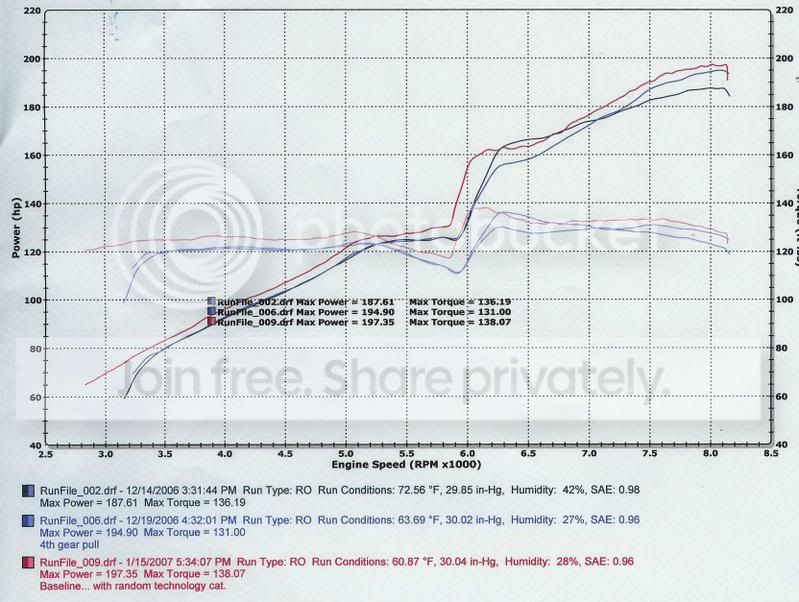
This graph is a compilation of the 3 times I dyno'd the car.
Purple is with Injen CAI + Comptech Exhaust
Blue is with Injen CAI + Comptech Exhaust + Comptech Header
Red is with with Injen CAI + Comptech Exhaust + Header and Random Tech High Flow Cat
Honda-Tech Member
Joined: Aug 2002
Posts: 667
Likes: 1
From: Los Angeles, CRX Heaven
Re: (06blacksi)
Cool! Some data to compare...
So let's see what we got- 5% more HP and 1% more torque. At what cost? A header, exhaust and intake cost about $1700 plus shipping and tax, Figure about 6 hours of shop time to install @$75 per, so you are well over $2K.
But wait! We did not take into account the warmer temperature during the first run compared to the cooler temps during the subsequent runs. 10 degrees does not sound like a lot to us, but it makes big difference to an engine. I will assume that all the run were on the same dyno and that all other conditions were exactly the same (fuel used, etc.)
My point is that each succesive pull was at a cooler temperature and the corresponding increases in HP and torque are probably due more to higher atmospheric density that any new parts.
So I think that the previous posting proves my point that there is little to no advantage to adding a bolt on intake/header/exhaust to the current Si because the factory does a darn good job striaght out to the box.
If you are dieing to spend money on your car, a Hondadata reflash and a Comptech SC will definitely make demonstrated HP.
Scott
Modified by cbstd at 3:18 PM 2/17/2007
So let's see what we got- 5% more HP and 1% more torque. At what cost? A header, exhaust and intake cost about $1700 plus shipping and tax, Figure about 6 hours of shop time to install @$75 per, so you are well over $2K.
But wait! We did not take into account the warmer temperature during the first run compared to the cooler temps during the subsequent runs. 10 degrees does not sound like a lot to us, but it makes big difference to an engine. I will assume that all the run were on the same dyno and that all other conditions were exactly the same (fuel used, etc.)
My point is that each succesive pull was at a cooler temperature and the corresponding increases in HP and torque are probably due more to higher atmospheric density that any new parts.
So I think that the previous posting proves my point that there is little to no advantage to adding a bolt on intake/header/exhaust to the current Si because the factory does a darn good job striaght out to the box.
If you are dieing to spend money on your car, a Hondadata reflash and a Comptech SC will definitely make demonstrated HP.
Scott
Modified by cbstd at 3:18 PM 2/17/2007

Senior Member
Joined: Jul 2005
Posts: 3,728
Likes: 0
From: Armonk, NY, USA
Re: (Demonis)
The whole point of "SAE" numbers is that they have a correction factor--it factors temp, humidity and barometric pressure. I don't know if the runs in that dyno show corrected (SAE) or uncorrected numbers. But the weather conditions are irrelevant when looking at SAE numbers. The only thing that might make a difference is intake temp from engine bay heat and oil and coolant temp.
Example. Last time I dynoed my car, it was a cold (30 degree) day, and it was quite dry--7% humidity. MY best run on my NA d16a6 was 180 hp/139 uncorrected. This was on a Dynojet. The corrected numbers --SAE were 166/128. The reason there was such a difference is because I dynoed in almost ideal conditions--ie cold and dry. I don't know what the SAE conditions equate to, but my guess is an "avg" day--60 degrees, 50-60 % humidity--bar pressure I don't know.
Run 6 (the highest) had a correction factor of 0.96, while run 2 (the lowest) had a correction factor of 0.98. Meaning, if those indeed are uncorrected numbers--the
"corrected or SAE" numbers would be 96% and 98% respectively of the posted numbers if in fact they are uncorrected. It doesn't say anywhere weather they are corrected or uncorrected.
Now, if you dyno on a 120 degree day with 95% humidity, the correction factor will probably be something like 1.05--meaning your "actual" uncorrected numbers will be lower than the corrected/SAE numbers.
Its not a perfect system by any means-but it does do a fair job of equalizing different weather conditions. The only thing it can't compensate for is the internal oil and coolant temp of the motor but it pretty much throws most of CBSTD's reasoning out the window.
Modified by d16dcoe45 at 9:51 AM 2/17/2007
Modified by d16dcoe45 at 9:55 AM 2/17/2007
Example. Last time I dynoed my car, it was a cold (30 degree) day, and it was quite dry--7% humidity. MY best run on my NA d16a6 was 180 hp/139 uncorrected. This was on a Dynojet. The corrected numbers --SAE were 166/128. The reason there was such a difference is because I dynoed in almost ideal conditions--ie cold and dry. I don't know what the SAE conditions equate to, but my guess is an "avg" day--60 degrees, 50-60 % humidity--bar pressure I don't know.
Run 6 (the highest) had a correction factor of 0.96, while run 2 (the lowest) had a correction factor of 0.98. Meaning, if those indeed are uncorrected numbers--the
"corrected or SAE" numbers would be 96% and 98% respectively of the posted numbers if in fact they are uncorrected. It doesn't say anywhere weather they are corrected or uncorrected.
Now, if you dyno on a 120 degree day with 95% humidity, the correction factor will probably be something like 1.05--meaning your "actual" uncorrected numbers will be lower than the corrected/SAE numbers.
Its not a perfect system by any means-but it does do a fair job of equalizing different weather conditions. The only thing it can't compensate for is the internal oil and coolant temp of the motor but it pretty much throws most of CBSTD's reasoning out the window.
Modified by d16dcoe45 at 9:51 AM 2/17/2007
Modified by d16dcoe45 at 9:55 AM 2/17/2007
Senior Member
Joined: Jul 2005
Posts: 3,728
Likes: 0
From: Armonk, NY, USA
Re: (d16dcoe45)
Also, I hear alot of people say "Honda already made a motor with 100 hp per/liter--its hard to improve on that" I hear the same thing about the s2000. The b16a has 100 hp per liter, and it isn't that hard to get 180 whp on a Dynojet with some careful mods out of one, that is around 200-205 crank hp. The s2000 puts about 200-210 to the wheels on a Dynojet, say that f22 was in a FWD car with a more efficient FWD transaxle--it would probably put down around 215 whp. Anyone who builds a 2.0 liter b-series motor knows that 210-215 whp from one isn't hard to do at all. Once you get above 220-230 whp on a b20 vtec type build--getting power starts to get alot harder.
My point is there are alot of things that can be done to increase a new Si's power. Yes, 200 crank hp from a 2.0 liter production car that has to be reliable is an impressive engineering feat. But it has been proven time and again from other Hondas that came from the factory with 100 or more per liter--that even certain "bolt-ons" can free up some power. Honda has to make intakes and exhausts that are cheap to produce and very quiet if they want to sell cars--someone looking for more power won't mind spending money to get a higher quality better flowing exhaust, and they won't mind the induction roar that a free flowing intake will give them.
My point is there are alot of things that can be done to increase a new Si's power. Yes, 200 crank hp from a 2.0 liter production car that has to be reliable is an impressive engineering feat. But it has been proven time and again from other Hondas that came from the factory with 100 or more per liter--that even certain "bolt-ons" can free up some power. Honda has to make intakes and exhausts that are cheap to produce and very quiet if they want to sell cars--someone looking for more power won't mind spending money to get a higher quality better flowing exhaust, and they won't mind the induction roar that a free flowing intake will give them.
Honda-Tech Member
Joined: Aug 2002
Posts: 667
Likes: 1
From: Los Angeles, CRX Heaven
Re: (d16dcoe45)
<TABLE WIDTH="90%" CELLSPACING=0 CELLPADDING=0 ALIGN=CENTER><TR><TD>Quote, originally posted by d16dcoe45 »</TD></TR><TR><TD CLASS="quote">The whole point of "SAE" numbers is that they have a correction factor--it factors temp, humidity and barometric pressure. </TD></TR></TABLE>
OK, look again at the charts. They all have the same SAE number. So outside of the expensive parts that got slapped on this car, what else is the single factor that changes from test to test? Atmospheric conditions, which could also increase measured power. And so this is not a realistic demonstration of significant improvement due to parts (I/H/E) installed.
I am not saying that it is not possible to improve upon what Honda gives us. I am saying that the amount of improvement from I/H/E is realtively tiny and comes with a large price tag. You would be better served to save your money and go directly to installing a S/C.
Scott
OK, look again at the charts. They all have the same SAE number. So outside of the expensive parts that got slapped on this car, what else is the single factor that changes from test to test? Atmospheric conditions, which could also increase measured power. And so this is not a realistic demonstration of significant improvement due to parts (I/H/E) installed.
I am not saying that it is not possible to improve upon what Honda gives us. I am saying that the amount of improvement from I/H/E is realtively tiny and comes with a large price tag. You would be better served to save your money and go directly to installing a S/C.
Scott

Honda-Tech Member
Joined: Apr 2002
Posts: 113
Likes: 0
From: Upstate, NY
Re: (cbstd)
<TABLE WIDTH="90%" CELLSPACING=0 CELLPADDING=0 ALIGN=CENTER><TR><TD>Quote, originally posted by cbstd »</TD></TR><TR><TD CLASS="quote">OK, look again at the charts. They all have the same SAE number. So outside of the expensive parts that got slapped on this car, what else is the single factor that changes from test to test? Atmospheric conditions, which could also increase measured power. And so this is not a realistic demonstration of significant improvement due to parts (I/H/E) installed.
I am not saying that it is not possible to improve upon what Honda gives us. I am saying that the amount of improvement from I/H/E is realtively tiny and comes with a large price tag. You would be better served to save your money and go directly to installing a S/C.
Scott</TD></TR></TABLE>
No they dont. First pull is 0.98 second and third are 0.96.
I am not saying that it is not possible to improve upon what Honda gives us. I am saying that the amount of improvement from I/H/E is realtively tiny and comes with a large price tag. You would be better served to save your money and go directly to installing a S/C.
Scott</TD></TR></TABLE>
No they dont. First pull is 0.98 second and third are 0.96.
Honda-Tech Member
Joined: Aug 2002
Posts: 667
Likes: 1
From: Los Angeles, CRX Heaven
Re: (MHill)
<TABLE WIDTH="90%" CELLSPACING=0 CELLPADDING=0 ALIGN=CENTER><TR><TD>Quote, originally posted by MHill »</TD></TR><TR><TD CLASS="quote">No they dont. First pull is 0.98 second and third are 0.96.</TD></TR></TABLE>
Yep, you are right. Your eyes are better than mine. Damn old age.
But I still need better evidence that some garage engineered bolt ons are worth their steep price.
Scott
Yep, you are right. Your eyes are better than mine. Damn old age.
But I still need better evidence that some garage engineered bolt ons are worth their steep price.
Scott
Honda-Tech Member
Joined: Apr 2002
Posts: 113
Likes: 0
From: Upstate, NY
Re: (cbstd)
<TABLE WIDTH="90%" CELLSPACING=0 CELLPADDING=0 ALIGN=CENTER><TR><TD>Quote, originally posted by cbstd »</TD></TR><TR><TD CLASS="quote">Yep, you are right. Your eyes are better than mine. Damn old age.
But I still need better evidence that some garage engineered bolt ons are worth their steep price.
Scott</TD></TR></TABLE>
I agree the gains in foreward momentum do not match the price. I would spend the money on susp. brakes and tires first.
But I still need better evidence that some garage engineered bolt ons are worth their steep price.
Scott</TD></TR></TABLE>
I agree the gains in foreward momentum do not match the price. I would spend the money on susp. brakes and tires first.

Honda-Tech Member
Joined: Jan 2006
Posts: 928
Likes: 0
From: Hudsonville, MI
Re: (MHill)
<TABLE WIDTH="90%" CELLSPACING=0 CELLPADDING=0 ALIGN=CENTER><TR><TD>Quote, originally posted by MHill »</TD></TR><TR><TD CLASS="quote">
I agree the gains in forward momentum do not match the price. I would spend the money on susp. brakes and tires first.</TD></TR></TABLE>
This is what everyone should improve first, and IMO is a large cause of why we see so many wrecked performance vehicles. So many people get all drool happy over straight line performance, and bring it to the point where it overwhelms what the stock suspension and brakes can handle safely. I guarantee a civic with $3000 in suspension/brake/tire modifications will run circles around a civic with $3000 in engine mods on anything but a drag strip.
I agree the gains in forward momentum do not match the price. I would spend the money on susp. brakes and tires first.</TD></TR></TABLE>
This is what everyone should improve first, and IMO is a large cause of why we see so many wrecked performance vehicles. So many people get all drool happy over straight line performance, and bring it to the point where it overwhelms what the stock suspension and brakes can handle safely. I guarantee a civic with $3000 in suspension/brake/tire modifications will run circles around a civic with $3000 in engine mods on anything but a drag strip.
Senior Member
Joined: Jul 2005
Posts: 3,728
Likes: 0
From: Armonk, NY, USA
Re: (d16dcoe45)
No, actually--they DON'T have the same SAE number!!! Run 2 where the temp was 73 degrees had an SAE number of 0.98, run 6 which had a 64 degree temp had an SAE corr. factor of 0.96--so in actuality, the uncorrected numbers for run 2 should be better or equal to run 6--but the SAE numbers show that run 6 was the second best run. Run 6 and 9 use the same correction factor because the temp is only 3 degrees difference, the humidity and the barometric pressure are almost identical.
The whole point of I/H/E is that it lets the motor breath for when you want to start doing some real power making mods--increased compression, more aggressive cams, intake manifold, headwork (the k head stock flows incredibly well however!!). By themselves, no--there isn't a huge increase in power. Alot of people however want to keep the car naturally aspirated for a variety of reasons--throttle response, sound, the "feel" of a high strung NA motor. Of course installing a reliable forced induction system is usually going to give you alot more power per dollar--but its like comparing apples and oranges.
I still feel like you don't understand SAE numbers--those ARE sae numbers printed on the page!! SAE corrects for atmospheric conditions--if you went by atmospheric conditions--the actual numbers would look like this--alot do to weather:
run 2: 191.4 whp
run 6: 203.0 whp
run 9: 205.6 whp
So the "uncorrected" numbers showed a BIG increase from run 2 to 6 and 9--and alot of that was do to the more favorable conditions for run 6 and 9. By using the SAE correction however, we can see that even though alot of the increase was do to weather conditions--there was still a good gain--entirely (within the estimation of the correction factor) due to the induction improvements. So with the corrected numbers (SAE) you are seeing a "level" playing field--you are assuming equal conditions and yet there was STILL an increase in power as shown by runs 6 and 9.
The whole point of I/H/E is that it lets the motor breath for when you want to start doing some real power making mods--increased compression, more aggressive cams, intake manifold, headwork (the k head stock flows incredibly well however!!). By themselves, no--there isn't a huge increase in power. Alot of people however want to keep the car naturally aspirated for a variety of reasons--throttle response, sound, the "feel" of a high strung NA motor. Of course installing a reliable forced induction system is usually going to give you alot more power per dollar--but its like comparing apples and oranges.
I still feel like you don't understand SAE numbers--those ARE sae numbers printed on the page!! SAE corrects for atmospheric conditions--if you went by atmospheric conditions--the actual numbers would look like this--alot do to weather:
run 2: 191.4 whp
run 6: 203.0 whp
run 9: 205.6 whp
So the "uncorrected" numbers showed a BIG increase from run 2 to 6 and 9--and alot of that was do to the more favorable conditions for run 6 and 9. By using the SAE correction however, we can see that even though alot of the increase was do to weather conditions--there was still a good gain--entirely (within the estimation of the correction factor) due to the induction improvements. So with the corrected numbers (SAE) you are seeing a "level" playing field--you are assuming equal conditions and yet there was STILL an increase in power as shown by runs 6 and 9.
Senior Member
Joined: Jul 2005
Posts: 3,728
Likes: 0
From: Armonk, NY, USA
Re: (d16dcoe45)
The uncorrected numbers are the ACTUAL numbers put down that day, in those specific weather conditions-- SAE correction gives a level playing field that eliminates weather factors to see if the parts you bought are helping power in any way.
The reason SAE correction exists is because say you go dyno a stock SI in "perfect" conditions--50 degrees, 5% humidity and high barometric pressure--you put down 190 uncorrected. 2 months later, you go the same dyno, only the weather conditions on this day are far from perfect--90 degrees, 90% humidity, and low barometric pressure--this time you added an intake to your car--but it seems you lost power!! You only put down 185 uncorrected!! By using a correction factor--you may see that putting down 185 in those awful conditions was better than putting down 190 in perfect conditions, so the actual SAE corrected numbers might look like this: (this is pulled out of my head, its just an example to show why SAE numbers are important)
stock si: SAE-183 (uncorrected "perfect" weather-190) correction factor: 0.96
si w/intake: SAE-195 (uncorrected "terrible" conditions-185) corr factor: 1.05
So in actuality--it was a good mod--it gave you power. You wouldn't have known that if there was no correction factor--you would have thought the intake made you lose 5 hp--but it was really the terrible weather conditions that you dynoed in with the intake on the car. By using a "standard" --it shows that the intake did in fact help you make more power.
Its obviously not perfect because different cars might respond differently to weather conditions, and it might always not be accurate to 1 hp but it lets you see if you are making progress--even by dynoing at a later date at the same dyno--with differing weather conditions. Without it,to get accurate comparisons you would have to make sure you dynoed different parts on days with the EXACT same temp, bar pressure, and humidity--and we all know that is virtually impossible.
Modified by d16dcoe45 at 1:47 PM 2/17/2007
The reason SAE correction exists is because say you go dyno a stock SI in "perfect" conditions--50 degrees, 5% humidity and high barometric pressure--you put down 190 uncorrected. 2 months later, you go the same dyno, only the weather conditions on this day are far from perfect--90 degrees, 90% humidity, and low barometric pressure--this time you added an intake to your car--but it seems you lost power!! You only put down 185 uncorrected!! By using a correction factor--you may see that putting down 185 in those awful conditions was better than putting down 190 in perfect conditions, so the actual SAE corrected numbers might look like this: (this is pulled out of my head, its just an example to show why SAE numbers are important)
stock si: SAE-183 (uncorrected "perfect" weather-190) correction factor: 0.96
si w/intake: SAE-195 (uncorrected "terrible" conditions-185) corr factor: 1.05
So in actuality--it was a good mod--it gave you power. You wouldn't have known that if there was no correction factor--you would have thought the intake made you lose 5 hp--but it was really the terrible weather conditions that you dynoed in with the intake on the car. By using a "standard" --it shows that the intake did in fact help you make more power.
Its obviously not perfect because different cars might respond differently to weather conditions, and it might always not be accurate to 1 hp but it lets you see if you are making progress--even by dynoing at a later date at the same dyno--with differing weather conditions. Without it,to get accurate comparisons you would have to make sure you dynoed different parts on days with the EXACT same temp, bar pressure, and humidity--and we all know that is virtually impossible.
Modified by d16dcoe45 at 1:47 PM 2/17/2007