


track use: what gauges are you running?


Thread Starter
Honda-Tech Member
Joined: May 2003
Posts: 1,324
Likes: 0
 track use: what gauges are you running?
Just curious what you are running, and which are the important factors to monitor in your race cars?
For an NA application that is:
So here's what I currently have in my NA DC5...
1. oil pressure since our VTEC motors run off of oil psi!
2. oil temp -- it was a debate between oil and water temp for track use to monitor if motor is near overheating. i looked at many race car setups, and they were running either water or oil temps, and the rest were running both lol.
So now I have oil temp and psi, mounted in my dash cluster, but I'm thinking of adding a third (if necessary) in which case I will fabricate a triple DIN gauge.
I was thinking:
- tranny temp...so since I have oil temp, i figured i shouldn't need water temp. since i have KPro ECU as it is, it activates the fan at 190 deg F (i can lower that activation point if i wanted) and it illuminates the CEL if the water temp reaches an overheating temp--currently mine is set to 220 deg F but I can also change that. But tranny temp, should I be concerned about it?
- it's not going to be an all-out dedicated track car, just running open track days in the hot cali. desert and i got these gauges to monitor the motor...do i need anything else (tranny temp? water temp?) or am I find with what i have now?
For an NA application that is:
So here's what I currently have in my NA DC5...
1. oil pressure since our VTEC motors run off of oil psi!
2. oil temp -- it was a debate between oil and water temp for track use to monitor if motor is near overheating. i looked at many race car setups, and they were running either water or oil temps, and the rest were running both lol.
So now I have oil temp and psi, mounted in my dash cluster, but I'm thinking of adding a third (if necessary) in which case I will fabricate a triple DIN gauge.
I was thinking:
- tranny temp...so since I have oil temp, i figured i shouldn't need water temp. since i have KPro ECU as it is, it activates the fan at 190 deg F (i can lower that activation point if i wanted) and it illuminates the CEL if the water temp reaches an overheating temp--currently mine is set to 220 deg F but I can also change that. But tranny temp, should I be concerned about it?
- it's not going to be an all-out dedicated track car, just running open track days in the hot cali. desert and i got these gauges to monitor the motor...do i need anything else (tranny temp? water temp?) or am I find with what i have now?

a/k/a Jomo
Joined: Jan 2002
Posts: 6,275
Likes: 0
Re: track use: what gauges are you running? (blackdc5)
I think Oil Pressure, Oil Temp and Water Temp are the three critical gages you would want to monitor.
I have recently purchased this set-up and will be using it for '07.

On most production cars I would say trans temp not a big issue, but for some reason I remember the RSX's running higher then normal trans temps when on track and a couple company's offering improved trans coolers. Maybe I am dreaming though? Someone help me out here.
I have recently purchased this set-up and will be using it for '07.
On most production cars I would say trans temp not a big issue, but for some reason I remember the RSX's running higher then normal trans temps when on track and a couple company's offering improved trans coolers. Maybe I am dreaming though? Someone help me out here.

Honda-Tech Member
Joined: Dec 2003
Posts: 2,336
Likes: 1
From: DFW Area, TX
I use Defi oil pressure, oil temp, and water temp gauges.

I ran GIR without an oil cooler this summer, and the oil temps would shoot up to 270F+ while the water temp stayed rock solid at 180F, so I'd suggest using both. I've found that on the track, the two readings are quite independent of each other. BTW, I had already removed the stock oil cooler at that point, and now I have a 25 row Mocal installed. I haven't had a chance to run with the Mocal in the summer, though.
I ran GIR without an oil cooler this summer, and the oil temps would shoot up to 270F+ while the water temp stayed rock solid at 180F, so I'd suggest using both. I've found that on the track, the two readings are quite independent of each other. BTW, I had already removed the stock oil cooler at that point, and now I have a 25 row Mocal installed. I haven't had a chance to run with the Mocal in the summer, though.

Member
Joined: Jun 2001
Posts: 1,440
Likes: 2
From: Elkton, MD, 21921
Re: track use: what gauges are you running? (blackdc5)
hi.
in order of importance, i'd say you need: water temp, oil press, oil temp, volts. i have all those in my K powered EG.
the K seems to run cooler water temps compared to B. mine is a K20A2, stock but tuned up real well for H1 racing. water stays around 200 deg F on hot days. oil temp usually around 140-145 deg C. oil press usually around 75+ psi if motor is going over 4k rpm (hot). hot idle after a race is about 20 psi.
i am running a fluidyne half length, double width rad. stock oem oil cooler/warmer. have about 4k-5k race miles on the setup; no engine probs.
my gauge package i put together myself, mostly from wrecked cars in the junkyard. see pic below:

total cost was about $30, if i remember correctly..... the tach i bought separately, at Advance, for $39. up on the left of the dashboard is the tach, and the oil pressure gage. the blue mini-mag lite is now a customized oil pressure low warning light; it activates at 35 psi and below; i drilled out the bulb area and installed a honda brake-lightbulb in there; it is super bright and can't be missed, even in direct sunlight. if that light comes on during a race, i know something is terribly wrong and to shut down immediately! the oil temp gauge is the one directly in front of the steering wheel; easy to see. the volt gauge is down and to the left in the dashboard. the entire package works really well for me, and keeps me informed of the health of my racecar!
good luck!
in order of importance, i'd say you need: water temp, oil press, oil temp, volts. i have all those in my K powered EG.
the K seems to run cooler water temps compared to B. mine is a K20A2, stock but tuned up real well for H1 racing. water stays around 200 deg F on hot days. oil temp usually around 140-145 deg C. oil press usually around 75+ psi if motor is going over 4k rpm (hot). hot idle after a race is about 20 psi.
i am running a fluidyne half length, double width rad. stock oem oil cooler/warmer. have about 4k-5k race miles on the setup; no engine probs.
my gauge package i put together myself, mostly from wrecked cars in the junkyard. see pic below:
total cost was about $30, if i remember correctly..... the tach i bought separately, at Advance, for $39. up on the left of the dashboard is the tach, and the oil pressure gage. the blue mini-mag lite is now a customized oil pressure low warning light; it activates at 35 psi and below; i drilled out the bulb area and installed a honda brake-lightbulb in there; it is super bright and can't be missed, even in direct sunlight. if that light comes on during a race, i know something is terribly wrong and to shut down immediately! the oil temp gauge is the one directly in front of the steering wheel; easy to see. the volt gauge is down and to the left in the dashboard. the entire package works really well for me, and keeps me informed of the health of my racecar!
good luck!

Senior Member
Joined: Jun 2004
Posts: 10,399
Likes: 3
From: Chicagoland, IL
Re: track use: what gauges are you running? (Todd Reid)
Todd, you're super-geeenius!
I have one car with just water temp (OEM one broke) and a shift light.
My other car has oil temp, oil pressure, wideband O2 and EGT. I'd toss the wideband O2 when I'm not tuning, though it's a little reassuring to see it. EGT is about the same, too hard to make anything useful out of it except "something is wrong". It's nice for tuning timing, I guess...
If your OEM water temp gauge is there, get oil temp and pressure. The OEM water temp gauge is good enough to tell you when to shut it down.
I have one car with just water temp (OEM one broke) and a shift light.
My other car has oil temp, oil pressure, wideband O2 and EGT. I'd toss the wideband O2 when I'm not tuning, though it's a little reassuring to see it. EGT is about the same, too hard to make anything useful out of it except "something is wrong". It's nice for tuning timing, I guess...
If your OEM water temp gauge is there, get oil temp and pressure. The OEM water temp gauge is good enough to tell you when to shut it down.

Senior Member
Joined: Jun 2004
Posts: 10,399
Likes: 3
From: Chicagoland, IL
Re: track use: what gauges are you running? (Stinkycheezmonky)
<TABLE WIDTH="90%" CELLSPACING=0 CELLPADDING=0 ALIGN=CENTER><TR><TD>Quote, originally posted by Stinkycheezmonky »</TD></TR><TR><TD CLASS="quote">Todd, is that oil temp right? 145*C = almost 300*F  Kind of right at the limit of oil breaking down I thought...</TD></TR></TABLE>
LOL hell no! Oil is thinner when it's hot. Thinner == less parasitic losses. I blocked off my OEM oil cooler, gained 0.5 HP.
But really, 300F isn't so bad.
Kind of right at the limit of oil breaking down I thought...</TD></TR></TABLE>LOL hell no! Oil is thinner when it's hot. Thinner == less parasitic losses. I blocked off my OEM oil cooler, gained 0.5 HP.
But really, 300F isn't so bad.
Trending Topics
Member
Joined: Jun 2001
Posts: 1,440
Likes: 2
From: Elkton, MD, 21921
Re: track use: what gauges are you running? (Stinkycheezmonky)
<TABLE WIDTH="90%" CELLSPACING=0 CELLPADDING=0 ALIGN=CENTER><TR><TD>Quote, originally posted by Stinkycheezmonky »</TD></TR><TR><TD CLASS="quote">Todd, is that oil temp right? 145*C = almost 300*F Kind of right at the limit of oil breaking down I thought...</TD></TR></TABLE>
yeah; 300 deg F is starting to get into the "i'm worried" area. but, compared to my B series car, its not so bad... the gauge goes to 170 deg C, and the B car used to peg the gauge (before i got the huge Howe radiator/oil cooler).
i think with synth oil, and changing it every two weekends, it is OK at 300 F. no problems in over two years, so i think it is OK...
todd
Kind of right at the limit of oil breaking down I thought...</TD></TR></TABLE>yeah; 300 deg F is starting to get into the "i'm worried" area. but, compared to my B series car, its not so bad... the gauge goes to 170 deg C, and the B car used to peg the gauge (before i got the huge Howe radiator/oil cooler).
i think with synth oil, and changing it every two weekends, it is OK at 300 F. no problems in over two years, so i think it is OK...
todd

Honda-Tech Member
Joined: Mar 2004
Posts: 1,349
Likes: 0
From: Orange County, CA
Re: track use: what gauges are you running? (Stinkycheezmonky)
<TABLE WIDTH="90%" CELLSPACING=0 CELLPADDING=0 ALIGN=CENTER><TR><TD>Quote, originally posted by Stinkycheezmonky »</TD></TR><TR><TD CLASS="quote">Todd, is that oil temp right? 145*C = almost 300*F Kind of right at the limit of oil breaking down I thought...</TD></TR></TABLE>
I was at a bar last night having a beer with a circle track engine builder. He's been doing it for 25 years. So we're talking about oil, and I asked what he considered "normal" oil temps buring a race. "Oh, usually between 340 & 360 degrees... On the half mile track, we change it every 100 laps or so."
Damn.
Kind of right at the limit of oil breaking down I thought...</TD></TR></TABLE>I was at a bar last night having a beer with a circle track engine builder. He's been doing it for 25 years. So we're talking about oil, and I asked what he considered "normal" oil temps buring a race. "Oh, usually between 340 & 360 degrees... On the half mile track, we change it every 100 laps or so."
Damn.
Senior Member
Joined: Jun 2004
Posts: 10,399
Likes: 3
From: Chicagoland, IL
Re: track use: what gauges are you running? (thawley)
<TABLE WIDTH="90%" CELLSPACING=0 CELLPADDING=0 ALIGN=CENTER><TR><TD>Quote, originally posted by thawley »</TD></TR><TR><TD CLASS="quote">
I was at a bar last night having a beer with a circle track engine builder. He's been doing it for 25 years. So we're talking about oil, and I asked what he considered "normal" oil temps buring a race. "Oh, usually between 340 & 360 degrees... On the half mile track, we change it every 100 laps or so."
Damn.</TD></TR></TABLE>
Change it every 100 laps though? That's... 50 miles... or about 30-45 minutes...
I was at a bar last night having a beer with a circle track engine builder. He's been doing it for 25 years. So we're talking about oil, and I asked what he considered "normal" oil temps buring a race. "Oh, usually between 340 & 360 degrees... On the half mile track, we change it every 100 laps or so."
Damn.</TD></TR></TABLE>
Change it every 100 laps though? That's... 50 miles... or about 30-45 minutes...
Thread Starter
Honda-Tech Member
Joined: May 2003
Posts: 1,324
Likes: 0
Re: track use: what gauges are you running? (Todd Reid)
<TABLE WIDTH="90%" CELLSPACING=0 CELLPADDING=0 ALIGN=CENTER><TR><TD>Quote, originally posted by Todd Reid »</TD></TR><TR><TD CLASS="quote">the blue mini-mag lite is now a customized oil pressure low warning light; it activates at 35 psi and below; </TD></TR></TABLE>
Is it customized down to the wiring and sender? That's hardcore!
I've seen some kits on summitracing and it looks like it will plug into a 1/8" NPT so it's good I went with a sandwich kit I guess.
I need to look into one of those. Although, since coming out of a long turn, the car's usually at a mid to high RPM anyway, should the low psi warning light come on any earlier? I mean since the oil PSIs are at +70psi all day long when you're on the track anyway? Even when you're driving home PSI stays +70 as well. Could it be a better/earlier indication of loss in PSI by having the light activate sooner? Maybe 60 or 58 psi?
Is it customized down to the wiring and sender? That's hardcore!
I've seen some kits on summitracing and it looks like it will plug into a 1/8" NPT so it's good I went with a sandwich kit I guess.
I need to look into one of those. Although, since coming out of a long turn, the car's usually at a mid to high RPM anyway, should the low psi warning light come on any earlier? I mean since the oil PSIs are at +70psi all day long when you're on the track anyway? Even when you're driving home PSI stays +70 as well. Could it be a better/earlier indication of loss in PSI by having the light activate sooner? Maybe 60 or 58 psi?
Honda-Tech Member
Joined: Dec 2003
Posts: 2,336
Likes: 1
From: DFW Area, TX
You can buy pressure switches for oil pressure warning lights at various pressures. IIRC, Pegasus also sells one that is adjustable.
I have a warning light that I have yet to install that I purchased a 35 PSI switch for.
I have a warning light that I have yet to install that I purchased a 35 PSI switch for.
Thread Starter
Honda-Tech Member
Joined: May 2003
Posts: 1,324
Likes: 0
Re: (117)
Ic. Thanks for the discussion guys and thanks for the replies so far.
So far I'm thinking my oil psi and oil temp gauges are looking like all I need, I have a adjustable warning light for my WATER TEMP through my ECU (illuminates CEL at a certain point) so I think a oil psi warning light will be the last thing I need.
So far I'm thinking my oil psi and oil temp gauges are looking like all I need, I have a adjustable warning light for my WATER TEMP through my ECU (illuminates CEL at a certain point) so I think a oil psi warning light will be the last thing I need.
Member
Joined: Jun 2001
Posts: 1,440
Likes: 2
From: Elkton, MD, 21921
Re: (blackdc5)
hi again.
my KPro turns the CEL on at 225 F on my H1 car. it definitely works, too; on very hot days (over 90 deg) if i am drafting very close for a couple of laps, i have seen the CEL come on. by the way, the stock water temp gauge really doesnt start moving past 1/3 until the car hits about 220 deg. as soon as the needle starts creeping up, the CEL comes on. when that has happened, i try to duck into the cleaner air, and the CEL goes off and the temp gauge returns to 1/3 within about 30 secs....
todd
my KPro turns the CEL on at 225 F on my H1 car. it definitely works, too; on very hot days (over 90 deg) if i am drafting very close for a couple of laps, i have seen the CEL come on. by the way, the stock water temp gauge really doesnt start moving past 1/3 until the car hits about 220 deg. as soon as the needle starts creeping up, the CEL comes on. when that has happened, i try to duck into the cleaner air, and the CEL goes off and the temp gauge returns to 1/3 within about 30 secs....
todd
Honda-Tech Member
Joined: Mar 2004
Posts: 1,349
Likes: 0
From: Orange County, CA
Re: (blackdc5)
<TABLE WIDTH="90%" CELLSPACING=0 CELLPADDING=0 ALIGN=CENTER><TR><TD>Quote, originally posted by blackdc5 »</TD></TR><TR><TD CLASS="quote">So far I'm thinking my oil psi and oil temp gauges are looking like all I need, I have a adjustable warning light for my WATER TEMP through my ECU (illuminates CEL at a certain point) so I think a oil psi warning light will be the last thing I need.</TD></TR></TABLE>
I am more interested in water temps than oil. Oil will take more temperature abuse than. Water is a more instant reflection of how the engine is being cooled, IMO. Nobody ever blew a head gasket or warped a head from high oil temp.
My vote would be for water temp, oil pressure (with light) and good, fresh oil.
I am more interested in water temps than oil. Oil will take more temperature abuse than. Water is a more instant reflection of how the engine is being cooled, IMO. Nobody ever blew a head gasket or warped a head from high oil temp.
My vote would be for water temp, oil pressure (with light) and good, fresh oil.

Thread Starter
Honda-Tech Member
Joined: May 2003
Posts: 1,324
Likes: 0
Re: (thawley)
<TABLE WIDTH="90%" CELLSPACING=0 CELLPADDING=0 ALIGN=CENTER><TR><TD>Quote, originally posted by thawley »</TD></TR><TR><TD CLASS="quote">I am more interested in water temps than oil. Oil will take more temperature abuse than. Water is a more instant reflection of how the engine is being cooled, IMO. Nobody ever blew a head gasket or warped a head from high oil temp.
My vote would be for water temp, oil pressure (with light) and good, fresh oil.</TD></TR></TABLE>
Dang, I was told differently, the exact opposite in fact. They said engine oil will give you a tell-tale sign quicker than rising water temp, where the water temp when it rises it will already be too late. I got a temp guage for that exact purpose, to mitigate overheating issues and potential blown head gaskets. Since I'm not competing I can easily let off the throttle and pit in if need be.
With that said, I've noticed oil takes longer to warm than water (maybe twice as long) but it reaches a steady peak. I guess their suggestion was based off of the fact that we have a water cooler, but no oil cooler stock?
In any case, I probably won't get a water temp gauge since as Todd Reid mentioned, we can set the CEL to illuminate when the water temp/ECT reaches a certain temperature--his is at 225 deg, mine is at stock 220 temp, but I can easily lower it to give me better warning. I think it'll be safe for me to rely on the CEL illuminating to tell me if water temps are peaking...unless other suggest a water temp gauge anyway?
Again I already have an oil psi and temp gauge mounted and running.
My vote would be for water temp, oil pressure (with light) and good, fresh oil.</TD></TR></TABLE>
Dang, I was told differently, the exact opposite in fact. They said engine oil will give you a tell-tale sign quicker than rising water temp, where the water temp when it rises it will already be too late. I got a temp guage for that exact purpose, to mitigate overheating issues and potential blown head gaskets. Since I'm not competing I can easily let off the throttle and pit in if need be.
With that said, I've noticed oil takes longer to warm than water (maybe twice as long) but it reaches a steady peak. I guess their suggestion was based off of the fact that we have a water cooler, but no oil cooler stock?
In any case, I probably won't get a water temp gauge since as Todd Reid mentioned, we can set the CEL to illuminate when the water temp/ECT reaches a certain temperature--his is at 225 deg, mine is at stock 220 temp, but I can easily lower it to give me better warning. I think it'll be safe for me to rely on the CEL illuminating to tell me if water temps are peaking...unless other suggest a water temp gauge anyway?
Again I already have an oil psi and temp gauge mounted and running.
Honda-Tech Member
Joined: Mar 2004
Posts: 1,349
Likes: 0
From: Orange County, CA
Re: (blackdc5)
<TABLE WIDTH="90%" CELLSPACING=0 CELLPADDING=0 ALIGN=CENTER><TR><TD>Quote, originally posted by blackdc5 »</TD></TR><TR><TD CLASS="quote">I've noticed oil takes longer to warm than water (maybe twice as long) but it reaches a steady peak. I guess their suggestion was based off of the fact that we have a water cooler, but no oil cooler stock? </TD></TR></TABLE>
Well, that's my thinking. It's not that big a deal, though. You'll be better off keeping your eye on either than none at all.
My thinking about water temp is related to the airflow and cooling by the radiator in a race car. If you go off and fill the grill with weeds or lose coolant, you'll notice the cooling issue right away whether you're under load (accelerating) or not. Same with sitting on the grid with the engine running, or in the hot pits during a stop. Oil will not likely show the cooling problem in those situations because their is no load on the bearings to get is hot. Water will get hot, load or no load. With that as a guide, you can diagnose issues while driving and adjust your pace accordingly.
Well, that's my thinking. It's not that big a deal, though. You'll be better off keeping your eye on either than none at all.
My thinking about water temp is related to the airflow and cooling by the radiator in a race car. If you go off and fill the grill with weeds or lose coolant, you'll notice the cooling issue right away whether you're under load (accelerating) or not. Same with sitting on the grid with the engine running, or in the hot pits during a stop. Oil will not likely show the cooling problem in those situations because their is no load on the bearings to get is hot. Water will get hot, load or no load. With that as a guide, you can diagnose issues while driving and adjust your pace accordingly.

Honda-Tech Member
Joined: Nov 2001
Posts: 3,476
Likes: 0
Re: (thawley)
This is making me think that maybe I should get an aftermarket water temp gauge.
What I have noticed, is that my water temp stays pretty constant while my oil temp will vary significantly.
For example, when going to work this morning, once the car was warm, the water temp never changed, oil temp was also rock solid at 180. (I have an oil cooler)
once I stoped and was driving in city traffic, the oil temp climbed to 190, the water temp didn't change.
Now on the TRACK: The water temp was again ROCK SOLID, no matter how hard I was on the car, but the oil temp would flucuate based on the use of the engine, the hard I ran, and the more time I spent at higher RPMs the higher the oil temp. But the water temp never changed.
I am wondering if the stock water temp sender or guage is over-damped?
What I have noticed, is that my water temp stays pretty constant while my oil temp will vary significantly.
For example, when going to work this morning, once the car was warm, the water temp never changed, oil temp was also rock solid at 180. (I have an oil cooler)
once I stoped and was driving in city traffic, the oil temp climbed to 190, the water temp didn't change.
Now on the TRACK: The water temp was again ROCK SOLID, no matter how hard I was on the car, but the oil temp would flucuate based on the use of the engine, the hard I ran, and the more time I spent at higher RPMs the higher the oil temp. But the water temp never changed.
I am wondering if the stock water temp sender or guage is over-damped?
Honda-Tech Member
Joined: Mar 2004
Posts: 1,349
Likes: 0
From: Orange County, CA
Re: (Crazydave)
The stock water temp gauge is more like an idiot light than a switch. Cold, normal and hot are the default temp levels for most factory temp gauges. (I think some genius discovered that they got fewer frivolous warranty service calls if they took all the accuracy out of the gauge and only let it move when things were really a problem.)
So, yeah. A good electronic water temp gauge will add some accuracy and entertainment to your daily gauge reading experience.
So, yeah. A good electronic water temp gauge will add some accuracy and entertainment to your daily gauge reading experience.

Honda-Tech Member
Joined: May 2002
Posts: 13,483
Likes: 0
From: cali
Re: (thawley)
IMO if we are talking about a race car i would go with something like the AIM Mycron setup.
when i was pricing out autometer gauges, i just stopped at 600 dollars. that was for the whole package of gauges, but i hadn't even got to the warning lights and such. Another issue was i couldn't find decent spots for all the gauges.
I ended up going with the AIM mycron setup. Yes it is more expensive, and not by a small amount either. But you get a lot more. You have tach, shift light, gear indicator, oil pressure, oil temp, water temp, volts. And you can setup warning lights for any of functions. An added bonus is you have data logging so you can look back and see what all the inputs were doing while you were out on track.
The system is REALLY open, so all the inputs i listed above don't have to be used and you could switch them out for something else.
when i was pricing out autometer gauges, i just stopped at 600 dollars. that was for the whole package of gauges, but i hadn't even got to the warning lights and such. Another issue was i couldn't find decent spots for all the gauges.
I ended up going with the AIM mycron setup. Yes it is more expensive, and not by a small amount either. But you get a lot more. You have tach, shift light, gear indicator, oil pressure, oil temp, water temp, volts. And you can setup warning lights for any of functions. An added bonus is you have data logging so you can look back and see what all the inputs were doing while you were out on track.
The system is REALLY open, so all the inputs i listed above don't have to be used and you could switch them out for something else.

Honda-Tech Member
Joined: Oct 2001
Posts: 6,805
Likes: 1
From: building H2 cars, NY
im using an oil temp, oil pressure and aftermarket tach. water temp is the enxt to be added. i sorced all mine on ebay and cost me about 200 bucks total including the 6' braided steel oil line and the kit for the back of the block. my oil pressure warning light has a 30 psi switch and even with the morosso baffled pan ive seen pressure drops. but thats due to low oil level and a bent pick up. i burn a little oil on track  im good for about 220-230*F oil temp with the b&m cooler and 10w40 castrol dyno
Modified by Lo-Buck EF at 5:21 PM 12/18/2006
im good for about 220-230*F oil temp with the b&m cooler and 10w40 castrol dynoModified by Lo-Buck EF at 5:21 PM 12/18/2006


Joined: Oct 2006
Posts: 252
Likes: 0
Re: track use: what gauges are you running? (blackdc5)
Over here, most track/road race cars runs on Oil Temp, Oil Pressure and Water Temp. I personally feel oil temp and oil pressure is most important. Water temp we got the standard cluster to see though it may not be as accurate or slow to respond.
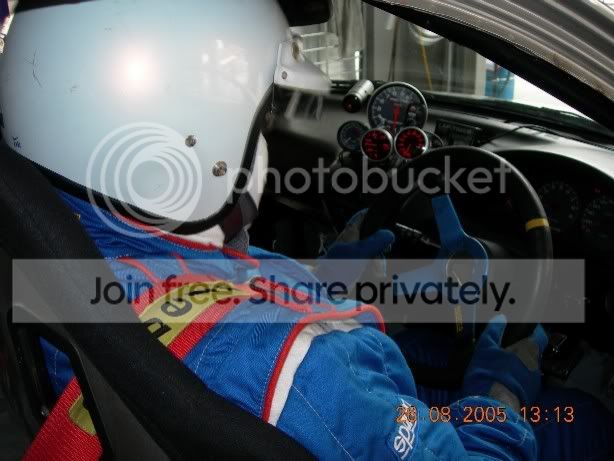
Attached picture taken last year of my DC2 with B18C5 engine. Shows Defi oil temp, oil pressure, HKS water temp and a Autometer RPM meter. This year season i have changed the HKS water temp to Defi also. Next year plan to change the Autometer to Defi RPM meter too
Attached picture taken last year of my DC2 with B18C5 engine. Shows Defi oil temp, oil pressure, HKS water temp and a Autometer RPM meter. This year season i have changed the HKS water temp to Defi also. Next year plan to change the Autometer to Defi RPM meter too
Joined: Oct 2006
Posts: 252
Likes: 0
Re: (blackdc5)
Oil pressure to me is very important to identify potential engine problems. When i get misses only into corner or exiting corner and if the oil press meter fluactuates or the peak oil press during vtec at WOT is lower than my normal bar/psi then i know its oil related and often its low in oil level.
Oil temp is also important as i can gauge what temp my oil is so i know how well the lubes are protecting my engine. If it is a long race, we use oil temp to gauge when we can push hard and when we should actually eases off slightly but this normally in endurance races. In sprint race like 10 to 15 lap race, just go flat out. And change oil after race.
Oil temp is also important as i can gauge what temp my oil is so i know how well the lubes are protecting my engine. If it is a long race, we use oil temp to gauge when we can push hard and when we should actually eases off slightly but this normally in endurance races. In sprint race like 10 to 15 lap race, just go flat out. And change oil after race.