


Possible Detonation, Help


Thread Starter
Honda-Tech Member
Joined: Feb 2004
Posts: 335
Likes: 0
From: Guam, USA, USA
 Possible Detonation, Help
Ok, need some help.
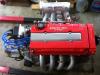
Currently running a B16B CTR engine with 2 layer headgasket, Toda A cams, MSD Ignition, 255lph fuel pump, AEM fuel rail and regulator, stock injectors , rechipped ecu and all the other bolt-on parts.
Innovate wideband (brand new) reads between 11.0 to 13.2 A/F throughout the rpm range and in the 11's at WOT.
Now, when I check the plugs, the plugs electrode has a white coating. Additionally when I hold the rpm at about and/or close 4,000rpm there is popping from the exhaust.
Compression should be about 11.1 with the 2 layer head gasket, running 91 pump gas with octane booster and BKR-7EIX-11 NGK Iridium plugs, ignition timing set at 18 degress at idle.
Wondering why there is a popping noise from the exhaust when I hold the rpms around 4,000 and why the plugs are white even if the wideband reads rich???
Is it detonating and am I running lean or rich??? Please help.
Currently running a B16B CTR engine with 2 layer headgasket, Toda A cams, MSD Ignition, 255lph fuel pump, AEM fuel rail and regulator, stock injectors , rechipped ecu and all the other bolt-on parts.
Innovate wideband (brand new) reads between 11.0 to 13.2 A/F throughout the rpm range and in the 11's at WOT.
Now, when I check the plugs, the plugs electrode has a white coating. Additionally when I hold the rpm at about and/or close 4,000rpm there is popping from the exhaust.
Compression should be about 11.1 with the 2 layer head gasket, running 91 pump gas with octane booster and BKR-7EIX-11 NGK Iridium plugs, ignition timing set at 18 degress at idle.
Wondering why there is a popping noise from the exhaust when I hold the rpms around 4,000 and why the plugs are white even if the wideband reads rich???
Is it detonating and am I running lean or rich??? Please help.

Honda-Tech Member
Joined: Jul 2003
Posts: 1,838
Likes: 0
From: western, PA
Re: Possible Detonation, Help (DEMNTD1)
you are running rich if your a:f is in the 11's. You can still be running rich and detonate if your running too much timing. Right around 4,000 rpms where n/a motors tend to detonate.
You should def try setting the timing at 16 degs at idle. see if it goes away.
just for an example, my setup is a 12:1 comp ls/vtec on 93 octane it would detonate with the stock p30 map and any more base timing than 15 degrees.
You should def try setting the timing at 16 degs at idle. see if it goes away.
just for an example, my setup is a 12:1 comp ls/vtec on 93 octane it would detonate with the stock p30 map and any more base timing than 15 degrees.
Thread Starter
Honda-Tech Member
Joined: Feb 2004
Posts: 335
Likes: 0
From: Guam, USA, USA
Re: Possible Detonation, Help (Used2beAb16)
Ok, I'll try setting the timing back to 16 degrees and see if it goes away. Thanks
That answers why it pops at about 4,000rpm, but why is the plugs white even if wideband O2 shows rich reading of 11's.
Does detonation cause the plugs to turn white?
Also fuel is regulated to about 57psi, stock Type R setting.
More input will be most helpful. Getting ready to upgrade to 1.8L block with Toda 81mm pistons and pnp head, compression set at 12.5:1. I want to figure this out on my current motor so I can make adjustment when I swap over to the new engine.
That answers why it pops at about 4,000rpm, but why is the plugs white even if wideband O2 shows rich reading of 11's.
Does detonation cause the plugs to turn white?
Also fuel is regulated to about 57psi, stock Type R setting.
More input will be most helpful. Getting ready to upgrade to 1.8L block with Toda 81mm pistons and pnp head, compression set at 12.5:1. I want to figure this out on my current motor so I can make adjustment when I swap over to the new engine.
 Re: Possible Detonation, Help (DEMNTD1)
Popping from your exhaust is not detonation...
Detonation sounds like bbs flying around in your motor.
Do a search on detecting detonation on spark plugs (It looks like white specs on plugs)

Detonation sounds like bbs flying around in your motor.
Do a search on detecting detonation on spark plugs (It looks like white specs on plugs)
Thread Starter
Honda-Tech Member
Joined: Feb 2004
Posts: 335
Likes: 0
From: Guam, USA, USA
Re: Possible Detonation, Help (mtber)
So what is the popping I here through the exhaust when I hold the rpm around 4,000?
I retarded the timing 1 degree from 18 degrees to 17 degrees and the popping seems to have gone away. I will check again later, it was late last night so couldn't really hold it at 4,000 rpm too long without disturbing my neighbors. If still popping, I will try 16 degrees.
Additionally when I pulled the plugs, the electrode is grey white color, porcelin is white, no signs of black spots on the prcelin of the plug (according to mopar and ngk plug info) or white spots anywhere.
Running Toda headers and the springs on the header piping are starting to corrode and some seem loose, so when I rev the motor the springs start to vibrate, with the vibration noise, can't here or tell the sound of bb's in a can.
I retarded the timing 1 degree from 18 degrees to 17 degrees and the popping seems to have gone away. I will check again later, it was late last night so couldn't really hold it at 4,000 rpm too long without disturbing my neighbors. If still popping, I will try 16 degrees.
Additionally when I pulled the plugs, the electrode is grey white color, porcelin is white, no signs of black spots on the prcelin of the plug (according to mopar and ngk plug info) or white spots anywhere.
Running Toda headers and the springs on the header piping are starting to corrode and some seem loose, so when I rev the motor the springs start to vibrate, with the vibration noise, can't here or tell the sound of bb's in a can.
Honda-Tech Member

Joined: Apr 2003
Posts: 6,919
Likes: 5
From: In the garage
Re: Possible Detonation, Help (DEMNTD1)
<TABLE WIDTH="90%" CELLSPACING=0 CELLPADDING=0 ALIGN=CENTER><TR><TD>Quote, originally posted by DEMNTD1 »</TD></TR><TR><TD CLASS="quote">So what is the popping I here through the exhaust when I hold the rpm around 4,000?
I retarded the timing 1 degree from 18 degrees to 17 degrees and the popping seems to have gone away. I will check again later, it was late last night so couldn't really hold it at 4,000 rpm too long without disturbing my neighbors. If still popping, I will try 16 degrees.
Additionally when I pulled the plugs, the electrode is grey white color, porcelin is white, no signs of black spots on the prcelin of the plug (according to mopar and ngk plug info) or white spots anywhere.
Running Toda headers and the springs on the header piping are starting to corrode and some seem loose, so when I rev the motor the springs start to vibrate, with the vibration noise, can't here or tell the sound of bb's in a can.</TD></TR></TABLE>
Use the wideband as a guide, not as the "end all" of everything. Set the timing back to 16, try it out. Personally, from what you have explained, your wideband is wrong.
I retarded the timing 1 degree from 18 degrees to 17 degrees and the popping seems to have gone away. I will check again later, it was late last night so couldn't really hold it at 4,000 rpm too long without disturbing my neighbors. If still popping, I will try 16 degrees.
Additionally when I pulled the plugs, the electrode is grey white color, porcelin is white, no signs of black spots on the prcelin of the plug (according to mopar and ngk plug info) or white spots anywhere.
Running Toda headers and the springs on the header piping are starting to corrode and some seem loose, so when I rev the motor the springs start to vibrate, with the vibration noise, can't here or tell the sound of bb's in a can.</TD></TR></TABLE>
Use the wideband as a guide, not as the "end all" of everything. Set the timing back to 16, try it out. Personally, from what you have explained, your wideband is wrong.
Honda-Tech Member
Joined: Jul 2003
Posts: 1,838
Likes: 0
From: western, PA
Re: Possible Detonation, Help (Hybrid93Eg)
Yeah try 17 degrees and then try 16 if necessary. Your not gonna be seing a super huge power gain, prolly actuall a power loss up at high rpms do to the stroke of the b16b motor.
A guy on here that i know actually pulled i think 4 degress of timing for best peak power on a b16a motor, and thats prolly alot to do with the stroke of the motor. (it was fairly stock)
With a stroke like yours you may benefit from retarding timing up top anyways.
Also on a side note, i read you are having exhaust probs, are there any leaks? If so hopefully they are after the o2 sensor cuz that will throw off the wideband readings.
A guy on here that i know actually pulled i think 4 degress of timing for best peak power on a b16a motor, and thats prolly alot to do with the stroke of the motor. (it was fairly stock)
With a stroke like yours you may benefit from retarding timing up top anyways.
Also on a side note, i read you are having exhaust probs, are there any leaks? If so hopefully they are after the o2 sensor cuz that will throw off the wideband readings.
Trending Topics
Thread Starter
Honda-Tech Member
Joined: Feb 2004
Posts: 335
Likes: 0
From: Guam, USA, USA
Re: Possible Detonation, Help (Used2beAb16)
The wideband is on my straight pipe cat replacement after the header collector. No leaks on the manifold to head area. I'll check the doughnut gasket for the straight pipe connection to the header for leaks or just replace it to a new doughnut gasket.
Innovate Wideband is new and performed all the calibration including free air calibration and was fine. Is there any way I can check the wideband if it is reading properly. Sorry no dyno where I live.
Don't get me wrong, if I just cruise around at about 2,500rpm the plugs are black, but when at WOT and in Vtec through the gears they are grey white but the wideband reads in the 11's.
I'll also tie down the springs for the Toda header so it doesn't rattle and see if I can here detonation or any type of unusual noise from the motor.
Would i be able to here detonation by revving the motor on nuetral or does it have to be on load.
Car is gutted with replacement right and left mounts and energy suspension mount insert for the rear and torque mounts. The car vibrates when driving so can't really here anything but the exhaust and rattle noise.
Thanks for your opinions. Please keep on providing your thoughts.
Innovate Wideband is new and performed all the calibration including free air calibration and was fine. Is there any way I can check the wideband if it is reading properly. Sorry no dyno where I live.
Don't get me wrong, if I just cruise around at about 2,500rpm the plugs are black, but when at WOT and in Vtec through the gears they are grey white but the wideband reads in the 11's.
I'll also tie down the springs for the Toda header so it doesn't rattle and see if I can here detonation or any type of unusual noise from the motor.
Would i be able to here detonation by revving the motor on nuetral or does it have to be on load.
Car is gutted with replacement right and left mounts and energy suspension mount insert for the rear and torque mounts. The car vibrates when driving so can't really here anything but the exhaust and rattle noise.
Thanks for your opinions. Please keep on providing your thoughts.
Honda-Tech Member
Joined: Apr 2003
Posts: 6,919
Likes: 5
From: In the garage
Re: Possible Detonation, Help (DEMNTD1)
<TABLE WIDTH="90%" CELLSPACING=0 CELLPADDING=0 ALIGN=CENTER><TR><TD>Quote, originally posted by DEMNTD1 »</TD></TR><TR><TD CLASS="quote">The wideband is on my straight pipe cat replacement after the header collector. No leaks on the manifold to head area. I'll check the doughnut gasket for the straight pipe connection to the header for leaks or just replace it to a new doughnut gasket.
Innovate Wideband is new and performed all the calibration including free air calibration and was fine. Is there any way I can check the wideband if it is reading properly. Sorry no dyno where I live.
Don't get me wrong, if I just cruise around at about 2,500rpm the plugs are black, but when at WOT and in Vtec through the gears they are grey white but the wideband reads in the 11's.
I'll also tie down the springs for the Toda header so it doesn't rattle and see if I can here detonation or any type of unusual noise from the motor.
Would i be able to here detonation by revving the motor on nuetral or does it have to be on load.
Car is gutted with replacement right and left mounts and energy suspension mount insert for the rear and torque mounts. The car vibrates when driving so can't really here anything but the exhaust and rattle noise.
Thanks for your opinions. Please keep on providing your thoughts.</TD></TR></TABLE>
You should be able to clearly hear detonation when its bad.. I have never heard it revving, only under a load. You have the knock sensor enabled or disabled? Any ability to log its recordings? This might help you to pinpoint where the problem is, IF there is a problem.
Innovate Wideband is new and performed all the calibration including free air calibration and was fine. Is there any way I can check the wideband if it is reading properly. Sorry no dyno where I live.
Don't get me wrong, if I just cruise around at about 2,500rpm the plugs are black, but when at WOT and in Vtec through the gears they are grey white but the wideband reads in the 11's.
I'll also tie down the springs for the Toda header so it doesn't rattle and see if I can here detonation or any type of unusual noise from the motor.
Would i be able to here detonation by revving the motor on nuetral or does it have to be on load.
Car is gutted with replacement right and left mounts and energy suspension mount insert for the rear and torque mounts. The car vibrates when driving so can't really here anything but the exhaust and rattle noise.
Thanks for your opinions. Please keep on providing your thoughts.</TD></TR></TABLE>
You should be able to clearly hear detonation when its bad.. I have never heard it revving, only under a load. You have the knock sensor enabled or disabled? Any ability to log its recordings? This might help you to pinpoint where the problem is, IF there is a problem.

Honda-Tech Member
Joined: Feb 2005
Posts: 1,921
Likes: 1
From: netherlands
Re: Possible Detonation, Help (Used2beAb16)
<TABLE WIDTH="90%" CELLSPACING=0 CELLPADDING=0 ALIGN=CENTER><TR><TD>Quote, originally posted by Used2beAb16 »</TD></TR><TR><TD CLASS="quote"> A guy on here that i know actually pulled i think 4 degress of timing for best peak power on a b16a motor, and thats prolly alot to do with the stroke of the motor. (it was fairly stock) </TD></TR></TABLE>
because of the high r/s ratio of the b16b (b16a also) this sounds like logic. with high r/s ratio the piston is moving slower when at the top of the powerstroke(slower then an engine with a low r/s ratio) why is to long to simply explain on here, you'll have to search.
the spark comes before tdc, so that the max. combustion energy will be at the right time/place. low r/s engines are having trouble because of the piston outrunning the flame/combustion at high rpms. high r/s engines won't outrun the flame within the engines revcapabilities. so the max combustion energy can come a bit later and slam harder on the crank. that's why high r/s engines like slow burning fuel.
aaargh in my head it's all so simple but to write it down simple is hard. hope you get my points.
low r/s engine must have max combustion energy right after tdc or else the piston is already outrunning the flame. they like short/fast powerfull combustion.
high r/s engines don't have this problem. they like long/slow less powerfull combustion.
the under curve area of energy produced will be equal/more.
this graph is not for this purpose but shows excactly what i mean by undercurve area. short-powerfull vs long-less powerfull http://www.theoldone.com/artic...2.jpg
get the point?
because of the high r/s ratio of the b16b (b16a also) this sounds like logic. with high r/s ratio the piston is moving slower when at the top of the powerstroke(slower then an engine with a low r/s ratio) why is to long to simply explain on here, you'll have to search.
the spark comes before tdc, so that the max. combustion energy will be at the right time/place. low r/s engines are having trouble because of the piston outrunning the flame/combustion at high rpms. high r/s engines won't outrun the flame within the engines revcapabilities. so the max combustion energy can come a bit later and slam harder on the crank. that's why high r/s engines like slow burning fuel.
aaargh in my head it's all so simple but to write it down simple is hard. hope you get my points.
low r/s engine must have max combustion energy right after tdc or else the piston is already outrunning the flame. they like short/fast powerfull combustion.
high r/s engines don't have this problem. they like long/slow less powerfull combustion.
the under curve area of energy produced will be equal/more.
this graph is not for this purpose but shows excactly what i mean by undercurve area. short-powerfull vs long-less powerfull http://www.theoldone.com/artic...2.jpg
get the point?

Honda-Tech Member
Joined: Mar 2002
Posts: 9,854
Likes: 4
From: Southern California, U.S.A.
Re: Possible Detonation, Help (DEMNTD1)
<TABLE WIDTH="90%" CELLSPACING=0 CELLPADDING=0 ALIGN=CENTER><TR><TD>Quote, originally posted by DEMNTD1 »</TD></TR><TR><TD CLASS="quote">running 91 pump gas with octane booster </TD></TR></TABLE>
Octane booster can do strange things to spark plugs, leave deposits of varying colors.
Octane booster can do strange things to spark plugs, leave deposits of varying colors.
Honda-Tech Member
Joined: Jul 2003
Posts: 1,838
Likes: 0
From: western, PA
Re: Possible Detonation, Help (wolve)
<TABLE WIDTH="90%" CELLSPACING=0 CELLPADDING=0 ALIGN=CENTER><TR><TD>Quote, originally posted by wolve »</TD></TR><TR><TD CLASS="quote">
because of the high r/s ratio of the b16b (b16a also) this sounds like logic. with high r/s ratio the piston is moving slower when at the top of the powerstroke(slower then an engine with a low r/s ratio) why is to long to simply explain on here, you'll have to search.
the spark comes before tdc, so that the max. combustion energy will be at the right time/place. low r/s engines are having trouble because of the piston outrunning the flame/combustion at high rpms. high r/s engines won't outrun the flame within the engines revcapabilities. so the max combustion energy can come a bit later and slam harder on the crank. that's why high r/s engines like slow burning fuel.
aaargh in my head it's all so simple but to write it down simple is hard. hope you get my points.
low r/s engine must have max combustion energy right after tdc or else the piston is already outrunning the flame. they like short/fast powerfull combustion.
high r/s engines don't have this problem. they like long/slow less powerfull combustion.
the under curve area of energy produced will be equal/more.
this graph is not for this purpose but shows excactly what i mean by undercurve area. short-powerfull vs long-less powerfull http://www.theoldone.com/artic...2.jpg
get the point?</TD></TR></TABLE>
exactly why i suggested he may not benefit from the advanced timing. You just kinda elaborated and i appreciate it becuase me = teh lazy
You basically got the main point that the b16b stroke creates longer piston dwelling at tdc. my point was that even the b16a like retarded timing so the b16b should for sure. (im sure that the custom chip u got in there is actually advancing it anyways because thats pretty much what all the "performance" chips do)
because of the high r/s ratio of the b16b (b16a also) this sounds like logic. with high r/s ratio the piston is moving slower when at the top of the powerstroke(slower then an engine with a low r/s ratio) why is to long to simply explain on here, you'll have to search.
the spark comes before tdc, so that the max. combustion energy will be at the right time/place. low r/s engines are having trouble because of the piston outrunning the flame/combustion at high rpms. high r/s engines won't outrun the flame within the engines revcapabilities. so the max combustion energy can come a bit later and slam harder on the crank. that's why high r/s engines like slow burning fuel.
aaargh in my head it's all so simple but to write it down simple is hard. hope you get my points.
low r/s engine must have max combustion energy right after tdc or else the piston is already outrunning the flame. they like short/fast powerfull combustion.
high r/s engines don't have this problem. they like long/slow less powerfull combustion.
the under curve area of energy produced will be equal/more.
this graph is not for this purpose but shows excactly what i mean by undercurve area. short-powerfull vs long-less powerfull http://www.theoldone.com/artic...2.jpg
get the point?</TD></TR></TABLE>
exactly why i suggested he may not benefit from the advanced timing. You just kinda elaborated and i appreciate it becuase me = teh lazy
You basically got the main point that the b16b stroke creates longer piston dwelling at tdc. my point was that even the b16a like retarded timing so the b16b should for sure. (im sure that the custom chip u got in there is actually advancing it anyways because thats pretty much what all the "performance" chips do)
Honda-Tech Member
Joined: Jul 2003
Posts: 1,838
Likes: 0
From: western, PA
Re: Possible Detonation, Help (b19coupe)
<TABLE WIDTH="90%" CELLSPACING=0 CELLPADDING=0 ALIGN=CENTER><TR><TD>Quote, originally posted by b19coupe »</TD></TR><TR><TD CLASS="quote">
Octane booster can do strange things to spark plugs, leave deposits of varying colors.</TD></TR></TABLE>
I missed that octane booster in there. Not to mention that it most likely doesnt do ****. Maybe a couple tenths of an octane depending on the stuff.
Octane booster can do strange things to spark plugs, leave deposits of varying colors.</TD></TR></TABLE>
I missed that octane booster in there. Not to mention that it most likely doesnt do ****. Maybe a couple tenths of an octane depending on the stuff.
Thread Starter
Honda-Tech Member
Joined: Feb 2004
Posts: 335
Likes: 0
From: Guam, USA, USA
Re: Possible Detonation, Help (Used2beAb16)
Thanks for all the great info. Retarded the timing back to 16 degrees.
Knock sensor still enabled.
As I retarded the timing from 18 degrees to 17 degrees and to 16 degrees, the wideband a/f started to read leaner mixture. So I guess the entire mixture and combustion is better at a retarded timing than an advanced timing for high r/s ratio of the b16b.
Added the octane booster just because I was concerned.
Again, thanks for all the explanations.
I'll check for any unusual noises under load.
Knock sensor still enabled.
As I retarded the timing from 18 degrees to 17 degrees and to 16 degrees, the wideband a/f started to read leaner mixture. So I guess the entire mixture and combustion is better at a retarded timing than an advanced timing for high r/s ratio of the b16b.
Added the octane booster just because I was concerned.
Again, thanks for all the explanations.
I'll check for any unusual noises under load.
Re: Possible Detonation, Help (DEMNTD1)
<TABLE WIDTH="90%" CELLSPACING=0 CELLPADDING=0 ALIGN=CENTER><TR><TD>Quote, originally posted by DEMNTD1 »</TD></TR><TR><TD CLASS="quote">So what is the popping I here through the exhaust when I hold the rpm around 4,000?
I retarded the timing 1 degree from 18 degrees to 17 degrees and the popping seems to have gone away. I will check again later, it was late last night so couldn't really hold it at 4,000 rpm too long without disturbing my neighbors. If still popping, I will try 16 degrees.
Additionally when I pulled the plugs, the electrode is grey white color, porcelin is white, no signs of black spots on the prcelin of the plug (according to mopar and ngk plug info) or white spots anywhere.
Running Toda headers and the springs on the header piping are starting to corrode and some seem loose, so when I rev the motor the springs start to vibrate, with the vibration noise, can't here or tell the sound of bb's in a can.</TD></TR></TABLE>
Free flowing exhaust makes popping noises
I doubt what you are hearing is detonation.
I retarded the timing 1 degree from 18 degrees to 17 degrees and the popping seems to have gone away. I will check again later, it was late last night so couldn't really hold it at 4,000 rpm too long without disturbing my neighbors. If still popping, I will try 16 degrees.
Additionally when I pulled the plugs, the electrode is grey white color, porcelin is white, no signs of black spots on the prcelin of the plug (according to mopar and ngk plug info) or white spots anywhere.
Running Toda headers and the springs on the header piping are starting to corrode and some seem loose, so when I rev the motor the springs start to vibrate, with the vibration noise, can't here or tell the sound of bb's in a can.</TD></TR></TABLE>
Free flowing exhaust makes popping noises
I doubt what you are hearing is detonation.

Thread
Thread Starter
Forum
Replies
Last Post
BoldFart16
Acura Integra
24
Jul 4, 2011 11:51 AM
