


who has ported a head themselves?


Thread Starter
B*a*n*n*e*d
Joined: May 2005
Posts: 6,291
Likes: 0
From: Hessian Aggression
 who has ported a head themselves?
wondering how far you went and if you polished both the intake and exhuast ports.
ive done a couple VW VR6 heads so im not a total jackass to the subject just wondering if anyone done one themselves and can offer up some info.
ive done a couple VW VR6 heads so im not a total jackass to the subject just wondering if anyone done one themselves and can offer up some info.


Honda-Tech Member
Joined: Mar 2002
Posts: 2,657
Likes: 0
From: in this nutshell
Re: (drchulo)
i would only polish the exhaust side-apparently you need the rough surface on the intake side so the fuel mixes with the air nicely before it reaches the combustion chamber.

Honda-Tech Member
Joined: Nov 2003
Posts: 8,963
Likes: 0
Re: (philafelman)
<TABLE WIDTH="90%" CELLSPACING=0 CELLPADDING=0 ALIGN=CENTER><TR><TD>Quote, originally posted by philafelman »</TD></TR><TR><TD CLASS="quote">i would only polish the exhaust side-apparently you need the rough surface on the intake side so the fuel mixes with the air nicely before it reaches the combustion chamber.</TD></TR></TABLE>
Seriously? anybody have some information to back that up?
Seriously? anybody have some information to back that up?
Thread Starter
B*a*n*n*e*d
Joined: May 2005
Posts: 6,291
Likes: 0
From: Hessian Aggression
Re: (Mr.RHTuner)
yes. i was going to mention the part about leaving the intake side rough. we found this out thru a little trial and error although ive seen it documented. just wanted to find for myself. the roughness its not neccisarily a mixture thing, its an atomization issue. the real question is does the intake manifold not atomize the mixture enough that the head needs to be left a little rough on the intake side of a b series head?
my brother and i went a little more than a millimeter and generally cleaned up a 2jz head and had awesome results. anyone have "no ****" measurements?
there are places that can leave a swirl pattern on the intake ports much like the rifling inside the barrel of a rifle. that would be the trick.
anyone ever gasket match an intake manifold? are they already pretty close?
my brother and i went a little more than a millimeter and generally cleaned up a 2jz head and had awesome results. anyone have "no ****" measurements?
there are places that can leave a swirl pattern on the intake ports much like the rifling inside the barrel of a rifle. that would be the trick.
anyone ever gasket match an intake manifold? are they already pretty close?

Honda-Tech Member
Joined: Sep 2001
Posts: 615
Likes: 0
From: Walla Walla, WA, USA
Re: (CRXofPain)
you'll want to polish the exhaust ports.. makes it harder for carbon to stick to it..
you can smooth the intake side.. just not polish it.. use like a 80 grit cartridge roll to finish the intake surface.. it'll be smoother than factory finish.. but still help atomize the fuel..
remember that fuel isnt introduced to the intake tract till right at the head so you can polish your intake manifold if you so desired..
the main reason you dont polish your intake ports is because fuel tends to want to stick to super smooth finishes so basically separating from the air fuel mixture..
you can smooth the intake side.. just not polish it.. use like a 80 grit cartridge roll to finish the intake surface.. it'll be smoother than factory finish.. but still help atomize the fuel..
remember that fuel isnt introduced to the intake tract till right at the head so you can polish your intake manifold if you so desired..
the main reason you dont polish your intake ports is because fuel tends to want to stick to super smooth finishes so basically separating from the air fuel mixture..
Trending Topics

B*a*n*n*e*d
Joined: Mar 2002
Posts: 7,765
Likes: 1
Re: (Speedz)
IMPORTANT NOTE RE HEADWORK
Myth 1: Rough intake ports is where it's at.
The Deal: Wrong! Maybe for 4k rpm deals with poor fuel delivery but certainly not 8k+ motors. Case in point. MAX_CFM fixed Tbone's head and that included mirror polishing the intake. Needless to say Tbone's "street" motor make more power than some pro race motors.
The main reason for a rough finish is to hide "pooh pooh" port work. Rough hides the nicks left from un-even and amateur carbide work.
Here is a picture of my exhaust ports. I also finish my intake ports to the same finish.
Myth 2: Just going in and polishing up the ports is a port job.
The Deal: Wrong! The most important aspect of cylinder head preparation is in the valve job. The valve is the main restriction in the port and a good valve job allows the air to go around the valve more effectively. If you have a stock valve job, guess what? You got stock flow! (maybe 3cfm more from bling). Hint a proper valve job not only has the correct seat width, throat angle/radii but also sizes the throat and defines the relief in the chamber.
Another important but commonly over looked aspect of a good valve job is to seal. Compression is a key input in the internal combustion motor right?
Here's 3 feet away view on some real deal valve jobs. The head on the right was Arno's head that was on his 232whp (church dyno) 1797cc ITR motor.

Myth 3: I can benefit from doing my own headwork
The deal: If you understand what is said above and are meticoulous and good with a grinder (took me about 2 heads 4 years ago to train myself to manipulate the grinder) then you will have satisfactory results. Otherwise you are just going to be spending you time making the your cyl. head resemble a real head.
Myth 1: Rough intake ports is where it's at.
The Deal: Wrong! Maybe for 4k rpm deals with poor fuel delivery but certainly not 8k+ motors. Case in point. MAX_CFM fixed Tbone's head and that included mirror polishing the intake. Needless to say Tbone's "street" motor make more power than some pro race motors.
The main reason for a rough finish is to hide "pooh pooh" port work. Rough hides the nicks left from un-even and amateur carbide work.
Here is a picture of my exhaust ports. I also finish my intake ports to the same finish.
Myth 2: Just going in and polishing up the ports is a port job.
The Deal: Wrong! The most important aspect of cylinder head preparation is in the valve job. The valve is the main restriction in the port and a good valve job allows the air to go around the valve more effectively. If you have a stock valve job, guess what? You got stock flow! (maybe 3cfm more from bling). Hint a proper valve job not only has the correct seat width, throat angle/radii but also sizes the throat and defines the relief in the chamber.
Another important but commonly over looked aspect of a good valve job is to seal. Compression is a key input in the internal combustion motor right?
Here's 3 feet away view on some real deal valve jobs. The head on the right was Arno's head that was on his 232whp (church dyno) 1797cc ITR motor.
Myth 3: I can benefit from doing my own headwork
The deal: If you understand what is said above and are meticoulous and good with a grinder (took me about 2 heads 4 years ago to train myself to manipulate the grinder) then you will have satisfactory results. Otherwise you are just going to be spending you time making the your cyl. head resemble a real head.

 Re: who has ported a head themselves? (CRXofPain)
Nice explanation Rocket. Maybe someday I'll start going at my spare D heads when I have the money to dyno after each one.

Thread Starter
B*a*n*n*e*d
Joined: May 2005
Posts: 6,291
Likes: 0
From: Hessian Aggression
Re: (Rocket)
Myth 1: Rough intake ports is where it's at.
The Deal: Wrong! Maybe for 4k rpm deals with poor fuel delivery but certainly not 8k+ motors. Case in point. MAX_CFM fixed Tbone's head and that included mirror polishing the intake. Needless to say Tbone's "street" motor make more power than some pro race motors.
that explains why the the guys who swore on it were pushrod ford guys at the dealership i worked at. makes perfect sense. thanks
The Deal: Wrong! Maybe for 4k rpm deals with poor fuel delivery but certainly not 8k+ motors. Case in point. MAX_CFM fixed Tbone's head and that included mirror polishing the intake. Needless to say Tbone's "street" motor make more power than some pro race motors.
that explains why the the guys who swore on it were pushrod ford guys at the dealership i worked at. makes perfect sense. thanks

Honda-Tech Member
Joined: Apr 2004
Posts: 1,318
Likes: 0
From: Monterey Bay, CA
Re:
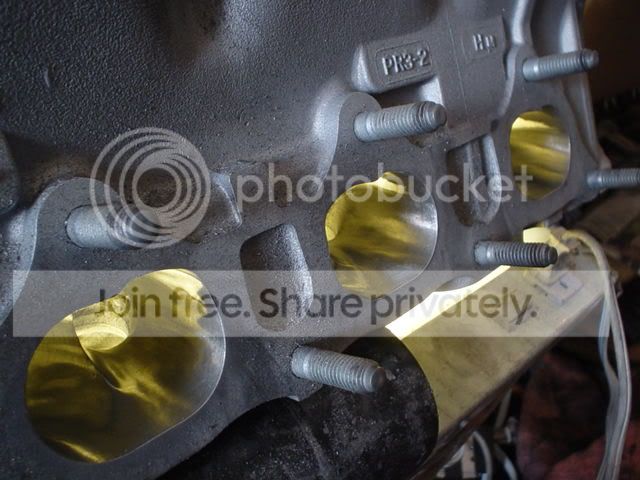
a guy from our crew ported his head by himself, first head he ever ported. **** first time digging in to aluminum. and it turned out great, and made great power. with rs cams on 12.1 compression he pumped out 231 whp with a stock ls crank. i thought he was crazy at first, then i saw the results, and went and got my own head and started porting it. its really not that hard, here are a few pics, i only have a couple exhaust ports that i worked on, but **** first time ever, you can kinda get the point. all done with a handy dremel.  they are not finished yet either, kinda time consuming when your using a dremel. lol.


they are not finished yet either, kinda time consuming when your using a dremel. lol.


Honda-Tech Member
Joined: Feb 2003
Posts: 515
Likes: 0
From: Pittsburgh area, PA
Re: (Rocket)
<TABLE WIDTH="90%" CELLSPACING=0 CELLPADDING=0 ALIGN=CENTER><TR><TD>Quote, originally posted by Rocket »</TD></TR><TR><TD CLASS="quote">IMPORTANT NOTE RE HEADWORK
Myth 2: Just going in and polishing up the ports is a port job.
The Deal: Wrong! The most important aspect of cylinder head preparation is in the valve job. The valve is the main restriction in the
port and a good valve job allows the air to go around the valve more effectively. If you have a stock valve job, guess what? You got stock
flow! (maybe 3cfm more from bling). Hint a proper valve job not only has the correct seat width, throat angle/radii but also sizes the
throat and defines the relief in the chamber.
Another important but commonly over looked aspect of
a good valve job is to seal. Compression is a key input in
the internal combustion motor right?
</TD></TR></TABLE>
Can you explain a proper valve job? What angles cause what effect to flow? Which is beter the 3 angle, 5 angle, or radius
valve job? What about the importance of lapping? I am sure these are all questions that we all would like to here answers
for from the top dogs of porting and head work.
I for one understand that this is key but is it a guarded secret or just common knowledge and practice amoung good head porters?
Modified by DDD at 11:13 AM 5/26/2005
Myth 2: Just going in and polishing up the ports is a port job.
The Deal: Wrong! The most important aspect of cylinder head preparation is in the valve job. The valve is the main restriction in the
port and a good valve job allows the air to go around the valve more effectively. If you have a stock valve job, guess what? You got stock
flow! (maybe 3cfm more from bling). Hint a proper valve job not only has the correct seat width, throat angle/radii but also sizes the
throat and defines the relief in the chamber.
Another important but commonly over looked aspect of
a good valve job is to seal. Compression is a key input in
the internal combustion motor right?
</TD></TR></TABLE>
Can you explain a proper valve job? What angles cause what effect to flow? Which is beter the 3 angle, 5 angle, or radius
valve job? What about the importance of lapping? I am sure these are all questions that we all would like to here answers
for from the top dogs of porting and head work.
I for one understand that this is key but is it a guarded secret or just common knowledge and practice amoung good head porters?
Modified by DDD at 11:13 AM 5/26/2005
Honda-Tech Member
Joined: Sep 2001
Posts: 615
Likes: 0
From: Walla Walla, WA, USA
Re: (DDD)
well it all depends on what you intend for the motor.. some valve jobs dont last very long so not good on a daily driver....
intake ports like actual angled surfaces..
exhaust ports like a radius
i'm doing a 5 angle on intake and 2 angle plus radius exhaust. i've been told this valve job wont last as long.. but flows better.
intake ports like actual angled surfaces..
exhaust ports like a radius
i'm doing a 5 angle on intake and 2 angle plus radius exhaust. i've been told this valve job wont last as long.. but flows better.

Honda-Tech Member
Joined: Jul 2004
Posts: 4,640
Likes: 1
From: VA Beach, VA, USA
Re: (Speedz)
I have several LS heads sitting around that I am practicing head porting on. Doesnt seem hard but I am sure I am messing stuff up but hopefully get better over time!
Bowl work. I wonder if you want to open it up some or just smooth it out?
I am also turning my head( the one in my current build) in to get a competition 3 angle valve job and a mill! If valves arent seated properly what effects can it have on your motor? Bad idle, loss of compression?
Modified by hybrid_vtec at 7:09 AM 5/26/2005
Bowl work. I wonder if you want to open it up some or just smooth it out?
I am also turning my head( the one in my current build) in to get a competition 3 angle valve job and a mill!
If valves arent seated properly what effects can it have on your motor? Bad idle, loss of compression?Modified by hybrid_vtec at 7:09 AM 5/26/2005


Swollen Member
Joined: Jan 2003
Posts: 485
Likes: 0
From: Highland, MD, USA
Re: (JdM DA InTeGrA)
<TABLE WIDTH="90%" CELLSPACING=0 CELLPADDING=0 ALIGN=CENTER><TR><TD>Quote, originally posted by JdM DA InTeGrA »</TD></TR><TR><TD CLASS="quote">Anyone have like a write up on how to p&p? Like what sand paper and everything ta use? I have a d15 head lying around so i think im gonna practice on that.</TD></TR></TABLE>
http://www.theoldone.com/articles/b16a%5Fhead/ This is on Endyn's site, I have read it many times and I am going to read it again, and then start on my GSR head. if anyone has any others, Id like to read them as well.
http://www.theoldone.com/articles/b16a%5Fhead/ This is on Endyn's site, I have read it many times and I am going to read it again, and then start on my GSR head. if anyone has any others, Id like to read them as well.
Honda-Tech Member
Joined: Apr 2004
Posts: 1,318
Likes: 0
From: Monterey Bay, CA
Re: (hybrid_vtec)
<TABLE WIDTH="90%" CELLSPACING=0 CELLPADDING=0 ALIGN=CENTER><TR><TD>Quote, originally posted by hybrid_vtec »</TD></TR><TR><TD CLASS="quote">I have several LS heads sitting around that I am practicing head porting on. Doesnt seem hard but I am sure I am messing stuff up but hopefully get better over time!
Modified by hybrid_vtec at 7:09 AM 5/26/2005</TD></TR></TABLE>
practice makes perfect bro.
Modified by hybrid_vtec at 7:09 AM 5/26/2005</TD></TR></TABLE>
practice makes perfect bro.