


Intake Manifold Question:


Thread Starter
Honda-Tech Member
Joined: Oct 2003
Posts: 6,281
Likes: 0
From: Catching Rivers on Fire TWICE
 Intake Manifold Question:
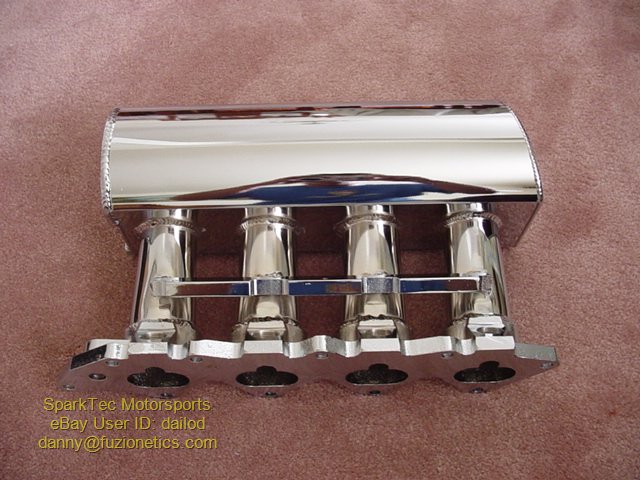
Okay, like i always do i was browsing ebay and stumbled upon the new OBX intake manifold, it looks just like an awesome manifold, i was wodnering if anyone has gotten one or has any opinions on it, other than hearsay or obx sux.
http://cgi.ebay.com/ebaymotors...36474
it essentially looks like they took the venom intake manifold design...


Modified by Soccerking3000 at 3:40 PM 2/10/2005
http://cgi.ebay.com/ebaymotors...36474
it essentially looks like they took the venom intake manifold design...
Modified by Soccerking3000 at 3:40 PM 2/10/2005
Thread Starter
Honda-Tech Member
Joined: Oct 2003
Posts: 6,281
Likes: 0
From: Catching Rivers on Fire TWICE
Re: Intake Manifold Question: (Honda V-Tec)
its not for a show car, it seems to be a much betetr design than the stock manifold, it has the same design as the venom intake so i dont see why i wouldnt perform similarly to it, and i would most likely powdercoat it black
Trending Topics

Thread Starter
Honda-Tech Member
Joined: Oct 2003
Posts: 6,281
Likes: 0
From: Catching Rivers on Fire TWICE
Re: Intake Manifold Question: (jlacoy82)
i dont know, but some plenums are better than others and such i dont understand how something such as this would perform worse than its "real"counterpart

71.192.16.183
Joined: Nov 2004
Posts: 18
Likes: 0
From: Red Sox Nation
Re: Intake Manifold Question: (Soccerking3000)
Thats what I'm wondering. If inch for inch its the EXACT SAME MANIFOLD as the Venow, then how in the world does putting the letters OBX on it make it less effective?

Honda-Tech Member
Joined: May 2002
Posts: 5,187
Likes: 2
From: SoCal, CA, USA
Re: Intake Manifold Question: (Soccerking3000)
There is a lot more to designing an intake manifold than just plenum size, runner area, and runner length.
They all must be properly sized for the application. The shape, area, length of a runner is critical, and fractions of an inch means whether you will lose or make power.
I've never really seen any dyno's of an OBX, or a Venom intake that shows exactly how it works. I wish I could have it tested.
The whole combination of how a intake manifold is designed is based on air flow and frequency harmonics. I seriously doubt that a company like OBX, which copies other people's products, actually has the engineering capability to insure that the manifold works properly.
They all must be properly sized for the application. The shape, area, length of a runner is critical, and fractions of an inch means whether you will lose or make power.
I've never really seen any dyno's of an OBX, or a Venom intake that shows exactly how it works. I wish I could have it tested.
The whole combination of how a intake manifold is designed is based on air flow and frequency harmonics. I seriously doubt that a company like OBX, which copies other people's products, actually has the engineering capability to insure that the manifold works properly.
Thread Starter
Honda-Tech Member
Joined: Oct 2003
Posts: 6,281
Likes: 0
From: Catching Rivers on Fire TWICE
Re: Intake Manifold Question: (Marauder)
i doubt obx has that capability but if they copy a manifold that has been proven to have nice gains on engines and has the reputation to back it up, then wont the obx perform the same, maybe not last as long, but at least have similar gains?

Honda-Tech Member
Joined: Aug 2003
Posts: 3,905
Likes: 0
From: Colorado
Re: Intake Manifold Question: (Marauder)
<TABLE WIDTH="90%" CELLSPACING=0 CELLPADDING=0 ALIGN=CENTER><TR><TD>Quote, originally posted by Marauder »</TD></TR><TR><TD CLASS="quote">There is a lot more to designing an intake manifold than just plenum size, runner area, and runner length.
They all must be properly sized for the application. The shape, area, length of a runner is critical, and fractions of an inch means whether you will lose or make power.
I've never really seen any dyno's of an OBX, or a Venom intake that shows exactly how it works. I wish I could have it tested.
The whole combination of how a intake manifold is designed is based on air flow and frequency harmonics. I seriously doubt that a company like OBX, which copies other people's products, actually has the engineering capability to insure that the manifold works properly.</TD></TR></TABLE>
can u beleive this company makes LSD for d series and b series motors, and there are people on this site who use them, there is a dude on this site who has had one for over a year without anyproblems but i dont know his name, they also have a groub buy going on right now for the lsd on this web site.
They all must be properly sized for the application. The shape, area, length of a runner is critical, and fractions of an inch means whether you will lose or make power.
I've never really seen any dyno's of an OBX, or a Venom intake that shows exactly how it works. I wish I could have it tested.
The whole combination of how a intake manifold is designed is based on air flow and frequency harmonics. I seriously doubt that a company like OBX, which copies other people's products, actually has the engineering capability to insure that the manifold works properly.</TD></TR></TABLE>
can u beleive this company makes LSD for d series and b series motors, and there are people on this site who use them, there is a dude on this site who has had one for over a year without anyproblems but i dont know his name, they also have a groub buy going on right now for the lsd on this web site.

Honda-Tech Member

Joined: Jul 2004
Posts: 4,337
Likes: 0
From: a fuzzy happy place, USA
Re: Intake Manifold Question: (jlacoy82)
skunk or obx, either way is a larger intake manifold that will kill your low end torque and give you minimal gains on the top end without mods to compression and/or cams. It would be for show only for your application

Junior Member
Joined: Sep 2002
Posts: 866
Likes: 0
From: usa
Re: Intake Manifold Question: (jlacoy82)
its a knock off...who cares. if it works it works. that design has a huge plenum with short straight runners. it would be good for high boost applications but horrible for n/a or even low boost. due to the huge plenum an n/a motor would not be able to fill the manifold completely and would create differences in vacuum at different cylendars. its simalar to the jg edlebrock manifold. some people say they are great for na but in reality the design is for fi. usually manifolds like this will make some power at very high rpms such as 7k+ but for most the increase in the powerband is such a narrow band it is worthless and a smaller plenum longer runner design would be better suited. there are tons of threads about this...just look at similar designs such as the edlebrock and read posts on that, for most builds a skunk 2 or itr manifold will work the best.
Honda-Tech Member
Joined: May 2002
Posts: 5,187
Likes: 2
From: SoCal, CA, USA
Re: Intake Manifold Question: (Soccerking3000)
<TABLE WIDTH="90%" CELLSPACING=0 CELLPADDING=0 ALIGN=CENTER><TR><TD>Quote, originally posted by Soccerking3000 »</TD></TR><TR><TD CLASS="quote">i doubt obx has that capability but if they copy a manifold that has been proven to have nice gains on engines and has the reputation to back it up, then wont the obx perform the same, maybe not last as long, but at least have similar gains?</TD></TR></TABLE>
I've never seen any information that shows how a Venom works on a D series over the stock intake. Do you know where I could find some info on this?
I've never seen any information that shows how a Venom works on a D series over the stock intake. Do you know where I could find some info on this?
Thread Starter
Honda-Tech Member
Joined: Oct 2003
Posts: 6,281
Likes: 0
From: Catching Rivers on Fire TWICE
Re: Intake Manifold Question: (Marauder)
it was an assumption that a manifold that has 70% better efficiency than the stock manifold would have much better gains, the venom is recommended for FI or heavily modified NA applications, so i think that the manifold would be good for any turbo motor where the air is being forced into the engine as apposed to being sucked into the engine where velocity has a large impact on how much air enters. I don't know if this is the same but its like the scavenging affect for exhaust, for turbo apps, the larger runners would should have gains because the velocity isn't as much of a factor while NA they have to be sized appropriately to have the maximum velocity and there for gains 

Honda-Tech Member
Joined: May 2002
Posts: 5,187
Likes: 2
From: SoCal, CA, USA
Re: Intake Manifold Question: (Soccerking3000)
<TABLE WIDTH="90%" CELLSPACING=0 CELLPADDING=0 ALIGN=CENTER><TR><TD>Quote, originally posted by Soccerking3000 »</TD></TR><TR><TD CLASS="quote">what the scavenging affect? or the better effiecny
</TD></TR></TABLE>
Just better.....like a dyno before and after and what the setup is. Thats what everyone wants to know. You can't really tell the efficency unless its dyno'd and the readout tells you the volumetric effeciency, but then its on the whole package.
</TD></TR></TABLE>
Just better.....like a dyno before and after and what the setup is. Thats what everyone wants to know. You can't really tell the efficency unless its dyno'd and the readout tells you the volumetric effeciency, but then its on the whole package.


All Motor Mentor
Joined: Aug 2004
Posts: 6,987
Likes: 1
From: 902, Nova Scotia, Canada
Re: Intake Manifold Question: (Soccerking3000)
<TABLE WIDTH="90%" CELLSPACING=0 CELLPADDING=0 ALIGN=CENTER><TR><TD>Quote, originally posted by Soccerking3000 »</TD></TR><TR><TD CLASS="quote">it was an assumption that a manifold that has 70% better efficiency than the stock manifold would have much better gains, the venom is recommended for FI or heavily modified NA applications, so i think that the manifold would be good for any turbo motor where the air is being forced into the engine as apposed to being sucked into the engine where velocity has a large impact on how much air enters. I don't know if this is the same but its like the scavenging affect for exhaust, for turbo apps, the larger runners would should have gains because the velocity isn't as much of a factor while NA they have to be sized appropriately to have the maximum velocity and there for gains </TD></TR></TABLE>
Generally speaking, this is very correct. As far as being 70% more efficient goes, that's all relative and is vague at best. It could mean that at 7500 rpm it is 70% more efficient than a stock manifold. What it doesn't indicate is that at 2500 rpm it could be 70% LESS efficient than a stock manifold. If the car is forced induction a manifold like the OBX and VENOM will tend to perform better than on a NA engine because of it's configuration. Skunk2, ITR, BLOX and AEBS and the Edelbrock longer runner manifolds will tend to perform better on all motor street cars.
Modified by 00Red_SiR at 12:43 AM 2/11/2005
</TD></TR></TABLE>Generally speaking, this is very correct. As far as being 70% more efficient goes, that's all relative and is vague at best. It could mean that at 7500 rpm it is 70% more efficient than a stock manifold. What it doesn't indicate is that at 2500 rpm it could be 70% LESS efficient than a stock manifold. If the car is forced induction a manifold like the OBX and VENOM will tend to perform better than on a NA engine because of it's configuration. Skunk2, ITR, BLOX and AEBS and the Edelbrock longer runner manifolds will tend to perform better on all motor street cars.
Modified by 00Red_SiR at 12:43 AM 2/11/2005
Honda-Tech Member
Joined: May 2002
Posts: 5,187
Likes: 2
From: SoCal, CA, USA
Re: Intake Manifold Question: (00Red_SiR)
I also have a problem with the 70% more efficient.
Usually, when talking about efficiency with dyno performance, you are talking volumetric efficiency of the engine. A stock engine is somewhere on the lines of 80-90% range on volumetric efficiency. Then as the motor gets built and you upgrade parts and start making a lot more power with the same displacement you can get 100-120% volumetric efficiency. (these numbers are very ballpark, just used as an example)
But to increase efficiency 70%, they are deffinately talking about something other than volumetric efficiency and its probably a number not related to power gains.
<TABLE WIDTH="90%" CELLSPACING=0 CELLPADDING=0 ALIGN=CENTER><TR><TD>Quote, originally posted by 00Red_SiR »</TD></TR><TR><TD CLASS="quote">
If the car is forced induction a manifold like the OBX and VENOM will tend to perform better than on a NA engine because of it's configuration. Sjunk2, ITR, BLOX and AEBS and the Edelbrock longer runner manifolds will tend to perform better on all motor street cars.</TD></TR></TABLE>
Not really. I'll have to see what data I can pull up. But I have some dyno data around here that shows a VictorX manifold vs. a new "longer runner" manifold and the VictorX loses hands down on a turbo'd B16.
Usually, when talking about efficiency with dyno performance, you are talking volumetric efficiency of the engine. A stock engine is somewhere on the lines of 80-90% range on volumetric efficiency. Then as the motor gets built and you upgrade parts and start making a lot more power with the same displacement you can get 100-120% volumetric efficiency. (these numbers are very ballpark, just used as an example)
But to increase efficiency 70%, they are deffinately talking about something other than volumetric efficiency and its probably a number not related to power gains.
<TABLE WIDTH="90%" CELLSPACING=0 CELLPADDING=0 ALIGN=CENTER><TR><TD>Quote, originally posted by 00Red_SiR »</TD></TR><TR><TD CLASS="quote">
If the car is forced induction a manifold like the OBX and VENOM will tend to perform better than on a NA engine because of it's configuration. Sjunk2, ITR, BLOX and AEBS and the Edelbrock longer runner manifolds will tend to perform better on all motor street cars.</TD></TR></TABLE>
Not really. I'll have to see what data I can pull up. But I have some dyno data around here that shows a VictorX manifold vs. a new "longer runner" manifold and the VictorX loses hands down on a turbo'd B16.

Thread
Thread Starter
Forum
Replies
Last Post
