


Clicking noise while turning


Thread Starter
Joined: Jun 2004
Posts: 323
Likes: 0
From: Columbus, Ohio, usa
 Clicking noise while turning
When I turn at slow speeds there's a clicking from the driver's side wheel. I just replaced the axles with remans. about 5,000 miles ago and the boots are fine. Also when I push the brakes hard it almost feels like I have ABS, like a cam lobe is spinning under my brake pedal or something.. Just got new rotors and pads too. Think the axle was junk? What else could it be? I have an 00 dx with a ctr engine.


Member
Joined: Nov 2004
Posts: 1,792
Likes: 0
From: Kitchener, Ontario, Canada
Re: Clicking noise while turning (BoostedDelsol)
Check the control arms to make sure they're not bent. Also check the control arm bushings for deterioration or damage while you're there. I had a really loud CLICK when I had the wheel to the left and I stepped on the brakes. I replaced the driver's upper control arm today and it doesn't do it any more. Control arm was bent and one bolt was kind of loose... 
Thread Starter
Joined: Jun 2004
Posts: 323
Likes: 0
From: Columbus, Ohio, usa
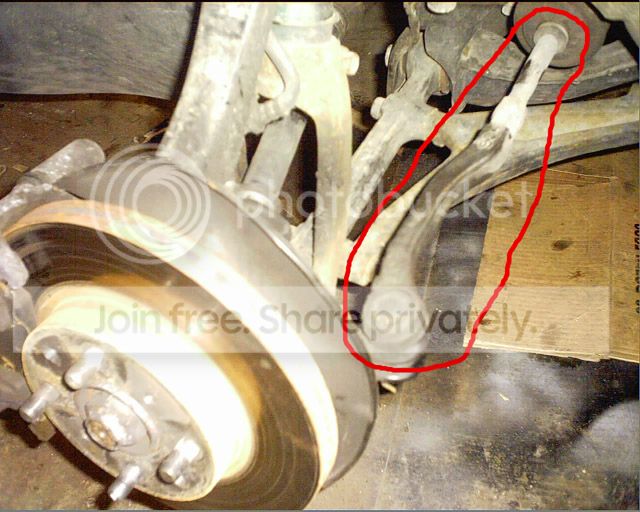
Here are pictures of my driver's side. In the first one, is this steering bar supposed to twist freely? Mine does, only about 10º though.
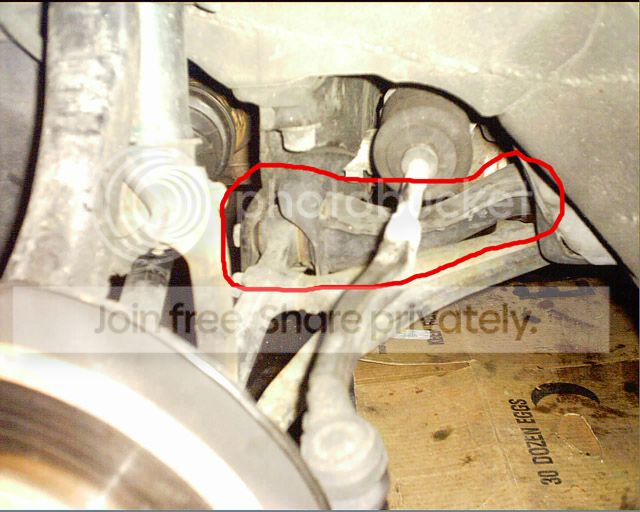
Second pic, I think this whole part is bent forward, but it doesn't look damaged in person..
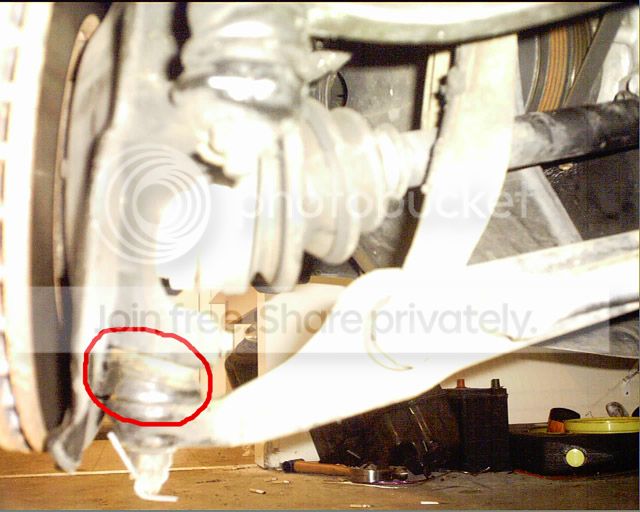
Here's the last, and this little bushing looks pretty flatened out..
Anything else I should check while the wheel's off?
Second pic, I think this whole part is bent forward, but it doesn't look damaged in person..
Here's the last, and this little bushing looks pretty flatened out..
Anything else I should check while the wheel's off?


Trending Topics
Member
Joined: Nov 2004
Posts: 1,792
Likes: 0
From: Kitchener, Ontario, Canada
Re: (Ricochet.)
<u>First pic:</u> That's your outer tie rod end/tie rod (attached to). The end that is attached to the knuckle is attached by a ball joint, so rotational play is normal.
<u>Second pic:</u> It doesn't look bent.
<u>Third pic:</u> That's your lower ball joint's rubber boot that is flat. It's normal as well.
Here's a test that I would do in your situation: (and have done as a matter of fact!)
Jack up the passenger side as well and secure both sides with safety stands/jack stands. Remove both front wheels, unbolt the calipers and hang them out of the way with mechanics wire. Use an impact screw driver or a good, fairly new big screw driver and carefully take the screws that hold the rotors on to the hubs out, remove rotors. Now get in your car, start it up and put it in second, let the engine idle in gear so the front hubs are spinning. Turn the steering wheel from lock to lock, if it's a CV joint, it'll make the noise you've been hearing when you do this test. Get out of the car while it's running like this and locate the bad joint and replace it.
Another test you should do is put everything back together, brakes, wheels torqued. With the front end still in the air, shake the wheel side to side (right hand @ 3 o'clock, left hand @ 9 o'clock) and feel for play. Then shake it top and bottom (right hand at 12 o'clock, left hand at 6 o'clock) to feel for play in the ball joints.
Let us know how these tests go for you.
<u>Second pic:</u> It doesn't look bent.
<u>Third pic:</u> That's your lower ball joint's rubber boot that is flat. It's normal as well.
Here's a test that I would do in your situation: (and have done as a matter of fact!)
Jack up the passenger side as well and secure both sides with safety stands/jack stands. Remove both front wheels, unbolt the calipers and hang them out of the way with mechanics wire. Use an impact screw driver or a good, fairly new big screw driver and carefully take the screws that hold the rotors on to the hubs out, remove rotors. Now get in your car, start it up and put it in second, let the engine idle in gear so the front hubs are spinning. Turn the steering wheel from lock to lock, if it's a CV joint, it'll make the noise you've been hearing when you do this test. Get out of the car while it's running like this and locate the bad joint and replace it.
Another test you should do is put everything back together, brakes, wheels torqued. With the front end still in the air, shake the wheel side to side (right hand @ 3 o'clock, left hand @ 9 o'clock) and feel for play. Then shake it top and bottom (right hand at 12 o'clock, left hand at 6 o'clock) to feel for play in the ball joints.
Let us know how these tests go for you.

Junior Member
Joined: Sep 2002
Posts: 342
Likes: 1
From: Markham, ONT, Canada
Re: (CycloneBlue_1.6EL)
<TABLE WIDTH="90%" CELLSPACING=0 CELLPADDING=0 ALIGN=CENTER><TR><TD>Quote »</TD></TR><TR><TD CLASS="quote">
Here's a test that I would do in your situation: (and have done as a matter of fact!)
Jack up the passenger side as well and secure both sides with safety stands/jack stands. Remove both front wheels, unbolt the calipers and hang them out of the way with mechanics wire. Use an impact screw driver or a good, fairly new big screw driver and carefully take the screws that hold the rotors on to the hubs out, remove rotors. Now get in your car, start it up and put it in second, let the engine idle in gear so the front hubs are spinning. Turn the steering wheel from lock to lock, if it's a CV joint, it'll make the noise you've been hearing when you do this test. Get out of the car while it's running like this and locate the bad joint and replace it.
Another test you should do is put everything back together, brakes, wheels torqued. With the front end still in the air, shake the wheel side to side (right hand @ 3 o'clock, left hand @ 9 o'clock) and feel for play. Then shake it top and bottom (right hand at 12 o'clock, left hand at 6 o'clock) to feel for play in the ball joints.
Let us know how these tests go for you.</TD></TR></TABLE>
if you do this DON'T STEP ON THE BRAKES
Here's a test that I would do in your situation: (and have done as a matter of fact!)
Jack up the passenger side as well and secure both sides with safety stands/jack stands. Remove both front wheels, unbolt the calipers and hang them out of the way with mechanics wire. Use an impact screw driver or a good, fairly new big screw driver and carefully take the screws that hold the rotors on to the hubs out, remove rotors. Now get in your car, start it up and put it in second, let the engine idle in gear so the front hubs are spinning. Turn the steering wheel from lock to lock, if it's a CV joint, it'll make the noise you've been hearing when you do this test. Get out of the car while it's running like this and locate the bad joint and replace it.
Another test you should do is put everything back together, brakes, wheels torqued. With the front end still in the air, shake the wheel side to side (right hand @ 3 o'clock, left hand @ 9 o'clock) and feel for play. Then shake it top and bottom (right hand at 12 o'clock, left hand at 6 o'clock) to feel for play in the ball joints.
Let us know how these tests go for you.</TD></TR></TABLE>
if you do this DON'T STEP ON THE BRAKES
Member
Joined: Nov 2004
Posts: 1,792
Likes: 0
From: Kitchener, Ontario, Canada
Re: (untuned)
<TABLE WIDTH="90%" CELLSPACING=0 CELLPADDING=0 ALIGN=CENTER><TR><TD>Quote, originally posted by untuned »</TD></TR><TR><TD CLASS="quote">if you do this DON'T STEP ON THE BRAKES</TD></TR></TABLE>
****, forgot to add that!
That could have been all kinds of bad for this guy.
****, forgot to add that!
That could have been all kinds of bad for this guy.


Joined: Oct 2003
Posts: 391
Likes: 0
From: Las Vegas, NV, USA
Re: (CycloneBlue_1.6EL)
<TABLE WIDTH="90%" CELLSPACING=0 CELLPADDING=0 ALIGN=CENTER><TR><TD>Quote, originally posted by CycloneBlue_1.6EL »</TD></TR><TR><TD CLASS="quote">
****, forgot to add that!
That could have been all kinds of bad for this guy.</TD></TR></TABLE>

****, forgot to add that!
That could have been all kinds of bad for this guy.</TD></TR></TABLE>

Thread
Thread Starter
Forum
Replies
Last Post
alscrx
Honda CRX / EF Civic (1988 - 1991)
29
Aug 10, 2021 11:23 PM
allmotorpackage
Suspension & Brakes
4
Oct 24, 2007 03:09 PM
d16vteceg
Honda Civic / Del Sol (1992 - 2000)
4
Aug 12, 2006 10:09 AM
track_assassin
Honda Civic / Del Sol (1992 - 2000)
11
Jan 26, 2006 03:38 PM
