


buffing 101


Junior Member
Joined: Nov 2003
Posts: 733
Likes: 0
From: Dallas, TX, USA
 Re: buffing 101 (downswing1416)
try searching.. theres lots of threads on buffing and polishing..
are you buffing after wetsanding or just trying to get shine out of your bumper? more info....
are you buffing after wetsanding or just trying to get shine out of your bumper? more info....

Joined: Feb 2007
Posts: 779
Likes: 0
From: Pittsburgh, PA, USA
Re: buffing 101 (downswing1416)
Items you will need:
1. A Buffer (Makita, DeWalt, etc...)
2. White Foam Pad (or wool, your preferance)
3. Black Foam Pad (softer less abrasive than white)
4. Extra Cut Rubbing Compound (not always needed, I swear by 3M brand)
5. Rubbing Compound (I use a water base, seems to work better, also 3M)
6. Finishing Glaze (if you have a dark colored car, get the dark colored finishing glaze, light colored car get the white glaze.)
7. Hand Glaze (or a wax of your choice, unless freshly painted then go with hand glaze.)
After Area is Wetsanded:
1. Start with the white foam pad. Use the rubbing compound first and buff a 2 square foot area. Don't try to buff the whole thing at once, concentrate on one area first then move on. Don't turn your buffer up too high, I usually keep mine around 1200 or 1400 RPM. Don't keep the buffer in one area too long or you will heat the panel up too much and burn through your clear coat (not good).
2. When there is no dullness to the clear coat, switch to the black foam pad. Using the same compound go over the panel again. Use the same method at in step 1. This step not everyone does (cause it's an added step), but your car will look better than theirs in the end Going from a white foam pad to a black foam pad using the same compound pretty much assures that you will have no swirl marks at all.
3. After going over the panel and satisfied with outcome, either rinse out your black foam pad or put a new one on. Now switch to the finishing glaze. Same method as above, this will really make your car shine.
1. A Buffer (Makita, DeWalt, etc...)
2. White Foam Pad (or wool, your preferance)
3. Black Foam Pad (softer less abrasive than white)
4. Extra Cut Rubbing Compound (not always needed, I swear by 3M brand)
5. Rubbing Compound (I use a water base, seems to work better, also 3M)
6. Finishing Glaze (if you have a dark colored car, get the dark colored finishing glaze, light colored car get the white glaze.)
7. Hand Glaze (or a wax of your choice, unless freshly painted then go with hand glaze.)
After Area is Wetsanded:
1. Start with the white foam pad. Use the rubbing compound first and buff a 2 square foot area. Don't try to buff the whole thing at once, concentrate on one area first then move on. Don't turn your buffer up too high, I usually keep mine around 1200 or 1400 RPM. Don't keep the buffer in one area too long or you will heat the panel up too much and burn through your clear coat (not good).
2. When there is no dullness to the clear coat, switch to the black foam pad. Using the same compound go over the panel again. Use the same method at in step 1. This step not everyone does (cause it's an added step), but your car will look better than theirs in the end
Going from a white foam pad to a black foam pad using the same compound pretty much assures that you will have no swirl marks at all.3. After going over the panel and satisfied with outcome, either rinse out your black foam pad or put a new one on. Now switch to the finishing glaze. Same method as above, this will really make your car shine.

EPIC TUNING
Joined: Sep 2002
Posts: 10,285
Likes: 0
From: WA
Re: buffing 101 (WihaSi)
<TABLE WIDTH="90%" CELLSPACING=0 CELLPADDING=0 ALIGN=CENTER><TR><TD>Quote, originally posted by WihaSi »</TD></TR><TR><TD CLASS="quote">Items you will need:
1. A Buffer (Makita, DeWalt, etc...)
2. White Foam Pad (or wool, your preferance)
3. Black Foam Pad (softer less abrasive than white)
4. Extra Cut Rubbing Compound (not always needed, I swear by 3M brand)
5. Rubbing Compound (I use a water base, seems to work better, also 3M)
6. Finishing Glaze (if you have a dark colored car, get the dark colored finishing glaze, light colored car get the white glaze.)
7. Hand Glaze (or a wax of your choice, unless freshly painted then go with hand glaze.)
After Area is Wetsanded:
1. Start with the white foam pad. Use the rubbing compound first and buff a 2 square foot area. Don't try to buff the whole thing at once, concentrate on one area first then move on. Don't turn your buffer up too high, I usually keep mine around 1200 or 1400 RPM. Don't keep the buffer in one area too long or you will heat the panel up too much and burn through your clear coat (not good).
2. When there is no dullness to the clear coat, switch to the black foam pad. Using the same compound go over the panel again. Use the same method at in step 1. This step not everyone does (cause it's an added step), but your car will look better than theirs in the end Going from a white foam pad to a black foam pad using the same compound pretty much assures that you will have no swirl marks at all.
3. After going over the panel and satisfied with outcome, either rinse out your black foam pad or put a new one on. Now switch to the finishing glaze. Same method as above, this will really make your car shine. </TD></TR></TABLE>
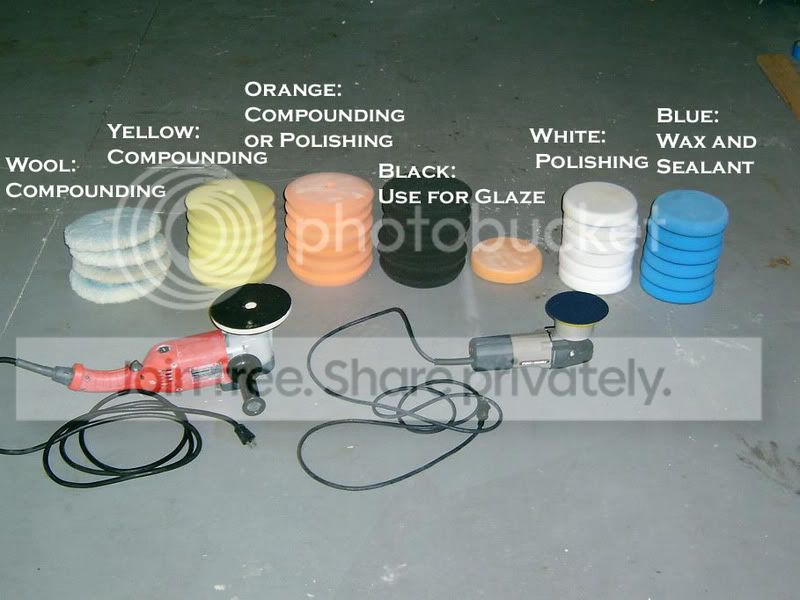
you go from compound to glaze? and a polishing pad with compound? I guess everyone has their own techniques but the most common way is compound with orange or yellow, or I like foamed wool. then polish with white (A white pad has very very little cut, I am not sure why you use it with a compound), then follow with a glaze on a black pad. I would definately rather use a polish after one step of compounding opposed to compounding it twice with very mild pads. Compound IS abrasive, and even if you use it with a black finishing pad (Which is made for wax, sealants, and glaze), you run a very high chance of still have micromarring.
Optimum Hyper Compound (or Optimum Compound) with a foamed wool or yellow cutting pad + Optimum Polish with a white polishing pad (see the trend here?) + your favorite glaze with a black finishing pad + followed with wax or sealant on a blue fine finishing pad
Orange pads are nice because those have a light cut and can be used for both mild compounding or polishing. white polishing pads have very little cut at all, if any.
Foamed wool pads are gangster for compounding.
but I guess everyone does it differently...
also I highly do not recommend rinsing out a pad used for compounding to apply a glaze. black pads shouldnt be used for compounding, and if you do, you are almost guaranteed to leave abrisives behind which doesnt make sense if you are applying glaze. Keep black pads for glaze
a picture for refrence:
more detailed info can be found here:
https://honda-tech.com/zerothread/1994412
Modified by E-Rok at 10:46 AM 5/31/2007
Modified by E-Rok at 11:07 AM 5/31/2007
1. A Buffer (Makita, DeWalt, etc...)
2. White Foam Pad (or wool, your preferance)
3. Black Foam Pad (softer less abrasive than white)
4. Extra Cut Rubbing Compound (not always needed, I swear by 3M brand)
5. Rubbing Compound (I use a water base, seems to work better, also 3M)
6. Finishing Glaze (if you have a dark colored car, get the dark colored finishing glaze, light colored car get the white glaze.)
7. Hand Glaze (or a wax of your choice, unless freshly painted then go with hand glaze.)
After Area is Wetsanded:
1. Start with the white foam pad. Use the rubbing compound first and buff a 2 square foot area. Don't try to buff the whole thing at once, concentrate on one area first then move on. Don't turn your buffer up too high, I usually keep mine around 1200 or 1400 RPM. Don't keep the buffer in one area too long or you will heat the panel up too much and burn through your clear coat (not good).
2. When there is no dullness to the clear coat, switch to the black foam pad. Using the same compound go over the panel again. Use the same method at in step 1. This step not everyone does (cause it's an added step), but your car will look better than theirs in the end
Going from a white foam pad to a black foam pad using the same compound pretty much assures that you will have no swirl marks at all.3. After going over the panel and satisfied with outcome, either rinse out your black foam pad or put a new one on. Now switch to the finishing glaze. Same method as above, this will really make your car shine.
</TD></TR></TABLE>you go from compound to glaze? and a polishing pad with compound? I guess everyone has their own techniques but the most common way is compound with orange or yellow, or I like foamed wool. then polish with white (A white pad has very very little cut, I am not sure why you use it with a compound), then follow with a glaze on a black pad. I would definately rather use a polish after one step of compounding opposed to compounding it twice with very mild pads. Compound IS abrasive, and even if you use it with a black finishing pad (Which is made for wax, sealants, and glaze), you run a very high chance of still have micromarring.
Optimum Hyper Compound (or Optimum Compound) with a foamed wool or yellow cutting pad + Optimum Polish with a white polishing pad (see the trend here?) + your favorite glaze with a black finishing pad + followed with wax or sealant on a blue fine finishing pad
Orange pads are nice because those have a light cut and can be used for both mild compounding or polishing. white polishing pads have very little cut at all, if any.
Foamed wool pads are gangster for compounding.
but I guess everyone does it differently...
also I highly do not recommend rinsing out a pad used for compounding to apply a glaze. black pads shouldnt be used for compounding, and if you do, you are almost guaranteed to leave abrisives behind which doesnt make sense if you are applying glaze. Keep black pads for glaze
a picture for refrence:
more detailed info can be found here:
https://honda-tech.com/zerothread/1994412
Modified by E-Rok at 10:46 AM 5/31/2007
Modified by E-Rok at 11:07 AM 5/31/2007
Joined: Feb 2007
Posts: 779
Likes: 0
From: Pittsburgh, PA, USA
Re: buffing 101 (E-Rok)
<TABLE WIDTH="90%" CELLSPACING=0 CELLPADDING=0 ALIGN=CENTER><TR><TD>Quote, originally posted by E-Rok »</TD></TR><TR><TD CLASS="quote">
you go from compound to glaze? and a polishing pad with compound</TD></TR></TABLE>
Wow, yes...I told you this in another thread also. I work in a body shop, and I used to paint for a body shop. That is the method I use for buffing a car after it is painted. I have never had a problem with this method, nor have I ever had any problems with dull spots from sanding or swirl marks. Are you kidding that a white foam pad has very little cut? What white foam are you using? And using a black foam pad with compound is just stepping the fine scratches down, there is nothing wrong with using white foam with compound then black foam with compound.
You can rinse out a black foam pad if you want, use a spur first then rinse it well. I personally would buy 2 black foam pads, that's why I said "either rinse out your black foam pad or put a new one on" Using a new one is of course better when glazing, but if you don't have 2 black pads, by all means rinse it out well.
Just because my method is different from yours doesn't mean that it won't work. Maybe try it out before you tell me it's "odd". I also spray the car with water while I buff, is that "not common"? I was trained by technicians that have been in the business for 40+ years, and I adopted their methods and they work. You're probably a detailer right? If that's so then I can see why are methods are different.
you go from compound to glaze? and a polishing pad with compound</TD></TR></TABLE>
Wow, yes...I told you this in another thread also. I work in a body shop, and I used to paint for a body shop. That is the method I use for buffing a car after it is painted. I have never had a problem with this method, nor have I ever had any problems with dull spots from sanding or swirl marks. Are you kidding that a white foam pad has very little cut? What white foam are you using? And using a black foam pad with compound is just stepping the fine scratches down, there is nothing wrong with using white foam with compound then black foam with compound.
You can rinse out a black foam pad if you want, use a spur first then rinse it well. I personally would buy 2 black foam pads, that's why I said "either rinse out your black foam pad or put a new one on" Using a new one is of course better when glazing, but if you don't have 2 black pads, by all means rinse it out well.
Just because my method is different from yours doesn't mean that it won't work. Maybe try it out before you tell me it's "odd". I also spray the car with water while I buff, is that "not common"? I was trained by technicians that have been in the business for 40+ years, and I adopted their methods and they work. You're probably a detailer right? If that's so then I can see why are methods are different.
Joined: Feb 2007
Posts: 779
Likes: 0
From: Pittsburgh, PA, USA
Re: buffing 101 (alltech_hybrid)
<TABLE WIDTH="90%" CELLSPACING=0 CELLPADDING=0 ALIGN=CENTER><TR><TD>Quote, originally posted by alltech_hybrid »</TD></TR><TR><TD CLASS="quote">wow! GREAT INFO!! 
so you dont use air buffers? do those electric ones work ok?
Modified by alltech_hybrid at 10:17 AM 5/31/2007</TD></TR></TABLE>
I actually like air buffers better, personal preferance really.
so you dont use air buffers? do those electric ones work ok?
Modified by alltech_hybrid at 10:17 AM 5/31/2007</TD></TR></TABLE>
I actually like air buffers better, personal preferance really.
Trending Topics
Junior Member
Joined: Nov 2003
Posts: 733
Likes: 0
From: Dallas, TX, USA
Re: buffing 101 (WihaSi)
<TABLE WIDTH="90%" CELLSPACING=0 CELLPADDING=0 ALIGN=CENTER><TR><TD>Quote, originally posted by WihaSi »</TD></TR><TR><TD CLASS="quote">
I actually like air buffers better, personal preferance really.</TD></TR></TABLE>
word! me too... never tried an electric b4
I actually like air buffers better, personal preferance really.</TD></TR></TABLE>
word! me too... never tried an electric b4
EPIC TUNING
Joined: Sep 2002
Posts: 10,285
Likes: 0
From: WA
Re: buffing 101 (WihaSi)
Well I am assuming you meant a white LC or equivalent pad (most common) which is a polishing pad with very little cut. if your pads differ, then I am sorry for mistaking that.
And are your methods for freshly painted cars? If so then yes, I am a detailer so it is understandable that our methods differ since you are working with fresh paint.
spraying a car with water or wetting the pad works great, it provides librication so the pad does not skip or jump.
And are your methods for freshly painted cars? If so then yes, I am a detailer so it is understandable that our methods differ since you are working with fresh paint.
spraying a car with water or wetting the pad works great, it provides librication so the pad does not skip or jump.
Joined: Feb 2007
Posts: 779
Likes: 0
From: Pittsburgh, PA, USA
Re: buffing 101 (E-Rok)
<TABLE WIDTH="90%" CELLSPACING=0 CELLPADDING=0 ALIGN=CENTER><TR><TD>Quote, originally posted by E-Rok »</TD></TR><TR><TD CLASS="quote">Well I am assuming you meant a white LC or equivalent pad (most common) which is a polishing pad with very little cut. if your pads differ, then I am sorry for mistaking that.
And are your methods for freshly painted cars? If so then yes, I am a detailer so it is understandable that our methods differ since you are working with fresh paint.
spraying a car with water or wetting the pad works great, it provides librication so the pad does not skip or jump.</TD></TR></TABLE>
Yeah I've only ever buffed cars that were freshly painted. So my methods are a bit different, but it really works well.
And are your methods for freshly painted cars? If so then yes, I am a detailer so it is understandable that our methods differ since you are working with fresh paint.
spraying a car with water or wetting the pad works great, it provides librication so the pad does not skip or jump.</TD></TR></TABLE>
Yeah I've only ever buffed cars that were freshly painted. So my methods are a bit different, but it really works well.

Junior Member
Joined: Mar 2005
Posts: 910
Likes: 0
From: Bowling Green, KY, U.S.
Re: buffing 101 (WihaSi)
Half the cars I detail are cars the came from body shops not long before I receive and are in needs of some much needed TLC from the Body shop putting horrible Buffer trails/Burns in the paint due to starting out with a Wool or twisted wool pad on a rotary and then stepping down to nothing but a glaze to hide all those swirls they covered the paint with. Most the time those bodymen dont even know how to buff, thinking that one quick pass over the panel with the edge of a wool pad is going to make it look fresh. While most the time this does get rid of the haze from wetsanding, the micromarring and and holograms left are ridiculous. Im not saying your method is wrong WihaSI nor am I trying to argue with you, but it MY experience every car ive seen thats been buffed using your method comes out looking like a steel wool was used to wash the fresh paint, especially after the glaze wears off after it rains once or twice
EPIC TUNING
Joined: Sep 2002
Posts: 10,285
Likes: 0
From: WA
Re: buffing 101 (EJ8tunerman)
<TABLE WIDTH="90%" CELLSPACING=0 CELLPADDING=0 ALIGN=CENTER><TR><TD>Quote, originally posted by EJ8tunerman »</TD></TR><TR><TD CLASS="quote">Half the cars I detail are cars the came from body shops not long before I receive and are in needs of some much needed TLC from the Body shop putting horrible Buffer trails/Burns in the paint due to starting out with a Wool or twisted wool pad on a rotary and then stepping down to nothing but a glaze to hide all those swirls they covered the paint with. Most the time those bodymen dont even know how to buff, thinking that one quick pass over the panel with the edge of a wool pad is going to make it look fresh. While most the time this does get rid of the haze from wetsanding, the micromarring and and holograms left are ridiculous. Im not saying your method is wrong WihaSI nor am I trying to argue with you, but it MY experience every car ive seen thats been buffed using your method comes out looking like a steel wool was used to wash the fresh paint, especially after the glaze wears off after it rains once or twice </TD></TR></TABLE>
agreed. I do a ton of work removing marring and holograms from body shops
</TD></TR></TABLE>agreed. I do a ton of work removing marring and holograms from body shops
Joined: Feb 2007
Posts: 779
Likes: 0
From: Pittsburgh, PA, USA
Re: buffing 101 (EJ8tunerman)
<TABLE WIDTH="90%" CELLSPACING=0 CELLPADDING=0 ALIGN=CENTER><TR><TD>Quote, originally posted by EJ8tunerman »</TD></TR><TR><TD CLASS="quote">Half the cars I detail are cars the came from body shops not long before I receive and are in needs of some much needed TLC from the Body shop putting horrible Buffer trails/Burns in the paint due to starting out with a Wool or twisted wool pad on a rotary and then stepping down to nothing but a glaze to hide all those swirls they covered the paint with. Most the time those bodymen dont even know how to buff, thinking that one quick pass over the panel with the edge of a wool pad is going to make it look fresh. While most the time this does get rid of the haze from wetsanding, the micromarring and and holograms left are ridiculous. Im not saying your method is wrong WihaSI nor am I trying to argue with you, but it MY experience every car ive seen thats been buffed using your method comes out looking like a steel wool was used to wash the fresh paint, especially after the glaze wears off after it rains once or twice </TD></TR></TABLE>
Maybe they were lazy, I go over it till I would be happy with the job...and I'm ****. I don't take "one quick pass over a panel". You shouldn't generalize and put blame on bodymen. Did you personally go around to all the body shops in your area just to ask what buffing method they use, lol? Body techs do know how to buff, it's just a matter of how lazy they are, if you get a lazy one that doesn't want to buff it right, of course you'll still see dull spots and swirls.
Anyway no need to get your panties in a bunch. I guess detailers know it all.
</TD></TR></TABLE>Maybe they were lazy, I go over it till I would be happy with the job...and I'm ****. I don't take "one quick pass over a panel". You shouldn't generalize and put blame on bodymen. Did you personally go around to all the body shops in your area just to ask what buffing method they use, lol? Body techs do know how to buff, it's just a matter of how lazy they are, if you get a lazy one that doesn't want to buff it right, of course you'll still see dull spots and swirls.
Anyway no need to get your panties in a bunch. I guess detailers know it all.
Joined: Feb 2007
Posts: 779
Likes: 0
From: Pittsburgh, PA, USA
Re: buffing 101 (EJ8tunerman)
<TABLE WIDTH="90%" CELLSPACING=0 CELLPADDING=0 ALIGN=CENTER><TR><TD>Quote, originally posted by EJ8tunerman »</TD></TR><TR><TD CLASS="quote">Could you elaborate on your exact process/steps/products when buffing a new paint job/wetsanded paint?</TD></TR></TABLE>
Why so you can tell me how detailers do it and that my method is wrong again?
Why so you can tell me how detailers do it and that my method is wrong again?

Honda-Tech Member
Joined: Jan 2007
Posts: 889
Likes: 0
From: Thieves suck, USA
Re: buffing 101 (WihaSi)
I used to be a detailer for 2 years.
Steps for detailing cars:
1. First I wash the car by hand. If the paint has little rough spots all over it, I clay it. Then We blow it off with compressed air.
2. Determing the condition of the paint. I normally cut the paint with a yellow pad with a mix of ardex pearl and 3m compound mixed together.
3. Then I polish it with a 2 step. I do this with do different polishers from ardex also. BC-1 and BC-2. With a black or grey pad.
4. I then wax the car with a thick paste from ARdex called Flint.
At this point the car looks brand new.
I know this is nothing but some basic steps but I like to elaborate a little.
Steps for detailing cars:
1. First I wash the car by hand. If the paint has little rough spots all over it, I clay it. Then We blow it off with compressed air.
2. Determing the condition of the paint. I normally cut the paint with a yellow pad with a mix of ardex pearl and 3m compound mixed together.
3. Then I polish it with a 2 step. I do this with do different polishers from ardex also. BC-1 and BC-2. With a black or grey pad.
4. I then wax the car with a thick paste from ARdex called Flint.
At this point the car looks brand new.
I know this is nothing but some basic steps but I like to elaborate a little.
EPIC TUNING
Joined: Sep 2002
Posts: 10,285
Likes: 0
From: WA
Re: buffing 101 (WihaSi)
<TABLE WIDTH="90%" CELLSPACING=0 CELLPADDING=0 ALIGN=CENTER><TR><TD>Quote, originally posted by WihaSi »</TD></TR><TR><TD CLASS="quote">
Maybe they were lazy, I go over it till I would be happy with the job...and I'm ****. I don't take "one quick pass over a panel". You shouldn't generalize and put blame on bodymen. Did you personally go around to all the body shops in your area just to ask what buffing method they use, lol? Body techs do know how to buff, it's just a matter of how lazy they are, if you get a lazy one that doesn't want to buff it right, of course you'll still see dull spots and swirls.
Anyway no need to get your panties in a bunch. I guess detailers know it all.</TD></TR></TABLE>
not saying that you partucularly, but detailers everywhere seem to do alot of work correcting body shop buffing *shrug*
Maybe they were lazy, I go over it till I would be happy with the job...and I'm ****. I don't take "one quick pass over a panel". You shouldn't generalize and put blame on bodymen. Did you personally go around to all the body shops in your area just to ask what buffing method they use, lol? Body techs do know how to buff, it's just a matter of how lazy they are, if you get a lazy one that doesn't want to buff it right, of course you'll still see dull spots and swirls.
Anyway no need to get your panties in a bunch. I guess detailers know it all.</TD></TR></TABLE>
not saying that you partucularly, but detailers everywhere seem to do alot of work correcting body shop buffing *shrug*

EPIC TUNING
Joined: Sep 2002
Posts: 10,285
Likes: 0
From: WA
Re: (Genuine Rolla)
<TABLE WIDTH="90%" CELLSPACING=0 CELLPADDING=0 ALIGN=CENTER><TR><TD>Quote, originally posted by Genuine Rolla »</TD></TR><TR><TD CLASS="quote">What do you guys use to get rid of the compound that gets stuck in the side moldings...i'm having the hardest time removing it. </TD></TR></TABLE>
if its in a crevice that you cant get to....try using a thing object under a microfiber towel.
and I'm sure you know to tape off trim parts when compounding
if its in a crevice that you cant get to....try using a thing object under a microfiber towel.
and I'm sure you know to tape off trim parts when compounding
EPIC TUNING
Joined: Sep 2002
Posts: 10,285
Likes: 0
From: WA
Re: buffing 101 (methos713)
<TABLE WIDTH="90%" CELLSPACING=0 CELLPADDING=0 ALIGN=CENTER><TR><TD>Quote, originally posted by methos713 »</TD></TR><TR><TD CLASS="quote">any online stores that sell those buffer pads?</TD></TR></TABLE>
http://www.autogeek.net sells pads.
http://www.autogeek.net sells pads.

Honda-Tech Member
Joined: Sep 2007
Posts: 1,738
Likes: 0
From: NJ
Re: buffing 101 (E-Rok)
<TABLE WIDTH="90%" CELLSPACING=0 CELLPADDING=0 ALIGN=CENTER><TR><TD>Quote, originally posted by E-Rok »</TD></TR><TR><TD CLASS="quote">
http://www.autogeek.net sells pads.</TD></TR></TABLE>
Also check ebay; or your local paint supplier.
http://www.autogeek.net sells pads.</TD></TR></TABLE>
Also check ebay; or your local paint supplier.

Honda-Tech Member
Joined: Feb 2007
Posts: 4,259
Likes: 0
From: Connecticut
Re: (E-Rok)
<TABLE WIDTH="90%" CELLSPACING=0 CELLPADDING=0 ALIGN=CENTER><TR><TD>Quote, originally posted by E-Rok »</TD></TR><TR><TD CLASS="quote">
if its in a crevice that you cant get to....try using a thing object under a microfiber towel.
and I'm sure you know to tape off trim parts when compounding </TD></TR></TABLE>
I don't know why I didn't think about taping off the parts where the compounding could get stuck in..! haha
I'm gonna take off my moldings to get rid of the compound that dried in there and put the moldings back on. Thanks a lot man, you've been the most help so far..!
if its in a crevice that you cant get to....try using a thing object under a microfiber towel.
and I'm sure you know to tape off trim parts when compounding
</TD></TR></TABLE>I don't know why I didn't think about taping off the parts where the compounding could get stuck in..! haha
I'm gonna take off my moldings to get rid of the compound that dried in there and put the moldings back on. Thanks a lot man, you've been the most help so far..!


Thread
Thread Starter
Forum
Replies
Last Post