


Should these 2 connect?


Thread Starter
Honda-Tech Member
Joined: Sep 2004
Posts: 1,101
Likes: 0
From: North Carolina
 Should these 2 connect?
i have been having some idle problems but that is fixxed now.... but i just noticed that there was nothing connecting to either of these two, should they connect? i think the one on the firewall comes from the gas tank, and the one on the throttle body is pulling a vacuum.
if it matters, the car is an 89 DX and the engine is a jdm b20.


if it matters, the car is an 89 DX and the engine is a jdm b20.


Thread Starter
Honda-Tech Member
Joined: Sep 2004
Posts: 1,101
Likes: 0
From: North Carolina

Honda-Tech Member
Joined: Jun 2003
Posts: 512
Likes: 0
From: Southwest Texas
Re: Should these 2 connect?
I have seen people that have removed the canister run a line straight from the gas vent line straight to that nipple on the throttle body. I do not know if it affects mpg or performance running it like this though.
Thread Starter
Honda-Tech Member
Joined: Sep 2004
Posts: 1,101
Likes: 0
From: North Carolina
Re: Should these 2 connect?
The line is the vent for the gas tank, hence the reason for smelling gas. A line runs from there to the charcoal canister like stated above. And from the charcoal canister to the nipple on the throttle body there should be another line. Is your charcoal canister missing?
I have seen people that have removed the canister run a line straight from the gas vent line straight to that nipple on the throttle body. I do not know if it affects mpg or performance running it like this though.
I have seen people that have removed the canister run a line straight from the gas vent line straight to that nipple on the throttle body. I do not know if it affects mpg or performance running it like this though.
on my old 90 si, it was the same way but i never smelt gas coming from that line.



Trending Topics

Honda-Tech Member
Joined: Oct 2005
Posts: 488
Likes: 0
From: Portsmouth, va, united states
Re: Should these 2 connect?

Keyboard Humorist
Joined: May 2002
Posts: 9,814
Likes: 11
From: Granada Hills, Ca, USA
Re: Should these 2 connect?
You are pulling fuel tank fumes into a vacuum port on your throttlebody all the time now.
"No need to pollute", but you remove the EVAP system.

Now you are making your engine run rich most of the time.... "no need to pollute" he says.
EVAP system turns on and off to allow the vapors back into the engine when they can actually be used and burned up properly.

No Big Whoop
Joined: Jul 2001
Posts: 2,120
Likes: 4
From: A little closer to the Ecuator
Re: Should these 2 connect?
Do you realize what you are doing?
You are pulling fuel tank fumes into a vacuum port on your throttlebody all the time now.
"No need to pollute", but you remove the EVAP system.
Now you are making your engine run rich most of the time.... "no need to pollute" he says.
EVAP system turns on and off to allow the vapors back into the engine when they can actually be used and burned up properly.
You are pulling fuel tank fumes into a vacuum port on your throttlebody all the time now.
"No need to pollute", but you remove the EVAP system.
Now you are making your engine run rich most of the time.... "no need to pollute" he says.
EVAP system turns on and off to allow the vapors back into the engine when they can actually be used and burned up properly.
Connect the two or cap the two, and problem solved.
No Big Whoop
Joined: Jul 2001
Posts: 2,120
Likes: 4
From: A little closer to the Ecuator
Keyboard Humorist
Joined: May 2002
Posts: 9,814
Likes: 11
From: Granada Hills, Ca, USA
Re: Should these 2 connect?
I know how it works.
If your solution was really that effective, then they wouldn't have a canister, valve, and solenoid between the throttle body and tank tube.
It's ECU controlled to allow the vapors into the engine, not throttle body vacuum controlled.
When an EVAP purge solenoid fails and sticks open, your engine runs Lean and possibly rough because there is now an uncontrolled vacuum leak to the gas tank. ECU tries to correct for O2 sending lean conditions and you now have an emissions failing engine.
If your solution was really that effective, then they wouldn't have a canister, valve, and solenoid between the throttle body and tank tube.
It's ECU controlled to allow the vapors into the engine, not throttle body vacuum controlled.
When an EVAP purge solenoid fails and sticks open, your engine runs Lean and possibly rough because there is now an uncontrolled vacuum leak to the gas tank. ECU tries to correct for O2 sending lean conditions and you now have an emissions failing engine.
No Big Whoop
Joined: Jul 2001
Posts: 2,120
Likes: 4
From: A little closer to the Ecuator
Re: Should these 2 connect?
I know how it works.
If your solution was really that effective, then they wouldn't have a canister, valve, and solenoid between the throttle body and tank tube.
It's ECU controlled to allow the vapors into the engine, not throttle body vacuum controlled.
When an EVAP purge solenoid fails and sticks open, your engine runs Lean and possibly rough because there is now an uncontrolled vacuum leak to the gas tank. ECU tries to correct for O2 sending lean conditions and you now have an emissions failing engine.
If your solution was really that effective, then they wouldn't have a canister, valve, and solenoid between the throttle body and tank tube.
It's ECU controlled to allow the vapors into the engine, not throttle body vacuum controlled.
When an EVAP purge solenoid fails and sticks open, your engine runs Lean and possibly rough because there is now an uncontrolled vacuum leak to the gas tank. ECU tries to correct for O2 sending lean conditions and you now have an emissions failing engine.
OP, just plug the ports and move on with your life. It will be fine.
Keyboard Humorist
Joined: May 2002
Posts: 9,814
Likes: 11
From: Granada Hills, Ca, USA
Re: Should these 2 connect?
This is getting painful. I'm not arguing for arguments sake.
The best option is to cap the TB and vent the vapor line. I would say plug the line too, but I think that may pressurize the fuel tank - I know that plugging the line somewhere creates pressure, but can't remember where - makes engine run rich.
Running vapor line to TB will give you a lean condition and possibly a rough running engine especially noticable at idle.
Lastly, to beat a dead horse, my point remains and is not moot. Hooking the TB to the vapor line is not an effective way for reducing pollution. Obtaining the proper emissions equipment is the right way to do this.
The best option is to cap the TB and vent the vapor line. I would say plug the line too, but I think that may pressurize the fuel tank - I know that plugging the line somewhere creates pressure, but can't remember where - makes engine run rich.
Running vapor line to TB will give you a lean condition and possibly a rough running engine especially noticable at idle.
Lastly, to beat a dead horse, my point remains and is not moot. Hooking the TB to the vapor line is not an effective way for reducing pollution. Obtaining the proper emissions equipment is the right way to do this.

Honda-Tech Member
Joined: Oct 2012
Posts: 1,858
Likes: 4
From: Orlando, FL
Re: Should these 2 connect?
4dr is right again! lol
Don't connect them together. Cap the TB, and put an open vent line on the one in the firewall. You will probably smell fuel vapors occasionally, but unless you want to reinstall the charcoal canister, then you will have to live with that
Don't connect them together. Cap the TB, and put an open vent line on the one in the firewall. You will probably smell fuel vapors occasionally, but unless you want to reinstall the charcoal canister, then you will have to live with that
Honda-Tech Member
Joined: Oct 2005
Posts: 488
Likes: 0
From: Portsmouth, va, united states
Re: Should these 2 connect?
So the only issue, with connecting the nips, is running a little rich? Yeah I will keep them connected unless someone has some has some science that will prove I am destroying my car by connecting them.
By they way, I disconnected them to see if my smooth idle would get smoother. Drove around for a day and nothing changed :shrugs:
I'm going to pull my plugs to check for lean condition.
*edit* pulled plugs, no lean condition indicated by color.
Worst comes to worst I can put the purge solenoid on mid line.
By they way, I disconnected them to see if my smooth idle would get smoother. Drove around for a day and nothing changed :shrugs:
I'm going to pull my plugs to check for lean condition.
*edit* pulled plugs, no lean condition indicated by color.
Worst comes to worst I can put the purge solenoid on mid line.
Last edited by crxmadness; Dec 6, 2014 at 07:16 AM.
Honda-Tech Member
Joined: Oct 2005
Posts: 488
Likes: 0
From: Portsmouth, va, united states
Re: Should these 2 connect?
Hmm.... Just did some research and it seems that pre1996 jdm motors didn't have evap purge solenoids. So even if I reinstalled my evap purge solenoid I doubt my PW0 ecu would even send a signal to the evap purge valve. Seems as if jdm motors pulled vacuum all the time. Can anyone confirm this?
Honda-Tech Member
Joined: Oct 2005
Posts: 488
Likes: 0
From: Portsmouth, va, united states
Re: Should these 2 connect?
I guess if I wanted to be thorough I could put one of these in between the nipples.
In-Line Air Dryer & Adsorber Filters | AirDryers.com

In-Line Air Dryer & Adsorber Filters | AirDryers.com
Honda-Tech Member
Joined: Oct 2005
Posts: 488
Likes: 0
From: Portsmouth, va, united states
Re: Should these 2 connect?
Hondata has confirmed it. Obd0 pin a6 matches up with obd1 pin a20 to add evap purge solenoid when creating obd0 to obd1 conversion harness. According to hondata link below the pw0/pr3 a6 has no function. Therefore the jdm pw0/pr3 ecu does not send a signal to the evap purge valve like the Usdm obd0 ecus. In conclusion, if I would have left my purge valve connected, it would have acted like a plug on the gas tank vent line because the ecu never would have sent the signal to open, thus proving that the jdm motors had vacuum all the time on the vent line.
www.hondata.com/techwiringpw0.html
So why can't you connect the 2 nipples?
www.hondata.com/techwiringpw0.html
So why can't you connect the 2 nipples?
No Big Whoop
Joined: Jul 2001
Posts: 2,120
Likes: 4
From: A little closer to the Ecuator
Re: Should these 2 connect?
You can, you absolutely can. The reason you can is because that is VENTURY vacuum not direct engine vacuum, big difference.
That port only sees vacuum ( about 5 in/hg) when the butterfly is open to no more than 5 degrees. Beyond that, vacuum drops out. Also , no vacuum when the throttle is closed and no vacuum when accelerating. So it's the perfect port for sucking fuel vapors into the engine when you are cruising.
This would not work if the port had direct engine vacuum where you get upwards of 20 in/hg of vacuum on a very constant rate.

 Re: Should these 2 connect?
The fumes from the fuel tank normally travel into the charcoal canister and get stored there. These fumes then get drawn out of the canister once the engine is started and up to temp. Once the motor is up to temp, the purge solenoid sends a vacuum signal to the canister (via the #7 hose) that allows the vapors to be slowly drawn into the nipple on the throttle body.
Here is the diagram for the Si. Purge solenoid and map sensor are on the fire wall. The line going to the tank is labeled "To two-way valve" because there is a 2-way valve on the fuel tank.
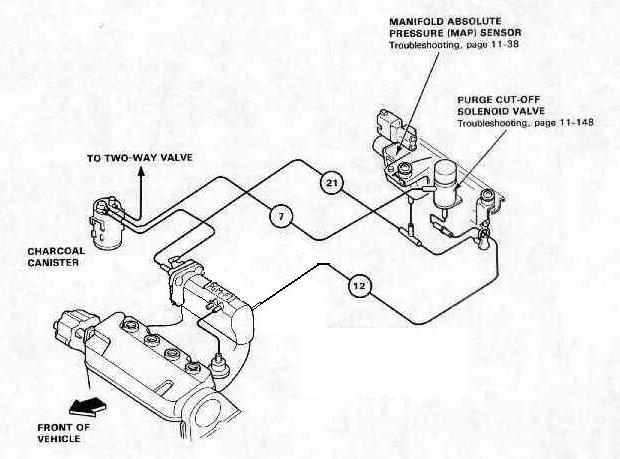
These older EVAP systems can still be overwhelmed. With hard working AC, and 110* summer temps, I typically get fumes coming out of the fresh air port on the canister. This is why they went to the sealed, pressure monitored systems for OBD2.
Here is the diagram for the Si. Purge solenoid and map sensor are on the fire wall. The line going to the tank is labeled "To two-way valve" because there is a 2-way valve on the fuel tank.
These older EVAP systems can still be overwhelmed. With hard working AC, and 110* summer temps, I typically get fumes coming out of the fresh air port on the canister. This is why they went to the sealed, pressure monitored systems for OBD2.

Honda-Tech Member
Joined: Jul 2024
Posts: 5
Likes: 0
Re: Should these 2 connect?
You can, you absolutely can. The reason you can is because that is VENTURY vacuum not direct engine vacuum, big difference.
That port only sees vacuum ( about 5 in/hg) when the butterfly is open to no more than 5 degrees. Beyond that, vacuum drops out. Also , no vacuum when the throttle is closed and no vacuum when accelerating. So it's the perfect port for sucking fuel vapors into the engine when you are cruising.
This would not work if the port had direct engine vacuum where you get upwards of 20 in/hg of vacuum on a very constant rate.
That port only sees vacuum ( about 5 in/hg) when the butterfly is open to no more than 5 degrees. Beyond that, vacuum drops out. Also , no vacuum when the throttle is closed and no vacuum when accelerating. So it's the perfect port for sucking fuel vapors into the engine when you are cruising.
This would not work if the port had direct engine vacuum where you get upwards of 20 in/hg of vacuum on a very constant rate.

Thread
Thread Starter
Forum
Replies
Last Post
si90rex
Honda Civic / Del Sol (1992 - 2000)
1
May 4, 2011 07:19 PM
dgn1978
Honda CRX / EF Civic (1988 - 1991)
5
Jul 13, 2003 02:44 PM