


At what point is a twin scroll setup needed?


Thread Starter
Honda-Tech Member
Joined: Dec 2004
Posts: 2,776
Likes: 0
From: Halifax, NS Canada
 At what point is a twin scroll setup needed?
Just a quick question for the people that have twin scroll turbo/manifold setups. At what point is does a twin really become the only option?
What are the higher HP/boost levels on a single 44mm wastegate setup?
I sold my old topmount and I was thinking about pickin up a full-race twin topmount. If I do, that means changing up my exhaust housing as well on my PT67.
Im looking to make around 650whp next year.
Thoughts on the topic? experiences?
What are the higher HP/boost levels on a single 44mm wastegate setup?
I sold my old topmount and I was thinking about pickin up a full-race twin topmount. If I do, that means changing up my exhaust housing as well on my PT67.
Im looking to make around 650whp next year.
Thoughts on the topic? experiences?

Honda-Tech Member
Joined: Dec 2008
Posts: 365
Likes: 0
Re: At what point is a twin scroll setup needed?
high hp isnt the problem for single gates, its low boost. the only reason to run dual is if you definately want to run a divided exhaust housing/manifold or if you want to run very low boost or have boost creep problems. your PT67 may or may not have problem with boost creep like your 35r did. if you are starting on a fresh new setup though why not. i had boost creep problems on two of my old 35r setups, and another 30r setup so this time around i built a similar motor, and just went with a divided t4 gt35r setup with twin tial 38mm vband wastegates. the setup holds 10psi 388whp and would hold even lower with smaller wastegate springs, and spools faster than my old gt30r setup, and makes more power. in the end you can get the best of both worlds, spool and power production, with no boost creep. this all comes at a small price though. its about 125 bucks more for 2x38mm + little more for the manifold vs 1x44mm.
its up to you, but i am very happy with the divided setup and with the divided t4 it gives me many options for future upgrades for more power.
its up to you, but i am very happy with the divided setup and with the divided t4 it gives me many options for future upgrades for more power.
Thread Starter
Honda-Tech Member
Joined: Dec 2004
Posts: 2,776
Likes: 0
From: Halifax, NS Canada
Re: At what point is a twin scroll setup needed?
I had the PT67 on my old manifold and it was holding 10psi @ 380whp no problem.. (ran into issues and couldnt go higher)
So I really dont NEED to run a twin scroll setup to reach my goals
So I really dont NEED to run a twin scroll setup to reach my goals


Junior Member
Joined: Jan 2007
Posts: 186
Likes: 0
From: colorado
Re: At what point is a twin scroll setup needed?
everyone on here gets flamed for using the term "twin scroll", yet full race is the first place i can remember advertising "twin scroll", and to this day still do.kinda funny huh?
Trending Topics

Honda-Tech Member
Joined: Jul 2003
Posts: 550
Likes: 0
From: magdeburg, saxony, germany
Re: At what point is a twin scroll setup needed?
And what do you guys think about the new divided Garrett T3 housings. They seem to be available in 0.82 and 1.06A/R wouldn´t they produce an awsome spoolup?
For example a Gt3076R single turbine housing vs a Gt3076R divided turbine housing...
For example a Gt3076R single turbine housing vs a Gt3076R divided turbine housing...



Honda-Tech Member
Joined: Jan 2008
Posts: 2,611
Likes: 1
From: Dinwiddie, VA, USA

Honda-Tech Member
Joined: Mar 2007
Posts: 1,116
Likes: 0
From: chester, va, united states

Honda-Tech Member
Joined: Feb 2005
Posts: 171
Likes: 0
From: Columbus, Ohio, USA
Re: At what point is a twin scroll setup needed?
Twin scroll or divided (turbine) housing are one and the same.
Developed in the F1 turbo era to improve exhaust flow, i.e. better VE.
The volutes (scrolls) keep the exhaust pulses seperated until they reach the inducer of the exhaust wheel. On a typical 4 cylinder the exhaust ports of cylinders 1 & 4 are grouped with 2 & 3 with a firing order of 1-3-4-2.
Think of it as everyone leaving a crowded room in an orderly fashion rather than everyone trying to hit the door at the same time.
It works and has a coolness factor to it but it's not the be-all, end-all. Like everything else it has it's pro's and con's.
Developed in the F1 turbo era to improve exhaust flow, i.e. better VE.
The volutes (scrolls) keep the exhaust pulses seperated until they reach the inducer of the exhaust wheel. On a typical 4 cylinder the exhaust ports of cylinders 1 & 4 are grouped with 2 & 3 with a firing order of 1-3-4-2.
Think of it as everyone leaving a crowded room in an orderly fashion rather than everyone trying to hit the door at the same time.
It works and has a coolness factor to it but it's not the be-all, end-all. Like everything else it has it's pro's and con's.

 Re: At what point is a twin scroll setup needed?
Twin scroll or divided (turbine) housing are one and the same.
Developed in the F1 turbo era to improve exhaust flow, i.e. better VE.
The volutes (scrolls) keep the exhaust pulses seperated until they reach the inducer of the exhaust wheel. On a typical 4 cylinder the exhaust ports of cylinders 1 & 4 are grouped with 2 & 3 with a firing order of 1-3-4-2.
Think of it as everyone leaving a crowded room in an orderly fashion rather than everyone trying to hit the door at the same time.
It works and has a coolness factor to it but it's not the be-all, end-all. Like everything else it has it's pro's and con's.
Developed in the F1 turbo era to improve exhaust flow, i.e. better VE.
The volutes (scrolls) keep the exhaust pulses seperated until they reach the inducer of the exhaust wheel. On a typical 4 cylinder the exhaust ports of cylinders 1 & 4 are grouped with 2 & 3 with a firing order of 1-3-4-2.
Think of it as everyone leaving a crowded room in an orderly fashion rather than everyone trying to hit the door at the same time.
It works and has a coolness factor to it but it's not the be-all, end-all. Like everything else it has it's pro's and con's.
Honda-Tech Member
Joined: Feb 2005
Posts: 171
Likes: 0
From: Columbus, Ohio, USA
Re: At what point is a twin scroll setup needed?
Ah, I see.
So... it's like you, the Shodan, are an *** but not all asses are you! Got it.
Get off your high horse for ALL practical purposes on this or ANY other automotive enthususiast site they ARE the same. Sure... wanna find an exception have at it but look at the big picture or head back to the college lecture hall where you can correct everyone and feel superior.
Your follow up corrective grand standing post will just certify the point. (wink)
So... it's like you, the Shodan, are an *** but not all asses are you! Got it.
Get off your high horse for ALL practical purposes on this or ANY other automotive enthususiast site they ARE the same. Sure... wanna find an exception have at it but look at the big picture or head back to the college lecture hall where you can correct everyone and feel superior.
Your follow up corrective grand standing post will just certify the point. (wink)
Re: At what point is a twin scroll setup needed?
Ah, I see.
So... it's like you, the Shodan, are an *** but not all asses are you! Got it.
Get off your high horse for ALL practical purposes on this or ANY other automotive enthususiast site they ARE the same. Sure... wanna find an exception have at it but look at the big picture or head back to the college lecture hall where you can correct everyone and feel superior.
Your follow up corrective grand standing post will just certify the point. (wink)
So... it's like you, the Shodan, are an *** but not all asses are you! Got it.
Get off your high horse for ALL practical purposes on this or ANY other automotive enthususiast site they ARE the same. Sure... wanna find an exception have at it but look at the big picture or head back to the college lecture hall where you can correct everyone and feel superior.
Your follow up corrective grand standing post will just certify the point. (wink)
No, no.. go ahead and work that off. Get it out of your system. This'll just get locked and then no one will learn anything if this thread continues on THIS course.

Honda-Tech Member
Joined: Feb 2009
Posts: 1,204
Likes: 0
Re: At what point is a twin scroll setup needed?
Ah, I see.
So... it's like you, the Shodan, are an *** but not all asses are you! Got it.
Get off your high horse for ALL practical purposes on this or ANY other automotive enthususiast site they ARE the same. Sure... wanna find an exception have at it but look at the big picture or head back to the college lecture hall where you can correct everyone and feel superior.
Your follow up corrective grand standing post will just certify the point. (wink)
So... it's like you, the Shodan, are an *** but not all asses are you! Got it.
Get off your high horse for ALL practical purposes on this or ANY other automotive enthususiast site they ARE the same. Sure... wanna find an exception have at it but look at the big picture or head back to the college lecture hall where you can correct everyone and feel superior.
Your follow up corrective grand standing post will just certify the point. (wink)

Honda-Tech Member
Joined: Apr 2010
Posts: 183
Likes: 0
From: OC, CA
Re: At what point is a twin scroll setup needed?
I see. I didn't make a comment to try and make you stupid, but it seems as though you got off that short-yellow school bus early today, eh? Look, you wanna try and distract everyone with personal attacks at me, after I've said nothing negative against you,that's cool, I got it. (You've got nothing better to do I suppose...) Its better to do that and not help those that may not understand the concept and perpetuate something incorrect so that when they go to the other professionals, they sound like they don't know what they're talking about instead of being adult about it. *wink*. (I think you just certified my point)
No, no.. go ahead and work that off. Get it out of your system. This'll just get locked and then no one will learn anything if this thread continues on THIS course.
No, no.. go ahead and work that off. Get it out of your system. This'll just get locked and then no one will learn anything if this thread continues on THIS course.


Honda-Tech Member
Joined: Apr 2009
Posts: 71
Likes: 0
From: Tempe, AZ
Re: At what point is a twin scroll setup needed?
Just for reference, Mazda used what they called a "twin scroll" turbo that had different ARs for each scroll back in the '80s. They used an open manifold along with a valve to make it act like a variable turbo...similar to the quick spool valves. Then they switched to what they call "twin independent scroll turbo" which resembles the commonly used divided housing...so they can differ. Although, im not sure if divided housings with different sized scrolls are still used? Maybe this is why the name has been adopted???
RX7 twin scroll top, twin independent scroll bottom

RX7 twin scroll top, twin independent scroll bottom
Re: At what point is a twin scroll setup needed?
Similar to where Paddington Bear could have received his information
http://www.modified.com/tech/modp-09...ign/index.html
There is a small difference the design from what a divided housing is, to one of a true "twin scroll" design. What is most popular with the Evolution that we're attempting to bring to the Honda world is a bit altered than the one being described and shown from the article above. The article is correct about the streamlining process of exhaust pulses so that there is a more efficient use in the exhaust stream for LARGER turbos (those that are tangential or that utilize a divided housing in .68, .96, 1.00, 1.15, and 1.25 from Garrett, Precision, and Turbonetics). For these divided housings, the volute (or "scroll") sizes are of equal size and dimension in which the divider goes about most of the way of the introduction into the volutes themselves. Once it reaches a certain point.
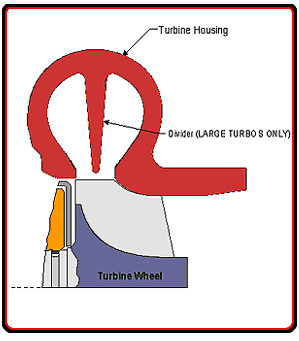
What everyone is all giddy about is the design that is mainly used on the mitsubishi Evolution series from The Evolution 7 to 9. the purpose of that design was so that it would act a lot like a turbo that has a Variable Vein (VNT) platform without the physical solenoid needed to change the characteristics of how the airflow was converted to pressurized air. On smaller turbo applications, the design was made so that it could be very responsive at lower rpms (so it makes a smaller engine act like a larger one), and at the same time allow enough exhaust energy to give the car additional top end power when called for. The difference? The volutes are of different sizes in which the divider goes much further down stream of the turbine inlet; not the same size as in the divided housings that are used on the larger platforms.
I'm sorry I don't have a cross-section of the two to show to give better imagery, but here's the differences in inlets themselves.
Here's the smaller twin scroll Mitsubishi inlet

Here's the standard divided T4 turbine Housing inlet similar to what was shown from the Kouki and Zenki models above

So in essence, what Alfa Turbo said wasn't completely wrong, it was simply inaccurate. It takes a "divided" housing in order to start the creation of a "twin scroll" designed turbine housing, but that simply being divided is a (watch out, big word here... might have to give a lecture later.j/k..) necessity, but it alone isn't (uh, oh, another big word.. LOL) sufficient for it to be a "twin scroll".
What happens? So what if the name is used wrong you ask? This means that people will get these larger standard T4 divided housings that contain these much larger exhaust wheels and housings thinking it will behave the same way as though it were used in a Mitsubishi, not knowing that its not nearly as transiently responsive as it should be. That incorrect claim may make someone waste money on a new or used turbo that just wasn't there to fit their needs or their goals. So, incorrect use of nomenclature as cool as it is and understood as it may be in the enthusiast world, may translate to someone getting the wrong damn turbo.. plain and simple.
Sorry for the book, folks... Guess I need to run to another lecture hall.. LMAO.
http://www.modified.com/tech/modp-09...ign/index.html
There is a small difference the design from what a divided housing is, to one of a true "twin scroll" design. What is most popular with the Evolution that we're attempting to bring to the Honda world is a bit altered than the one being described and shown from the article above. The article is correct about the streamlining process of exhaust pulses so that there is a more efficient use in the exhaust stream for LARGER turbos (those that are tangential or that utilize a divided housing in .68, .96, 1.00, 1.15, and 1.25 from Garrett, Precision, and Turbonetics). For these divided housings, the volute (or "scroll") sizes are of equal size and dimension in which the divider goes about most of the way of the introduction into the volutes themselves. Once it reaches a certain point.
What everyone is all giddy about is the design that is mainly used on the mitsubishi Evolution series from The Evolution 7 to 9. the purpose of that design was so that it would act a lot like a turbo that has a Variable Vein (VNT) platform without the physical solenoid needed to change the characteristics of how the airflow was converted to pressurized air. On smaller turbo applications, the design was made so that it could be very responsive at lower rpms (so it makes a smaller engine act like a larger one), and at the same time allow enough exhaust energy to give the car additional top end power when called for. The difference? The volutes are of different sizes in which the divider goes much further down stream of the turbine inlet; not the same size as in the divided housings that are used on the larger platforms.
I'm sorry I don't have a cross-section of the two to show to give better imagery, but here's the differences in inlets themselves.
Here's the smaller twin scroll Mitsubishi inlet
Here's the standard divided T4 turbine Housing inlet similar to what was shown from the Kouki and Zenki models above
So in essence, what Alfa Turbo said wasn't completely wrong, it was simply inaccurate. It takes a "divided" housing in order to start the creation of a "twin scroll" designed turbine housing, but that simply being divided is a (watch out, big word here... might have to give a lecture later.j/k..) necessity, but it alone isn't (uh, oh, another big word.. LOL) sufficient for it to be a "twin scroll".
What happens? So what if the name is used wrong you ask? This means that people will get these larger standard T4 divided housings that contain these much larger exhaust wheels and housings thinking it will behave the same way as though it were used in a Mitsubishi, not knowing that its not nearly as transiently responsive as it should be. That incorrect claim may make someone waste money on a new or used turbo that just wasn't there to fit their needs or their goals. So, incorrect use of nomenclature as cool as it is and understood as it may be in the enthusiast world, may translate to someone getting the wrong damn turbo.. plain and simple.
Sorry for the book, folks... Guess I need to run to another lecture hall.. LMAO.

Honda-Tech Member


Joined: Nov 2007
Posts: 5,282
Likes: 21
From: Indiana
