


Intercooler fin density


 Intercooler fin density
***Deleted original pic and added comparison pics between Treadstone and Greddy***
I just bought a Treadstone/Vecco 10.5" x 24" x 3.5" bar and plate intercooler. It's very heavy, but seems well built. My problem with it is the fin density. Although this is a pretty large intercooler, I wonder how efficient it is when compared to a tube and fin Greddy Type 24 with more closely looped fins on the outside and especially inside the intercooler. I own both intercoolers, and they're brand new. The Greddy core is thinner, almost the same length, slightly taller, and much lighter. After taking pics of the Greddy, the difference in the outer fin density isn't as substantial as I thought, but inner fin density is significantly better and more intricate on the Greddy. Let me know what you think.
Treadstone outer fins

Greddy outer fins

Treadstone inlet

Greddy inlet

Treadstone inner fins

Greddy inner fins

Modified by Sprockets at 8:28 PM 10/20/2006
I just bought a Treadstone/Vecco 10.5" x 24" x 3.5" bar and plate intercooler. It's very heavy, but seems well built. My problem with it is the fin density. Although this is a pretty large intercooler, I wonder how efficient it is when compared to a tube and fin Greddy Type 24 with more closely looped fins on the outside and especially inside the intercooler. I own both intercoolers, and they're brand new. The Greddy core is thinner, almost the same length, slightly taller, and much lighter. After taking pics of the Greddy, the difference in the outer fin density isn't as substantial as I thought, but inner fin density is significantly better and more intricate on the Greddy. Let me know what you think.
Treadstone outer fins
Greddy outer fins
Treadstone inlet
Greddy inlet
Treadstone inner fins
Greddy inner fins
Modified by Sprockets at 8:28 PM 10/20/2006


Honda-Tech Member
Joined: May 2002
Posts: 15,814
Likes: 8
From: Dallas, TX, USA
Re: Intercooler fin density (Sprockets)
Generally, the more dense the "fins" are, the better the intercooler is going to cool. They are there to break up the air more and help it cool. In a low boost application there is generally not much heat to try and get rid of, so an intercooler with less dense fins will have slightly less pressure drop because of less restriction. If you look at Greddy stuff, they have both styles, one for high boost applications and one for low boost apps.

Honda-Tech Member
Joined: Jan 2005
Posts: 7,015
Likes: 7
From: b00sting my D16s, SoWis, USA
Re: Intercooler fin density (tony1)
To add to tony's statement, there's also a point of diminishing returns on fin density, along with core thickness. I don't know what it is  , but I do know the reason is pressure drop. You want a suffecient velocity of air past the fins - too many or too thick, and turbulance isn't doing its job. Sizing an intercooler isn't unlike sizing a turbo - having a 600hp core on a 200whp daily driver just has no point.
What also matters is whats inside. If its a huge IC or high boost, you'd want lots of fins, otherwise you want a bit better flow.
, but I do know the reason is pressure drop. You want a suffecient velocity of air past the fins - too many or too thick, and turbulance isn't doing its job. Sizing an intercooler isn't unlike sizing a turbo - having a 600hp core on a 200whp daily driver just has no point.What also matters is whats inside. If its a huge IC or high boost, you'd want lots of fins, otherwise you want a bit better flow.

Honda-Tech Member
Joined: Jan 2000
Posts: 4,468
Likes: 0
From: Carbon Fiber Land, USA
Re: Intercooler fin density (HiProfile)
I have been testing some intercoolers, specifically bar and plate intercoolers lately. I think you can actually have too dense of a intercooler, for example my Precision 750. In some applications the Precision 750 does not allow enough air to travel into the engine bay causing the engine to run a lil hot. When switichin over to a same size tube and fin engine temps decrease about 20 degrees. In my opinion I think there core was designed primarily for race use rather than both driveability and performance. A lot of people have no problem running them in a street applications, but I don't think it was designed to perform well in those conditions. There are quite a few websites that have done a lil more intesive test which back up what I have found out myself.
I have tested a few bar and plate cores very similar to yours and datalogs show no decrease in performance between the 3 intercoolers I have been testing.
So what I am saying is, you might actually benefit from the lesser denser core, but not sacrifice performance.
I have tested a few bar and plate cores very similar to yours and datalogs show no decrease in performance between the 3 intercoolers I have been testing.
So what I am saying is, you might actually benefit from the lesser denser core, but not sacrifice performance.

Trending Topics
Honda-Tech Member
Joined: Jan 2000
Posts: 4,468
Likes: 0
From: Carbon Fiber Land, USA
Re: Intercooler fin density (Sprockets)
Most of the good bar and plates have very similar internal fin design and density. That's the reason why I have not really seen any diminishing results. The only time I see diminishing results when testing the cheap ebay bar and plate cores. Yes they work, but damn, they truly do not compare to a real bar and plate core.
Re: Intercooler fin density (BodyKits NW)
Ok, pics have been updated with requested quarter for size comparison. This is for a 350-400whp or so street car running 93 octane only. Currently the car has a Greddy Type 31 making 335whp with a Precision SC44 .63 a/r. The intercooler piping is being upgraded from the 50mm pre-intercooler to 60mm post, to full 2.5" turbo to throttle body. The turbo is also being swapped out to a GT3076R .63 a/r.
BodyKits NW, I recently read your post about the Precision 750 you swapped out because of overheating. I've always been aware that a tube and fin allows air to flow past it much better than a bar and plate. However, I have a C&R 36mm core radiator w/SPAL fan. I also bought a 12" 1650cfm slim fan for my a/c. I don't think I'll have any problems. Then again, the stock temperature gauge doesn't tell much.
My reason for buying the Treadstone intercooler (yes, it's from Ebay), was because all the name brand bar and plate intercoolers have the end tank inlets and outlets right in the way of where my foglights go. I know they'll fit with the Greddy, but I wanted a bar and plate because they're supposed to cool better. One thing I'm curioius about though is if bar and plate is so good, then why does Full Race use tube and fin PWR intercoolers?
BodyKits NW, I recently read your post about the Precision 750 you swapped out because of overheating. I've always been aware that a tube and fin allows air to flow past it much better than a bar and plate. However, I have a C&R 36mm core radiator w/SPAL fan. I also bought a 12" 1650cfm slim fan for my a/c. I don't think I'll have any problems. Then again, the stock temperature gauge doesn't tell much.
My reason for buying the Treadstone intercooler (yes, it's from Ebay), was because all the name brand bar and plate intercoolers have the end tank inlets and outlets right in the way of where my foglights go. I know they'll fit with the Greddy, but I wanted a bar and plate because they're supposed to cool better. One thing I'm curioius about though is if bar and plate is so good, then why does Full Race use tube and fin PWR intercoolers?
Honda-Tech Member
Joined: Jan 2000
Posts: 4,468
Likes: 0
From: Carbon Fiber Land, USA
Re: Intercooler fin density (Sprockets)
That's a question your just going to have to ask them. I've ran the PWR stuff, and they are good quality cores.
As for your intercooler, that is basically the common internal finning that most ebay bar and plates have which we I have tested. I actually thought it might be a lil better than most, but the internal finning is basically generic with most of the cores I have seen from ebay and at the shop.
As for your intercooler, that is basically the common internal finning that most ebay bar and plates have which we I have tested. I actually thought it might be a lil better than most, but the internal finning is basically generic with most of the cores I have seen from ebay and at the shop.
Re: Intercooler fin density (BodyKits NW)
Nah, I'm not going to bother FR with questions unless I'm a customer. PWR is good AND tube and fin, and considering a company like FR sells them makes me wonder why so many people use bar and plate. I don't have the luxury of testing both of my intercoolers, so I need to make up my mind and get it tuned with the one I pick.
So, now that you see the internal fins on the Treadstone, is it worse than you thought?
So, now that you see the internal fins on the Treadstone, is it worse than you thought?

Honda-Tech Member
Joined: Jun 2004
Posts: 188
Likes: 0
From: TX
Re: Intercooler fin density (Sprockets)
http://www.are.com.au/techtalk...ofile
found this on here awhile back . i read through some of it and its pretty interesting.
hope this helps ....
....
found this on here awhile back . i read through some of it and its pretty interesting.
hope this helps
....
Re: Intercooler fin density (black98gsr-t)
Thank you, I've seen that before, but I think it's the best intercooler tech site on the internet. After taking a close look at the pictures, it seems like the Treadstone has the same core as the one they sell. Take a look:
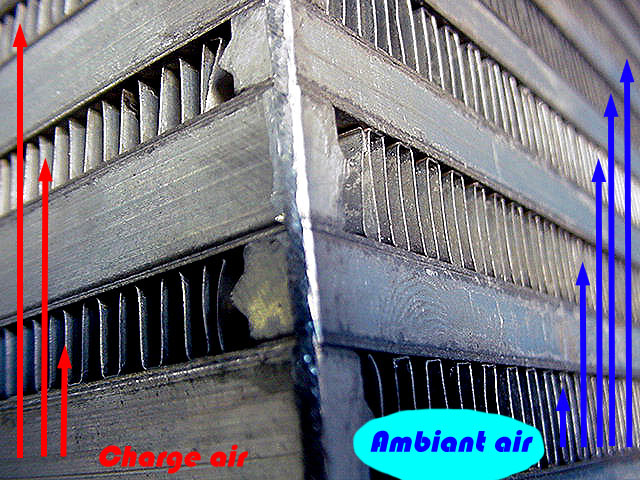
This image shows their core stacked on top of a Garrett. Although the fin density on the Garrett is better, they mention their core allows better flow to the radiator.
This image shows their core stacked on top of a Garrett. Although the fin density on the Garrett is better, they mention their core allows better flow to the radiator.
Honda-Tech Member
Joined: Jan 2000
Posts: 4,468
Likes: 0
From: Carbon Fiber Land, USA
Re: Intercooler fin density (Sprockets)
I think the pictues of the are.com of their cores is a lil deceiving. They are actually a lot more denser than the treadstone cores. I could be wrong, but I have looked at a lot of cores from many different manuf.
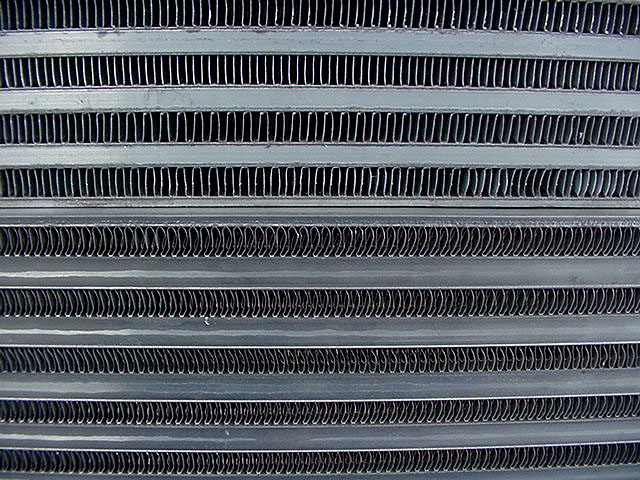
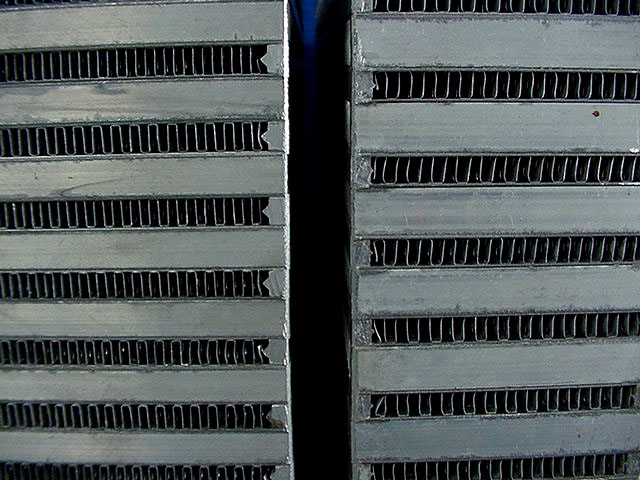
Here are some of the pictures of the core that I currently run on my car that were testing.
Same core size as my Precision 750

As you can see the internal finning is still pretty dense. Very similar to my Precision 750hp.

Here is a picture that shows the spacing as well as how the angle of picture shows as if the intercooler is not so dense. From this angle the intercooler looks like your typical ebay bar and plate or even the treadstone picture you posted. "look at the lower 2 rows in the picture, it looks like it is not very dense and just a square hole from this picture angle" But the picture above shows that the internal finning is actually pretty dense.

Now here is where it really differs is the outside finning. As you can see this is less dense than my precision 750 that I use to run. This allows for more air to travel to my engine bay as well as provide great performance. For a street application the finning I would say is perfect. It flows well, but at the same time does exactly what it needs to do.

Here are some of the pictures of the core that I currently run on my car that were testing.
Same core size as my Precision 750
As you can see the internal finning is still pretty dense. Very similar to my Precision 750hp.
Here is a picture that shows the spacing as well as how the angle of picture shows as if the intercooler is not so dense. From this angle the intercooler looks like your typical ebay bar and plate or even the treadstone picture you posted. "look at the lower 2 rows in the picture, it looks like it is not very dense and just a square hole from this picture angle" But the picture above shows that the internal finning is actually pretty dense.
Now here is where it really differs is the outside finning. As you can see this is less dense than my precision 750 that I use to run. This allows for more air to travel to my engine bay as well as provide great performance. For a street application the finning I would say is perfect. It flows well, but at the same time does exactly what it needs to do.

Honda-Tech Member
Joined: Sep 2002
Posts: 6,022
Likes: 0
From: tha East Coast
Re: Intercooler fin density (Sprockets)
[THIS IS ONLY MY .02CENTS, PLEASE DO NOT HATE ME FOR POSTING ALSO!]
Ok, you can continue...
I read a few posts and thought I'd give some insite too.
The purpose of a finned tube heat exchanger (also known as a "coil") is to isolate two different mediums so that they do not touch or mix together, and to transfer the heat from one medium to another.
To achieve heat transfer, there must be a difference in temperature between the two mediums (gas and/or liquid), a pathway made of materials that allows conduction of heat so it can convey from one location to another, and a means of exposing the heat to the gas or fluid medium. If any of these items are missing, heat transfer will not occur.
This is reflected in the basic relationship from which all heat transfer equations are derived:
Q = Amount of Heat Transferred Over Time (BTUs/hr)
U = Heat Transfer Coefficient (BTUs / ft2-°F-hr)
A = Area Available for Heat Transfer (ft2)
DT = Temperature Difference (°F)
Q = U A DT
Changing any one of these values affects Q (the amount of heat that is transferred). The following paragraphs review these basic values as related to heat transfer within coils.
U = Overall Heat Transfer Coefficient is affected by the thermal conductivity of the materials that the tubes and fins are made of, the viscosity and thermal conductivity of the two mediums and the velocities at which these mediums move through the coil. Medium velocity is important because a thin layer adheres to the rough surface of the metal thereby slowing the movement of the medium. This creates a laminar layer that insulates the bulk of the medium from touching the tube and/or fin surfaces. As a general rule, the faster the medium moves, the more turbulence is created, which breaks down this insulating laminar layer. The face area size of the coil and the number of coil tubes connected to the supply header (circuits) affects the velocity and the turbulence of the gas and/or liquid moving through the coil.
A = Heat Transfer Area of the fin and tube material exposed to the mediums. Air and gases are poor thermal conductors so more surface area is needed for heat transfer. Both sides of a single fin are exposed to the air or gas so when fins are stacked close together they create a very large amount of heat transfer surface area. It is important to have good metal contact between the fins and the tubes because without it there is not a thermal pathway for heat to move.
DT = The temperature difference between the two mediums. "U" has to do with conveying (conduction and convection) the heat and "A" relates to exposure to the heat. But the DT between the mediums as they move through the coil is the driving force that makes the heat want to move from one medium to the other.
Ok, you can continue...
I read a few posts and thought I'd give some insite too.
The purpose of a finned tube heat exchanger (also known as a "coil") is to isolate two different mediums so that they do not touch or mix together, and to transfer the heat from one medium to another.
To achieve heat transfer, there must be a difference in temperature between the two mediums (gas and/or liquid), a pathway made of materials that allows conduction of heat so it can convey from one location to another, and a means of exposing the heat to the gas or fluid medium. If any of these items are missing, heat transfer will not occur.
This is reflected in the basic relationship from which all heat transfer equations are derived:
Q = Amount of Heat Transferred Over Time (BTUs/hr)
U = Heat Transfer Coefficient (BTUs / ft2-°F-hr)
A = Area Available for Heat Transfer (ft2)
DT = Temperature Difference (°F)
Q = U A DT
Changing any one of these values affects Q (the amount of heat that is transferred). The following paragraphs review these basic values as related to heat transfer within coils.
U = Overall Heat Transfer Coefficient is affected by the thermal conductivity of the materials that the tubes and fins are made of, the viscosity and thermal conductivity of the two mediums and the velocities at which these mediums move through the coil. Medium velocity is important because a thin layer adheres to the rough surface of the metal thereby slowing the movement of the medium. This creates a laminar layer that insulates the bulk of the medium from touching the tube and/or fin surfaces. As a general rule, the faster the medium moves, the more turbulence is created, which breaks down this insulating laminar layer. The face area size of the coil and the number of coil tubes connected to the supply header (circuits) affects the velocity and the turbulence of the gas and/or liquid moving through the coil.
A = Heat Transfer Area of the fin and tube material exposed to the mediums. Air and gases are poor thermal conductors so more surface area is needed for heat transfer. Both sides of a single fin are exposed to the air or gas so when fins are stacked close together they create a very large amount of heat transfer surface area. It is important to have good metal contact between the fins and the tubes because without it there is not a thermal pathway for heat to move.
DT = The temperature difference between the two mediums. "U" has to do with conveying (conduction and convection) the heat and "A" relates to exposure to the heat. But the DT between the mediums as they move through the coil is the driving force that makes the heat want to move from one medium to the other.
BodyKits NW, it looks like the outer fin density on your new intercooler is similar to the Greddy, but the main difference I see with the internal fins vs. Treadstone is the fact that your intercooler has offset fins, whereas the Treadstone just has what looks to be one solid piece with holes punched in it. The spacing and shape of the fins look similar, though. What kind of intercooler is that, btw?
JDMs1eeper, that makes sense. Thanks for posting!
JDMs1eeper, that makes sense. Thanks for posting!

Thread
Thread Starter
Forum
Replies
Last Post
cueballsi
Classifieds: Forced Induction
5
May 3, 2005 11:31 AM
slwazgsr
Forced Induction
3
Sep 7, 2002 09:17 AM
750, brakeup, d16z6, density, fin, heavy, intercooler, intercoolers, pwr, review, test, testing, threadstone, treadstone, turbo
