


2013 OGS SFWD Class Rules


Honda-Tech Member
Joined: Jan 2004
Posts: 3,862
Likes: 1
From: MOBTOWN,MD
 Re: 2013 OGS SFWD Class Rules


Honda-Tech Member
Joined: Apr 2001
Posts: 1,974
Likes: 0
From: elizabeth, nj, usa
Re: 2013 OGS SFWD Class Rules
Its a valid point because i know of a all motor racer whos also not on fb who had me email him the rules. Kinda surprised there wasnt a Nyce1s press release there usually is.

Honda-Tech Member
Joined: Sep 2010
Posts: 333
Likes: 0
Re: 2013 OGS SFWD Class Rules
WTF!!!!!!! so basically what i got out of this is that they want to make us slower.WTF im not a 8 9 or 10 sec drag racer but i kow this is gonna **** people off.
arent we FWD, thats a disadvantage as it is WTF
arent we FWD, thats a disadvantage as it is WTF

Honda-Tech Member
Joined: Apr 2001
Posts: 16,905
Likes: 3
From: Lansdale, PA


Honda-Tech Member
Joined: Nov 2007
Posts: 347
Likes: 2
Re: 2013 OGS SFWD Class Rules
I emailed ogs and pm'ed roger about this to see if anything is gonna change but no response yet... hopefully someone can reach out to the ogs crew so they can clear this up...
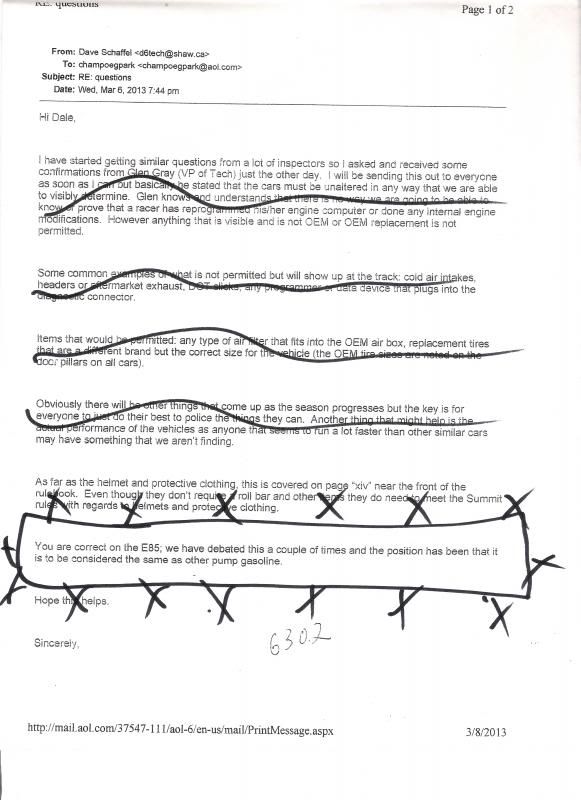
 Re: 2013 OGS SFWD Class Rules
ive got a couple racer friends that got so fed up with the bs online they got rid of all the forums and fb. they get all there info on rules and races thru me lol! cant really blame them tho.



 Re: 2013 OGS SFWD Class Rules
The information everyone should be after is at http://www.hondaday.com/blog/eventinfo/ if they need more information than is there, there are methods to contact the OGS staff to get more details
Honda-Tech Member
Joined: Jan 2004
Posts: 3,862
Likes: 1
From: MOBTOWN,MD
Re: 2013 OGS SFWD Class Rules
I can blame anyone that doesn't take it upon themselves to ensure they are informed with the most accurate information. The only way to do that is to go straight to the horses mouth. No one but the Hondaday/OGS staff is going to have the 100% accurate information. No one needs FaceBook, or Forums in order to stay current.
The information everyone should be after is at http://www.hondaday.com/blog/eventinfo/ if they need more information than is there, there are methods to contact the OGS staff to get more details
The information everyone should be after is at http://www.hondaday.com/blog/eventinfo/ if they need more information than is there, there are methods to contact the OGS staff to get more details
IMO if youre a promoter and you want racers to KNOW what your rules are post the ******* RULES ON EVERY FORUM. Why have EVERYONE confused about WTF is going on? Make them uniform and post them EVERYWHERE! So far I have seen 3 sets of rules from the same promoter....

 Re: 2013 OGS SFWD Class Rules
Those rules dont match all the other rules that have been posted....
IMO if youre a promoter and you want racers to KNOW what your rules are post the ******* RULES ON EVERY FORUM. Why have EVERYONE confused about WTF is going on? Make them uniform and post them EVERYWHERE! So far I have seen 3 sets of rules from the same promoter....
IMO if youre a promoter and you want racers to KNOW what your rules are post the ******* RULES ON EVERY FORUM. Why have EVERYONE confused about WTF is going on? Make them uniform and post them EVERYWHERE! So far I have seen 3 sets of rules from the same promoter....
I could be wrong, but my limited understanding is that the promoter here has only ever released 1 set of rules. Other people have posted rules that somewhere along the way have been changed, but the promoters officil rules have only ever been posted once.
As far as posting them on every forum, you must have more spare time than anyone else I know. If I was the promoter, I wouldn't have time to post on over 100 forums. I'd put them on my site, and explain to racers that it's their responsibility to go there to get them, same as the NHRA does.
Honda-Tech Member
Joined: Jan 2004
Posts: 3,862
Likes: 1
From: MOBTOWN,MD
Re: 2013 OGS SFWD Class Rules
I could be wrong, but my limited understanding is that the promoter here has only ever released 1 set of rules. Other people have posted rules that somewhere along the way have been changed, but the promoters officil rules have only ever been posted once.
As far as posting them on every forum, you must have more spare time than anyone else I know. If I was the promoter, I wouldn't have time to post on over 100 forums. I'd put them on my site, and explain to racers that it's their responsibility to go there to get them, same as the NHRA does.
As far as posting them on every forum, you must have more spare time than anyone else I know. If I was the promoter, I wouldn't have time to post on over 100 forums. I'd put them on my site, and explain to racers that it's their responsibility to go there to get them, same as the NHRA does.
Also show me where OGS has posted anything in 2013..
The link that YOU posted isnt the same as the OP. So what is it????
Jason Miller has the time......
Last edited by nonvtecallmotor; Mar 29, 2013 at 01:29 PM.

Honda-Tech Member
Joined: Jan 2004
Posts: 3,862
Likes: 1
From: MOBTOWN,MD
 Re: 2013 OGS SFWD Class Rules
https://www.facebook.com/OGS1320
Originally Posted by nonvtecallmotor
Also show me where OGS has posted anything in 2013..
The link that YOU posted isnt the same as the OP. So what is it????
The link that YOU posted isnt the same as the OP. So what is it????
Originally Posted by nonvtecallmotor
Jason Miller has the time......
That's awesome for Jason.
Honda-Tech Member
Joined: Jan 2004
Posts: 3,862
Likes: 1
From: MOBTOWN,MD
Re: 2013 OGS SFWD Class Rules
Actually you can. I've verified that this is visible on 4 different PCs/Macs and 2 iPad/iPhones with no facebook account.
https://www.facebook.com/OGS1320
Why does whether or not OGS has posted anything on here matter? They have the information on their facebook page, and if that's how they choose to disseminate the information, why is that so bad?
That's awesome for Jason.
https://www.facebook.com/OGS1320
Why does whether or not OGS has posted anything on here matter? They have the information on their facebook page, and if that's how they choose to disseminate the information, why is that so bad?
That's awesome for Jason.
Do those rules match the Honda Day that you posted? I dont thinks so!
They can promote there races however they want..
I'm going to stay far away from NJ this year... and my car fits the rules 100%.... I made almost every race in years past.... I'm not the only one that feels this way.. Maybe you will fill my spot...
Last edited by nonvtecallmotor; Mar 31, 2013 at 11:36 AM.
Re: 2013 OGS SFWD Class Rules
Are you blocked from facebook? There's no reason you shouldn't be able to see that. And as far you staying away from NJ, that's your choice. No one is trying to stop you from attending, or even trying to force you to go. Just making sure that the information is factual. There's no need for drama.
Honda-Tech Member
Joined: Jan 2004
Posts: 3,862
Likes: 1
From: MOBTOWN,MD
Re: 2013 OGS SFWD Class Rules
Are you blocked from facebook? There's no reason you shouldn't be able to see that. And as far you staying away from NJ, that's your choice. No one is trying to stop you from attending, or even trying to force you to go. Just making sure that the information is factual. There's no need for drama.
Why would I want to race at an event that has a few sets of rules and wont openly set them straight? Is that NOT a fact?
YOU posted 2 links to OGS rules that DONT MATCH..
Pretty ******* confusing or was it done on purpose?

Honda-Tech Member
Joined: Sep 2009
Posts: 718
Likes: 0
From: Charlotte,NC

Moderator
Joined: Feb 2008
Posts: 3,264
Likes: 2
From: queens, ny
Re: 2013 OGS SFWD Class Rules
These are the rules that I found dierectly from there site.
SFWD Rules
Minimum Weights (only at Triple Crown series events, all other rules are always in effect)
67mm and smaller-2200 lbs
Up to 72 mm-2400 lbs
Non billet wheel deduct 100 lbs
*67mm and smaller turbos with larger than 83mm turbine wheel will be subject to 72 mm weight minimums.
150lb penalty for Nitrous (cars with any nitrous equipment ie. Bottles, lines, nozzles, etc will incur penalty)
50lb penalty for Ethanol Based Fuel
CLASS REQUIREMENTS
ENGINE:
Engine swaps (e.g., B Series with B Series) permitted; however, OEM engine mounting points must be utilized. Engine swap (e.g., B Series to a K Series) permitted provided engine swap kits are commercially available and approved by OGS in advance.
Engine must be from same manufacturer as body. Engine must be overhead-cam, production-based design.
Maximum two power adders. Redundant power adders, such as a dual stage nitrous system, will be counted as one power adder. Engine must be in stock, transverse configuration.
Dry sump oil system or external oil pumps prohibited unless OEM equipped and engine is using complete OEM oiling system.
ENGINE CONTAINMENT DEVICE:
Engine diaper or catch-pan device to capture oil and debris in event of engine failure mandatory. Where exhaust header passes directly under oil pan, two-piece diaper may be utilized. FWD vehicles using OEM manual-transmission case must also have such a device for the transmission, to capture oil and debris in
event of transmission failure. If catch-pan device is used, catch pan must employ minimum 2-inch-high lips on all sides. Lips must be coved or curved inward, so as to contain oil in pan. Catch pan must cover entire area below engine/transmission. Catch pan must extend from radiator support to firewall and from framerail to framerail. In all cases, lips must be adequate enough to contain oil in the catch pan.
Should a competitor spill excessive oil from the catch pan and debris onto the track, he or she may be disqualified from further competition at the sole and absolute discretion of the event director until catch pan is upgraded, regardless of height of pan lips or pan design.
EXHAUST:
Not required.
FUEL:
NHRA-accepted racing gasoline permitted. Injection of any other fuel prohibited (e.g., methanol and or water injection). See General Regulations 1:6.
E85 is permitted with no alterations from the manufacturers. Any modifications to the ethanol from the manufacturer specs (eg. origin, oxygenation, gravity) will be disqualified from the event. Competitor must declare which fuel will be used during the event and must not deviate from it.
FUEL SYSTEM:
Fuel cell OK. NHRA guidelines MUST be followed. Must be in stock location or trunk area. No other container, fuel cell, bottle, etc. may contain any type of fuel. All cars must be equipped with a drain valve located on return side of fuel rail to facilitate removal of fuel samples for fuel-check purposes. See NHRA General Regulations 1:5.
LIQUID OVERFLOW:
See NHRA General Regulations 1:7.
NITROUS OXIDE:
Commercially available nitrous oxide permitted, including for supercharged and turbocharged engines. Nitrous bottle(s) in driver compartment must be equipped with a relief valve and vented outside of driver’s compartment. Bottle(s) must be stamped with a DOT-1800-pound rating and permanently mounted (no hose clamps or tie wraps). Hoses from bottle(s) to solenoid must be high-pressure steel-braided or NHRA-accepted hoses. Commercially available, thermostatically controlled, blanket-type
warmer accepted. Any other external heating of bottle(s) prohibited.
SUPERCHARGER, TURBOCHARGER:
Permitted. Restricted to a single turbocharger.
Turbocharger must utilize a turbine housing inlet flange commonly referred to as a
T04. The turbine housing inlet flange may be smaller, but may
never exceed the T04 dimensions in any direction.
Limited to a maximum 72mm turbo, where the maximum compressor housing
inducer diameter is 72.78mm (67mm-67.9 maximum), measured at the point where the
leading edge of the compressor wheel meets the housing. Compressor wheel inducer diameter not to exceed this value, and contours of wheel must not be “stepped, notched, or clipped”; e.g., the contours must be continuous features from the inducer to the wheel exducer.
Exducer limited to 102mm for billet wheels, 105mm for cast wheels. 67mm and smaller turbos limited to 94mm maximum exducer. To further clarify the maximum exducer wheel size applies to the entire size of the wheel. No part of the wheel may be larger than the exducer limits specified.
Exotic material wheels prohibited. Modified turbo housing is not allowed.
Intercooler must be air to air only.
CO2 or NOS is permitted as a cooling medium in place of water in liquid intercooler, but will count
as a second power adder; i.e., if CO2 or NOS is used as an intercooler medium, NOS may NOT be used in the engine. OEM liquid intercooler permitted only if OEM engine and OEM power
adder are used. Racing-type screw supercharger prohibited.
FLYWHEEL SHIELD:
All cars using a clutch and running quicker than 11.49 or faster than 135 mph must be equipped with a flywheel shield made of 1/4-inch-minimum-thickness steel plate. Shield must surround the bellhousing completely except for area of flywheel shield adjacent to differential and axle shaft. Shield may be multi-piece with pieces bolted together using minimum 3/8-inch-diameter Grade 5 or M10 class 8.8 bolts; may be attached to engine and/or bellhousing.
In lieu of shield, a blanket meeting SFI Spec 4.1, completely surrounding the bellhousing, is permitted. See NHRA General Regulations 2:5, 2:6, 2:9,
TRANSMISSION, AUTOMATIC:
All cars using an automatic transmission and running quicker than 10.99 or faster than 135 mph must be equipped with a transmission shield meeting SFI Spec 4.1, a flexplate shield labeled as meeting SFI Spec 30.1, and a flexplate labeled as meeting SFI Spec 29.1. Transmission must be OEM for engine used. Non-OEM or aftermarket transmission prohibited.
Transmission brake prohibited.
TRANSMISSION, MANUAL:
Automated, timer-type, pneumatic, electric, electronic, hydraulic, etc. shifting mechanism prohibited; each individual shift must be a function of the driver and controlled manually. (Driver must pull the
lever.) Non-OEM or aftermarket transmission prohibited.
BRAKES:
Four-wheel hydraulic brakes mandatory. Carbon fiber brake rotors prohibited. See NHRA General Regulations 3:1.
STEERING:
Must retain full, original OEM steering gear. See NHRA General Regulations 3:3
SUSPENSION, FRONT
Upper mounting point for strut assemblies must be in the factory location. Adjustable caster/camber pillowball mounts are permitted.
Lower control arm may be strengthened provided factory mounting points to chassis are maintained.
Lower mounting point for strut assembly may be modified for improved caster or camber.
Strut tower braces, lower tie bars, sway bars, and limit straps are permitted.
Traction bars/devices permitted; must be bolt on ONLY.
Final decision rests with OGS Technical staff.
SUSPENSION, REAR:
Aftermarket lower control arms, strut tower braces, lower tie bars, sway bars, and limit straps are permitted. Rear suspension must maintain minimum shock travel of 1 inch. All rear suspensions must
use at least one working shock absorber per wheel. Suspension modifications limited to bolt-on items only. All OEM suspension mounts/attachment points must be utilized. Spindle mounts prohibited.
WHEELIE BARS:
Prohibited.
BALLAST:
Permitted. See NHRA General Regulations 4:2.
CHASSIS:
OEM chassis, with complete OEM floorpan and firewall,mandatory. Wheel tubs, back-half conversions, tube chassis, etc.prohibited. Must retain FWD configuration; rear-drive conversionsprohibited. Engine must be located in OEM location for body used. Roll bar mandatory in any car running 11.49 or quicker; roll cage mandatory in any car running 9.99 or quicker or 135 mph or faster. Roll cage in cars running 9.99 or quicker must be inspected every three years by NHRA and have serialized sticker affixed to roll cage before participation. See NHRA General Regulations 4:10, 4:11, 10:6.
GROUND CLEARANCE:
Minimum 3 inches from front of car to 12 inches behind centerline of front axle, 2 inches for remainder of car (except for exhaust more than 12 inches behind centerline of front axle).
PARACHUTE:
Mandatory on any car running 150 mph or faster. See NHRA General Regulations 4:8.
WHEELBASE:
Must retain original wheelbase for body used, plus or minus 1 inch. Maximum wheelbase variation from left to right is 1 inch.
TIRES:
DOT or racing slicks permitted with a maximum width of 9.0 inches and maximum height of 25.0 inches. Retreads, space-saver spares, or any other non-DOT-approved tire prohibited.
WHEELS:
Must be automotive-type wheels suitable for street or racing use. Minimum wheel size 13 inches unless originally equipped with studs must be threaded into hex portion of lug nut a distance at
least equal to the diameter of the stud. Maximum width size is 10 inches.
Spindle mounts prohibited.
See NHRA General Regulations 5:2
INTERIOR:
Complete interior, including dashboard, door panels, headliner, etc. mandatory. Rear seat may be removed. Two front seats mandatory. Aftermarket seats permitted, but must be fully upholstered.
BODY:
Pickup and SUV bodies prohibited.
Mild customizing and body kits permitted, but must retain fullbodied
appearance, with minimum two functional doors.
Chopped roofs prohibited.
Doors must open and close from inside and outside.
Windshield and all windows must retain OEM safety glass.
Lightweight body panels limited to hood, fenders, and deck lid.
Aftermarket body kits permitted, but full street-legal appearance must be maintained. 50% of the air to air intercooler must be exposed to keep the spirit of the class.
One-piece aftermarket front end prohibited.
COMPETITION NUMBERS:
See NHRA General Regulations 7:2.
FIREWALL:
Complete OEM firewall mandatory. Mini-tubbing prohibited. See NHRA General Regulations 6:1, 7:4
FLOOR:
OEM floorpan, front to rear, mandatory.
STREET EQUIPMENT:
Complete headlight and taillight assemblies (all) mandatory; must be operative. One headlight may be removed for intake ducting.
WINDSHIELD/WINDOWS:
Complete OEM windshield and windows mandatory. Windows must be operative per factory specifications. (Must open and close via electrical or OEM mechanical means.
BATTERIES:
Batteries must be securely mounted; may not be located in driver compartment unless sealed off per General Regulations. See NHRA General Regulations 8:1.
IGNITION:
Two steps, rev limiters, etc. permitted. See NHRA General Regulations 8:1, 8:3, 8:4, 8:5.
MASTER CUTOFF:
Mandatory on any car running 9.99 or quicker, or 135 mph or faster, or on any car where battery is relocated to trunk area of vehicle. See NHRA General Regulations 8:4.
COMPUTER:
Prohibited. See NHRA General Regulations 9:1.
DATA RECORDER:
Permitted. See NHRA General Regulations 9:2.
FIRE EXTINGUISHER SYSTEM:
Permitted; must be securely mounted. See NHRA General Regulations 9:3.
TOW VEHICLES:
Prohibited.
WARM-UPS:
See NHRA General Regulations 9:4, 9:12.
CREDENTIALS:
All competitors must have competition number and membership number.
Valid NHRA competition license mandatory for driver of any vehicle running 9.99 or quicker.
All drivers running 10.00 seconds or slower must have a valid state- or government-issued driver’s license beyond a learner’s-permit level or valid NHRA competition license. See NHRA General Regulations 10:4.
DRIVER RESTRAINT SYSTEM:
Three-inch-wide driver restraint system labeled as meeting SFI Spec 16.1 mandatory in any car required to have a roll bar or roll cage. System includes crotch strap and must be updated at two year intervals from date of manufacture.
All other cars, OEM restraint system mandatory. See General Regulations 10:5, 10:11.
HELMET:
See NHRA General Regulations 10:7.
NECK COLLAR:
Mandatory on driver of any car running 9.99 seconds or quicker or 135 mph or faster. See NHRA General Regulations 10:8.
PROTECTIVE CLOTHING:
9.99 to 7.50 or any car exceeding 135 mph:
Jacket and pants meeting SFI Spec 3.2A/5 and gloves meeting SFI Spec 3.3/1 mandatory.
Ethanol fuel safety requirement as follows: Suit meeting SFI Specs 3.2A/15, gloves and boots meeting SFI Spec 3.3/5 mandatory.
All others, see NHRA General Regulations10:10
ANY MODIFICATION THAT DEVIATES FROM THE RULES WILL BE A VIOLATION AND WILL CAUSE IMMEDIATE DISQUALIFICATION FROM THE EVENT AND A PRESS RELEASE WILL BE CREATED WHY THE RACER IS DISQUALIFIED.
(eg. 1 piece front end, mislabeled tire size, etc…)
PLEASE DIRECT ALL TECH RELATED QUESTIONS OR ISSUES TO OGSTECH@GMAIL.COM
SFWD Rules
Minimum Weights (only at Triple Crown series events, all other rules are always in effect)
67mm and smaller-2200 lbs
Up to 72 mm-2400 lbs
Non billet wheel deduct 100 lbs
*67mm and smaller turbos with larger than 83mm turbine wheel will be subject to 72 mm weight minimums.
150lb penalty for Nitrous (cars with any nitrous equipment ie. Bottles, lines, nozzles, etc will incur penalty)
50lb penalty for Ethanol Based Fuel
CLASS REQUIREMENTS
ENGINE:
Engine swaps (e.g., B Series with B Series) permitted; however, OEM engine mounting points must be utilized. Engine swap (e.g., B Series to a K Series) permitted provided engine swap kits are commercially available and approved by OGS in advance.
Engine must be from same manufacturer as body. Engine must be overhead-cam, production-based design.
Maximum two power adders. Redundant power adders, such as a dual stage nitrous system, will be counted as one power adder. Engine must be in stock, transverse configuration.
Dry sump oil system or external oil pumps prohibited unless OEM equipped and engine is using complete OEM oiling system.
ENGINE CONTAINMENT DEVICE:
Engine diaper or catch-pan device to capture oil and debris in event of engine failure mandatory. Where exhaust header passes directly under oil pan, two-piece diaper may be utilized. FWD vehicles using OEM manual-transmission case must also have such a device for the transmission, to capture oil and debris in
event of transmission failure. If catch-pan device is used, catch pan must employ minimum 2-inch-high lips on all sides. Lips must be coved or curved inward, so as to contain oil in pan. Catch pan must cover entire area below engine/transmission. Catch pan must extend from radiator support to firewall and from framerail to framerail. In all cases, lips must be adequate enough to contain oil in the catch pan.
Should a competitor spill excessive oil from the catch pan and debris onto the track, he or she may be disqualified from further competition at the sole and absolute discretion of the event director until catch pan is upgraded, regardless of height of pan lips or pan design.
EXHAUST:
Not required.
FUEL:
NHRA-accepted racing gasoline permitted. Injection of any other fuel prohibited (e.g., methanol and or water injection). See General Regulations 1:6.
E85 is permitted with no alterations from the manufacturers. Any modifications to the ethanol from the manufacturer specs (eg. origin, oxygenation, gravity) will be disqualified from the event. Competitor must declare which fuel will be used during the event and must not deviate from it.
FUEL SYSTEM:
Fuel cell OK. NHRA guidelines MUST be followed. Must be in stock location or trunk area. No other container, fuel cell, bottle, etc. may contain any type of fuel. All cars must be equipped with a drain valve located on return side of fuel rail to facilitate removal of fuel samples for fuel-check purposes. See NHRA General Regulations 1:5.
LIQUID OVERFLOW:
See NHRA General Regulations 1:7.
NITROUS OXIDE:
Commercially available nitrous oxide permitted, including for supercharged and turbocharged engines. Nitrous bottle(s) in driver compartment must be equipped with a relief valve and vented outside of driver’s compartment. Bottle(s) must be stamped with a DOT-1800-pound rating and permanently mounted (no hose clamps or tie wraps). Hoses from bottle(s) to solenoid must be high-pressure steel-braided or NHRA-accepted hoses. Commercially available, thermostatically controlled, blanket-type
warmer accepted. Any other external heating of bottle(s) prohibited.
SUPERCHARGER, TURBOCHARGER:
Permitted. Restricted to a single turbocharger.
Turbocharger must utilize a turbine housing inlet flange commonly referred to as a
T04. The turbine housing inlet flange may be smaller, but may
never exceed the T04 dimensions in any direction.
Limited to a maximum 72mm turbo, where the maximum compressor housing
inducer diameter is 72.78mm (67mm-67.9 maximum), measured at the point where the
leading edge of the compressor wheel meets the housing. Compressor wheel inducer diameter not to exceed this value, and contours of wheel must not be “stepped, notched, or clipped”; e.g., the contours must be continuous features from the inducer to the wheel exducer.
Exducer limited to 102mm for billet wheels, 105mm for cast wheels. 67mm and smaller turbos limited to 94mm maximum exducer. To further clarify the maximum exducer wheel size applies to the entire size of the wheel. No part of the wheel may be larger than the exducer limits specified.
Exotic material wheels prohibited. Modified turbo housing is not allowed.
Intercooler must be air to air only.
CO2 or NOS is permitted as a cooling medium in place of water in liquid intercooler, but will count
as a second power adder; i.e., if CO2 or NOS is used as an intercooler medium, NOS may NOT be used in the engine. OEM liquid intercooler permitted only if OEM engine and OEM power
adder are used. Racing-type screw supercharger prohibited.
FLYWHEEL SHIELD:
All cars using a clutch and running quicker than 11.49 or faster than 135 mph must be equipped with a flywheel shield made of 1/4-inch-minimum-thickness steel plate. Shield must surround the bellhousing completely except for area of flywheel shield adjacent to differential and axle shaft. Shield may be multi-piece with pieces bolted together using minimum 3/8-inch-diameter Grade 5 or M10 class 8.8 bolts; may be attached to engine and/or bellhousing.
In lieu of shield, a blanket meeting SFI Spec 4.1, completely surrounding the bellhousing, is permitted. See NHRA General Regulations 2:5, 2:6, 2:9,
TRANSMISSION, AUTOMATIC:
All cars using an automatic transmission and running quicker than 10.99 or faster than 135 mph must be equipped with a transmission shield meeting SFI Spec 4.1, a flexplate shield labeled as meeting SFI Spec 30.1, and a flexplate labeled as meeting SFI Spec 29.1. Transmission must be OEM for engine used. Non-OEM or aftermarket transmission prohibited.
Transmission brake prohibited.
TRANSMISSION, MANUAL:
Automated, timer-type, pneumatic, electric, electronic, hydraulic, etc. shifting mechanism prohibited; each individual shift must be a function of the driver and controlled manually. (Driver must pull the
lever.) Non-OEM or aftermarket transmission prohibited.
BRAKES:
Four-wheel hydraulic brakes mandatory. Carbon fiber brake rotors prohibited. See NHRA General Regulations 3:1.
STEERING:
Must retain full, original OEM steering gear. See NHRA General Regulations 3:3
SUSPENSION, FRONT
Upper mounting point for strut assemblies must be in the factory location. Adjustable caster/camber pillowball mounts are permitted.
Lower control arm may be strengthened provided factory mounting points to chassis are maintained.
Lower mounting point for strut assembly may be modified for improved caster or camber.
Strut tower braces, lower tie bars, sway bars, and limit straps are permitted.
Traction bars/devices permitted; must be bolt on ONLY.
Final decision rests with OGS Technical staff.
SUSPENSION, REAR:
Aftermarket lower control arms, strut tower braces, lower tie bars, sway bars, and limit straps are permitted. Rear suspension must maintain minimum shock travel of 1 inch. All rear suspensions must
use at least one working shock absorber per wheel. Suspension modifications limited to bolt-on items only. All OEM suspension mounts/attachment points must be utilized. Spindle mounts prohibited.
WHEELIE BARS:
Prohibited.
BALLAST:
Permitted. See NHRA General Regulations 4:2.
CHASSIS:
OEM chassis, with complete OEM floorpan and firewall,mandatory. Wheel tubs, back-half conversions, tube chassis, etc.prohibited. Must retain FWD configuration; rear-drive conversionsprohibited. Engine must be located in OEM location for body used. Roll bar mandatory in any car running 11.49 or quicker; roll cage mandatory in any car running 9.99 or quicker or 135 mph or faster. Roll cage in cars running 9.99 or quicker must be inspected every three years by NHRA and have serialized sticker affixed to roll cage before participation. See NHRA General Regulations 4:10, 4:11, 10:6.
GROUND CLEARANCE:
Minimum 3 inches from front of car to 12 inches behind centerline of front axle, 2 inches for remainder of car (except for exhaust more than 12 inches behind centerline of front axle).
PARACHUTE:
Mandatory on any car running 150 mph or faster. See NHRA General Regulations 4:8.
WHEELBASE:
Must retain original wheelbase for body used, plus or minus 1 inch. Maximum wheelbase variation from left to right is 1 inch.
TIRES:
DOT or racing slicks permitted with a maximum width of 9.0 inches and maximum height of 25.0 inches. Retreads, space-saver spares, or any other non-DOT-approved tire prohibited.
WHEELS:
Must be automotive-type wheels suitable for street or racing use. Minimum wheel size 13 inches unless originally equipped with studs must be threaded into hex portion of lug nut a distance at
least equal to the diameter of the stud. Maximum width size is 10 inches.
Spindle mounts prohibited.
See NHRA General Regulations 5:2
INTERIOR:
Complete interior, including dashboard, door panels, headliner, etc. mandatory. Rear seat may be removed. Two front seats mandatory. Aftermarket seats permitted, but must be fully upholstered.
BODY:
Pickup and SUV bodies prohibited.
Mild customizing and body kits permitted, but must retain fullbodied
appearance, with minimum two functional doors.
Chopped roofs prohibited.
Doors must open and close from inside and outside.
Windshield and all windows must retain OEM safety glass.
Lightweight body panels limited to hood, fenders, and deck lid.
Aftermarket body kits permitted, but full street-legal appearance must be maintained. 50% of the air to air intercooler must be exposed to keep the spirit of the class.
One-piece aftermarket front end prohibited.
COMPETITION NUMBERS:
See NHRA General Regulations 7:2.
FIREWALL:
Complete OEM firewall mandatory. Mini-tubbing prohibited. See NHRA General Regulations 6:1, 7:4
FLOOR:
OEM floorpan, front to rear, mandatory.
STREET EQUIPMENT:
Complete headlight and taillight assemblies (all) mandatory; must be operative. One headlight may be removed for intake ducting.
WINDSHIELD/WINDOWS:
Complete OEM windshield and windows mandatory. Windows must be operative per factory specifications. (Must open and close via electrical or OEM mechanical means.
BATTERIES:
Batteries must be securely mounted; may not be located in driver compartment unless sealed off per General Regulations. See NHRA General Regulations 8:1.
IGNITION:
Two steps, rev limiters, etc. permitted. See NHRA General Regulations 8:1, 8:3, 8:4, 8:5.
MASTER CUTOFF:
Mandatory on any car running 9.99 or quicker, or 135 mph or faster, or on any car where battery is relocated to trunk area of vehicle. See NHRA General Regulations 8:4.
COMPUTER:
Prohibited. See NHRA General Regulations 9:1.
DATA RECORDER:
Permitted. See NHRA General Regulations 9:2.
FIRE EXTINGUISHER SYSTEM:
Permitted; must be securely mounted. See NHRA General Regulations 9:3.
TOW VEHICLES:
Prohibited.
WARM-UPS:
See NHRA General Regulations 9:4, 9:12.
CREDENTIALS:
All competitors must have competition number and membership number.
Valid NHRA competition license mandatory for driver of any vehicle running 9.99 or quicker.
All drivers running 10.00 seconds or slower must have a valid state- or government-issued driver’s license beyond a learner’s-permit level or valid NHRA competition license. See NHRA General Regulations 10:4.
DRIVER RESTRAINT SYSTEM:
Three-inch-wide driver restraint system labeled as meeting SFI Spec 16.1 mandatory in any car required to have a roll bar or roll cage. System includes crotch strap and must be updated at two year intervals from date of manufacture.
All other cars, OEM restraint system mandatory. See General Regulations 10:5, 10:11.
HELMET:
See NHRA General Regulations 10:7.
NECK COLLAR:
Mandatory on driver of any car running 9.99 seconds or quicker or 135 mph or faster. See NHRA General Regulations 10:8.
PROTECTIVE CLOTHING:
9.99 to 7.50 or any car exceeding 135 mph:
Jacket and pants meeting SFI Spec 3.2A/5 and gloves meeting SFI Spec 3.3/1 mandatory.
Ethanol fuel safety requirement as follows: Suit meeting SFI Specs 3.2A/15, gloves and boots meeting SFI Spec 3.3/5 mandatory.
All others, see NHRA General Regulations10:10
ANY MODIFICATION THAT DEVIATES FROM THE RULES WILL BE A VIOLATION AND WILL CAUSE IMMEDIATE DISQUALIFICATION FROM THE EVENT AND A PRESS RELEASE WILL BE CREATED WHY THE RACER IS DISQUALIFIED.
(eg. 1 piece front end, mislabeled tire size, etc…)
PLEASE DIRECT ALL TECH RELATED QUESTIONS OR ISSUES TO OGSTECH@GMAIL.COM
Honda-Tech Member
Joined: Jan 2004
Posts: 3,862
Likes: 1
From: MOBTOWN,MD
Re: 2013 OGS SFWD Class Rules
These are the rules on the Honda Day site...
What do the racers follow???
Very confusing wouldnt you say?
Drag Classes for Sunday, April 14th — Heads-Up & Bracket Classes
EAT SLEEP RACE SFWD (16 Car Field)
Open to all 4 cylinder Honda and Acura vehicles. “SFWD Trim” Must have 2 front seats and Interior panels required. No rear seats OK. No Gutted out cars permitted. Max Tire 25 x 9.0″ Open exhaust OK. Lexan prohibited. Water to Air intercoolers Prohibited 1 piece fronts prohibited. 3 piece fronts OK. 72mm max turbo size (Max 102mm Exd). Up to 2 Power adders allowed(comb ok) Fuel Cell OK – NHRA guidelines MUST be followed. .400 PT, Sportsman Ladder.
Winner – $1000; RU – $400; Semi’s – $200; ¼’s – $75 (1/4 finalists will be paid if there is 16 car field). **Must have 16 cars for full payout
K Tuned All Motor (16 Car Field)
Both sets of rules say that any and all S372/S400sx 71mm would be illegal....
What do the racers follow???
Very confusing wouldnt you say?
Drag Classes for Sunday, April 14th — Heads-Up & Bracket Classes
EAT SLEEP RACE SFWD (16 Car Field)
Open to all 4 cylinder Honda and Acura vehicles. “SFWD Trim” Must have 2 front seats and Interior panels required. No rear seats OK. No Gutted out cars permitted. Max Tire 25 x 9.0″ Open exhaust OK. Lexan prohibited. Water to Air intercoolers Prohibited 1 piece fronts prohibited. 3 piece fronts OK. 72mm max turbo size (Max 102mm Exd). Up to 2 Power adders allowed(comb ok) Fuel Cell OK – NHRA guidelines MUST be followed. .400 PT, Sportsman Ladder.
Winner – $1000; RU – $400; Semi’s – $200; ¼’s – $75 (1/4 finalists will be paid if there is 16 car field). **Must have 16 cars for full payout
K Tuned All Motor (16 Car Field)
Both sets of rules say that any and all S372/S400sx 71mm would be illegal....