


Dyno "numbers" discussion. Why the numbers do NOT matter.


Thread Starter
moderator emeritus
Joined: Oct 2002
Posts: 16,357
Likes: 6
From: Cantonment, FL
 Dyno "numbers" discussion. Why the numbers do NOT matter.
Ok people, I was asked by someone on another forum to make a thread about this topic. I think I have done this before but oh well. More search material.
First of all, a dynamometer's primary use is a tuning tool for tuners to view the GRAPH and see what changes are seen on the GRAPH when there are changes made to fuel, ignition, cam gear settings..etc. Another measurement is its use as a tool for someone to test parts to see where a certain part gained power to a prior setup and what changes need to be made to net the graph that is needed for a particular setup. These tests need to be done on the same dyno for the most consistent results.
Also, you can use the dyno to determine shift points at the drag so you land (in the next gear) in a portion of your chart that gives you the most momentum. Momentum is what keeps a car going. If you land in an area of low torque, your acceleration drops and your ET's suffer.
It's purpose is not there, like many think, for someone to go and see what kind of numbers the engine puts out and cry about the numberical output because they are "low". If you are worried about the output, do a compression or leakdown test. Preferably leakdown because in my opinion it is a more accurate. If those tests come out good, then check your cam timing and maintenance items. Then do research on the parts you have on your car and determine if they are what is keeping the motor from making power.
There is much more to understanding a graph than looking at the peak output. IE: peak rpm power, peak rpm torque, vtec crossover, how long the torque plateau's, where the torque drops off.
Here is a good article by Jeff Evans on why Horsepower does not matter:
http://www.evans-tuning.com/te....html
This is a little comparison to show how dyno's read differently:
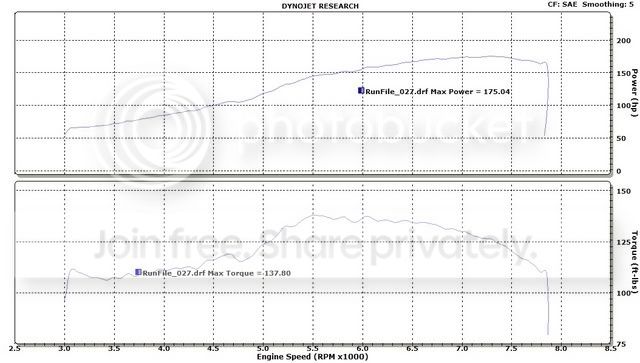
first, this is a dyno of my stock h22a with bolt ons and tuning on the local dynojet in tallahassee
second, this is an older dyno with the same mods and same tuning software. Also on a dyno, but this is on the velocity trends dynojet in jacksonville
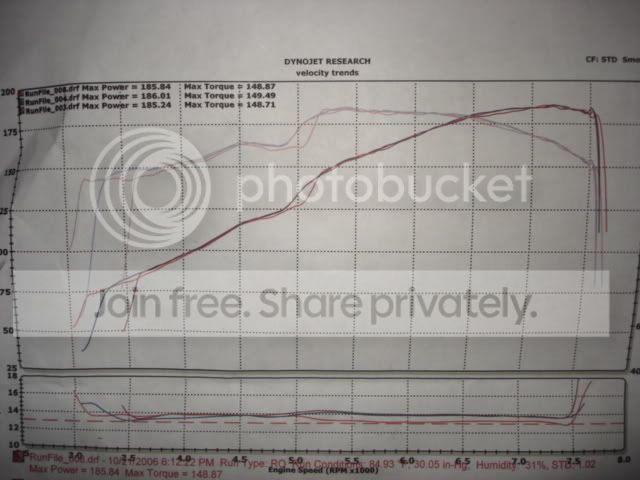
If i remember correctly, these dyno's were done in similar climate conditions as well and we even converted the lower graph (STD) to SAE and the differences were negligible. 2whp difference IIRC. The graphs are roughly the same however there is a 11whp and 11ft lbs discrepancy between them.
so what does this all boil down to and why am I blabbering on about nonsense that most will likely still disregard?
answer:
dyno's do not accurately display how "fast" or powerful a motor is. One engine that makes 180whp/150ftlbs on one dyno could get wooped by the same engine that makes the same power on a different dyno. This is why the most accurate way of displaying how "fast" a car is to go to the drag strip and see what you trap, the MPH. The numbers dont tell you anything other than what the dyno reads. The number the dyno gives you do not describe your car as slow and it does not describe your car as fast until you go to the drag strip and prove it.
Go to the dyno, go to the track. Compare. No more crying.
add more
First of all, a dynamometer's primary use is a tuning tool for tuners to view the GRAPH and see what changes are seen on the GRAPH when there are changes made to fuel, ignition, cam gear settings..etc. Another measurement is its use as a tool for someone to test parts to see where a certain part gained power to a prior setup and what changes need to be made to net the graph that is needed for a particular setup. These tests need to be done on the same dyno for the most consistent results.
Also, you can use the dyno to determine shift points at the drag so you land (in the next gear) in a portion of your chart that gives you the most momentum. Momentum is what keeps a car going. If you land in an area of low torque, your acceleration drops and your ET's suffer.
It's purpose is not there, like many think, for someone to go and see what kind of numbers the engine puts out and cry about the numberical output because they are "low". If you are worried about the output, do a compression or leakdown test. Preferably leakdown because in my opinion it is a more accurate. If those tests come out good, then check your cam timing and maintenance items. Then do research on the parts you have on your car and determine if they are what is keeping the motor from making power.
There is much more to understanding a graph than looking at the peak output. IE: peak rpm power, peak rpm torque, vtec crossover, how long the torque plateau's, where the torque drops off.
Here is a good article by Jeff Evans on why Horsepower does not matter:
http://www.evans-tuning.com/te....html
This is a little comparison to show how dyno's read differently:
first, this is a dyno of my stock h22a with bolt ons and tuning on the local dynojet in tallahassee
second, this is an older dyno with the same mods and same tuning software. Also on a dyno, but this is on the velocity trends dynojet in jacksonville
If i remember correctly, these dyno's were done in similar climate conditions as well and we even converted the lower graph (STD) to SAE and the differences were negligible. 2whp difference IIRC. The graphs are roughly the same however there is a 11whp and 11ft lbs discrepancy between them.
so what does this all boil down to and why am I blabbering on about nonsense that most will likely still disregard?
answer:
dyno's do not accurately display how "fast" or powerful a motor is. One engine that makes 180whp/150ftlbs on one dyno could get wooped by the same engine that makes the same power on a different dyno. This is why the most accurate way of displaying how "fast" a car is to go to the drag strip and see what you trap, the MPH. The numbers dont tell you anything other than what the dyno reads. The number the dyno gives you do not describe your car as slow and it does not describe your car as fast until you go to the drag strip and prove it.
Go to the dyno, go to the track. Compare. No more crying.
add more


Honda-Tech Member
Joined: Nov 2005
Posts: 3,643
Likes: 0
From: Somewhere puffin away in Spokane, USA
Re: Dyno "numbers" discussion. Why the numbers do NOT matter. (98vtec)
 I kinda thought all that was a given as far as one Dyno producing different numbers from another?
Thread Starter
moderator emeritus
Joined: Oct 2002
Posts: 16,357
Likes: 6
From: Cantonment, FL
Re: Dyno "numbers" discussion. Why the numbers do NOT matter. (badboyr66)
well it is to people who understand the concept, lol.
look at how many threads are made in this forum about "my numbers are low", "how do my numbers look"....completely disregarding what the chart looks like because they have no clue how to read it.
look at how many threads are made in this forum about "my numbers are low", "how do my numbers look"....completely disregarding what the chart looks like because they have no clue how to read it.

Honda-Tech Member
Joined: Mar 2007
Posts: 3,074
Likes: 0
From: SOCAL, ca, 91702
Re: Dyno "numbers" discussion. Why the numbers do NOT matter. (badboyr66)
<TABLE WIDTH="90%" CELLSPACING=0 CELLPADDING=0 ALIGN=CENTER><TR><TD>Quote, originally posted by badboyr66 »</TD></TR><TR><TD CLASS="quote">lol too true.</TD></TR></TABLE>
like all of these people who come and say i made 240 or i made 280.. yet they run high 12's...
and then i make 205 and run 11.9's....
Dyno #'s don't mean ****.. track times are what count..
dyno is for tuning... and its not a given. people on here are die hard about dyno #'s. and also a lot of them pump up their builds WAY too much...
like all of these people who come and say i made 240 or i made 280.. yet they run high 12's...
and then i make 205 and run 11.9's....
Dyno #'s don't mean ****.. track times are what count..
dyno is for tuning... and its not a given. people on here are die hard about dyno #'s. and also a lot of them pump up their builds WAY too much...
Trending Topics

Honda-Tech Member
Joined: Mar 2002
Posts: 9,854
Likes: 4
From: Southern California, U.S.A.
Good points
The dyno is a very useful tool, but is only a tool. In the hands of a skilled tuner, the dyno can be used to get the most power out of a particular setup, while maintaining good drive-ability and reasonable fuel economy.
As stated previously, one should not get too hung up on peak numbers. Sometimes it is better to give up a couple of peak HP in exchange for 4-8 ft-lbs. of torque across a broader RPM range.
Pissing contests between different dynos are also pointless. With the abundance of different dynos in the marketplace today, results on the same vehicle can vary widely between them. It is absurd to try and make a direct comparison between an inertial roller dyno (with the added inertia of the wheels and tires) and a controlled load dyno that bolts directly to the hubs.
If only more customers would read and understand this thread!
The dyno is a very useful tool, but is only a tool. In the hands of a skilled tuner, the dyno can be used to get the most power out of a particular setup, while maintaining good drive-ability and reasonable fuel economy.
As stated previously, one should not get too hung up on peak numbers. Sometimes it is better to give up a couple of peak HP in exchange for 4-8 ft-lbs. of torque across a broader RPM range.
Pissing contests between different dynos are also pointless. With the abundance of different dynos in the marketplace today, results on the same vehicle can vary widely between them. It is absurd to try and make a direct comparison between an inertial roller dyno (with the added inertia of the wheels and tires) and a controlled load dyno that bolts directly to the hubs.
If only more customers would read and understand this thread!


Honda-Tech Member
Joined: Nov 2006
Posts: 4,337
Likes: 0
From: JDM land, usa
Re: Dyno "numbers" discussion. Why the numbers do NOT matter. (HotboxedTypeR)
<TABLE WIDTH="90%" CELLSPACING=0 CELLPADDING=0 ALIGN=CENTER><TR><TD>Quote, originally posted by HotboxedTypeR »</TD></TR><TR><TD CLASS="quote">How do you determine shift points from looking at a graph?</TD></TR></TABLE>
you look at where the meat of your powerband is..where you get the most gains and go from there
you look at where the meat of your powerband is..where you get the most gains and go from there


Honda-Tech Member
Joined: Apr 2003
Posts: 1,502
Likes: 0
From: Baltimore, MD, USA
Re: Dyno "numbers" discussion. Why the numbers do NOT matter. (Shadowz7429)
All I use a dyno for is shape of the curve and if I change something does the engine respond good or bad. I get a good laugh out of people that compare dyno numbers, its impossible to compare dynos from down the street let alone another state or across the country.I dyno on a Mustang Powerdyne Dyno aka "The Honda Heartbreaker" you make mid 150's NA with a D16 you gotta be doing something right. Yet you put a IHE type R on the same dyno and it makes high 160' low 170's and the owner wants to cut his wrist until they drive it or take it to the track.


Honda-Tech Member
Joined: Sep 2001
Posts: 1,038
Likes: 1
From: 757, VA, US
Re: Dyno "numbers" discussion. Why the numbers do NOT matter. (98vtec)
I would have to agree and disagree with you. Using a dyno is a great reference tool to compare before/after result and so forth. The point where you tried to prove your point with the graphs is not substantial evidence that we cannot compare dynos(same manufacture). You have to question like all measurement devices ...were they calibrated accordingly? did we use the device properly with all same conditions? has the device of measurement changed? i know you said that no changes were made but you must be 100% sure. I'm sure Dynojet or Mustang has a procedure to insure all their dynos produce similar numbers for a standard/referenced output. With that said I highly doubt shops operating this measurement device calibrates them. so now we can say yes, that its very hard to compare my numbers against yours due to these given factors.
Thread Starter
moderator emeritus
Joined: Oct 2002
Posts: 16,357
Likes: 6
From: Cantonment, FL
Re: Dyno "numbers" discussion. Why the numbers do NOT matter. (00b18b)
so you think you can compare numbers between dyno's of the same brand?
What do the numbers even mean? What if someone makes 220whp and only runs 94mph? what does that tell you? There are WAY too many variables to do any kind of comparison between numbers. There just isnt a point to it when a dyno's sole purpose is for a tuners use when making changes via engine management or when swapping parts to see which part is going to give them that extra edge.
the numbers are there for people to brag and boast about or to cry about because the little calculator told them their engine sucked.
the calibrating is my whole point!! You could calibrate it horribly and its still going to draw the right graph.
What do the numbers even mean? What if someone makes 220whp and only runs 94mph? what does that tell you? There are WAY too many variables to do any kind of comparison between numbers. There just isnt a point to it when a dyno's sole purpose is for a tuners use when making changes via engine management or when swapping parts to see which part is going to give them that extra edge.
the numbers are there for people to brag and boast about or to cry about because the little calculator told them their engine sucked.
the calibrating is my whole point!! You could calibrate it horribly and its still going to draw the right graph.
Honda-Tech Member
Joined: Sep 2001
Posts: 1,038
Likes: 1
From: 757, VA, US
Re: Dyno "numbers" discussion. Why the numbers do NOT matter. (98vtec)
No no no...I think you misunderstood me.
With what you presented... it is unclear. you presented a constant(your car) with two dynos. you used the difference to prove that you cannot make a fair comparison against the two. this is the point i disagree...if the dyno was calibrated correctly it should given the same results for the same car(unchanged)...true?
I'm saying with calibration of the dyno you can compare your unchanged car against another dyno...your statements made it seem like there were no possible chance for comparison of dynos.
Now you brought up another point....comparing two different cars on two different dynos or same dyno? im unclear here.....anyway no, u cannot make a comparison here, because of many variables(the obvious). now if you held the variables (dyno,transmission, wheel size/weight/tires, parts,engine size etc etc) constants you can make a fair comparison...... true?
However people like to used these numbers is their personal choice, they must understand the changes and differences in order to make a fair comparison before they compare and cry.
all I'm saying is there is chance for comparison if proper measures are taken.
With what you presented... it is unclear. you presented a constant(your car) with two dynos. you used the difference to prove that you cannot make a fair comparison against the two. this is the point i disagree...if the dyno was calibrated correctly it should given the same results for the same car(unchanged)...true?
I'm saying with calibration of the dyno you can compare your unchanged car against another dyno...your statements made it seem like there were no possible chance for comparison of dynos.
Now you brought up another point....comparing two different cars on two different dynos or same dyno? im unclear here.....anyway no, u cannot make a comparison here, because of many variables(the obvious). now if you held the variables (dyno,transmission, wheel size/weight/tires, parts,engine size etc etc) constants you can make a fair comparison...... true?
However people like to used these numbers is their personal choice, they must understand the changes and differences in order to make a fair comparison before they compare and cry.
all I'm saying is there is chance for comparison if proper measures are taken.
Honda-Tech Member
Joined: Nov 2005
Posts: 3,643
Likes: 0
From: Somewhere puffin away in Spokane, USA
Re: Dyno "numbers" discussion. Why the numbers do NOT matter. (00b18b)
<TABLE WIDTH="90%" CELLSPACING=0 CELLPADDING=0 ALIGN=CENTER><TR><TD>Quote, originally posted by 00b18b »</TD></TR><TR><TD CLASS="quote">
all I'm saying is there is chance for comparison if proper measures are taken.
</TD></TR></TABLE>
Maybe true. But in the real world there are people.. people make errors. We can sit here all day as say IF they were calibrated ect ect. But the truth of the matter is there ARE variables dyno to dyno. We could sit here all day and talk about what they are... but at the end of the conversation.. they are still there. I have seen the same car go from dyno to dyno and put down different numbers.. Both dynos put down different numbers..not a damn thing anyone on here is gonna do about it. It is what it is.
I see the OPs point here... and that is you are comparing apples and oranges when you get down to it. All cause every machine is different.
all I'm saying is there is chance for comparison if proper measures are taken.
</TD></TR></TABLE>
Maybe true. But in the real world there are people.. people make errors. We can sit here all day as say IF they were calibrated ect ect. But the truth of the matter is there ARE variables dyno to dyno. We could sit here all day and talk about what they are... but at the end of the conversation.. they are still there. I have seen the same car go from dyno to dyno and put down different numbers.. Both dynos put down different numbers..not a damn thing anyone on here is gonna do about it. It is what it is.
I see the OPs point here... and that is you are comparing apples and oranges when you get down to it. All cause every machine is different.

Honda-Tech Member
Joined: Aug 2004
Posts: 4,680
Likes: 2
From: Carlisle, PA, USA
Re: Dyno "numbers" discussion. Why the numbers do NOT matter. (badboyr66)
<TABLE WIDTH="90%" CELLSPACING=0 CELLPADDING=0 ALIGN=CENTER><TR><TD>Quote, originally posted by badboyr66 »</TD></TR><TR><TD CLASS="quote"> All cause every machine is different. </TD></TR></TABLE>
Exactly!
Even dyno's of the same manufacturer/model vary in reading from one machine to another.
- Derek
Exactly!
Even dyno's of the same manufacturer/model vary in reading from one machine to another.
- Derek

Member
Joined: Mar 2007
Posts: 1,701
Likes: 0
From: Eastern, Ma, USA
Dyno's are a great tool, but too many people stress dyno numbers to a point in which they feel disappointed if they dont make x amount of power. Dynos are a great resource, but MPH never lie!
Thread Starter
moderator emeritus
Joined: Oct 2002
Posts: 16,357
Likes: 6
From: Cantonment, FL
Re: Dyno "numbers" discussion. Why the numbers do NOT matter. (98vtec)

Honda-Tech Member
Joined: Feb 2004
Posts: 1,036
Likes: 0
From: T Dot
Re: Dyno "numbers" discussion. Why the numbers do NOT matter. (98vtec)
<TABLE WIDTH="90%" CELLSPACING=0 CELLPADDING=0 ALIGN=CENTER><TR><TD>Quote, originally posted by 98vtec »</TD></TR><TR><TD CLASS="quote">http://www.theoldone.com/archi...p.htm
</TD></TR></TABLE>
this is the main reason why i've always questioned certain mods. to me, low-mid tq loss is catastrophic in or little pumps. hence, why i try to avoid using large plenums that shift my powerband up 700-1000rpm higher, to gain a few hp up top. i'm a tq fan, and have never understood...i.e. why people with mild b16's (or any mild b series motors at that) change their im's to gain a bit more power from 8K up, for added stress and low rpm power loss. its a mystery to me. longevity and acceleration are more important to me than peak hp. tq owns
</TD></TR></TABLE> this is the main reason why i've always questioned certain mods. to me, low-mid tq loss is catastrophic in or little pumps. hence, why i try to avoid using large plenums that shift my powerband up 700-1000rpm higher, to gain a few hp up top. i'm a tq fan, and have never understood...i.e. why people with mild b16's (or any mild b series motors at that) change their im's to gain a bit more power from 8K up, for added stress and low rpm power loss. its a mystery to me. longevity and acceleration are more important to me than peak hp. tq owns


Honda-Tech Member
Joined: Jan 2003
Posts: 10,170
Likes: 3
From: So Cal
Re: Dyno "numbers" discussion. Why the numbers do NOT matter. (98vtec)
<TABLE WIDTH="90%" CELLSPACING=0 CELLPADDING=0 ALIGN=CENTER><TR><TD>Quote, originally posted by 98vtec »</TD></TR><TR><TD CLASS="quote">http://www.theoldone.com/archi...p.htm
</TD></TR></TABLE>
I was with ya right up until here.
</TD></TR></TABLE>I was with ya right up until here.