


Who's running a harmonice balancer on their fully built motors?


Thread Starter
Member
Joined: Mar 2007
Posts: 1,701
Likes: 0
From: Eastern, Ma, USA
 Who's running a harmonice balancer on their fully built motors?
quick question for all these great b20's, are any of you guys running a harmonice balancer such as fluidyne or even ATI? I dont see any point of blueprinting or even balancing a setup if a balancer is not present to absorb all the waves from the crank...some inputs would b nice TIA!!!
Setup is a B20B4 with stock sleeves
Supertech valvetrain with pro 2 cams
JE 12:5 CR pistons
Crower forged rods
ACL bearings
Setup is a B20B4 with stock sleeves
Supertech valvetrain with pro 2 cams
JE 12:5 CR pistons
Crower forged rods
ACL bearings


Honda-Tech Member
Joined: Jan 2004
Posts: 1,044
Likes: 0
From: Land of the Lost, usa
Re: (b20beast978)
<TABLE WIDTH="90%" CELLSPACING=0 CELLPADDING=0 ALIGN=CENTER><TR><TD>Quote, originally posted by b20beast978 »</TD></TR><TR><TD CLASS="quote">Any reason in particular why you guys chose ATI over fluidamper?</TD></TR></TABLE>
We run the ATI on our K-series Drag motor.
Why trust anything else ? They have repeatedly proven there products work
We run the ATI on our K-series Drag motor.
Why trust anything else ? They have repeatedly proven there products work
Trending Topics
Re: (regamaster)
here is some info on it, and why ppl choose it over the rest, fluidamper etc,etc
Harmonic waves can travel thru the drive train and thru the crank. If there is nothing at the end of the crank to absorb the wave, it will travel back in the opposite direction to meet the next wave. This causes the unfavorable harmonic vibration. The first thing to take the abuse is the oil pump gear and you know what happens when that breaks. ALSO, pulling weight off of the crank that close to the center line will add ZERO horsepower or rpm capability. Don't fool yourself on this. Think of how big and thick the counter weights are on a crankshaft. The harmonic balancer is just another externally added counterweight that happens to absorb negative wave energy. Honda engineers were not stupid or naive. Don't try to out think them in this case, use a harmonic balancer.
Personal experience...We abuse the drive train launching at 8000 rpm and shifting over 10,000 rpm. The aluminum under the flywheel bolts started to eat away and the flywheel started to vibrate back and forth. When it came completely loose it sent a shock thru the crank so strong that it snapped the key holding the harmonic balancer in place. The balancer spun on the crank, put the crank fired ignition out of time and shut the motor off. When pulling everything apart, we found that the shock wave had actually also bent the crank to the point where it was unusable again. This proved to me the useful purpose of a harmonic balancer. We run steel flywheels now, BTW.
1)The ATI damper continues to dampen vibrations to unlimited rpms whereas the fluid unit loses its effectiveness at about 7000 rpm. Check the graph below.
2)The ATI is 1.25 pounds lighter than the fluid unit.
3)The ATI is rebuildable.
4)Viscous fluid dampers are sealed. The inertia weight can become locked by bearing failure or, more commonly, from the silicone turning to a solid mass. Your first warning of damper failure will probably be a broken crankshaft resulting in the replacement of your damper and the engine.
5)ATI units are used on all NASCAR engines as they were designed specifically for high performance engines. Their design is fail safe, efficient and available for any engine application. They are SFI certified.
6)Bolt on crank trigger wheels available with the ATI.
7)ATI was able to build a custom damper for our race car. It is for a S2000 engine with a Chevy bolt pattern to help us connect our dry sump pump to our engine.
8)Much more detailed information http://www.atiperformanceprodu...n.htm.

Harmonic waves can travel thru the drive train and thru the crank. If there is nothing at the end of the crank to absorb the wave, it will travel back in the opposite direction to meet the next wave. This causes the unfavorable harmonic vibration. The first thing to take the abuse is the oil pump gear and you know what happens when that breaks. ALSO, pulling weight off of the crank that close to the center line will add ZERO horsepower or rpm capability. Don't fool yourself on this. Think of how big and thick the counter weights are on a crankshaft. The harmonic balancer is just another externally added counterweight that happens to absorb negative wave energy. Honda engineers were not stupid or naive. Don't try to out think them in this case, use a harmonic balancer.
Personal experience...We abuse the drive train launching at 8000 rpm and shifting over 10,000 rpm. The aluminum under the flywheel bolts started to eat away and the flywheel started to vibrate back and forth. When it came completely loose it sent a shock thru the crank so strong that it snapped the key holding the harmonic balancer in place. The balancer spun on the crank, put the crank fired ignition out of time and shut the motor off. When pulling everything apart, we found that the shock wave had actually also bent the crank to the point where it was unusable again. This proved to me the useful purpose of a harmonic balancer. We run steel flywheels now, BTW.
1)The ATI damper continues to dampen vibrations to unlimited rpms whereas the fluid unit loses its effectiveness at about 7000 rpm. Check the graph below.
2)The ATI is 1.25 pounds lighter than the fluid unit.
3)The ATI is rebuildable.
4)Viscous fluid dampers are sealed. The inertia weight can become locked by bearing failure or, more commonly, from the silicone turning to a solid mass. Your first warning of damper failure will probably be a broken crankshaft resulting in the replacement of your damper and the engine.
5)ATI units are used on all NASCAR engines as they were designed specifically for high performance engines. Their design is fail safe, efficient and available for any engine application. They are SFI certified.
6)Bolt on crank trigger wheels available with the ATI.
7)ATI was able to build a custom damper for our race car. It is for a S2000 engine with a Chevy bolt pattern to help us connect our dry sump pump to our engine.
8)Much more detailed information http://www.atiperformanceprodu...n.htm.

Honda-Tech Member
Joined: Oct 2006
Posts: 296
Likes: 0
From: Middle River, MD, USA
Re: (Dual Cam Racing)
I don't think you can go wrong with either dampener. Just make sure you use one! I choose ATI because they are local, & I can just drive over instead of shipping.



Honda-Tech Member
Joined: Mar 2006
Posts: 2,062
Likes: 1
From: Columbus, OH
Re: (b20beast978)
<TABLE WIDTH="90%" CELLSPACING=0 CELLPADDING=0 ALIGN=CENTER><TR><TD>Quote, originally posted by b20beast978 »</TD></TR><TR><TD CLASS="quote">so your saying that a 200 whp DD would be ok with a ctr pulley??</TD></TR></TABLE>
No, it will be ok with the pulley that was designed for your crank.
No, it will be ok with the pulley that was designed for your crank.

Honda-Tech Member
Joined: Jan 2008
Posts: 396
Likes: 0
From: Soul Society
Re: (b20beast978)
<TABLE WIDTH="90%" CELLSPACING=0 CELLPADDING=0 ALIGN=CENTER><TR><TD>Quote, originally posted by b20beast978 »</TD></TR><TR><TD CLASS="quote">so your saying that a 200 whp DD would be ok with a ctr pulley??</TD></TR></TABLE>
You'll be fine.
You'll be fine.
Thread Starter
Member
Joined: Mar 2007
Posts: 1,701
Likes: 0
From: Eastern, Ma, USA
im just double checking..i dont want to end up with a spun bearing again!! My last b20vtec spun the rod and mains with an oem pulley, so consequently i am looking into avoiding this by purchasing a harmonic balancer and balancing the new setup. So if you guys say an oem is better than a ctr than ill just stick with that...

Thread Starter
Member
Joined: Mar 2007
Posts: 1,701
Likes: 0
From: Eastern, Ma, USA
SO most of you guys prefer an OEM over a CTR pulley huh...i figured since the ctr only weighs about 2lbs (which is 8 lbs lighter than stock) that it would be less rotating mass and would be less stress on the crank, but if oem is what everyone is running, i guess its best to play it safe!

Honda-Tech Member

Joined: Jun 2005
Posts: 1,903
Likes: 0
From: Vancouver,WA usa
Re: (b20beast978)
<TABLE WIDTH="90%" CELLSPACING=0 CELLPADDING=0 ALIGN=CENTER><TR><TD>Quote, originally posted by b20beast978 »</TD></TR><TR><TD CLASS="quote">i need one more input guys...oem or ctr pulley???</TD></TR></TABLE>
DO NOT GO CTR PULLEY!!!!!!!
They are cheap and have no dampner at all. If you want something lighter and still dampning then just do what I did. Take a stock cranck pulley and have it shaved and balanced by a profesional.
I had a 3 belt pulley, had the outer belt completely removed and the outside belt ribs shaved down on the second pulley. Then it was rebalanced.
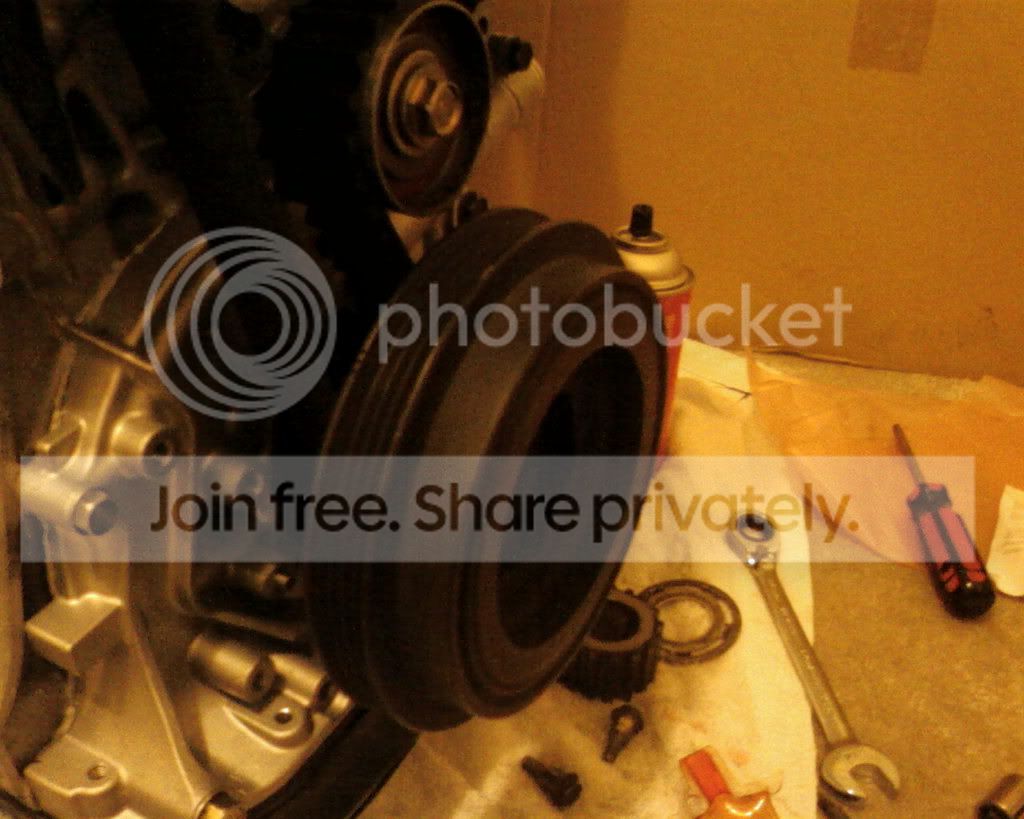
DO NOT GO CTR PULLEY!!!!!!!
They are cheap and have no dampner at all. If you want something lighter and still dampning then just do what I did. Take a stock cranck pulley and have it shaved and balanced by a profesional.
I had a 3 belt pulley, had the outer belt completely removed and the outside belt ribs shaved down on the second pulley. Then it was rebalanced.


Thread Starter
Member
Joined: Mar 2007
Posts: 1,701
Likes: 0
From: Eastern, Ma, USA
Re: (.I.Need.Money.)
<TABLE WIDTH="90%" CELLSPACING=0 CELLPADDING=0 ALIGN=CENTER><TR><TD>Quote, originally posted by .I.Need.Money. »</TD></TR><TR><TD CLASS="quote">I don't see why everyone bashes the CTR pulley all the time...  </TD></TR></TABLE>
Any reason why you feel this way? Some previous expirience or supporting details would be nice!
</TD></TR></TABLE>Any reason why you feel this way? Some previous expirience or supporting details would be nice!

Junior Member
Joined: Jan 2007
Posts: 897
Likes: 0
From: Jersey, middlesex
Re: (b20beast978)
the ctr pulley just does not seem like a good idea. i personally have had 2 ati's and thought both of them were great products. i would either go ati or oem. but definitly not the cheap ctr pulley.
yea honda designed the ctr pulley but it seems like it would be a bad thing to go with. rather be safe then sorry.
yea honda designed the ctr pulley but it seems like it would be a bad thing to go with. rather be safe then sorry.