


Twin Scroll Turbo? What are they? And a couple general turbo questions


Thread Starter
Honda-Tech Member
Joined: May 2006
Posts: 18
Likes: 0
From: San Antonio, tx, USA
 Twin Scroll Turbo? What are they? And a couple general turbo questions
I'm mostly an N/A guy, but I was reading about the new mini cooper ~170 tq, from ~1600 rpm. And how that's possible from a 1.6L motor because the twin-scroll turbocharger is done spooling by then.
I've been looking online and haven't found a satisfactory answer.
From what I can gather, the main thing is in the manifold-in an I4, the manifold is seperated into two tubes, by firing order. The two tubes remain seperate up until the impeller, and the stronger pulses cause the turbo to spool up faster. Why don't more people go twin scroll turbocharging? It shouldn't be that much more difficult than to make an equal length manifold?
Are the turbo's themselves special? Or is there just a wall where you connect it to the manifold flange going to the impeller, and that's it?
I'm really curious why twin-scroll turbos spool so quickly, and why nobody uses them in aftermarket, except expensive subaru kits?
Yes, most of what I've been able to find has been marketing hype, and not terribly technical, but are there any downsides to twin-scroll turbochargers?
I've been looking online and haven't found a satisfactory answer.
From what I can gather, the main thing is in the manifold-in an I4, the manifold is seperated into two tubes, by firing order. The two tubes remain seperate up until the impeller, and the stronger pulses cause the turbo to spool up faster. Why don't more people go twin scroll turbocharging? It shouldn't be that much more difficult than to make an equal length manifold?
Are the turbo's themselves special? Or is there just a wall where you connect it to the manifold flange going to the impeller, and that's it?
I'm really curious why twin-scroll turbos spool so quickly, and why nobody uses them in aftermarket, except expensive subaru kits?
Yes, most of what I've been able to find has been marketing hype, and not terribly technical, but are there any downsides to twin-scroll turbochargers?

Honda-Tech Member
Joined: Dec 2004
Posts: 756
Likes: 0
From: Atsugi, Japan, Japan
Re: Twin Scroll Turbo? What are they? And a couple general turbo questions (Sully90SiPrelude)
divided housing turbos is what they are called. Many companies are making the manifolds and usually your larger turbos have divided housings on them.
Some people did not use them before because they thought that the obstruction of the metal used to make it a divide housing would affect the flow characteristics of the turbo causing the performance of the unit to suffer.
They have been around for a while and people have been using them but the term "Twin Scroll" is the new buzz word.
Makes you sound like you know what you are talking about when you can confuse everyone else.
Some people did not use them before because they thought that the obstruction of the metal used to make it a divide housing would affect the flow characteristics of the turbo causing the performance of the unit to suffer.
They have been around for a while and people have been using them but the term "Twin Scroll" is the new buzz word.
Makes you sound like you know what you are talking about when you can confuse everyone else.

Honda-Tech Member
Joined: Feb 2005
Posts: 171
Likes: 0
From: Columbus, Ohio, USA
Re: Twin Scroll Turbo? What are they? And a couple general turbo questions (Fitti)
<TABLE WIDTH="90%" CELLSPACING=0 CELLPADDING=0 ALIGN=CENTER><TR><TD>Quote, originally posted by Fitti »</TD></TR><TR><TD CLASS="quote">divided housing turbos is what they are called. Many companies are making the manifolds and usually your larger turbos have divided housings on them.
Some people did not use them before because they thought that the obstruction of the metal used to make it a divide housing would affect the flow characteristics of the turbo causing the performance of the unit to suffer.
They have been around for a while and people have been using them but the term "Twin Scroll" is the new buzz word.
Makes you sound like you know what you are talking about when you can confuse everyone else.</TD></TR></TABLE>
The term twin scroll may be new to you but not everyone else... also WHO thinks the divided housing decreased flow?
The technology has been around for years. Started with diesel trucks to increase their power band and guess what... works for us too.
Basically, you sperate the exhaust pulses all the way to the turbine wheel so they do not interfere with each other. This improves flow (VE) which nets quicker boost onset and more top end. On the typlical 4 cylinder with a 1342 firing order you would group 1 with 4 and 2 with 3. I used a T04 .58 divided housing on a 2.0 liter in the 90's and it worked very well.
Long before F1 used them. Here is a BMW motor where you can clearly see the two volutes in the turbine housing.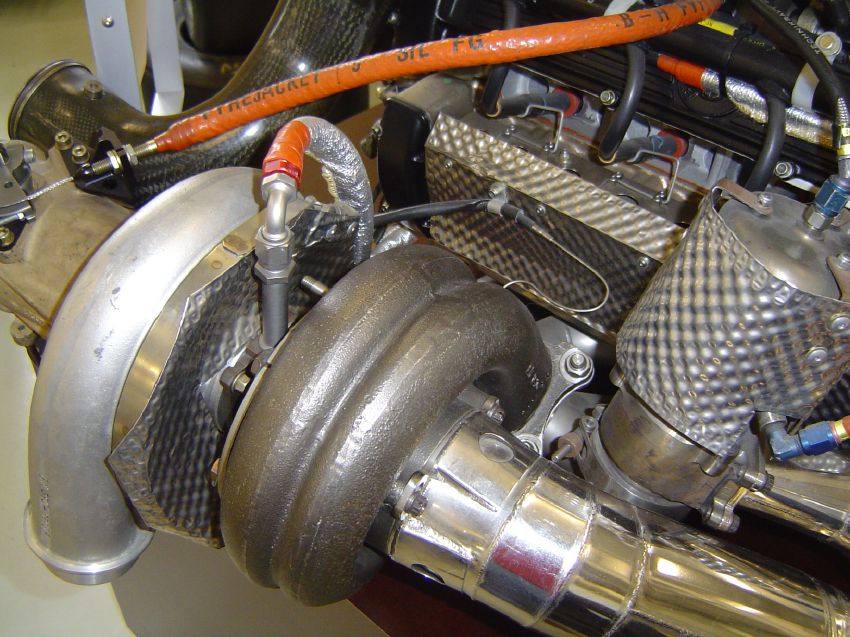
Last year I went to a GT3071R and wished they had the .78 T3 divided housing... it would be a no brainer. Look for more as the "secret" gets out. Shhh don't tell Fitti though...
Some people did not use them before because they thought that the obstruction of the metal used to make it a divide housing would affect the flow characteristics of the turbo causing the performance of the unit to suffer.
They have been around for a while and people have been using them but the term "Twin Scroll" is the new buzz word.
Makes you sound like you know what you are talking about when you can confuse everyone else.</TD></TR></TABLE>
The term twin scroll may be new to you but not everyone else... also WHO thinks the divided housing decreased flow?
The technology has been around for years. Started with diesel trucks to increase their power band and guess what... works for us too.
Basically, you sperate the exhaust pulses all the way to the turbine wheel so they do not interfere with each other. This improves flow (VE) which nets quicker boost onset and more top end. On the typlical 4 cylinder with a 1342 firing order you would group 1 with 4 and 2 with 3. I used a T04 .58 divided housing on a 2.0 liter in the 90's and it worked very well.
Long before F1 used them. Here is a BMW motor where you can clearly see the two volutes in the turbine housing.
Last year I went to a GT3071R and wished they had the .78 T3 divided housing... it would be a no brainer. Look for more as the "secret" gets out. Shhh don't tell Fitti though...
Honda-Tech Member
Joined: Dec 2004
Posts: 756
Likes: 0
From: Atsugi, Japan, Japan
If you read my post I never said that I thought it hurt performance but some people did and still do.
I also stated they were used on larger turbos as well hence your reference to the diesel truck.
but right on that BMW turbo looks crazy with that housing
Alfa turbo there is a .78 divided housing for that turbo. Let me know if you want to get one.
I also stated they were used on larger turbos as well hence your reference to the diesel truck.
but right on that BMW turbo looks crazy with that housing
Alfa turbo there is a .78 divided housing for that turbo. Let me know if you want to get one.


Joined: Oct 2004
Posts: 2,278
Likes: 0
From: upstate, ny
Re: (blinx9900)
<TABLE WIDTH="90%" CELLSPACING=0 CELLPADDING=0 ALIGN=CENTER><TR><TD>Quote, originally posted by blinx9900 »</TD></TR><TR><TD CLASS="quote">do all twin scroll set ups require 2 wg's?</TD></TR></TABLE>
no its not required it depends on the manifold, some manifolds have 2 runners to one gate, while most have 2 individual gates.
no its not required it depends on the manifold, some manifolds have 2 runners to one gate, while most have 2 individual gates.

Honda-Tech Member
Joined: Jan 2004
Posts: 8,732
Likes: 3
From: Ft. Hood
Re: (blinx9900)
<TABLE WIDTH="90%" CELLSPACING=0 CELLPADDING=0 ALIGN=CENTER><TR><TD>Quote, originally posted by blinx9900 »</TD></TR><TR><TD CLASS="quote">do all twin scroll set ups require 2 wg's?</TD></TR></TABLE> No, take for example the Evo 8 16G, twin scroll but still retains one internal wastegate.
Trending Topics

Honda-Tech Member
Joined: Jan 2005
Posts: 7,015
Likes: 7
From: b00sting my D16s, SoWis, USA
Re: (dr_latino999)
Anyone know much about the divided T3 housings? I haven't seen many used here, and I think they would be a good answer for a street car, assuming you don't have the cash for a ball-bearing chra.
And is that BMW flange really that thin, or is the turbo just that big? My guess is its possibly inconel?
And is that BMW flange really that thin, or is the turbo just that big?
My guess is its possibly inconel?

Honda-Tech Member
Joined: Jan 2003
Posts: 1,791
Likes: 0
From: Molde, Norway
Re: Twin Scroll Turbo? What are they? And a couple general turbo questions (Alfa Turbo)
<TABLE WIDTH="90%" CELLSPACING=0 CELLPADDING=0 ALIGN=CENTER><TR><TD>Quote, originally posted by Alfa Turbo »</TD></TR><TR><TD CLASS="quote">
Last year I went to a GT3071R and wished they had the .78 T3 divided housing... it would be a no brainer.
</TD></TR></TABLE>
ATP Turbo has that .78 T3 divided housing as one of the options for the GT3071R.
Last year I went to a GT3071R and wished they had the .78 T3 divided housing... it would be a no brainer.
</TD></TR></TABLE>
ATP Turbo has that .78 T3 divided housing as one of the options for the GT3071R.
Honda-Tech Member
Joined: Feb 2005
Posts: 171
Likes: 0
From: Columbus, Ohio, USA
Re: Twin Scroll Turbo? What are they? And a couple general turbo questions (Pondus)
<TABLE WIDTH="90%" CELLSPACING=0 CELLPADDING=0 ALIGN=CENTER><TR><TD>Quote, originally posted by Pondus »</TD></TR><TR><TD CLASS="quote">
ATP Turbo has that .78 T3 divided housing as one of the options for the GT3071R.</TD></TR></TABLE>
Yes, I know. They did not at the time and I have already made a new EL non-divided manifold for the 30R. Should I want to make another manifold I know where to get the divided turbine housing.

ATP Turbo has that .78 T3 divided housing as one of the options for the GT3071R.</TD></TR></TABLE>
Yes, I know. They did not at the time and I have already made a new EL non-divided manifold for the 30R. Should I want to make another manifold I know where to get the divided turbine housing.


Honda-Tech Member
Joined: Aug 2005
Posts: 1,181
Likes: 0
From: New York
Re: (Got_soy)
I think twin scroll t3's are not seen as often is because it isn't necessary to use the divided housing to spool such a small housing. I agree that a twin scroll will probably spool a lot faster but due to the higher cost/more labor of the split housing and more complicated manifold design, it's really not needed unless you're spooling a large turbo, such as the GT42. Not here to debate really, just my $.02
Honda-Tech Member
Joined: Feb 2005
Posts: 171
Likes: 0
From: Columbus, Ohio, USA
Re: (DC-2uned)
<TABLE WIDTH="90%" CELLSPACING=0 CELLPADDING=0 ALIGN=CENTER><TR><TD>Quote, originally posted by DC-2uned »</TD></TR><TR><TD CLASS="quote">I think twin scroll t3's are not seen as often is because it isn't necessary to use the divided housing to spool such a small housing. I agree that a twin scroll will probably spool a lot faster but due to the higher cost/more labor of the split housing and more complicated manifold design, it's really not needed unless you're spooling a large turbo, such as the GT42. Not here to debate really, just my $.02 </TD></TR></TABLE>
You are correct a properly sized T3 responds very well. There are folks that want every last drop though and a divided housing will improve spool and TE, 5% on the low end and as much as 10% improvement if the entire system is well designed. In other words, Max spool at 4500 could be brought down a couple hundred RPM and max power up by 10%.
You are correct a properly sized T3 responds very well. There are folks that want every last drop though and a divided housing will improve spool and TE, 5% on the low end and as much as 10% improvement if the entire system is well designed. In other words, Max spool at 4500 could be brought down a couple hundred RPM and max power up by 10%.
Honda-Tech Member
Joined: Jan 2005
Posts: 7,015
Likes: 7
From: b00sting my D16s, SoWis, USA
Re: (Alfa Turbo)
I'm looking at it from the perspective of a 1.6L D-series. They are notorious for slow-spooling larger turbos. Is it safe to assume a .78ar divided T3 would spool a bit faster than a .63 but flow more?
And for extracting every last bit out of the turbo for power & reduced lag -
And for extracting every last bit out of the turbo for power & reduced lag -
Honda-Tech Member
Joined: Aug 2005
Posts: 1,181
Likes: 0
From: New York
Re: (HiProfile)
Well, Alfa says it could lower spool time by 5%, which I know is not exact but if that is close(I honestly don't know) just see what rpm a .63 spools at and compare it to a .78 minus that 5% of rpm.
Honda-Tech Member
Joined: Feb 2005
Posts: 171
Likes: 0
From: Columbus, Ohio, USA
Re: (DC-2uned)
<TABLE WIDTH="90%" CELLSPACING=0 CELLPADDING=0 ALIGN=CENTER><TR><TD>Quote, originally posted by DC-2uned »</TD></TR><TR><TD CLASS="quote">Well, Alfa says it could lower spool time by 5%, which I know is not exact but if that is close(I honestly don't know) just see what rpm a .63 spools at and compare it to a .78 minus that 5% of rpm.</TD></TR></TABLE>
Yes I said it, to be clearer I learned this from Messrs. Bell and Warner. In their repsective books they both quote the 5-10% figure. I never did objective side by side test on my twin scroll. Subjectively a T04 .58 divided would hit full boost around 4500 RPM on an 8 valve (read: no flow) 2.0 liter engine.

Yes I said it, to be clearer I learned this from Messrs. Bell and Warner. In their repsective books they both quote the 5-10% figure. I never did objective side by side test on my twin scroll. Subjectively a T04 .58 divided would hit full boost around 4500 RPM on an 8 valve (read: no flow) 2.0 liter engine.

Honda-Tech Member
Joined: Jul 2003
Posts: 678
Likes: 0
From: Billings, MT, 59105
Re: (DC-2uned)
I know I don't have a honda but I will have a back to back comparison from a non-divided GT30R to a divided .78 GT30r as soon as the turbo/manifold gets here from Geoff. I'll be sure to let everyone know how it works out. Also the divided housing and manifold make it safer to make more power on pump gas. It leans things out to because of the better efficency so it will require some tuning but it should be worth it. There are a few other 240 people using these and they are making 380hp/370ft/lbs at boost as low as 16psi and full boost in the lower 3000 rpm range. Talk about power band. And thats at pretty low boost. I plan on dynoing at 18 on pump gas and 25 on 100 octane so we'll see how it works.

Honda-Tech Member
Joined: Oct 2003
Posts: 244
Likes: 0
From: Orlando, FL, US
Twin Scroll...
Isn't this a twin scroll turbo as long as the divider is run all the way from the inlet of the exhaust housing (scroll 1/3 down on the page)...?
http://www.turbobygarrett.com/....html
http://www.turbobygarrett.com/....html
Honda-Tech Member
Joined: Oct 2003
Posts: 244
Likes: 0
From: Orlando, FL, US
Re: Twin Scroll... (Surfjunkie44)
Ok... Garrett's site went down but to my understanding isn't the twin-scroll design becoming a mainstay in the market since the concept is to keep from allowing the interchange of exhaust fumes back into the combustion chambers as they open for the exhaust cycle?
Thread Starter
Honda-Tech Member
Joined: May 2006
Posts: 18
Likes: 0
From: San Antonio, tx, USA
Re: (TS4L)
<TABLE WIDTH="90%" CELLSPACING=0 CELLPADDING=0 ALIGN=CENTER><TR><TD>Quote, originally posted by TS4L »</TD></TR><TR><TD CLASS="quote">I know I don't have a honda but I will have a back to back comparison from a non-divided GT30R to a divided .78 GT30r as soon as the turbo/manifold gets here from Geoff. I'll be sure to let everyone know how it works out. </TD></TR></TABLE>
Any word yet?
Any word yet?

Honda-Tech Member
Joined: Mar 2007
Posts: 7
Likes: 0
From: Tucson, AZ, usa
Re: (Sully90SiPrelude)
<TABLE WIDTH="90%" CELLSPACING=0 CELLPADDING=0 ALIGN=CENTER><TR><TD>Quote, originally posted by TS4L »</TD></TR><TR><TD CLASS="quote">I know I don't have a honda but I will have a back to back comparison from a non-divided GT30R to a divided .78 GT30r as soon as the turbo/manifold gets here from Geoff. I'll be sure to let everyone know how it works out. </TD></TR></TABLE>
Any word on this set up yet?
Any word on this set up yet?


Honda-Tech Member
Joined: Mar 2000
Posts: 2,859
Likes: 1
From: Toronto, ON, Canada
Re: Twin Scroll Turbo? What are they? And a couple general turbo questions
Twin scroll are really proven to work well under most situations... Some folks main goal is to make as much power as possible for drag racing, and twin scroll wouldn't be their concern at all. The manifold has to be built differently, and the wastegate routing is a bit more work to implement twin scroll design. it's just easier to go with a typical non-divided setup.
As for more restriction up top, it is true that divided housings are more restrictive compared to a non-divided housing of equal size. The cross sectional area of the housing passage is simply lesser with a divider along the middle.
I am sure you can always run a slightly larger divided housing to compensate for the lesser flow, but still being able to reap the benefits of faster exhaust flow and preventing exhaust contamination from the divided passage/paired cylinders.
Too bad I couldn't offer a real useful before/after comparison. I have a turbocharged Camry and I am going from a non-divided to a divided setup with nothing changed on the motor or turbo. However, the car sports a high stall built automatic, so you won't be able to see the RPM spool difference on the dyno.
As for more restriction up top, it is true that divided housings are more restrictive compared to a non-divided housing of equal size. The cross sectional area of the housing passage is simply lesser with a divider along the middle.
I am sure you can always run a slightly larger divided housing to compensate for the lesser flow, but still being able to reap the benefits of faster exhaust flow and preventing exhaust contamination from the divided passage/paired cylinders.
Too bad I couldn't offer a real useful before/after comparison. I have a turbocharged Camry and I am going from a non-divided to a divided setup with nothing changed on the motor or turbo. However, the car sports a high stall built automatic, so you won't be able to see the RPM spool difference on the dyno.