


variable camber suspension.


Thread Starter
Honda-Tech Member
Joined: Mar 2004
Posts: 1,165
Likes: 1
From: ca
 variable camber suspension.
im pretty amazed. although this violated the rules of many racing classes, pretty cool none the less.
http://www.oncamber.com/
the camber increases as steering angle increases

i have not see anything for double wishbone, but for mcpherson this is cool.
oh and one last thing, the reason i came across this was cause i was searching for f1 suspenion and how the anti-roll bars work. cause i look at them and have no idea how it funtions(pm me with answers)
to lazy to start a new post so here is the other picture
explain how this helps with the roll?

Modified by Cory Matthews at 2:52 PM 4/15/2007
http://www.oncamber.com/
the camber increases as steering angle increases
i have not see anything for double wishbone, but for mcpherson this is cool.
oh and one last thing, the reason i came across this was cause i was searching for f1 suspenion and how the anti-roll bars work. cause i look at them and have no idea how it funtions(pm me with answers)
to lazy to start a new post so here is the other picture
explain how this helps with the roll?
Modified by Cory Matthews at 2:52 PM 4/15/2007

Junior Member
Joined: Jan 2007
Posts: 491
Likes: 0
From: Houston,, TX
Re: variable camber suspension. (Cory Matthews)
That anti-roll bar looks like a variation of the blade type. It's a small picture and really hard to see though.
Here's a bigger picture of a blade type. The blade is at the bottom.
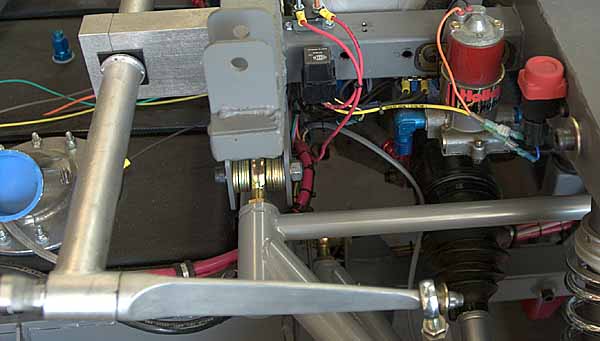
It's similar to a 2x6 piece of wood. The wood is very sturdy when standing up, like a rafter, but flexes more when it's layed down flat, like if it was used as a ramp or something. The blade is basically the same. When the thick part is parallel to the connecting link, it's very stiff. My picture appears to show the bar rotated to offer the maximum resistance to roll (assuming that link goes straight down). The more you rotate the blade towards 90 degrees, and the more perpendicular the flat part is to the link, the more it is able to flex. Your picture appears to show the blade offering the least amount of resistance. You can very precisely tune the stiffness this way. I hope that makes sense.
Blade type swar bars can be made to be adjustable from the cockpit because all you need is a motor to rotate the blade while driving. My picture looks like it might be adjustable, but I can't see if there's a motor on the end of it or not.
Modified by ThoseDarnKids at 7:26 PM 4/15/2007
Here's a bigger picture of a blade type. The blade is at the bottom.
It's similar to a 2x6 piece of wood. The wood is very sturdy when standing up, like a rafter, but flexes more when it's layed down flat, like if it was used as a ramp or something. The blade is basically the same. When the thick part is parallel to the connecting link, it's very stiff. My picture appears to show the bar rotated to offer the maximum resistance to roll (assuming that link goes straight down). The more you rotate the blade towards 90 degrees, and the more perpendicular the flat part is to the link, the more it is able to flex. Your picture appears to show the blade offering the least amount of resistance. You can very precisely tune the stiffness this way. I hope that makes sense.
Blade type swar bars can be made to be adjustable from the cockpit because all you need is a motor to rotate the blade while driving. My picture looks like it might be adjustable, but I can't see if there's a motor on the end of it or not.
Modified by ThoseDarnKids at 7:26 PM 4/15/2007
Thread Starter
Honda-Tech Member
Joined: Mar 2004
Posts: 1,165
Likes: 1
From: ca
Re: variable camber suspension. (ThoseDarnKids)
yea i understand that but i dont understand how the rockers work. then the right wheel travels up the rocker pulls it forward, but how does that counter the roll? i seem to jus pust the left wheel down aswell.

Thread
Thread Starter
Forum
Replies
Last Post
Halo
Suspension & Brakes
5
Jun 28, 2005 05:23 PM
Greyout
Road Racing / Autocross & Time Attack
18
Aug 4, 2004 12:47 PM
