


Gurney Lip?


Thread Starter
Honda-Tech Member

Joined: Dec 2003
Posts: 961
Likes: 0
From: North Las Vegas, NV, USA
 Gurney Lip?
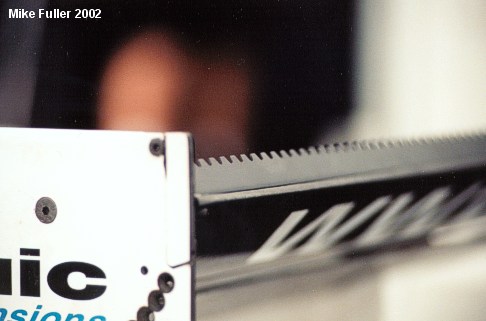
Anyone ever try a Gurney lip on their trunk lid? I know they help smooth the airflow out at the trailing edge of the wing, and reduce drag. Is it possible it could work with the mostly un-aerodynamic back end of a Civic Coupe? Or am I just trying to be an innovative *** and barking up the wrong tree?


Thread Starter
Honda-Tech Member
Joined: Dec 2003
Posts: 961
Likes: 0
From: North Las Vegas, NV, USA
Re: Gurney Lip? (chad)
It doesn't necessarily have to have a sawtooth edge. Here's something I found from the All American Racers website. http://www.allamericanracers.com

"Picture the trailing edge of the wing cross-section, with the Gurney pointing upwards and the airflow moving from left to right (above). At the trailing edge, the airflow immediately beneath the wing rolls into a small anti-clockwise vortex behind the Gurney. Immediately above this, a second small vortex, rotating in the opposite direction, is formed by the airflow traveling above the wing as it passes over the gurney's lip. together these two vortices form a small separation bubble - a rotating mass of air removed from the main flow - which is somewhat taller overall than the gurney itself.
In clearing this separation bubble, the airflow's vertical deflection is increased and hence downforce increases. Additionally, separation of airflow from the wing's lower surface is postponed, allowing a higher angle of attack to be used before stall, which further enhances the wing's effectiveness. "
I'm thinking now, that since there is quite a large separation of air between what's coming over the car, and what's coming underneath, it probably wouldn't do much of anything. Maybe with a more aerodynamic back end, akin to a Prototype sports car, it would work, but I think I'm barking up the wrong tree. Maybe I'll try it someday, though, just to see if it works.
Some more on the history of the Gurney Flap, from the same website:
"Few people, even the greats of motorsport, get to have their moniker attached to something they invented. Colin Chapman, perhaps the greatest innovator of them all, had only the Chapman strut named after him, and that was hardly his finest creation. For a driver-turned-team owner to enjoy the privilege is virtually unknown. There's no Brabham caliper or Surtees inlet, for instance, or Prost linkage come to that. But there is a Gurney Flap, named after Dan Gurney - a device, moreover, which has retained its currency in a way that Chapman's minimalist rear suspension never did.
If you understand anything of aerodynamics you'll know what a flap is: a (generally) hinged device at the trailing edge of a wing which can be lowered to increase lift when an aircraft is taking off or landing. The prolonged whirring you often hear a few minutes before a commercial airliner touches down is the flaps being deployed: large, hydraulically-actuated auxiliary surfaces which sprout from the rear of the wing and curl down like a crooked finger.
A Gurney Flap - often called simply a Gurney or a wickerbill in the US - is nothing like as sophisticated. Classically it's no more complex than a length of aluminum right-angle rigidly bolted or riveted to a wing's trailing edge. Usually it's a wing intended to keep a racing car on the road, although the Gurney Flap does also see some aircraft service, on helicopter tailplanes for example. Crude as it looks, it serves essentially the same purpose as the complex flap on an aircraft wing it increases lift or, in this instance, downforce.
Conception of the Flap was, to use Dan Gurney's own description, a classic example of necessity being the mother of invention. It happened in 1971 while his AAR team was testing its new USAC car at Phoenix, prior to the season's first race there. The car was too slow and everyone knew it. Towards the end of the third and last day of testing, driver Bobby Unser challenged 'the boss' to come up with a solution, and Gurney suggested the flap. He'd seen the success Richie Ginther had had experimenting with spoilers on Ferrari sportscars and wondered what would happen if a small spoiler was fitted along a wing's trailing edge.
In 45 minutes or so, the first Gurney Flap was fabricated and attached to the car's rear wing, and Unser went out again. Within a couple of laps it was clear he was circulating no faster than before and everyone in the pit assumed the flap was a failure. But when Unser came in he called Gurney over and quietly asked him whether anyone was around to spy on what they were doing. Once Gurney had confirmed they were alone, Unser told him the rear was now so well planted that the car was pushing (understeering) badly, hence the poor lap times. All they needed to do was restore the aerodynamic balance by adding more front-end downforce and the car would be transformed.
For most of that first season, none of the other teams cottoned on to what Gurney had achieved. Anyone who asked was told that the flap was a purely structural feature to strengthen the wing's trailing edge. Taken in by this, some teams tried fitting Gurneys on the underside of the wing with predictable results: they lost lap time or worse. Eventually word got around that the Flap was an Eagle secret weapon and everybody started using it, whether they understood its function or not. As Carroll Smith bluntly observed in Tune To Win, "It was a case of monkey see monkey do".
Gurney, meanwhile, had allowed McDonnell Douglas in on the secret and was given access to an old wind tunnel in which to test it. Measurements on the test wing showed that fitting the Gurney Flap affected pressure across the wing's entire upper and lower surface, increasing lift (or downforce) and reducing flow separation on the wing's suction side. Gurney placed the patenting of the device in the hands of McDonnell Douglas and, for some years after, AAR cars used to carry 'Pat Pend' scripts on their wings.
This patenting effort, however, eventually came to nothing, not least because one Edward F Zaparka had patented a similar device as far back as the early 1930s. As Dan wryly pointed out when he faxed me a copy of Zaparka's patent, it was originally filed on 3 April 1931 - exactly 10 days before one Daniel Sexton Gurney was born.
Dr Bob Liebeck, the McDonnell Douglas aerodynamicist hired by AAR as a consultant to help design its cars in the 1970s, was the first to hypothesize that the Gurney Flap's effect was the result of small twin vortices generated immediately downstream of its lip. Various studies conducted since have confirmed this, the most recent being by researchers at both Southampton and Glasgow universities. Sponsored by Penske Cars, this used a technique called laser Doppler anemometry (LDA) to measure the direction and speed of airflow across a tightly-packed grid of points downstream of the Gurney.
Thirty years on from its first, mysterious appearance, the Gurney Flap is still widely utilized in motorsport as an inexpensive and effective aerodynamic tweak. Fitting or removing a Gurney, or changing its height, are quick, straightforward-to-do and repeatable ways of tuning a car's set-up.
Insignificant as it looks, this deceptively simple device has helped win countless races over the years - which must make it a very gratifying thing to carry your name."

"Picture the trailing edge of the wing cross-section, with the Gurney pointing upwards and the airflow moving from left to right (above). At the trailing edge, the airflow immediately beneath the wing rolls into a small anti-clockwise vortex behind the Gurney. Immediately above this, a second small vortex, rotating in the opposite direction, is formed by the airflow traveling above the wing as it passes over the gurney's lip. together these two vortices form a small separation bubble - a rotating mass of air removed from the main flow - which is somewhat taller overall than the gurney itself.
In clearing this separation bubble, the airflow's vertical deflection is increased and hence downforce increases. Additionally, separation of airflow from the wing's lower surface is postponed, allowing a higher angle of attack to be used before stall, which further enhances the wing's effectiveness. "
I'm thinking now, that since there is quite a large separation of air between what's coming over the car, and what's coming underneath, it probably wouldn't do much of anything. Maybe with a more aerodynamic back end, akin to a Prototype sports car, it would work, but I think I'm barking up the wrong tree. Maybe I'll try it someday, though, just to see if it works.
Some more on the history of the Gurney Flap, from the same website:
"Few people, even the greats of motorsport, get to have their moniker attached to something they invented. Colin Chapman, perhaps the greatest innovator of them all, had only the Chapman strut named after him, and that was hardly his finest creation. For a driver-turned-team owner to enjoy the privilege is virtually unknown. There's no Brabham caliper or Surtees inlet, for instance, or Prost linkage come to that. But there is a Gurney Flap, named after Dan Gurney - a device, moreover, which has retained its currency in a way that Chapman's minimalist rear suspension never did.
If you understand anything of aerodynamics you'll know what a flap is: a (generally) hinged device at the trailing edge of a wing which can be lowered to increase lift when an aircraft is taking off or landing. The prolonged whirring you often hear a few minutes before a commercial airliner touches down is the flaps being deployed: large, hydraulically-actuated auxiliary surfaces which sprout from the rear of the wing and curl down like a crooked finger.
A Gurney Flap - often called simply a Gurney or a wickerbill in the US - is nothing like as sophisticated. Classically it's no more complex than a length of aluminum right-angle rigidly bolted or riveted to a wing's trailing edge. Usually it's a wing intended to keep a racing car on the road, although the Gurney Flap does also see some aircraft service, on helicopter tailplanes for example. Crude as it looks, it serves essentially the same purpose as the complex flap on an aircraft wing it increases lift or, in this instance, downforce.
Conception of the Flap was, to use Dan Gurney's own description, a classic example of necessity being the mother of invention. It happened in 1971 while his AAR team was testing its new USAC car at Phoenix, prior to the season's first race there. The car was too slow and everyone knew it. Towards the end of the third and last day of testing, driver Bobby Unser challenged 'the boss' to come up with a solution, and Gurney suggested the flap. He'd seen the success Richie Ginther had had experimenting with spoilers on Ferrari sportscars and wondered what would happen if a small spoiler was fitted along a wing's trailing edge.
In 45 minutes or so, the first Gurney Flap was fabricated and attached to the car's rear wing, and Unser went out again. Within a couple of laps it was clear he was circulating no faster than before and everyone in the pit assumed the flap was a failure. But when Unser came in he called Gurney over and quietly asked him whether anyone was around to spy on what they were doing. Once Gurney had confirmed they were alone, Unser told him the rear was now so well planted that the car was pushing (understeering) badly, hence the poor lap times. All they needed to do was restore the aerodynamic balance by adding more front-end downforce and the car would be transformed.
For most of that first season, none of the other teams cottoned on to what Gurney had achieved. Anyone who asked was told that the flap was a purely structural feature to strengthen the wing's trailing edge. Taken in by this, some teams tried fitting Gurneys on the underside of the wing with predictable results: they lost lap time or worse. Eventually word got around that the Flap was an Eagle secret weapon and everybody started using it, whether they understood its function or not. As Carroll Smith bluntly observed in Tune To Win, "It was a case of monkey see monkey do".
Gurney, meanwhile, had allowed McDonnell Douglas in on the secret and was given access to an old wind tunnel in which to test it. Measurements on the test wing showed that fitting the Gurney Flap affected pressure across the wing's entire upper and lower surface, increasing lift (or downforce) and reducing flow separation on the wing's suction side. Gurney placed the patenting of the device in the hands of McDonnell Douglas and, for some years after, AAR cars used to carry 'Pat Pend' scripts on their wings.
This patenting effort, however, eventually came to nothing, not least because one Edward F Zaparka had patented a similar device as far back as the early 1930s. As Dan wryly pointed out when he faxed me a copy of Zaparka's patent, it was originally filed on 3 April 1931 - exactly 10 days before one Daniel Sexton Gurney was born.
Dr Bob Liebeck, the McDonnell Douglas aerodynamicist hired by AAR as a consultant to help design its cars in the 1970s, was the first to hypothesize that the Gurney Flap's effect was the result of small twin vortices generated immediately downstream of its lip. Various studies conducted since have confirmed this, the most recent being by researchers at both Southampton and Glasgow universities. Sponsored by Penske Cars, this used a technique called laser Doppler anemometry (LDA) to measure the direction and speed of airflow across a tightly-packed grid of points downstream of the Gurney.
Thirty years on from its first, mysterious appearance, the Gurney Flap is still widely utilized in motorsport as an inexpensive and effective aerodynamic tweak. Fitting or removing a Gurney, or changing its height, are quick, straightforward-to-do and repeatable ways of tuning a car's set-up.
Insignificant as it looks, this deceptively simple device has helped win countless races over the years - which must make it a very gratifying thing to carry your name."

Honda-Tech Member
Joined: Dec 2001
Posts: 4,035
Likes: 0
From: Greensboro, NC, USA
Re: Gurney Lip? (chad)
A Gurney increases negative lift out of proportion to its cost in drag so it is a very useful tool. It only enhances the lift-generating action of an airfoil however - at least in its typical scale - so would be of little use on a stock bodyshell.
A traditional plate spoiler (a la NASCAR) is essentially the same thing, scaled up to the point that it makes a measurable difference in that application.
K
A traditional plate spoiler (a la NASCAR) is essentially the same thing, scaled up to the point that it makes a measurable difference in that application.
K

Honda-Tech Member
Joined: Jan 2003
Posts: 3,144
Likes: 3
From: Union, KY, USA
Re: Gurney Lip? (FormulaIntegra)
Thanks for the interesting info. I'll likely never use one but I now have a better understanding and history of an item that I have seen and heard of before.
Trending Topics

Honda-Tech Member
Joined: Jan 2000
Posts: 1,771
Likes: 1
From: Charlotte, NC, USA
Re: Gurney Lip? (FormulaIntegra)
I would think controlling the separation coming off the bottom with a diffuser (or some other way to increase the upward draft angle) would be much more useful though obviously more involved. A wingless Civic Coupe trunk lid is close to parallel with the ground, so I would say that a small Gurney flap would only provide additional drag. A G flap on a wing makes this a different story. 
Thread Starter
Honda-Tech Member
Joined: Dec 2003
Posts: 961
Likes: 0
From: North Las Vegas, NV, USA
Re: Gurney Lip? (GSpeedR)
<TABLE WIDTH="90%" CELLSPACING=0 CELLPADDING=0 ALIGN=CENTER><TR><TD>Quote, originally posted by GSpeedR »</TD></TR><TR><TD CLASS="quote">I would think controlling the separation coming off the bottom with a diffuser (or some other way to increase the upward draft angle) would be much more useful though obviously more involved. A wingless Civic Coupe trunk lid is close to parallel with the ground, so I would say that a small Gurney flap would only provide additional drag. A G flap on a wing makes this a different story. </TD></TR></TABLE>
That's the same conclusion I've come to.
<TABLE WIDTH="90%" CELLSPACING=0 CELLPADDING=0 ALIGN=CENTER><TR><TD>Quote, originally posted by Knestis »</TD></TR><TR><TD CLASS="quote">A traditional plate spoiler (a la NASCAR) is essentially the same thing, scaled up to the point that it makes a measurable difference in that application.K</TD></TR></TABLE>
Is it safe to assume these aren't allowed in Honda Challenge, or IT rules, since they are effectively reshaping the body? Eventually, I plan on installing a wing, so I don't think adding a nascar plate spoiler would be necessary, or intelligent for a FWD, naturally understeering car, no? I should probably concentrate more on a front airdam/splitter.
Thanks for the comments.
</TD></TR></TABLE>That's the same conclusion I've come to.
<TABLE WIDTH="90%" CELLSPACING=0 CELLPADDING=0 ALIGN=CENTER><TR><TD>Quote, originally posted by Knestis »</TD></TR><TR><TD CLASS="quote">A traditional plate spoiler (a la NASCAR) is essentially the same thing, scaled up to the point that it makes a measurable difference in that application.K</TD></TR></TABLE>
Is it safe to assume these aren't allowed in Honda Challenge, or IT rules, since they are effectively reshaping the body? Eventually, I plan on installing a wing, so I don't think adding a nascar plate spoiler would be necessary, or intelligent for a FWD, naturally understeering car, no? I should probably concentrate more on a front airdam/splitter.
Thanks for the comments.


Honda-Tech Member
Joined: Jul 2003
Posts: 542
Likes: 0
From: Delaware, OH, 43015
Re: Gurney Lip? (FormulaIntegra)
[QUOTE=FormulaIntegra]Is it safe to assume these aren't allowed in Honda Challenge, or IT rules, since they are effectively reshaping the body? Eventually, I plan on installing a wing, so I don't think adding a nascar plate spoiler would be necessary, or intelligent for a FWD, naturally understeering car, no? I should probably concentrate more on a front airdam/splitter.
[/QUOTE
Read the rules. HC allows wings & spoilers.
Gurney lip basically allow a wing to act like a bigger wing without the same proportional increase in drag.
[/QUOTE
Read the rules. HC allows wings & spoilers.
Gurney lip basically allow a wing to act like a bigger wing without the same proportional increase in drag.

Honda-Tech Member
Joined: Nov 2001
Posts: 3,968
Likes: 1
From: Austin, Tx, USA
Re: Gurney Lip? (jpl95si)
How effective are those NASCAR-style spoilers anyway? Do they create more drag then lift (They look like they would) then a airfoil-on-stilts-style spoiler?
Also, has anyone ever seen vortex generators on a automotive spoiler, either in the front or rear?

Also, has anyone ever seen vortex generators on a automotive spoiler, either in the front or rear?

Honda-Tech Member
Joined: Jan 2001
Posts: 1,917
Likes: 0
From: Bench, Racer
Re: Gurney Lip? (Greyout)
is the vortex generator in the case shown above effectively doing the same thing as making the top profile of that wing larger, giving the air a longer distance to traverse before it rejoins the air passing the bottom of the wing? thats what creates lift right?

Joined: Aug 2002
Posts: 1,125
Likes: 0
From: 15 percent slip, FL, USA
Re: Gurney Lip? (SBE)
<TABLE WIDTH="90%" CELLSPACING=0 CELLPADDING=0 ALIGN=CENTER><TR><TD>Quote, originally posted by SBE »</TD></TR><TR><TD CLASS="quote">is the vortex generator in the case shown above effectively doing the same thing as making the top profile of that wing larger, giving the air a longer distance to traverse before it rejoins the air passing the bottom of the wing? thats what creates lift right?</TD></TR></TABLE>
The vortex generators shown above on upper surface of the airplane wing create vortices that are parallel to the airstream. This energizes the boundary layer by mixing the faster-moving air that's further from the wing with the slow air at the surface of the wing. This delays separation, thus allowing the wing to operate at a higher angle of attack, thus generating more lift.
The vortex generators shown above on upper surface of the airplane wing create vortices that are parallel to the airstream. This energizes the boundary layer by mixing the faster-moving air that's further from the wing with the slow air at the surface of the wing. This delays separation, thus allowing the wing to operate at a higher angle of attack, thus generating more lift.

Joined: Jan 2002
Posts: 4,931
Likes: 0
From: formerly elgorey, VIRginia
Re: Gurney Lip? (Greyout)
<TABLE WIDTH="90%" CELLSPACING=0 CELLPADDING=0 ALIGN=CENTER><TR><TD>Quote, originally posted by Greyout »</TD></TR><TR><TD CLASS="quote">How effective are those NASCAR-style spoilers anyway? Do they create more drag then lift (They look like they would) then a airfoil-on-stilts-style spoiler?</TD></TR></TABLE>
yes, they create a huge amount of drag, and is part of the package to slow cars down on the super speedways.
This is why teams will take those flaps on the roof that pop up when the car spins and prop them up as much as they can sneak by the tech inspectors. It bumps the air up and over the rear spoiler.
yes, they create a huge amount of drag, and is part of the package to slow cars down on the super speedways.
This is why teams will take those flaps on the roof that pop up when the car spins and prop them up as much as they can sneak by the tech inspectors. It bumps the air up and over the rear spoiler.

Honda-Tech Member
Joined: Jan 2000
Posts: 1,288
Likes: 0
From: Fort Worth, TX
Re: Gurney Lip? (Agent Smith)
<TABLE WIDTH="90%" CELLSPACING=0 CELLPADDING=0 ALIGN=CENTER><TR><TD>Quote, originally posted by Agent Smith »</TD></TR><TR><TD CLASS="quote">
The vortex generators shown above on upper surface of the airplane wing create vortices that are parallel to the airstream. This energizes the boundary layer by mixing the faster-moving air that's further from the wing with the slow air at the surface of the wing. This delays separation, thus allowing the wing to operate at a higher angle of attack, thus generating more lift.
</TD></TR></TABLE>
Vortex generators can also trip the flow into turbulence and reattach it if you get the geometry right. I was planning on trying this with my Aerospace buddy on my 240SX at some point as a fun learning project. Namely I was going to try to reattach the flow to the hatch area after it separates about 2/3 down the roof area.
The vortex generators shown above on upper surface of the airplane wing create vortices that are parallel to the airstream. This energizes the boundary layer by mixing the faster-moving air that's further from the wing with the slow air at the surface of the wing. This delays separation, thus allowing the wing to operate at a higher angle of attack, thus generating more lift.
</TD></TR></TABLE>
Vortex generators can also trip the flow into turbulence and reattach it if you get the geometry right. I was planning on trying this with my Aerospace buddy on my 240SX at some point as a fun learning project. Namely I was going to try to reattach the flow to the hatch area after it separates about 2/3 down the roof area.
Honda-Tech Member
Joined: Jan 2000
Posts: 1,771
Likes: 1
From: Charlotte, NC, USA
Re: Gurney Lip? (Def)
<TABLE WIDTH="90%" CELLSPACING=0 CELLPADDING=0 ALIGN=CENTER><TR><TD>Quote, originally posted by Def »</TD></TR><TR><TD CLASS="quote">Vortex generators can also trip the flow into turbulence and reattach it if you get the geometry right. I was planning on trying this with my Aerospace buddy on my 240SX at some point as a fun learning project. Namely I was going to try to reattach the flow to the hatch area after it separates about 2/3 down the roof area.</TD></TR></TABLE>
Are you going to use tufts?
Are you going to use tufts?

Honda-Tech Member
Joined: Jul 2002
Posts: 859
Likes: 0
From: Memphis, TN, usa
Re: Gurney Lip? (GSpeedR)
So is the sawtooth designed gurney flap trying to incorporate the effects of the aforementioned 'vortex generator' into the design?
bonus worthless comment: We have an adjustable gurney flap of sorts on the girlfriends car (e36 m3). I haven't done a track day since the wing was installed to compare it stock and doubt I'm a good enough driver to notice. I'll be doing two more in the next two months and plan on removing it for one session to see how it effects or doesnt effect the car.
Fully extended it does make a noticable difference in mpg though on the street.


Modified by FritzInTN at 2:36 AM 7/30/2004
bonus worthless comment: We have an adjustable gurney flap of sorts on the girlfriends car (e36 m3). I haven't done a track day since the wing was installed to compare it stock and doubt I'm a good enough driver to notice. I'll be doing two more in the next two months and plan on removing it for one session to see how it effects or doesnt effect the car.
Fully extended it does make a noticable difference in mpg though on the street
.Modified by FritzInTN at 2:36 AM 7/30/2004
Joined: Aug 2002
Posts: 1,125
Likes: 0
From: 15 percent slip, FL, USA
Re: Gurney Lip? (FormulaIntegra)
<TABLE WIDTH="90%" CELLSPACING=0 CELLPADDING=0 ALIGN=CENTER><TR><TD>Quote, originally posted by FormulaIntegra »</TD></TR><TR><TD CLASS="quote">I would assume, then, that one could try these on the underside of a car wing to get a similar effect?</TD></TR></TABLE>
That would only be worthwhile if you were having problems with the flow separating (on a wing, this is generally referred to as stalling). Vortex generators are typically used as a bandaid to fix an underperforming design. They're rarely designed in from the start since they add cost, complexity, weight, and a small amount of drag. On the other hand, they can be very effective.
That would only be worthwhile if you were having problems with the flow separating (on a wing, this is generally referred to as stalling). Vortex generators are typically used as a bandaid to fix an underperforming design. They're rarely designed in from the start since they add cost, complexity, weight, and a small amount of drag. On the other hand, they can be very effective.
Honda-Tech Member
Joined: Nov 2001
Posts: 3,968
Likes: 1
From: Austin, Tx, USA
Re: Gurney Lip? (GSpeedR)
I wonder if vortex generators could be used at the back of a splitter (the end under the car), to get the air smoothly under the engine & onto the floor pan with less turbulence?

Honda-Tech Member
Joined: Jan 2004
Posts: 2,350
Likes: 1
From: Cerritos, CA, USA
Re: Gurney Lip? (Greyout)
<TABLE WIDTH="90%" CELLSPACING=0 CELLPADDING=0 ALIGN=CENTER><TR><TD>Quote, originally posted by Greyout »</TD></TR><TR><TD CLASS="quote">I wonder if vortex generators could be used at the back of a splitter (the end under the car), to get the air smoothly under the engine & onto the floor pan with less turbulence?
</TD></TR></TABLE>
Vortex generators are not used to smooth airflow in any case, they are strictly used to energize the thickening and sluggish boundary layer that's usually found in regions of adverse pressure gradient (i.e. areas where the flow is slowing down like the aft section of the underside of a racecar wing). This is not the case in the region you're speaking about.
</TD></TR></TABLE>
Vortex generators are not used to smooth airflow in any case, they are strictly used to energize the thickening and sluggish boundary layer that's usually found in regions of adverse pressure gradient (i.e. areas where the flow is slowing down like the aft section of the underside of a racecar wing). This is not the case in the region you're speaking about.


Thread
Thread Starter
Forum
Replies
Last Post
