


How realistic is it to create your own underbody panels?


Thread Starter
Junior Member
Joined: Aug 2003
Posts: 554
Likes: 0
From: BC, Canada
 How realistic is it to create your own underbody panels?
I'm wondering if anyone here has experience making/designing/testing their own underbody panels on hondas.
how hard (if possible) is it to make some that would create downforce?
my primary goal would be to reduce drag, particularly around the rear bumper (which in most hondas is open from underneath but there is nowhere for the air to go).
any opinions? thoughts? experiences?
how hard (if possible) is it to make some that would create downforce?
my primary goal would be to reduce drag, particularly around the rear bumper (which in most hondas is open from underneath but there is nowhere for the air to go).
any opinions? thoughts? experiences?

Honda-Tech Member

Joined: Aug 2002
Posts: 667
Likes: 1
From: Los Angeles, CRX Heaven
Re: How realistic is it to create your own underbody panels? (kablamo)
There is a guy in New Zealand who was trying for some sort of speed record in a CRX so he fabricated his own panels for under the car. As I recall, he used a sheet of heat resistant plastic.
On my '87 Si the under body is fairly smooth (not perfect but pretty good) with a central tunnel for the transmission linkage and exaust which acts like a venturi tunnel.
The way ground effects works is:
A) Create a smooth passage for air under the car.
B) Create a vacuum under the car so it gets sucked down to the road.
You are on the right track when you point to the rear bumper cover. It is hollow and acts like a drag parachute. On my car I "vented" the rear bumper cover like this:

So now the air passes more smoothly under the car.
To create the vacuum under the car, I created a smaller front opening under the car with a deeper front air dam. A small front opening and a large rear opening creates a tiny vacuum under the car.
Eventually, I will design and build a difuser for the rear on my car to more effeciently remove the air under the air, but for now this works pretty well.
Before venting the rear bumper cover, my car would get "squirrely" at speeds over 70mph. But now the car sits nicely at extra legal speeds.
Scott
On my '87 Si the under body is fairly smooth (not perfect but pretty good) with a central tunnel for the transmission linkage and exaust which acts like a venturi tunnel.
The way ground effects works is:
A) Create a smooth passage for air under the car.
B) Create a vacuum under the car so it gets sucked down to the road.
You are on the right track when you point to the rear bumper cover. It is hollow and acts like a drag parachute. On my car I "vented" the rear bumper cover like this:
So now the air passes more smoothly under the car.
To create the vacuum under the car, I created a smaller front opening under the car with a deeper front air dam. A small front opening and a large rear opening creates a tiny vacuum under the car.
Eventually, I will design and build a difuser for the rear on my car to more effeciently remove the air under the air, but for now this works pretty well.
Before venting the rear bumper cover, my car would get "squirrely" at speeds over 70mph. But now the car sits nicely at extra legal speeds.
Scott
 Re: How realistic is it to create your own underbody panels? (cbstd)
I've seen different types of diffusers.
One kind is like the underside of a ramp with vertical plates coming down.
The other the same ramp design but has another ramp underneath it held up by vertical plates. Sort of like those darth vader double deck wings the homeboys like.
Whats the best method for designing a diffuser?
One kind is like the underside of a ramp with vertical plates coming down.
The other the same ramp design but has another ramp underneath it held up by vertical plates. Sort of like those darth vader double deck wings the homeboys like.
Whats the best method for designing a diffuser?
Honda-Tech Member
Joined: Aug 2002
Posts: 667
Likes: 1
From: Los Angeles, CRX Heaven
Re: How realistic is it to create your own underbody panels? (Aquafina)
I would guess that the "best" diffuser is the one you design in your wind tunnel. Since I do not have access to a wind tunnel, I will poach a design from succesful racers like on the Le Mans prototypes which have the vertical vanes to control turbulence in the air passing under the car.
Scott
Scott

Honda-Tech Member
Joined: Feb 2000
Posts: 2,223
Likes: 0
From: Somewhere, doing a rain dance.
Re: How realistic is it to create your own underbody panels? (kablamo)
Keep in mind that front underbody panels have to allow for engine cooling. An awful lot of engine cooling air gets dumped underneath.
If you close it off, you run the risk of overheating... and you increase drag through the engine bay.
If you close it off, you run the risk of overheating... and you increase drag through the engine bay.
Thread Starter
Junior Member
Joined: Aug 2003
Posts: 554
Likes: 0
From: BC, Canada
Re: How realistic is it to create your own underbody panels? (maxQ)
<TABLE WIDTH="90%" CELLSPACING=0 CELLPADDING=0 ALIGN=CENTER><TR><TD>Quote, originally posted by maxQ »</TD></TR><TR><TD CLASS="quote">Keep in mind that front underbody panels have to allow for engine cooling. An awful lot of engine cooling air gets dumped underneath.
If you close it off, you run the risk of overheating... and you increase drag through the engine bay.
</TD></TR></TABLE>
yes i understand the need for cooling in the engine bay.
i'm mainly concerned about the rear half of the car, like i said around the rear bumper and the rear suspension somewhat.
CBSTD, i'm curious why did you trim the rear bumper as opposed to say putting plastic sheeting between the bumper and the body, to prevent the air from getting trapped in the first place?
If you close it off, you run the risk of overheating... and you increase drag through the engine bay.
</TD></TR></TABLE>
yes i understand the need for cooling in the engine bay.
i'm mainly concerned about the rear half of the car, like i said around the rear bumper and the rear suspension somewhat.
CBSTD, i'm curious why did you trim the rear bumper as opposed to say putting plastic sheeting between the bumper and the body, to prevent the air from getting trapped in the first place?

Honda-Tech Member
Joined: Feb 2004
Posts: 375
Likes: 0
From: South Carolina
Re: How realistic is it to create your own underbody panels? (kablamo)
You have opend a pandoras box you know. Congrats..i have thought of the same thing..it doesn't seem the trouble scares me.
I have the joy of playing with a Formula Continental and having driven downforce cars, so other than the CRX i have a little bit of work on this. Anyway...some points.
Much of the air that gets under a street car actually comes from the sides. Side skirts running the length of the rockers would do wonders, without having to worry about the pros and cons that come later.
Desiging a diffuser. Some basics.
#1, it better be of a strong and light material. If you create it right, it will suck itself off the car, or just flex and break. This is why honeycomb, and carbon fiber works well. I used to think just go with a sheet of fiberglass...it wont work it neds something to support it.
#2 Air needs to be laminar before the break (where it sweeps up) a breaks optimum angle of rise is 7%. There is also some length ahead of it thats "too long" and the air will seperate anyway, non laminar flow wont help much. Gerneraly, the mosre slats (verticle dividers) the better from what i hear...but if this is the case why do we only see 1 every couple of inches on the LMP 900s... i am thinking that there is a praticality issue there.
#3 you need to "trap" the air under the diffuser. if you allow it to spill out from the sides, it isn't going to help much. 2 ways that the air will "spill" 1) the sides of the diffuser are not low enough, and the air just squeezes out. 2) the car rolls inthe corner, and it lifts one of the sides of the diffuser, letting the air out.
#4 more downforce means different suspension behavior. now you need stiffer springs and shocks valved differently. your suspension is going to act differently, and now you have to change alignments..etc
So now we know that going the downforce rout you need a strong material, the area in front of the diffuser is as important as the diffuser itself, and your set-ups are all going to change. (god i wish i had the time and $ to try it on a CRX..i really think it would work)
Things that will work without much change: A good chin lip, continuing it back a little ways to cut air from going under the car. Side skirts, that dont let the air come around the front wheels and get pulled under the car.
For me, i think i will dream for now, and go buy the $500 pre-built diffuser for my Formula Continental. (then figure out how big a spring rate change i need)
Jon K
http://www.seat-time.com
I have the joy of playing with a Formula Continental and having driven downforce cars, so other than the CRX i have a little bit of work on this. Anyway...some points.
Much of the air that gets under a street car actually comes from the sides. Side skirts running the length of the rockers would do wonders, without having to worry about the pros and cons that come later.
Desiging a diffuser. Some basics.
#1, it better be of a strong and light material. If you create it right, it will suck itself off the car, or just flex and break. This is why honeycomb, and carbon fiber works well. I used to think just go with a sheet of fiberglass...it wont work it neds something to support it.
#2 Air needs to be laminar before the break (where it sweeps up) a breaks optimum angle of rise is 7%. There is also some length ahead of it thats "too long" and the air will seperate anyway, non laminar flow wont help much. Gerneraly, the mosre slats (verticle dividers) the better from what i hear...but if this is the case why do we only see 1 every couple of inches on the LMP 900s... i am thinking that there is a praticality issue there.
#3 you need to "trap" the air under the diffuser. if you allow it to spill out from the sides, it isn't going to help much. 2 ways that the air will "spill" 1) the sides of the diffuser are not low enough, and the air just squeezes out. 2) the car rolls inthe corner, and it lifts one of the sides of the diffuser, letting the air out.
#4 more downforce means different suspension behavior. now you need stiffer springs and shocks valved differently. your suspension is going to act differently, and now you have to change alignments..etc
So now we know that going the downforce rout you need a strong material, the area in front of the diffuser is as important as the diffuser itself, and your set-ups are all going to change. (god i wish i had the time and $ to try it on a CRX..i really think it would work)
Things that will work without much change: A good chin lip, continuing it back a little ways to cut air from going under the car. Side skirts, that dont let the air come around the front wheels and get pulled under the car.
For me, i think i will dream for now, and go buy the $500 pre-built diffuser for my Formula Continental. (then figure out how big a spring rate change i need)
Jon K
http://www.seat-time.com
Trending Topics

Joined: May 2002
Posts: 43
Likes: 0
Re: How realistic is it to create your own underbody panels? (kablamo)
Depends on how you want everything to connect. For weight, get some luan (1/8" to 1/4" board), yet very flexible. Take measurements and add two inches all the way around. Fit it again and get more precise measurements. Use the luan to make some diffusers. Then when you're done, use the luan as a mold and make a fiberglass version. Also, look in theyellow pages under "Plasitc" look for a "Plastic Manufacturer or Wholesaler". Go to them and look at what they have...they have all types of different plastic. Get ABS plastic about 1/8" thick. You can also use carbon fiber...the options go on... Take your time fabricating the piece.

Honda-Tech Member
Joined: Dec 2002
Posts: 5,778
Likes: 1
From: BeaveRun, PA, USA
Re: How realistic is it to create your own underbody panels? (just4fun)
If you guys are members at Team-integra.net....there is a guy on there who made his own underbody panels and a rear diffuser. Turned out great with some sheet metal and rivets!
here's a preview...
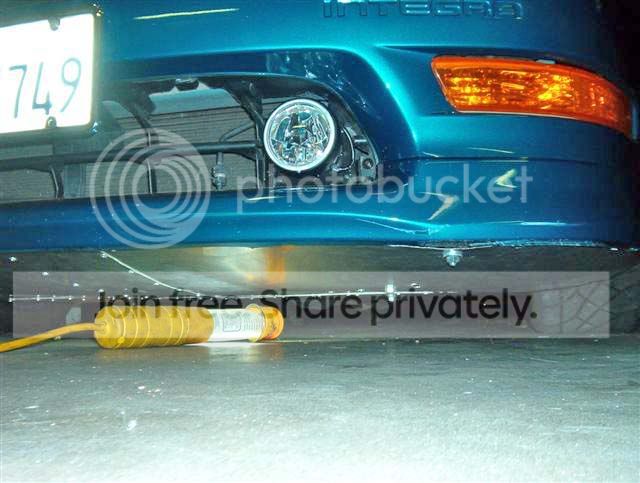
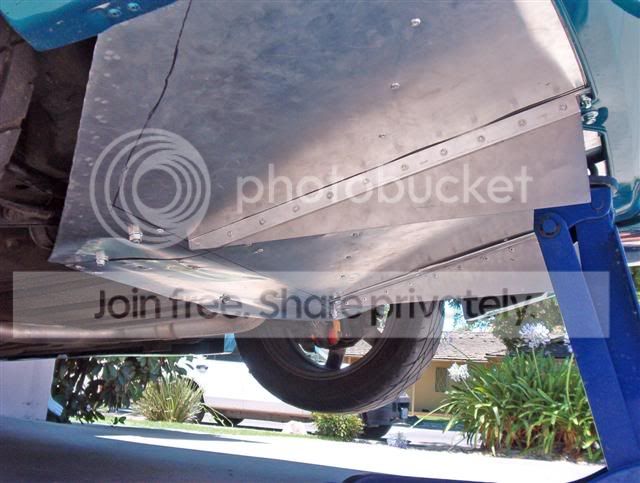
here's a preview...
Honda-Tech Member
Joined: Feb 2004
Posts: 375
Likes: 0
From: South Carolina
Re: How realistic is it to create your own underbody panels? (ScreaminTeg)
i think thats a step in the right direction, but with no smooth area in front of it, its not going to be very functional. you would at least have to add a flat section beneath the passenger compartment.
Jon K
http://www.seat-time.com
Jon K
http://www.seat-time.com

Joined: Feb 2003
Posts: 120
Likes: 0
From: san jose, ca, USA
Re: How realistic is it to create your own underbody panels? (kablamo)
It is simple. For my race cars I go to a sige making place and get a 8 by 10 foot peice of dibond. Its abs-aluminum-abs about as think as a carboard peice. Its light and smooth, and strong. SCCA only allows you from the middle of the front wheels up, and from the middle of the back wheels back.
You don't really need a wind tunnel. If you cover the entire underside of the car, it turns it into a upsidedown wing, and thus creative downforce not lift.
For the defusor part if you can find a peice of stirafoam and cut out the shape you want lay carbon fiber in the mold you made and cover evenlly with resin. presto defusor.
Dan
http://www.akarimotorsports.com
You don't really need a wind tunnel. If you cover the entire underside of the car, it turns it into a upsidedown wing, and thus creative downforce not lift.
For the defusor part if you can find a peice of stirafoam and cut out the shape you want lay carbon fiber in the mold you made and cover evenlly with resin. presto defusor.
Dan
http://www.akarimotorsports.com
Thread Starter
Junior Member
Joined: Aug 2003
Posts: 554
Likes: 0
From: BC, Canada
Re: How realistic is it to create your own underbody panels? (coos)
Ok so assuming i find an appropriate material (cost/weight/workable) to create these underbody panels and diffusers, what are the areas that need the most improvement?
I mean, beneath the footwells, the floor pan of the car is relatively smooth, with no major pieces that could interfere - so would that be a low priority part, or would turbulence there interefere with a "car long" design?
also, i'm presuming that a car needs to be quite low to maximize the downforce gains from diffusers (hence any kind of formula car sits very low), but how low is necessary to see decent gains (i'm talking independently of suspension tuning...). Is ride height requirements dependent on the design/size of the diffusers - whereas smaller diffusers require the car to be lower to work while larger diffusers can work even with a few inches of groung clearance?
I mean, beneath the footwells, the floor pan of the car is relatively smooth, with no major pieces that could interfere - so would that be a low priority part, or would turbulence there interefere with a "car long" design?
also, i'm presuming that a car needs to be quite low to maximize the downforce gains from diffusers (hence any kind of formula car sits very low), but how low is necessary to see decent gains (i'm talking independently of suspension tuning...). Is ride height requirements dependent on the design/size of the diffusers - whereas smaller diffusers require the car to be lower to work while larger diffusers can work even with a few inches of groung clearance?
Honda-Tech Member
Joined: Dec 2002
Posts: 5,778
Likes: 1
From: BeaveRun, PA, USA
Re: How realistic is it to create your own underbody panels? (kablamo)
kablamo...one of the critical parts of these panels is the rear diffuser. I borrowed an image from Team-Integra and Automotivetech.org ro show just how you want to aim your airflow.
You want air that enters the front air damn to be channeled out the top of the car. Which is why you see the Mugen hoods have the reverse scoop in it. That is to direct the air that enters your engine bay out and upward. This will now direct it over the top of the car aiding in less drag and higher downforce.
Now, any air that goes under your vehicle, should be directed straight under the car and to a rear diffuser. You will see that most rear diffusers are angled and channeled. This is to, once again, keep a low drag situation and help create downforce instead of lift. Check this image out....this is the diagram of the Mugen aerodynamics. They are one of the few, if not only, companies that actually aero tests their body products in wind tunnels.

You want air that enters the front air damn to be channeled out the top of the car. Which is why you see the Mugen hoods have the reverse scoop in it. That is to direct the air that enters your engine bay out and upward. This will now direct it over the top of the car aiding in less drag and higher downforce.
Now, any air that goes under your vehicle, should be directed straight under the car and to a rear diffuser. You will see that most rear diffusers are angled and channeled. This is to, once again, keep a low drag situation and help create downforce instead of lift. Check this image out....this is the diagram of the Mugen aerodynamics. They are one of the few, if not only, companies that actually aero tests their body products in wind tunnels.

Honda-Tech Member
Joined: Mar 2001
Posts: 2,578
Likes: 0
From: AWFUL autocrosser from, RI
Re: How realistic is it to create your own underbody panels? (kablamo)
Jeez! The Integra's aluminum work is VERY impressive! I'd merely like to fab up some sort of diffuser for the rear bumper of my daily driver to reduce more drag for better mpg!
Great thread
Great thread

Honda-Tech Member
Joined: Apr 2002
Posts: 1,599
Likes: 0
From: somewhere out there, CA
Re: How realistic is it to create your own underbody panels? (gamby)
the integra's rear diffuser is not bad for home made(it could be better)
wish i have pic of the one that i am building right now(for customer), i will post some with it is completed with using pre-prep.
wish i have pic of the one that i am building right now(for customer), i will post some with it is completed with using pre-prep.
Thread Starter
Junior Member
Joined: Aug 2003
Posts: 554
Likes: 0
From: BC, Canada
Re: How realistic is it to create your own underbody panels? (ScreaminTeg)
So basically you are saying that the rear diffuser's purpose is to allow air from underneath the car to flow upwards? and the cross "fins" are to straighten the air flow?
so any underbody panels (as long as they are smooth), and slope upwards at the back of the car would be good, and more fins are better...
right?
so any underbody panels (as long as they are smooth), and slope upwards at the back of the car would be good, and more fins are better...
right?

Thread Starter
Junior Member
Joined: Aug 2003
Posts: 554
Likes: 0
From: BC, Canada
Re: How realistic is it to create your own underbody panels? (RiceNmotioN)
<TABLE WIDTH="90%" CELLSPACING=0 CELLPADDING=0 ALIGN=CENTER><TR><TD>Quote, originally posted by RiceNmotioN »</TD></TR><TR><TD CLASS="quote">"Race Car Aerodynamics: Designing for Speed" by Joseph Katz
Read it.. best explaination you'll need
</TD></TR></TABLE>
Thanks!! will do!!
none of the books i've seen about racing have ever had much about aerodynamics particularly underbody.
Read it.. best explaination you'll need
</TD></TR></TABLE>
Thanks!! will do!!
none of the books i've seen about racing have ever had much about aerodynamics particularly underbody.

B*a*n*n*e*d
Joined: Apr 2004
Posts: 3,904
Likes: 1
From: Malt in yor moulth, boston
Re: How realistic is it to create your own underbody panels? (kablamo)
so would it work if i ued fiberglass with some small metal 1/8th" rods in it for support.. ultra smooth...

Honda-Tech Member
Joined: Sep 2002
Posts: 2,448
Likes: 0
From: Morgantown, wv, usa
Re: How realistic is it to create your own underbody panels? (DewMota)
Screw carbon fiber. Get your car 50lbs under weight for your class, then build a rear defuser out of steal to add 50lbs down low and in the back of the car 


Joined: Jun 2003
Posts: 485
Likes: 0
Re: How realistic is it to create your own underbody panels? (GSpeedR)
I own that book and was kind of disappointed in that it left me wanting more. It wasnt nearly as good as some of his better books . . . haven't gotten my hands on the Katz book yet.
<TABLE WIDTH="90%" CELLSPACING=0 CELLPADDING=0 ALIGN=CENTER><TR><TD>Quote, originally posted by GSpeedR »</TD></TR><TR><TD CLASS="quote">Also, try "Competition Car Downforce", though I haven't read it myself. </TD></TR></TABLE>
<TABLE WIDTH="90%" CELLSPACING=0 CELLPADDING=0 ALIGN=CENTER><TR><TD>Quote, originally posted by GSpeedR »</TD></TR><TR><TD CLASS="quote">Also, try "Competition Car Downforce", though I haven't read it myself. </TD></TR></TABLE>
Joined: Jun 2003
Posts: 485
Likes: 0
Re: How realistic is it to create your own underbody panels? (577HondaPrelude)
Umm. What I would do is prototype what you want to do with aluminum sheet and test with it. Then use the final aluminum panels as a mold for carbon parts. Id also use a thin foam core to save weight and dollars.
<TABLE WIDTH="90%" CELLSPACING=0 CELLPADDING=0 ALIGN=CENTER><TR><TD>Quote, originally posted by 577HondaPrelude »</TD></TR><TR><TD CLASS="quote">Screw carbon fiber. Get your car 50lbs under weight for your class, then build a rear defuser out of steal to add 50lbs down low and in the back of the car</TD></TR></TABLE>
<TABLE WIDTH="90%" CELLSPACING=0 CELLPADDING=0 ALIGN=CENTER><TR><TD>Quote, originally posted by 577HondaPrelude »</TD></TR><TR><TD CLASS="quote">Screw carbon fiber. Get your car 50lbs under weight for your class, then build a rear defuser out of steal to add 50lbs down low and in the back of the car
</TD></TR></TABLE>

Joined: Jan 2004
Posts: 88
Likes: 0
From: Albuquerque, NM, USA
Re: How realistic is it to create your own underbody panels? (eHoward)
You need to remember, that underbody downforce is created by accelerating the air underneath the car (i.e. the air moving under the car is traveling faster than the airflow around or above the car). If the car is not a true flat bottom car i.e. road car you are going to get tumbling of the air due to things like trany, exhaust, and any other piece that may protrude into the airflow. Tumbling or turbulence is a BAD thing and will not assist in moving the air faster. IMHO homemade diffusers COULD help by cleaning up the airflow from the rear of the vehicle, but any gains in real downforce would be negligible.
Thread Starter
Junior Member
Joined: Aug 2003
Posts: 554
Likes: 0
From: BC, Canada
Re: How realistic is it to create your own underbody panels? (Blackhorse6)
Assuming any realistically attainable gains in downforce are almost impossible though, it would still contribute significantly to reducing the vehicle's overall wind resistance, right?