


PINNED block by endyn...opinions?


Thread Starter
I'm a Jackass
Joined: Jun 2003
Posts: 925
Likes: 0
From: stillwater, ok, us
 PINNED block by endyn...opinions?
this block has been "pinned"...supposedly Larry fron Endyn has been doing it for years. The owner of the block got 400 horses from it. Anybody ever seen this before? seems like a cheaper alternative to sleeving, and better cooling than a blockguard.
 or
or  ???
???


Modified by Slimm-rw- at 3:51 AM 6/3/2004
or ??? Modified by Slimm-rw- at 3:51 AM 6/3/2004

Honda-Tech Member
Joined: Mar 2002
Posts: 14,296
Likes: 1
From: Charleston, SC
Re: PINNED block by endyn...opinions? (Slimm-rw-)
that is also known as block posting
Personally, I would sleeve or use a block guard but block posting has worked for many people in the past.
Personally, I would sleeve or use a block guard but block posting has worked for many people in the past.


Honda-Tech Member
Joined: Jun 2001
Posts: 2,763
Likes: 2
From: Dark Aether
Re: PINNED block by endyn...opinions? (Slimm-rw-)
I haven't seen a block like that from Larry. His normally look like this:
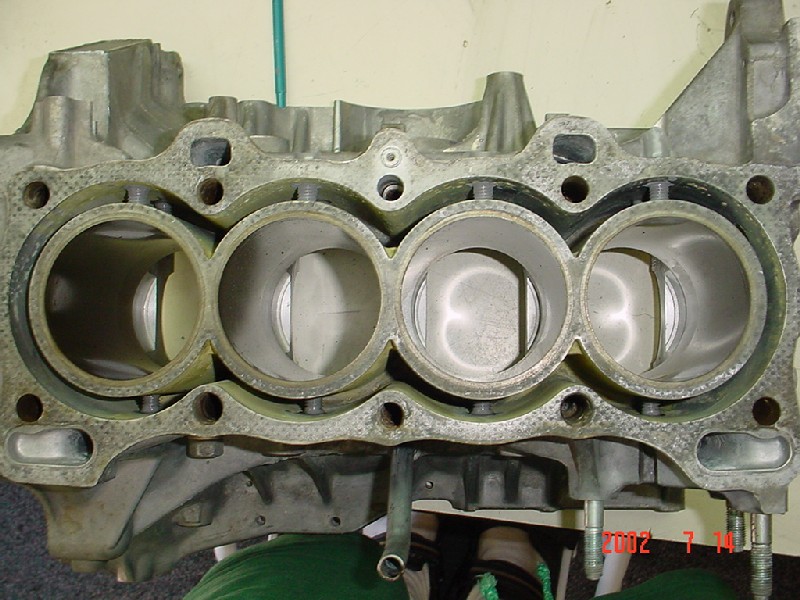
That's my block that Larry helped me post. The sleeves haven't seen boost yet, but I've got about 1500 miles on the engine and no problems with coolant leaks, oval cylinders, etc.
Sonny

Joined: Jan 2004
Posts: 79
Likes: 0
From: Hudson Valley, NY, United States
Re: PINNED block by endyn...opinions? (94goldjungsr)
Seem's like a nice concept but you still have the stock thickness of the OEM sleeve i think it would be good for low boost app's but i wouldn't trust it for any high boost. just my 2 cents.
Trending Topics

Honda-Tech Member
Joined: Feb 2002
Posts: 10,836
Likes: 0
From: SC61ville, Brooklyn, NY/TX, USA
Re: PINNED block by endyn...opinions? (Slimm-rw-)
I would trust Larrys judgement 100%, he's been doing this i think for over 20 years! Think about it like this, if he sucked or did things wrong, why would he still be in business. Here's some shots from my block when he was working on it.


threes
Joined: Nov 2003
Posts: 2,485
Likes: 0
From: Hot Hot heat, AZ
Re: PINNED block by endyn...opinions? (FredoSP)
i would have to say that posting your block like in the first pictures is a very bad idea. you are taking away metal from around the outside of the sleeve, making it weaker. even if you are replacing it with an aluminum post, there is still space in between the two, since theyre two separate pieces of metal. you are weakening your sleeves if you do this.

Member
Joined: Aug 2002
Posts: 2,384
Likes: 0
From: SoCal, ca
Re: PINNED block by endyn...opinions? (FredoSP)
<TABLE WIDTH="90%" CELLSPACING=0 CELLPADDING=0 ALIGN=CENTER><TR><TD>Quote, originally posted by FredoSP »</TD></TR><TR><TD CLASS="quote">I would trust Larrys judgement 100%, he's been doing this i think for over 20 years! Think about it like this, if he sucked or did things wrong, why would he still be in business. Here's some shots from my block when he was working on it.
</TD></TR></TABLE>
i was talking about the pining of the block, does he still do this??? id be surprised if he did...
your block doesnt have that done, how do you know it can be trusted???
Landon
</TD></TR></TABLE>
i was talking about the pining of the block, does he still do this??? id be surprised if he did...
your block doesnt have that done, how do you know it can be trusted???
Landon

Better than steak

Joined: Jan 2000
Posts: 16,859
Likes: 0
Re: PINNED block by endyn...opinions? (Slimm-rw-)
<TABLE WIDTH="90%" CELLSPACING=0 CELLPADDING=0 ALIGN=CENTER><TR><TD>Quote, originally posted by Slimm-rw- »</TD></TR><TR><TD CLASS="quote">this block has been "pinned"...supposedly Larry fron Endyn has been doing it for years. The owner of the block got 400 horses from it. Anybody ever seen this before? seems like a cheaper alternative to sleeving, and better cooling than a blockguard. By the way, its 250 shipped to my door 
or ???
</TD></TR></TABLE>
I an assure you that these pics you posted are not the work of Larry.
or ??? </TD></TR></TABLE>I an assure you that these pics you posted are not the work of Larry.
Better than steak
Joined: Jan 2000
Posts: 16,859
Likes: 0
Re: PINNED block by endyn...opinions? (Slimm-rw-)
I wouldnt get it. I can tell its not his because he posts his blocks like how sonny showed up above. Plus he doesnt like to have anything on top of the sleeves to keep coolant there.
art
art

Member
Joined: Apr 2002
Posts: 1,095
Likes: 0
From: Snailville, TX, USA
Re: PINNED block by endyn...opinions? (Arturbo)
I dont think Larry would put his name on that one. I have seen the quality of his work first hand and that definaltey isnt something that falls in that catagory.

Honda-Tech Member
Joined: Jan 2003
Posts: 524
Likes: 0
From: Ohio
Re: PINNED block by endyn...opinions? (c jackson)
<TABLE WIDTH="90%" CELLSPACING=0 CELLPADDING=0 ALIGN=CENTER><TR><TD>Quote, originally posted by c jackson »</TD></TR><TR><TD CLASS="quote">i would have to say that posting your block like in the first pictures is a very bad idea. you are taking away metal from around the outside of the sleeve, making it weaker. even if you are replacing it with an aluminum post, there is still space in between the two, since theyre two separate pieces of metal. you are weakening your sleeves if you do this. </TD></TR></TABLE>
You are correct. A weak spot(s) is being created where each of those "pins" are located. I learnered this in my Machine Design class in school. Now this sleeve is more prone to cracking where the material from the stock sleeve has been removed.
</TD></TR></TABLE>You are correct. A weak spot(s) is being created where each of those "pins" are located. I learnered this in my Machine Design class in school. Now this sleeve is more prone to cracking where the material from the stock sleeve has been removed.


Honda-Tech Member
Joined: May 2001
Posts: 1,058
Likes: 0
From: somewhere in the valley,, BC.
I think pinning addresses the problem of shifting sleeves, without the cooling issues that go along with using a block guard.
As for this being an "old" way of doing things, get your head out of your ***. It's not like building internal combustion engines was invented yesterday.....
Btw, as others have said, that is not an Endyn block, nor is it even pinned. It looks like someone built their own style of blockguard.
As for this being an "old" way of doing things, get your head out of your ***. It's not like building internal combustion engines was invented yesterday.....
Btw, as others have said, that is not an Endyn block, nor is it even pinned. It looks like someone built their own style of blockguard.

Honda-Tech Member
Joined: Aug 2002
Posts: 4,417
Likes: 0
From: ashEVILle, NC, USSR
Re: PINNED block by endyn...opinions? (MilanoRedLST)
<TABLE WIDTH="90%" CELLSPACING=0 CELLPADDING=0 ALIGN=CENTER><TR><TD>Quote, originally posted by MilanoRedLST »</TD></TR><TR><TD CLASS="quote">
You are correct. A weak spot(s) is being created where each of those "pins" are located. I learnered this in my Machine Design class in school. Now this sleeve is more prone to cracking where the material from the stock sleeve has been removed.</TD></TR></TABLE>
Yup.
First method displayed is pinning, the second method displayed is posting. I'm not a huge fan of posting. I've seen a couple of posted engines that came apart. Face facts and accept that the stock sleeves, which are ribbed and 0.060" at their thinnest, are going to swell under large cylinder pressures associated with big power turbo setups. When you place a post against the sleeve, at some point it restricts the bore's ability to swell and causes the sleeve to crack at 90 degree angles to where the post contacts the outside of the stock sleeve.
Don't take any of that the wrong way - I feel that block posting is a valid method of liner reinforcement, and an intermediate step between stock block and sleeves. It's just not good for as much power as some people I've talked to think that it is.
Modified by J. Davis at 11:15 PM 4/5/2004
You are correct. A weak spot(s) is being created where each of those "pins" are located. I learnered this in my Machine Design class in school. Now this sleeve is more prone to cracking where the material from the stock sleeve has been removed.</TD></TR></TABLE>
Yup.
First method displayed is pinning, the second method displayed is posting. I'm not a huge fan of posting. I've seen a couple of posted engines that came apart. Face facts and accept that the stock sleeves, which are ribbed and 0.060" at their thinnest, are going to swell under large cylinder pressures associated with big power turbo setups. When you place a post against the sleeve, at some point it restricts the bore's ability to swell and causes the sleeve to crack at 90 degree angles to where the post contacts the outside of the stock sleeve.
Don't take any of that the wrong way - I feel that block posting is a valid method of liner reinforcement, and an intermediate step between stock block and sleeves. It's just not good for as much power as some people I've talked to think that it is.
Modified by J. Davis at 11:15 PM 4/5/2004

Joined: Jul 2002
Posts: 40
Likes: 0
From: USA
Re: PINNED block by endyn...opinions? (MilanoRedLST)
I used to work at Endyn. I know larry well, and THAT is not larry's work. he is against block guards becuse they don't allow coolant to reach the top of the cylinder. "pinning" is an old light weight trick used in racing that works very well. I have seen exploded blocks where the pins are still intact. It also does not remove any material from the cylinder making it weaker as previously stated.

Thread
Thread Starter
Forum
Replies
Last Post
preludesi93-arg
Honda Prelude
4
Jun 19, 2005 06:44 AM
