


Breaking in your engine... think outside the box... VERY VERY LONG...


Thread Starter
Joined: Nov 2001
Posts: 1,770
Likes: 0
From: Racine, WI, USA
 Breaking in your engine... think outside the box... VERY VERY LONG...
Well since this is a section devoted to engine theory and tuning, I figured this would be a good place to post this information. This info requires you to let go of what you previously understood to be true. Just try to keep an open mind. I didn't come up with the information, and i will post a link to the original pages at the end of this thread.
I don't know if anyone else has come across this but here it goes.
How To Break In Your Engine For More Power & Less Wear !
One of the most critical parts of the engine building process is the break in !!
No matter how well an engine is assembled, it's final power output is all up to you !!
Although the examples shown here are motorcycle engines,
these principles apply to all 4 stroke engines:
Street or Race Motorcycles, Cars, Snowmobiles, Airplanes & yes ...
even Lawn Mowers !!
( regardless of brand, cooling type, or number of cylinders. )
These same break in techniques apply to both steel cylinders and Nikasil, as well as the ceramic
composite cylinders that Yamaha uses in it's motorcycles and snowmobiles.
What's the Best Way to Break in a New Engine ??
The Short Answer: Run it Hard !
Why ??
Nowadays, the piston ring seal is really what the break in process is all about. Contrary to popular belief, piston rings don't seal the combustion pressure by spring tension. Ring tension is necessary only to "scrape" the oil to prevent it from entering the combustion chamber.
If you think about it, the ring exerts maybe 5-10 lbs of spring tension against the cylinder wall ...
How can such a small amount of spring tension seal against thousands of
PSI (Pounds Per Square Inch) of combustion pressure ??
Of course it can't.
How Do Rings Seal Against Tremendous Combustion Pressure ??
From the actual gas pressure itself !! It passes over the top of the ring, and gets behind it to force it outward against the cylinder wall. The problem is that new rings are far from perfect and they must be worn in quite a bit in order to completely seal all the way around the bore. If the gas pressure is strong enough during the engine's first miles of operation (open that throttle !!!), then the entire ring will wear into
the cylinder surface, to seal the combustion pressure as well as possible.
The Problem With "Easy Break In" ...
The honed crosshatch pattern in the cylinder bore acts like a file to allow the rings to wear. The rings quickly wear down the "peaks" of this roughness, regardless of how hard the engine is run.
There's a very small window of opportunity to get the rings to seal really well ... the first 20 miles !!
If the rings aren't forced against the walls soon enough, they'll use up the roughness before they fully seat. Once that happens there is no solution but to re hone the cylinders, install new rings and start over again.
Fortunately, most new sportbike owners can't resist the urge to "open it up" once or twice,
which is why more engines don't have this problem !!
An additional factor that you may not have realized, is that the person at the dealership who set up your bike probably blasted your brand new bike pretty hard on the "test run". So, without realizing it, that adrenaline crazed set - up mechanic actually did you a huge favor !!
<FONT SIZE="5">Here's How To Do It:</FONT>
Because of the wind resistance, you don't need to use higher gears like you would on a dyno machine. The main thing is to load the engine by opening the throttle hard in 2nd, 3rd and 4th gear.
The best method is to alternate between short bursts of hard acceleration and deceleration. You don't have to go over 65 mph / 104 kph to properly load the rings. Also, make sure that you're not being followed by another bike or car when you decelerate, most drivers won't expect that you'll suddenly slow down, and we don't want
anyone to get hit from behind !!
The biggest problem with breaking your engine in on the street (besides police) is if you ride the bike on the freeway (too little throttle = not enough pressure on the rings) or if you get stuck in slow city traffic. For the first 200 miles or so, get out into the country where you can vary the speed more
and run it through the gears !
<FONT SIZE="8">Yeah - But ...</FONT>
the owner's manual says to break it in easy ...
Notice that this technique isn't "beating" on the engine, but rather taking a purposeful, methodical approach to sealing the rings. The logic to this method is sound. However, some will have a hard time with this approach, since it seems to "go against the grain".
The argument for an easy break - in is usually: "that's what the manual says" ....
Or more specifically: "there may be tight parts in the engine and you might do damage or even seize it if you run it hard."
Consider this:
Due to the vastly improved metal casting and machining technologies which are now used, tight parts in new engines are an extremely very rare occurrence these days. But, if there is something wrong with the engine clearances from the factory, no amount of running will correct the problem ...
... regardless of how easy or hard you run the engine during it's break-in !!
The real reason ???
So why do all the owner's manuals say to take it easy for the first
thousand miles ???
This is a good question ...
Q: What is the most common cause of engine problems ???
A: Failure to: <FONT COLOR="red">Warm the engine up completely before running it hard !!!</FONT>
Q: What is the second most common cause of engine problems ???
A: An easy break in !!!
Because, when the rings don't seal well, the blow-by gasses contaminate the oil with acids and other harmful combustion by-products !!
Ironically, an "easy break in" is not at all what it seems. By trying to "protect" the engine, the exact opposite happens, as leaky rings continue to contaminate your engine oil for the rest of the life of your engine !!
A Picture's Worth A Thousand Words:
These Honda F3 pistons show
the difference.
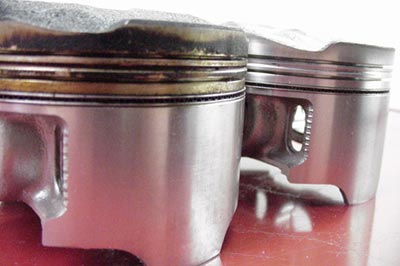
Although these pistons came out of engines which were raced for a full season, they weren't set-up with any special clearances or other preparation.
These engines were never worked on prior to being raced. They were totally stock as built by Honda.
The only difference was the break in method they used...
The one on the right was broken in as per the new break in instructions.
The one on the left was broken in exactly according to the owner's manual. The resulting leaky rings have allowed pressure to "blow by" down into the crankcase on acceleration, and oil to "suck-up" into the combustion chamber on deceleration.
The loss in power from an easy break in and the resulting poor ring seal can be anywhere from 2% - 10% !!
This piston is from a 650 Honda Hawk.
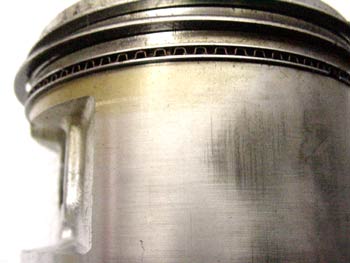
The brown discoloration that extends up into the piston pin bore is burnt oil from the extreme heat leaking past all 3 rings !!
The uneven heat leakage was so bad, that it caused the cylinder to distort and become out of round, causing piston to cylinder scuffing in the tight part of the "oval" cylinder.
When I showed the customer his
pistons, he said:
<FONT COLOR="red">" I don't understand how that happened, I followed the owner's manual break-in instructions 100% !! "</FONT>
Why would Honda recommend a break in method which will prevent the
rings from sealing as well as possible ??
<FONT COLOR="blue">This is a good question ...</FONT>
Q: What's the third most common cause of engine problems ???
A: Not changing the oil soon enough after the engine is first run !!
<FONT COLOR="red">Change Your Oil Right Away !!</FONT>
Change Your Oil Right Away !!
The best thing you can do for your engine is to change your oil and filter after the first 20 miles. Most of the wearing in process happens immediately, creating a lot of metal in the oil. Plus, the amount of leftover machining chips and other crud left behind in the manufacturing process is simply amazing !! You want to flush that stuff out before it gets recycled and embedded in the transmission gears, and oil pump etc...
Why do the manufacturers recommend waiting until 600 miles to
flush out all the loose metal ???
<FONT COLOR="blue">This is a good question ...</FONT>
<FONT SIZE="7">3 more words on break- in:
NO SYNTHETIC OIL !!</FONT>
Use Valvoline, Halvoline, or similar 10 w 40 Petroleum Car Oil for at least
2 full days of hard racing or 1,500 miles of street riding.
After that use your favorite brand of oil.
Q: If break- in happens so quickly, why do you recommend using petroleum break- in oil for 1500 miles ??
A: Because while about 80% of the ring sealing takes place in the first hour of running the engine,
the last 20% of the process takes a longer time. Street riding isn't a controlled environment, so most of the mileage may
not be in "ring loading mode". Synthetic oil is so slippery that it actually "arrests" the break in process before the rings can seal completely. I've had a few customers who switched to synthetic oil too soon, and the rings never sealed properly no matter how hard they rode. Taking a new engine apart to re - ring it is the last thing anyone wants to do, so I recommend a lot
of mileage before switching to synthetic. It's really a "better safe than sorry" situation.
Q: Will this break - in method cause my engine to wear out faster ???
A: No, in fact, a poor ring seal will allow an increase in the by products of combustion to contaminate the oil.
Acid contamination and oil consumption are the 2 reliability problems which are the result of an
"owner's manual" or "magazine tech article" style easy break-in.
By following the instructions on this page, you'll find that your oil is cleaner and the engine will rev quicker
from not being "aluminized". Plus, you'll have much better torque and power across
the power range from the vastly improved ring seal.
Reliability and Power are 100% connected !!
<FONT SIZE="7">Did you know ??</FONT>
Many visitors to the motorcycle factories in Japan have been surprised to learn that ...
the first time they start up the bikes at the end of the assembly line,
the workers warm the engines up,
and then they rev them waaay up ... ... right up to <FONT COLOR="red">R E D L I N E !!</FONT>
Plus, the manufacturers don't just rev the new engines to redline once, they redline them
many times through the gears !
That's a lot of full throttle trips to redline !!
Why ???
One reason they do this is for a final check on the bike, but that can be done without going over 4,000 rpm. Why do they blast them hard waaaay up to 10,000-14,000 ??
( SSshhhhh ... it's a secret .... don't tell anyone .... it's to start the ring sealing process !!!!!)
The Big Question:
After running your brand new bike right straight up to the rev-limiter, doesn't it seem strange that the very same manufacturers recommend not going past 4,000 rpm to avoid
severe engine damage to your new engine ??
In other words:
" How can you wreck your motor from high rpm's after ten miles, when the manufacturers couldn't wreck it from hitting the rev-limiter at zero miles ?? "
" I think something's up !!! "
What do you think the motorcycle manufacturer's
easy "break in" recommendation is really all about ... ???
To figure out what's really going on, we must tune out the various emotional distractions and take a good, objective look at all the evidence !!

To figure out what's really going on, we must tune out the various emotional distractions and take a good, objective look at all the evidence !!
Cognitive Dissonance is the biggest barrier to this, because we'll never get to the point
of understanding, if we can't get past thinking:
"That's the way it's always been done ... "
Or Especially:
" The manufacturers must know best "
How much time ...
... do you think the motorcycle manufacturers spend thinking of ways to avoid
unfair lawsuits that take large chunks out of their hard earned profits?
One of the best ways to avoid lawsuits is to avoid accidents in the first place ! It stands to reason that the first miles on a new and unfamiliar bike are the most likely to produce an accident.
Conveniently, this same period of time is also known as the "break in period''
<FONT SIZE="9"><FONT COLOR="green">"Connecting The Dots"</FONT></FONT>
Nowadays, "Break-in according to the manual" has nothing to do with the engine !!
<U>Think</U>: It's all about avoiding lawsuits from riders who have crashed their new bikes !!
(The motorcycle manufacturers simply don't trust you to use your own judgment.)
By using the threat of severe engine damage, new riders are scared into riding slower
as they get used to their new bike.
Fear is a powerful motivator. More people have their thoughts and actions
controlled by fear than by any other source.
Ironically, leaky rings cause combustion blow-by, which is high in acid content. These acids contaminate the oil, and are harmful to all internal engine parts. "The owner's manual break in" actually increases the amount of acid circulating throughout the engine !!
<U>Think:</U> If engines lasted longer there would be fewer sales of parts, service and of course ... new bikes !!
Increasing sales and minimizing lawsuits. It's a business decision.
Unfortunately, it has nothing to do with actually breaking in your engine for the best reliability and power.
Thinking out of the box allows you to see that there's often a huge difference between the "official" reason and the real reason for things.
It takes exceptional courage to think this way, since
the official source will never "say so" !!
<FONT COLOR="blue">What's The Opposite of Thinking Out Of The Box ???
Automatic Thinking !!</FONT>

<FONT SIZE="7">" If you would be a real seeker after truth, it is necessary that at
least once in your life you doubt, as far as possible, all things. " </FONT>
~ Rene Descartes -- 17th Century Philosopher

See Through The Bricks
Just as in the animation above, it's sometimes necessary to remove a few bricks to see the truth. This can be scary, because doing so can
sometimes reveal a completely opposite picture of what
we previously thought about a situation.
Thinking out of the box is not human nature, instead we tend to look to others in deciding what we should think about a situation.
For this reason, whenever the true version of reality is unknown to the
vast majority of people, it can invoke a surprisingly angry response.
When both sides of our brain work towards a 50-50 balance, we get super intelligence.
but ....
When one side tries to dominate or fight the other side, we never see the "big pictures".
Learning isn't the problem, just the process by which it usually happens:
As young kids, we learn things mostly because adults say
"No", "Don't do that", "Never", "Stop that", or even "Shut up" ....
... and then we get rewarded when we finally do the " right " thing.
Next, as we get a little older, we learn by the true or false system which
teaches us that there's a right way to think and a wrong way to think.
Eventually, we become afraid of thinking "wrong".
This has the effect of training the mind to only see 2 options for every problem !!
Just tryin to keep you thinking guys ( and girls )

-----------------------------------------------------------------------------------------------
http://mototuneusa.com
I don't know if anyone else has come across this but here it goes.
How To Break In Your Engine For More Power & Less Wear !
One of the most critical parts of the engine building process is the break in !!
No matter how well an engine is assembled, it's final power output is all up to you !!
Although the examples shown here are motorcycle engines,
these principles apply to all 4 stroke engines:
Street or Race Motorcycles, Cars, Snowmobiles, Airplanes & yes ...
even Lawn Mowers !!
( regardless of brand, cooling type, or number of cylinders. )
These same break in techniques apply to both steel cylinders and Nikasil, as well as the ceramic
composite cylinders that Yamaha uses in it's motorcycles and snowmobiles.
What's the Best Way to Break in a New Engine ??
The Short Answer: Run it Hard !
Why ??
Nowadays, the piston ring seal is really what the break in process is all about. Contrary to popular belief, piston rings don't seal the combustion pressure by spring tension. Ring tension is necessary only to "scrape" the oil to prevent it from entering the combustion chamber.
If you think about it, the ring exerts maybe 5-10 lbs of spring tension against the cylinder wall ...
How can such a small amount of spring tension seal against thousands of
PSI (Pounds Per Square Inch) of combustion pressure ??
Of course it can't.
How Do Rings Seal Against Tremendous Combustion Pressure ??
From the actual gas pressure itself !! It passes over the top of the ring, and gets behind it to force it outward against the cylinder wall. The problem is that new rings are far from perfect and they must be worn in quite a bit in order to completely seal all the way around the bore. If the gas pressure is strong enough during the engine's first miles of operation (open that throttle !!!), then the entire ring will wear into
the cylinder surface, to seal the combustion pressure as well as possible.
The Problem With "Easy Break In" ...
The honed crosshatch pattern in the cylinder bore acts like a file to allow the rings to wear. The rings quickly wear down the "peaks" of this roughness, regardless of how hard the engine is run.
There's a very small window of opportunity to get the rings to seal really well ... the first 20 miles !!
If the rings aren't forced against the walls soon enough, they'll use up the roughness before they fully seat. Once that happens there is no solution but to re hone the cylinders, install new rings and start over again.
Fortunately, most new sportbike owners can't resist the urge to "open it up" once or twice,
which is why more engines don't have this problem !!
An additional factor that you may not have realized, is that the person at the dealership who set up your bike probably blasted your brand new bike pretty hard on the "test run". So, without realizing it, that adrenaline crazed set - up mechanic actually did you a huge favor !!
<FONT SIZE="5">Here's How To Do It:</FONT>
Because of the wind resistance, you don't need to use higher gears like you would on a dyno machine. The main thing is to load the engine by opening the throttle hard in 2nd, 3rd and 4th gear.
The best method is to alternate between short bursts of hard acceleration and deceleration. You don't have to go over 65 mph / 104 kph to properly load the rings. Also, make sure that you're not being followed by another bike or car when you decelerate, most drivers won't expect that you'll suddenly slow down, and we don't want
anyone to get hit from behind !!
The biggest problem with breaking your engine in on the street (besides police) is if you ride the bike on the freeway (too little throttle = not enough pressure on the rings) or if you get stuck in slow city traffic. For the first 200 miles or so, get out into the country where you can vary the speed more
and run it through the gears !
<FONT SIZE="8">Yeah - But ...</FONT>
the owner's manual says to break it in easy ...
Notice that this technique isn't "beating" on the engine, but rather taking a purposeful, methodical approach to sealing the rings. The logic to this method is sound. However, some will have a hard time with this approach, since it seems to "go against the grain".
The argument for an easy break - in is usually: "that's what the manual says" ....
Or more specifically: "there may be tight parts in the engine and you might do damage or even seize it if you run it hard."
Consider this:
Due to the vastly improved metal casting and machining technologies which are now used, tight parts in new engines are an extremely very rare occurrence these days. But, if there is something wrong with the engine clearances from the factory, no amount of running will correct the problem ...
... regardless of how easy or hard you run the engine during it's break-in !!
The real reason ???
So why do all the owner's manuals say to take it easy for the first
thousand miles ???
This is a good question ...
Q: What is the most common cause of engine problems ???
A: Failure to: <FONT COLOR="red">Warm the engine up completely before running it hard !!!</FONT>
Q: What is the second most common cause of engine problems ???
A: An easy break in !!!
Because, when the rings don't seal well, the blow-by gasses contaminate the oil with acids and other harmful combustion by-products !!
Ironically, an "easy break in" is not at all what it seems. By trying to "protect" the engine, the exact opposite happens, as leaky rings continue to contaminate your engine oil for the rest of the life of your engine !!
A Picture's Worth A Thousand Words:
These Honda F3 pistons show
the difference.
Although these pistons came out of engines which were raced for a full season, they weren't set-up with any special clearances or other preparation.
These engines were never worked on prior to being raced. They were totally stock as built by Honda.
The only difference was the break in method they used...
The one on the right was broken in as per the new break in instructions.
The one on the left was broken in exactly according to the owner's manual. The resulting leaky rings have allowed pressure to "blow by" down into the crankcase on acceleration, and oil to "suck-up" into the combustion chamber on deceleration.
The loss in power from an easy break in and the resulting poor ring seal can be anywhere from 2% - 10% !!
This piston is from a 650 Honda Hawk.
The brown discoloration that extends up into the piston pin bore is burnt oil from the extreme heat leaking past all 3 rings !!
The uneven heat leakage was so bad, that it caused the cylinder to distort and become out of round, causing piston to cylinder scuffing in the tight part of the "oval" cylinder.
When I showed the customer his
pistons, he said:
<FONT COLOR="red">" I don't understand how that happened, I followed the owner's manual break-in instructions 100% !! "</FONT>
Why would Honda recommend a break in method which will prevent the
rings from sealing as well as possible ??
<FONT COLOR="blue">This is a good question ...</FONT>
Q: What's the third most common cause of engine problems ???
A: Not changing the oil soon enough after the engine is first run !!
<FONT COLOR="red">Change Your Oil Right Away !!</FONT>
Change Your Oil Right Away !!
The best thing you can do for your engine is to change your oil and filter after the first 20 miles. Most of the wearing in process happens immediately, creating a lot of metal in the oil. Plus, the amount of leftover machining chips and other crud left behind in the manufacturing process is simply amazing !! You want to flush that stuff out before it gets recycled and embedded in the transmission gears, and oil pump etc...
Why do the manufacturers recommend waiting until 600 miles to
flush out all the loose metal ???
<FONT COLOR="blue">This is a good question ...</FONT>
<FONT SIZE="7">3 more words on break- in:
NO SYNTHETIC OIL !!</FONT>
Use Valvoline, Halvoline, or similar 10 w 40 Petroleum Car Oil for at least
2 full days of hard racing or 1,500 miles of street riding.
After that use your favorite brand of oil.
Q: If break- in happens so quickly, why do you recommend using petroleum break- in oil for 1500 miles ??
A: Because while about 80% of the ring sealing takes place in the first hour of running the engine,
the last 20% of the process takes a longer time. Street riding isn't a controlled environment, so most of the mileage may
not be in "ring loading mode". Synthetic oil is so slippery that it actually "arrests" the break in process before the rings can seal completely. I've had a few customers who switched to synthetic oil too soon, and the rings never sealed properly no matter how hard they rode. Taking a new engine apart to re - ring it is the last thing anyone wants to do, so I recommend a lot
of mileage before switching to synthetic. It's really a "better safe than sorry" situation.
Q: Will this break - in method cause my engine to wear out faster ???
A: No, in fact, a poor ring seal will allow an increase in the by products of combustion to contaminate the oil.
Acid contamination and oil consumption are the 2 reliability problems which are the result of an
"owner's manual" or "magazine tech article" style easy break-in.
By following the instructions on this page, you'll find that your oil is cleaner and the engine will rev quicker
from not being "aluminized". Plus, you'll have much better torque and power across
the power range from the vastly improved ring seal.
Reliability and Power are 100% connected !!
<FONT SIZE="7">Did you know ??</FONT>
Many visitors to the motorcycle factories in Japan have been surprised to learn that ...
the first time they start up the bikes at the end of the assembly line,
the workers warm the engines up,
and then they rev them waaay up ... ... right up to <FONT COLOR="red">R E D L I N E !!</FONT>
Plus, the manufacturers don't just rev the new engines to redline once, they redline them
many times through the gears !
That's a lot of full throttle trips to redline !!
Why ???
One reason they do this is for a final check on the bike, but that can be done without going over 4,000 rpm. Why do they blast them hard waaaay up to 10,000-14,000 ??
( SSshhhhh ... it's a secret .... don't tell anyone .... it's to start the ring sealing process !!!!!)
The Big Question:
After running your brand new bike right straight up to the rev-limiter, doesn't it seem strange that the very same manufacturers recommend not going past 4,000 rpm to avoid
severe engine damage to your new engine ??
In other words:
" How can you wreck your motor from high rpm's after ten miles, when the manufacturers couldn't wreck it from hitting the rev-limiter at zero miles ?? "
" I think something's up !!! "
What do you think the motorcycle manufacturer's
easy "break in" recommendation is really all about ... ???
To figure out what's really going on, we must tune out the various emotional distractions and take a good, objective look at all the evidence !!
To figure out what's really going on, we must tune out the various emotional distractions and take a good, objective look at all the evidence !!
Cognitive Dissonance is the biggest barrier to this, because we'll never get to the point
of understanding, if we can't get past thinking:
"That's the way it's always been done ... "
Or Especially:
" The manufacturers must know best "
How much time ...
... do you think the motorcycle manufacturers spend thinking of ways to avoid
unfair lawsuits that take large chunks out of their hard earned profits?
One of the best ways to avoid lawsuits is to avoid accidents in the first place ! It stands to reason that the first miles on a new and unfamiliar bike are the most likely to produce an accident.
Conveniently, this same period of time is also known as the "break in period''
<FONT SIZE="9"><FONT COLOR="green">"Connecting The Dots"</FONT></FONT>
Nowadays, "Break-in according to the manual" has nothing to do with the engine !!
<U>Think</U>: It's all about avoiding lawsuits from riders who have crashed their new bikes !!
(The motorcycle manufacturers simply don't trust you to use your own judgment.)
By using the threat of severe engine damage, new riders are scared into riding slower
as they get used to their new bike.
Fear is a powerful motivator. More people have their thoughts and actions
controlled by fear than by any other source.
Ironically, leaky rings cause combustion blow-by, which is high in acid content. These acids contaminate the oil, and are harmful to all internal engine parts. "The owner's manual break in" actually increases the amount of acid circulating throughout the engine !!
<U>Think:</U> If engines lasted longer there would be fewer sales of parts, service and of course ... new bikes !!
Increasing sales and minimizing lawsuits. It's a business decision.
Unfortunately, it has nothing to do with actually breaking in your engine for the best reliability and power.
Thinking out of the box allows you to see that there's often a huge difference between the "official" reason and the real reason for things.
It takes exceptional courage to think this way, since
the official source will never "say so" !!
<FONT COLOR="blue">What's The Opposite of Thinking Out Of The Box ???
Automatic Thinking !!</FONT>
<FONT SIZE="7">" If you would be a real seeker after truth, it is necessary that at
least once in your life you doubt, as far as possible, all things. " </FONT>
~ Rene Descartes -- 17th Century Philosopher
See Through The Bricks
Just as in the animation above, it's sometimes necessary to remove a few bricks to see the truth. This can be scary, because doing so can
sometimes reveal a completely opposite picture of what
we previously thought about a situation.
Thinking out of the box is not human nature, instead we tend to look to others in deciding what we should think about a situation.
For this reason, whenever the true version of reality is unknown to the
vast majority of people, it can invoke a surprisingly angry response.
When both sides of our brain work towards a 50-50 balance, we get super intelligence.
but ....
When one side tries to dominate or fight the other side, we never see the "big pictures".
Learning isn't the problem, just the process by which it usually happens:
As young kids, we learn things mostly because adults say
"No", "Don't do that", "Never", "Stop that", or even "Shut up" ....
... and then we get rewarded when we finally do the " right " thing.
Next, as we get a little older, we learn by the true or false system which
teaches us that there's a right way to think and a wrong way to think.
Eventually, we become afraid of thinking "wrong".
This has the effect of training the mind to only see 2 options for every problem !!
Just tryin to keep you thinking guys ( and girls )
-----------------------------------------------------------------------------------------------
http://mototuneusa.com


 Re: Breaking in your engine... think outside the box... VERY VERY LONG... (ThirdGenLSR209)
wow never really new that i was thinking inside the box as being to "baby" it but never knew to beat it hard
you learn something new everyday hmm imagine that
you learn something new everyday hmm imagine that


Trending Topics

Honda-Tech Member
Joined: Nov 2001
Posts: 5,699
Likes: 0
From: Southern cali or boston
Re: Breaking in your engine... think outside the box... VERY VERY LONG... (dimotorsports)
why not just paste the link?
that was alot more work...
but yah its been posted a few times about that method from moto
that was alot more work...
but yah its been posted a few times about that method from moto


Honda-Tech Member
Joined: Nov 2002
Posts: 538
Likes: 0
From: Atlanta, GA
Re: (seppuku)
you know, i've read this article so many times and every time i have the same thought that nobody ever seems to address....... this article is about motorcycles. is it still valid for us 4-stroke guys?


threes
Joined: Nov 2003
Posts: 2,485
Likes: 0
From: Hot Hot heat, AZ
Re: (Team 4R)
yes still valid for four strokers. ****, racears just drive around the block once not even that before put on the dyno for tuning. why shouldnt we? hehe. good writeup, but the values of learning and opening your mind bored me.

Senior Member
Joined: Oct 2003
Posts: 10,289
Likes: 1
From: Hendersonville, NC
Re: Breaking in your engine... think outside the box... VERY VERY LONG... (rapid_roy)
<TABLE WIDTH="90%" CELLSPACING=0 CELLPADDING=0 ALIGN=CENTER><TR><TD>Quote, originally posted by rapid_roy »</TD></TR><TR><TD CLASS="quote">I read it on the Internet!! It must be true!!!</TD></TR></TABLE>
I've had great success when breaking in engines in a similar manner to the one described in this thread. It works, try it.
I've had great success when breaking in engines in a similar manner to the one described in this thread. It works, try it.

Honda-Tech Member
Joined: Dec 2001
Posts: 3,643
Likes: 1
From: assville, MI, USA
Re: Breaking in your engine... think outside the box... VERY VERY LONG... (Kendall)
break-in methods are like ********, everyone has one 
This method/idea has been around for a lot longer than this guy.
This method/idea has been around for a lot longer than this guy.

Member
Joined: Jun 2001
Posts: 1,395
Likes: 0
From: Norwalk, CT
Re: Breaking in your engine... think outside the box... VERY VERY LONG... (Kendall)
Yeah, you could have just posted the link. Or better yet, searched & found one of the many conversations that have taken place on the subject before, and contributed to it.
Personally, I'm not sure what to make of it. He's claiming that the principles apply to all 4-stroke engines of all sleeve types. I have a hard time believing that you're going to want to break in a motorcyle engine (uber-high rpms, tiny cylinders, much softer rings, and correspondingly different cylinder hones & materials) the same as a car engine with hard rings designed to last 150, 200k miles.
So I would think your engine break-in procedure should be tailored to the type of ring setup you're using, the cylinder liner material, the type of hone done on it, and your clearances. And of course, there's more to breaking in a car than the pistons. Cams, clutch, brakes, etc . . .
Personally, I'm not sure what to make of it. He's claiming that the principles apply to all 4-stroke engines of all sleeve types. I have a hard time believing that you're going to want to break in a motorcyle engine (uber-high rpms, tiny cylinders, much softer rings, and correspondingly different cylinder hones & materials) the same as a car engine with hard rings designed to last 150, 200k miles.
So I would think your engine break-in procedure should be tailored to the type of ring setup you're using, the cylinder liner material, the type of hone done on it, and your clearances. And of course, there's more to breaking in a car than the pistons. Cams, clutch, brakes, etc . . .

Joined: Sep 2002
Posts: 959
Likes: 0
From: Warren, RI, USA
Re: Breaking in your engine... think outside the box... VERY VERY LONG... (Kendall)
<TABLE WIDTH="90%" CELLSPACING=0 CELLPADDING=0 ALIGN=CENTER><TR><TD>Quote, originally posted by Kendall »</TD></TR><TR><TD CLASS="quote">
I've had great success when breaking in engines in a similar manner to the one described in this thread. It works, try it.</TD></TR></TABLE>
There is a galaxy of difference between "try it, it works" and "good idea".
The Hindeburg for instance. Someone on the ground could have been saying, "hey fellas, isn't that thing filled with an explosive gas?" Somewhere nearby someone was overheard as saying "Nah, try it, it works".
Not to mention, if I try it and my engine works, has his theory been proven? Of course not. That is not credible evidence. I could spit in the gas tank at every fillup and claim the same thing.
Even the motorcycle manufacturers themselves don't agree with this guy, and they built the damn things. Screw the Honda engineers, that they don't know what they are talking about. His way is the correct way, see, he have a web page that says so.
Trust the guys that build the damn things, they know lots about it.
Cheers,
Sean
I've had great success when breaking in engines in a similar manner to the one described in this thread. It works, try it.</TD></TR></TABLE>
There is a galaxy of difference between "try it, it works" and "good idea".
The Hindeburg for instance. Someone on the ground could have been saying, "hey fellas, isn't that thing filled with an explosive gas?" Somewhere nearby someone was overheard as saying "Nah, try it, it works".
Not to mention, if I try it and my engine works, has his theory been proven? Of course not. That is not credible evidence. I could spit in the gas tank at every fillup and claim the same thing.
Even the motorcycle manufacturers themselves don't agree with this guy, and they built the damn things. Screw the Honda engineers, that they don't know what they are talking about. His way is the correct way, see, he have a web page that says so.
Trust the guys that build the damn things, they know lots about it.
Cheers,
Sean

Member
Joined: Aug 2001
Posts: 2,451
Likes: 1
From: Crofton, MD
Re: Breaking in your engine... think outside the box... VERY VERY LONG... (Daemione)
<TABLE WIDTH="90%" CELLSPACING=0 CELLPADDING=0 ALIGN=CENTER><TR><TD>Quote, originally posted by Daemione »</TD></TR><TR><TD CLASS="quote">So I would think your engine break-in procedure should be tailored to the type of ring setup you're using, the cylinder liner material, the type of hone done on it, and your clearances. </TD></TR></TABLE>
I know less than nothing about moto engines and how they are different from the typical car engine, but this guy seems to make the most sense to me. Few things in life have one hard and fast rule that gets applied to eveything in all situations. I'd have to agree that breaking in a motor is the same way, it depends on a lot of factors.
I know less than nothing about moto engines and how they are different from the typical car engine, but this guy seems to make the most sense to me. Few things in life have one hard and fast rule that gets applied to eveything in all situations. I'd have to agree that breaking in a motor is the same way, it depends on a lot of factors.

Honda-Tech Member
Joined: Oct 2002
Posts: 869
Likes: 0
From: NYC, NYC, NYC
Re: Breaking in your engine... think outside the box... VERY VERY LONG... (jweller)
nice write up. Thats how i break in my motors too... i thought it was a secret of the racing world... oh well.
Thread Starter
Joined: Nov 2001
Posts: 1,770
Likes: 0
From: Racine, WI, USA
Re: Breaking in your engine... think outside the box... VERY VERY LONG... (rapid_roy)
<TABLE WIDTH="90%" CELLSPACING=0 CELLPADDING=0 ALIGN=CENTER><TR><TD>Quote, originally posted by rapid_roy »</TD></TR><TR><TD CLASS="quote">
has his theory been proven? Of course not.</TD></TR></TABLE>
Well, he had this to say about that.... I wrote "Break-In Secrets" after successfully applying this method
to approximately 300 new engines, all without any problems whatsoever.
I'm not telling anyone to DO THIS , just relaying the info. Sorry it was a repost, not everyone reads/catches everything when it's posted.
has his theory been proven? Of course not.</TD></TR></TABLE>
Well, he had this to say about that.... I wrote "Break-In Secrets" after successfully applying this method
to approximately 300 new engines, all without any problems whatsoever.
I'm not telling anyone to DO THIS , just relaying the info. Sorry it was a repost, not everyone reads/catches everything when it's posted.

Honda-Tech Member
Joined: Apr 2003
Posts: 304
Likes: 0
That sounds all fine and good if the only thing you are replacing is your rings. But what about the fact that when you rebuild a motor 95% of the time you also replace rod and crank bearings and sometimes do headwork. I really dont feel safe redlining my motor with new bearings.
Bearings dont spring load themselves to make up the clearence gap like rings do. They have a solid connection to the moving part, and if you run it hard its going to heat up and expand and you risk damaging the part it is supposed to protect and possibly seize the engine.
Plus this is coming from racers "secret of the racing industry" right? Well these people also rebuild their motors once a week or every few races so what do they care about long term reliability? Might as well rip it from the start if you are just going to rebuild it again in a week.
Until i see some real testing on this I am going to remain skeptical and break mine in the easy way.
Bearings dont spring load themselves to make up the clearence gap like rings do. They have a solid connection to the moving part, and if you run it hard its going to heat up and expand and you risk damaging the part it is supposed to protect and possibly seize the engine.
Plus this is coming from racers "secret of the racing industry" right? Well these people also rebuild their motors once a week or every few races so what do they care about long term reliability? Might as well rip it from the start if you are just going to rebuild it again in a week.
Until i see some real testing on this I am going to remain skeptical and break mine in the easy way.

Honda-Tech Member
Joined: May 2003
Posts: 2,329
Likes: 1
From: Greetings From Asbury Park,, NJ
Re: (cheezoto)
The only thing I will add to this post is, this. I have a couple of friends who have suscribed to the theory reported in the original post.
And I have seen with my own eyes and ears, their problems AFTER breaking in engines "hard". And I have heard what the "experts" said in response to their problems, when learning of the root causes. "Despite ALL the theories to the contrary engines don't need to be "babied", but they shouldn't be "beat on", either. Just break it in, as you would normally drive it.
Just my .02 cents.
And I have seen with my own eyes and ears, their problems AFTER breaking in engines "hard". And I have heard what the "experts" said in response to their problems, when learning of the root causes. "Despite ALL the theories to the contrary engines don't need to be "babied", but they shouldn't be "beat on", either. Just break it in, as you would normally drive it.
Just my .02 cents.
Honda-Tech Member
Joined: Nov 2001
Posts: 5,699
Likes: 0
From: Southern cali or boston
Re: (cheezoto)
<TABLE WIDTH="90%" CELLSPACING=0 CELLPADDING=0 ALIGN=CENTER><TR><TD>Quote, originally posted by cheezoto »</TD></TR><TR><TD CLASS="quote">
Bearings dont spring load themselves to make up the clearence gap like rings do. They have a solid connection to the moving part, and if you run it hard its going to heat up and expand and you risk damaging the part it is supposed to protect and possibly seize the engine.
</TD></TR></TABLE>
Bearings are protected by oil. Protecting bearings is oils #1 job. If you have metal to metal contact your bearings wont last a second. That is why people spin bearings, lack of oil due to loose clearances or too tight of clearances.
There is nothing that "springs" itself into spec.
There is proper piston ring gap and proper bearing clearance. Motor building lacks guess work.
When the bearing heats up, it is exactly in spec if you built the engine correctly. Putting in correct bearings in an engine is no rocket science either. It's not like only "top trained" mechanics can put in bearings correctly. Anyone with an IQ over 50 can.
I mean, I'm not saying one way is better then another, I am just saying bearings dont heat up and thus causing a spun bearing on a new motor.
Bearings dont spring load themselves to make up the clearence gap like rings do. They have a solid connection to the moving part, and if you run it hard its going to heat up and expand and you risk damaging the part it is supposed to protect and possibly seize the engine.
</TD></TR></TABLE>
Bearings are protected by oil. Protecting bearings is oils #1 job. If you have metal to metal contact your bearings wont last a second. That is why people spin bearings, lack of oil due to loose clearances or too tight of clearances.
There is nothing that "springs" itself into spec.
There is proper piston ring gap and proper bearing clearance. Motor building lacks guess work.
When the bearing heats up, it is exactly in spec if you built the engine correctly. Putting in correct bearings in an engine is no rocket science either. It's not like only "top trained" mechanics can put in bearings correctly. Anyone with an IQ over 50 can.
I mean, I'm not saying one way is better then another, I am just saying bearings dont heat up and thus causing a spun bearing on a new motor.
Honda-Tech Member
Joined: Apr 2003
Posts: 304
Likes: 0
Re: (irev210)
<TABLE WIDTH="90%" CELLSPACING=0 CELLPADDING=0 ALIGN=CENTER><TR><TD>Quote, originally posted by irev210 »</TD></TR><TR><TD CLASS="quote">
Bearings are protected by oil. Protecting bearings is oils #1 job. If you have metal to metal contact your bearings wont last a second. That is why people spin bearings, lack of oil due to loose clearances or too tight of clearances.
</TD></TR></TABLE>
When you first assemble an engine the tolerences are tight and the barrier of oil is going to be much thinner, and when most engines are assembled the parts are coated with an assembly grease because it takes the oil awhile to flow thru all the passageways wash away the grease and lubricate everything.
If you are trying to tell me that the clearences that the oil has to fill in and protect are the same on a brand new assembled motor as they would be on a 150k mile motor then your are dead wrong. The parts need to wear toghther with some easy driving.
If you start the motor up and take it all the way to redline all that is protecting the parts in friction is the assembly grease, it takes a bit untill all the oil gets thru all the passageways. If you have a motor with hydraulic lifter you will notice this, because after the motor has been sitting awhile or if its being rebuilt it takes a long time before oil reaches the lifters to fill them up. That is why you hear loud valve clatter untill the oil makes it way there. It took a good 2 mins for the lifters to stop clattering the last time i put my motor back in, and another 15-20mins of running to get rid of the last bit of ticking.
If you want to start your motor right up and rev it to redline be my guest, but just consider its going to take some considerable time for the oil to make its way to the crank ends and then thru the passageways to the bearing journals. Plus the fact that you have assembly grease mixed in with the oil.
You should dry crank a motor for at least 20-30 seconds before actually letting it fire up, just to build up oil pressure. Just pull the fuel pump/ing relay(or fuse) and crank it with the starter a few times.
Bearings are protected by oil. Protecting bearings is oils #1 job. If you have metal to metal contact your bearings wont last a second. That is why people spin bearings, lack of oil due to loose clearances or too tight of clearances.
</TD></TR></TABLE>
When you first assemble an engine the tolerences are tight and the barrier of oil is going to be much thinner, and when most engines are assembled the parts are coated with an assembly grease because it takes the oil awhile to flow thru all the passageways wash away the grease and lubricate everything.
If you are trying to tell me that the clearences that the oil has to fill in and protect are the same on a brand new assembled motor as they would be on a 150k mile motor then your are dead wrong. The parts need to wear toghther with some easy driving.
If you start the motor up and take it all the way to redline all that is protecting the parts in friction is the assembly grease, it takes a bit untill all the oil gets thru all the passageways. If you have a motor with hydraulic lifter you will notice this, because after the motor has been sitting awhile or if its being rebuilt it takes a long time before oil reaches the lifters to fill them up. That is why you hear loud valve clatter untill the oil makes it way there. It took a good 2 mins for the lifters to stop clattering the last time i put my motor back in, and another 15-20mins of running to get rid of the last bit of ticking.
If you want to start your motor right up and rev it to redline be my guest, but just consider its going to take some considerable time for the oil to make its way to the crank ends and then thru the passageways to the bearing journals. Plus the fact that you have assembly grease mixed in with the oil.
You should dry crank a motor for at least 20-30 seconds before actually letting it fire up, just to build up oil pressure. Just pull the fuel pump/ing relay(or fuse) and crank it with the starter a few times.