What is the purpose of having a breather?


Thread Starter
Honda-Tech Member
Joined: Feb 2003
Posts: 1,921
Likes: 0
From: San Jose, Ca, USA
 What is the purpose of having a breather?
I had a discussion with a mechanic guy and he said my breather on the valve cover of my GSR is not good. He recommended I should remove the K&N breather and connect the rubber tubing from the valve cover to the intake arm so a vaccuum could be created. The vaccuum is important to help the rings seat properly.
Any comments about this....
Any comments about this....

Member
Joined: Feb 2001
Posts: 1,176
Likes: 0
From: Charleston, SC, usa
Re: What is the purpose of having a breather? (AllmotorJunkie)
The purpose if the intake tube to be attached to the valve cover is to create a vaccuum. ..negitive vaccuum that is. This is to help draw out crank case vapors back into the intake stream to be combusted. The Crank case ventalation system is called "PCV" or positive because there is a vaccuum aid to positivly displace these vapors from the crankcase. With your breather element there is only Atmosphereic pressure as opposed to X ammount of inches of vaccuum in the intake system that draws vapors out of the valve cover. Hope that helps any.


Honda-Tech Member
Joined: Jun 2002
Posts: 4,133
Likes: 0
From: New Jersey
Re: What is the purpose of having a breather? (maxxdout)
I have wondered the same thing for a while now. So it is basically better to have the tube because it creates better pressure to ventilate the crankcase better?

Honda-Tech Member
Joined: Dec 2001
Posts: 3,643
Likes: 1
From: assville, MI, USA
Re: What is the purpose of having a breather? (VTECorona)
The crankcase is supposed to be pressurized. Having air from the intake run into the crankcase through the valvecover obtains this. PCV = positive crankcase valve.
Having just a breather filter does not allow a pressurization.. in fact I beleave it causes air to blow out of the crankcase. This in turn is going to cause more blowby and do damage to your piston rings.
Having just a breather filter does not allow a pressurization.. in fact I beleave it causes air to blow out of the crankcase. This in turn is going to cause more blowby and do damage to your piston rings.

Thread Starter
Honda-Tech Member
Joined: Feb 2003
Posts: 1,921
Likes: 0
From: San Jose, Ca, USA
Re: (P1mpSlap)
Thanks for the input fellas....thats exactly what the mechanic guy told me too.
So it is indeed better to leave the PVC tubing than have a breather....
So it is indeed better to leave the PVC tubing than have a breather....

Honda-Tech Member
Joined: Jan 2003
Posts: 8,132
Likes: 5
Re: (P1mpSlap)
<TABLE WIDTH="90%" CELLSPACING=0 CELLPADDING=0 ALIGN=CENTER><TR><TD>Quote, originally posted by P1mpSlap »</TD></TR><TR><TD CLASS="quote">He was tellin you to ditch the rice in a nicer manner.  </TD></TR></TABLE>
Yeah, I think so.
If everything else is working OK then it shouldn't matter. AllmotorJunkie didn't say he disconnected the PCV valve & hose; they're under the intake manifold on that breather box.
The PCV valve draws crankcase vapor out, and the breather tube lets fresh air in. It's as simple as that. It doesn't matter where the fresh air comes from; your main air cleaner, or from an external breather. Either way it keeps your crankcase close to atmospheric pressure (slight vacuum, actually).
Now if you get enough blow-by to overwhelm your PCV valve, or the valve gets plugged up or broken, then your breather flows backwards. Oily air flows into your intake tube and gets sucked into the throttle body. If you have an external breather it just makes a mess of that filter. Then it doesn't get sucked into the engine so the EPA doesn't like that. That's the only difference.
Why is this so hard to understand? Every car has this since the 70s; it's not some profound magical Honda thing.
</TD></TR></TABLE>Yeah, I think so.
If everything else is working OK then it shouldn't matter. AllmotorJunkie didn't say he disconnected the PCV valve & hose; they're under the intake manifold on that breather box.
The PCV valve draws crankcase vapor out, and the breather tube lets fresh air in. It's as simple as that. It doesn't matter where the fresh air comes from; your main air cleaner, or from an external breather. Either way it keeps your crankcase close to atmospheric pressure (slight vacuum, actually).
Now if you get enough blow-by to overwhelm your PCV valve, or the valve gets plugged up or broken, then your breather flows backwards. Oily air flows into your intake tube and gets sucked into the throttle body. If you have an external breather it just makes a mess of that filter. Then it doesn't get sucked into the engine so the EPA doesn't like that. That's the only difference.
Why is this so hard to understand? Every car has this since the 70s; it's not some profound magical Honda thing.
Trending Topics
Guest
Posts: n/a
Re: (JimBlake)
OK I've actually been wondering this for a while also...So as I understand it, the purpose of the tube from the valve cover to the intake, is to creat a vacuum in the head, so that vapors can be sucked out and recombusted. Now are there ANY benefits at all of having a breather in place of the rubber tubing ? There must be a reason why people put the breather there........
Honda-Tech Member
Joined: Dec 2001
Posts: 3,643
Likes: 1
From: assville, MI, USA
Re: (Eclipse spanker)
The crankcase does not run under a vaccum, it is pressurized.
POSITIVE CRANKCASE VALVE = PCV
The air coming in from the intake flows into the crankcase and pressurizes it. A breather does not do this, because the crankcase does not run under a vaccum a breather filter does not suck in air.. instead air flows out and this is very bad.
People often put a breather on their because they have a turbo and can't run a line from the IC piping to the valve cover otherwise they are going to be stuffing 8+psi of air into the crankcase which can't be good either.
So instead of running a line before the turbo, they just put a breather on there.. which isn't good.
POSITIVE CRANKCASE VALVE = PCV
The air coming in from the intake flows into the crankcase and pressurizes it. A breather does not do this, because the crankcase does not run under a vaccum a breather filter does not suck in air.. instead air flows out and this is very bad.
People often put a breather on their because they have a turbo and can't run a line from the IC piping to the valve cover otherwise they are going to be stuffing 8+psi of air into the crankcase which can't be good either.
So instead of running a line before the turbo, they just put a breather on there.. which isn't good.
Honda-Tech Member
Joined: Jan 2003
Posts: 8,132
Likes: 5
Re: (StyleTEG)
I'm gonna need a flame suit now. 
PCV = positive crancase ventilation
The word 'positive' in this context doesn't mean 'above atmospheric pressure', because it isn't. It means something more like 'forced'. The only way to pressurize the crankcase is with blow-by.
It's a whole system that works together, including the breather tube. The intake manifold is under vacuum, it sucks through the PCV valve. This sucks vapor out from the crankcase.
The breather tube coming from the intake tube is wide open. The crankcase draws air in through that tube to replace what gets sucked out through the PCV valve. That breather tube is big enough so there's very little pressure loss. But the pressure loss can't be negative - I can't find any tiny little compressors in that hose... The PCV valve is designed to be the dominating resistance in that whole system, so the crankcase is very close to atmospheric pressure.
PCV = positive crancase ventilation
The word 'positive' in this context doesn't mean 'above atmospheric pressure', because it isn't. It means something more like 'forced'. The only way to pressurize the crankcase is with blow-by.
It's a whole system that works together, including the breather tube. The intake manifold is under vacuum, it sucks through the PCV valve. This sucks vapor out from the crankcase.
The breather tube coming from the intake tube is wide open. The crankcase draws air in through that tube to replace what gets sucked out through the PCV valve. That breather tube is big enough so there's very little pressure loss. But the pressure loss can't be negative - I can't find any tiny little compressors in that hose... The PCV valve is designed to be the dominating resistance in that whole system, so the crankcase is very close to atmospheric pressure.

Honda-Tech Member
Joined: Jul 2002
Posts: 4,784
Likes: 0
Re: (StyleTEG)
<TABLE WIDTH="90%" CELLSPACING=0 CELLPADDING=0 ALIGN=CENTER><TR><TD>Quote, originally posted by StyleTEG »</TD></TR><TR><TD CLASS="quote">
The air coming in from the intake flows into the crankcase and pressurizes it. </TD></TR></TABLE>
But theres no way, with my blower, that when its sucking in air hard enough to produce 8psi, that the air is going to flow away from the blower and back into the head. The blower is going to suck air out of the head.
gmoore
The air coming in from the intake flows into the crankcase and pressurizes it. </TD></TR></TABLE>
But theres no way, with my blower, that when its sucking in air hard enough to produce 8psi, that the air is going to flow away from the blower and back into the head. The blower is going to suck air out of the head.
gmoore
Honda-Tech Member
Joined: Jan 2003
Posts: 8,132
Likes: 5
Re: (tegunderpressure)
All the stuff I said was for N/A engines. This all depends on exactly how you hooked up the PCV plumbing with the JRSC. Is your PCV valve still hooked up to the intake manifold? The 'intake manifold' is pretty much the outlet plenum of the compressor?
There is not much resistance in the breather tube attached to the valve cover. So whatever you hooked that up to controls the crankcase pressure. I suppose that's connected to the intake tube upstream of the compressor. So that's pretty much the same as a N/A engine.
When your manifold pressure goes above atmospheric, the PCV closes. I believe Honda PCV valves close tight like a check valve instead of flowing 'backwards'. At the same time there's more air being drawn thru the main air filter, so the air intake pipe is at some weak vacuum. Or a stronger vacuum if your air filter is clogged. Now any blow-by has noplace to go but back out thru the breather hose, into the intake air pipe.
There is not much resistance in the breather tube attached to the valve cover. So whatever you hooked that up to controls the crankcase pressure. I suppose that's connected to the intake tube upstream of the compressor. So that's pretty much the same as a N/A engine.
When your manifold pressure goes above atmospheric, the PCV closes. I believe Honda PCV valves close tight like a check valve instead of flowing 'backwards'. At the same time there's more air being drawn thru the main air filter, so the air intake pipe is at some weak vacuum. Or a stronger vacuum if your air filter is clogged. Now any blow-by has noplace to go but back out thru the breather hose, into the intake air pipe.


Junior Member
Joined: Sep 2001
Posts: 904
Likes: 0
From: East Coast, VA
Re: (JimBlake)
<TABLE WIDTH="90%" CELLSPACING=0 CELLPADDING=0 ALIGN=CENTER><TR><TD>Quote, originally posted by JimBlake »</TD></TR><TR><TD CLASS="quote">
Yeah, I think so.
If everything else is working OK then it shouldn't matter. AllmotorJunkie didn't say he disconnected the PCV valve & hose; they're under the intake manifold on that breather box.
The PCV valve draws crankcase vapor out, and the breather tube lets fresh air in. It's as simple as that. It doesn't matter where the fresh air comes from; your main air cleaner, or from an external breather. Either way it keeps your crankcase close to atmospheric pressure (slight vacuum, actually).
Now if you get enough blow-by to overwhelm your PCV valve, or the valve gets plugged up or broken, then your breather flows backwards. Oily air flows into your intake tube and gets sucked into the throttle body. If you have an external breather it just makes a mess of that filter. Then it doesn't get sucked into the engine so the EPA doesn't like that. That's the only difference.
Why is this so hard to understand? Every car has this since the 70s; it's not some profound magical Honda thing.
</TD></TR></TABLE>
this guy is dead on , as for the JRSC install its different than a Turbo install so the intake arm goes under high vacuum from the charger so it will suck oil from the valve cover. Either a breather or another check vavle on the intake->valve cover hose should fix it. So I would say only the JRSC's would "benefit" from the breather install.
Yeah, I think so.
If everything else is working OK then it shouldn't matter. AllmotorJunkie didn't say he disconnected the PCV valve & hose; they're under the intake manifold on that breather box.
The PCV valve draws crankcase vapor out, and the breather tube lets fresh air in. It's as simple as that. It doesn't matter where the fresh air comes from; your main air cleaner, or from an external breather. Either way it keeps your crankcase close to atmospheric pressure (slight vacuum, actually).
Now if you get enough blow-by to overwhelm your PCV valve, or the valve gets plugged up or broken, then your breather flows backwards. Oily air flows into your intake tube and gets sucked into the throttle body. If you have an external breather it just makes a mess of that filter. Then it doesn't get sucked into the engine so the EPA doesn't like that. That's the only difference.
Why is this so hard to understand? Every car has this since the 70s; it's not some profound magical Honda thing.
</TD></TR></TABLE>
this guy is dead on
, as for the JRSC install its different than a Turbo install so the intake arm goes under high vacuum from the charger so it will suck oil from the valve cover. Either a breather or another check vavle on the intake->valve cover hose should fix it. So I would say only the JRSC's would "benefit" from the breather install.
Junior Member
Joined: Sep 2001
Posts: 904
Likes: 0
From: East Coast, VA
Re: (r4integra)
<TABLE WIDTH="90%" CELLSPACING=0 CELLPADDING=0 ALIGN=CENTER><TR><TD>Quote, originally posted by r4integra »</TD></TR><TR><TD CLASS="quote">Any pictures you guys can post so I can check if my vaccum hoses are connected correctly from my CAI? I do have a unused hose just dangling... </TD></TR></TABLE>
go to the FI forum and look for "breathers" and "catch can". Its been beaten to death in there with threads long enough to make you NOT want to read it. Basically look into a breather if you are FI, for NA theres no real benefits or downsides... just a waste of a money and another way to fail a SMOG check.
go to the FI forum and look for "breathers" and "catch can". Its been beaten to death in there with threads long enough to make you NOT want to read it. Basically look into a breather if you are FI, for NA theres no real benefits or downsides... just a waste of a money and another way to fail a SMOG check.

Honda-Tech Member
Joined: Apr 2001
Posts: 2,223
Likes: 0
From: Union City, CA
Re: What is the purpose of having a breather? (AllmotorJunkie)
Tuan once had a very solid explanation why a breather is a big NO NO.
I don't know where he posts now but he even had a diagram about it.
I don't know where he posts now but he even had a diagram about it.
Honda-Tech Member
Joined: Dec 2001
Posts: 3,643
Likes: 1
From: assville, MI, USA
Re: What is the purpose of having a breather? (jl74)
<TABLE WIDTH="90%" CELLSPACING=0 CELLPADDING=0 ALIGN=CENTER><TR><TD>Quote »</TD></TR><TR><TD CLASS="quote">Originally posted by surferX
The honda crankcase breather is a POSITIVE pressure ventilation system.The air from the intake blows into the valve cover. It is NOT a negative pressure ventilation system...it does NOT suck air from the valvecover to the intake.
Breathers remove the source of positive ventilation that repressurizes the POSTIVE CRANKCASE VENTILATION (PCV) valve.
There is less pressure in the crank when you add a breather at the valve cover. The consequence of this is you get more positive blow-by from the combustion chamber past the piston rings and into the crankcase. More blow-by means less cylinder pressure...less cylinder pressure means the burn is slower and less complete...the result is more emissions and less power.
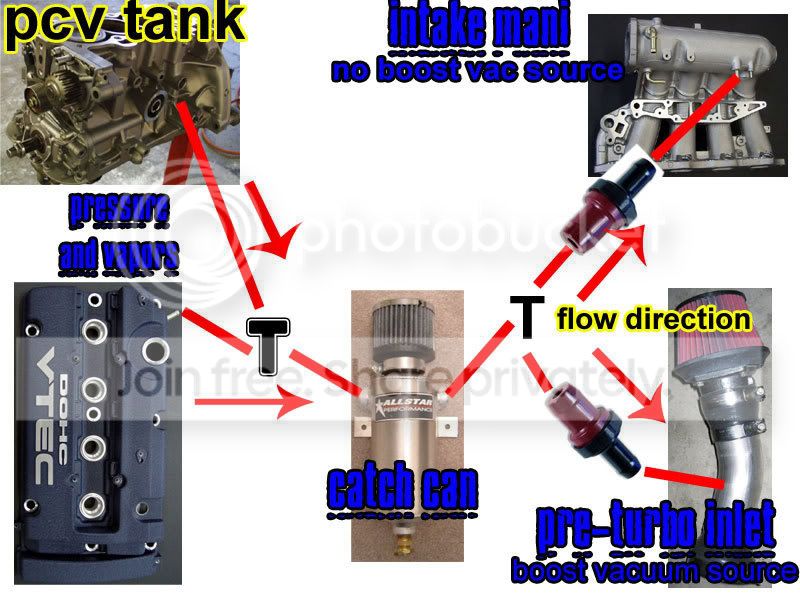
If you want to do this right and remove oil vapor from the circulating crankcase before it goes into the intake valve then, get an oilcatch can and put a breather on the catch can. Then place the catch can in between the valve cover breather and the PCV valve.
Disconnecting the breather tube, which blows fresh intake air into the valve cover, and placing a breather on the valve cover just creates more blow-by and emissions. Eventually you have so much blow-by, you lose power.
</TD></TR></TABLE>
<TABLE WIDTH="90%" CELLSPACING=0 CELLPADDING=0 ALIGN=CENTER><TR><TD>Quote »</TD></TR><TR><TD CLASS="quote">Originally posted by michael delaney
you have to remember that oil vapor into the IM cannot be helping your cause. The oil vapor occupies space or volume. That means less air/fuel mix going in wuth one gulp of the intake valve opening.
The thought behind the breather is that you are supposed to get more fresh air flow down into the crankcase from the valve cover. This increases the cycle of oil vapor flow out of the crankcase. The added fresh air displaces the oil vapors in the crankcase with the assistance from the IM vacuum sucking it out. You evacuate the crankcase more effectively...or so the thought behind it goes. Remember you have converted a closed system into an opeb PCV system when you add one of those breathers.
We have a PCV system designed as a closed system though. When attached to the intake, the breather hose actually generates more pressure gradient to push fresh air down into the crankcase via the valve cover breather from the intake at higher engine speeds! When you use only 1 breather in an open system, not enough fresh air coming through the breather filter gets down to the crankcase.
The crankcase has less pressure inside. This opens the door for more blow-by. Without the positive pressure in the crankcase to offer some resistance to blow-by past the piston ring, you get crap going down. The other problem with less fresh air entering is, as was said before, the circulation flow out to the PCV valve is decreased. So more crap stays in the crankcase. It becomes a vicious cycle.
If you insist on using an open PCV system then drill a second hole and mount a second breather tube in the valvecover. Using 2 breather filters will deliver enough fresh air down to the crankcase. This is what the AEBS boys did with their race B18C1 that ran in the 10's all motor:
Now the other smart move would be to use an oil catch can that is baffled so that it captures or intercepts the oil in the vapor leaving the crankcase before it reached the PCV valve and enters the IM. Now you have more fresh air entering the IM instead of oil vapor.
If you plan to use an open system, add more breathers. If you use a closed system or an open system, use an oil catch can.
The good oil catch cans have baffles and drain the captured oil back to the oil pan without you having to empty them periodically.
</TD></TR></TABLE>
The honda crankcase breather is a POSITIVE pressure ventilation system.The air from the intake blows into the valve cover. It is NOT a negative pressure ventilation system...it does NOT suck air from the valvecover to the intake.
Breathers remove the source of positive ventilation that repressurizes the POSTIVE CRANKCASE VENTILATION (PCV) valve.
There is less pressure in the crank when you add a breather at the valve cover. The consequence of this is you get more positive blow-by from the combustion chamber past the piston rings and into the crankcase. More blow-by means less cylinder pressure...less cylinder pressure means the burn is slower and less complete...the result is more emissions and less power.
If you want to do this right and remove oil vapor from the circulating crankcase before it goes into the intake valve then, get an oilcatch can and put a breather on the catch can. Then place the catch can in between the valve cover breather and the PCV valve.
Disconnecting the breather tube, which blows fresh intake air into the valve cover, and placing a breather on the valve cover just creates more blow-by and emissions. Eventually you have so much blow-by, you lose power.
</TD></TR></TABLE>
<TABLE WIDTH="90%" CELLSPACING=0 CELLPADDING=0 ALIGN=CENTER><TR><TD>Quote »</TD></TR><TR><TD CLASS="quote">Originally posted by michael delaney
you have to remember that oil vapor into the IM cannot be helping your cause. The oil vapor occupies space or volume. That means less air/fuel mix going in wuth one gulp of the intake valve opening.
The thought behind the breather is that you are supposed to get more fresh air flow down into the crankcase from the valve cover. This increases the cycle of oil vapor flow out of the crankcase. The added fresh air displaces the oil vapors in the crankcase with the assistance from the IM vacuum sucking it out. You evacuate the crankcase more effectively...or so the thought behind it goes. Remember you have converted a closed system into an opeb PCV system when you add one of those breathers.
We have a PCV system designed as a closed system though. When attached to the intake, the breather hose actually generates more pressure gradient to push fresh air down into the crankcase via the valve cover breather from the intake at higher engine speeds! When you use only 1 breather in an open system, not enough fresh air coming through the breather filter gets down to the crankcase.
The crankcase has less pressure inside. This opens the door for more blow-by. Without the positive pressure in the crankcase to offer some resistance to blow-by past the piston ring, you get crap going down. The other problem with less fresh air entering is, as was said before, the circulation flow out to the PCV valve is decreased. So more crap stays in the crankcase. It becomes a vicious cycle.
If you insist on using an open PCV system then drill a second hole and mount a second breather tube in the valvecover. Using 2 breather filters will deliver enough fresh air down to the crankcase. This is what the AEBS boys did with their race B18C1 that ran in the 10's all motor:
Now the other smart move would be to use an oil catch can that is baffled so that it captures or intercepts the oil in the vapor leaving the crankcase before it reached the PCV valve and enters the IM. Now you have more fresh air entering the IM instead of oil vapor.
If you plan to use an open system, add more breathers. If you use a closed system or an open system, use an oil catch can.
The good oil catch cans have baffles and drain the captured oil back to the oil pan without you having to empty them periodically.
</TD></TR></TABLE>
Honda-Tech Member
Joined: Jan 2003
Posts: 8,132
Likes: 5
Re: What is the purpose of having a breather? (StyleTEG)
I want to disagree, but I haven't actually measured pressures at these conditions. But as hard as I look, I can't find any tiny little compressors in that stock breather tube. So I'll be really surprised if that pressure is above atmospheric.
The engine takes in about it's displacement every 2 revolutions. Actually less, but I'll give you that. That's 1.8liters, 4000 times per minute. That's 4.23 cubic feet per second. I guess the air intake tube is about 3.5" diameter. Anybody know if that's right? So the air is moving about 63 ft/sec in the intake tube.
That breather tube isn't positioned to capture ALL of the stagnation pressure. But if it were, that's still only 0.033psi. I bet the drop across the filter element is larger than that.
The engine takes in about it's displacement every 2 revolutions. Actually less, but I'll give you that. That's 1.8liters, 4000 times per minute. That's 4.23 cubic feet per second. I guess the air intake tube is about 3.5" diameter. Anybody know if that's right? So the air is moving about 63 ft/sec in the intake tube.
That breather tube isn't positioned to capture ALL of the stagnation pressure. But if it were, that's still only 0.033psi. I bet the drop across the filter element is larger than that.

Honda-Tech Member
Joined: Dec 2001
Posts: 3,643
Likes: 1
From: assville, MI, USA
Re: What is the purpose of having a breather? (Moto TO4ELSVTEC)
One breather is not enough to properly ventilate the crankcase. Look at all the professionaly high built b18 engines that run open system, they have more than one breather.
<TABLE WIDTH="90%" CELLSPACING=0 CELLPADDING=0 ALIGN=CENTER><TR><TD>Quote »</TD></TR><TR><TD CLASS="quote">originally posted by larry from enedyn
EPA legality is the only issue. You should be able to achieve relatively good crankcase breathing with the open system, but we've found that a couple good sized breather tubes in the valve cover are also needed to do a "better" job. The tubes we weld in are both 1" in diameter and there's a shield in the valve cover to prevent excessive amounts of oil from exiting through the tubes. Both cover vents can be plumbed into one Moroso can with a breather element.
There is no such thing as too much crankcase breathing, so we're not going overboard here. If it was an all-out situation, we'd use a vacuum pump too.
</TD></TR></TABLE>
<TABLE WIDTH="90%" CELLSPACING=0 CELLPADDING=0 ALIGN=CENTER><TR><TD>Quote »</TD></TR><TR><TD CLASS="quote">originally posted by larry from enedyn
EPA legality is the only issue. You should be able to achieve relatively good crankcase breathing with the open system, but we've found that a couple good sized breather tubes in the valve cover are also needed to do a "better" job. The tubes we weld in are both 1" in diameter and there's a shield in the valve cover to prevent excessive amounts of oil from exiting through the tubes. Both cover vents can be plumbed into one Moroso can with a breather element.
There is no such thing as too much crankcase breathing, so we're not going overboard here. If it was an all-out situation, we'd use a vacuum pump too.
</TD></TR></TABLE>


Honda-Tech Member
Joined: Feb 2005
Posts: 61
Likes: 0
From: Columbia, SC, USA
Re: What is the purpose of having a breather? (thashadow)
I was always under the impression that the PCV valve relies on IM vaccuum to pull excess gases out of the crankcase, and the breather pulls in fresh, cool, filtered air in to replace it. In situations where the PCV is closed (I assume this would be rare on an NA Honda, I learned all of this in reference to an SRT-4), excess blow-by gas buildup would escape through the breather. If this is true, I would think that having vacuum on both the breather and the pcv would be bad, as there would be nowhere for the fresh air to come in. It would seem that the only reason for plumbing the breather back into the intake would be so the blow-by gases couldn't possibly escape to the atmosphere. I still don't see how having a vacuum on the breather side would encourage airflow, yet that's how Honda did it and they obviously knew what they were doing. I can definitely understand how having a second breather would help, but that does seem kinda tricky to do right. I'm willing to just run a second catch can on the breather hose (I know how to make a $20 catch can in about 5 minutes), but I'm still trying to figure out how vacuum on the breather hose would encourage it to take in more air than leaving it open to the atmosphere?

Honda-Tech Member
Joined: Jan 2006
Posts: 2,428
Likes: 0
From: Dallas, Tx, US
Re: What is the purpose of having a breather? (thashadow)
<TABLE WIDTH="90%" CELLSPACING=0 CELLPADDING=0 ALIGN=CENTER><TR><TD>Quote, originally posted by thashadow »</TD></TR><TR><TD CLASS="quote">i learned something new today </TD></TR></TABLE>
me too
</TD></TR></TABLE>me too