When you click on links to various merchants on this site and make a purchase, this can result in this site earning a commission. Affiliate programs and affiliations include, but are not limited to, the eBay Partner Network.
Hey guys, has anyone had any experience with the turbosmart 40psi opr? It’s designed to regulate oil pressure to the turbo, specifically BB turbos. I just installed mine along with the inline turbosmart filter. I have an AEM oil pressure gage hooked up to it and seems to be holding 44psi pretty well. I just haven’t tuned yet and just on a base map, so I’m not going over 1/2 throttle or 4500rpm. Anyone have any thoughts?
Interesting. I can't really figure much of what advantage it actually has over a PROPER restrictor setup.
The main reason I went this route over the restrictor is more or less peace of mind/I’m over cautious I guess. A PROPER restrictor no doubt has been tested and true, my issue was setting up an oil pressure sensor between the restrictor and turbo. Currently I have a gtx3071 Gen2 and the fitting for the oil feed is the 7/16-24 inverted flare. To get adapters and fittings to make up a port for an oil pressure sensor is a pain in the *** and personally I feel unreliable.
No need to make it more complicated than it really is. Use the oil restrictor jets at the oil inlet feed location and call it a day.
Can you not read his reasoning with going this route? If you put the restriction nozzle on the turbo you have no way of knowing if the nozzle gets clogged and your turbo starves of oil. He is going this route to put an oil pressure sensor between the restrictor and turbo for peace of mind.
Can you not read his reasoning with going this route? If you put the restriction nozzle on the turbo you have no way of knowing if the nozzle gets clogged and your turbo starves of oil. He is going this route to put an oil pressure sensor between the restrictor and turbo for peace of mind.
It's the same **** as him installing that junk. Do you honestly think it's going to alert him when it's clogged? Enlighten us all about that wizardry....
Can you not read his reasoning with going this route? If you put the restriction nozzle on the turbo you have no way of knowing if the nozzle gets clogged and your turbo starves of oil. He is going this route to put an oil pressure sensor between the restrictor and turbo for peace of mind.
**INSTEAD OF** OP stated that this particular device was to be used because it is difficult to find the appropriate fittings for a sensor setup. So, the intent was for the posted item to be used due to its claimed pressure consistency. However, what happens if this item gets clogged? Methinks he's trying to put out a grease fire with water here.. Every point in the feed line is subject to a potential clog whether it be this device or inline filter leading to a -AN feed jet.
**INSTEAD OF** OP stated that this particular device was to be used because it is difficult to find the appropriate fittings for a sensor setup. So, the intent was for the posted item to be used due to its claimed pressure consistency. However, what happens if this item gets clogged? Methinks he's trying to put out a grease fire with water here.. Every point in the feed line is subject to a potential clog whether it be this device or inline filter leading to a -AN feed jet.
Maybe you read something I didn't in regards to the true reason he wants to run it. I read he wants an oil pressure (sensor) gauge between the restrictor and the turbo. Gets clogged, gauge drops, you know you have a problem. Seems pretty simple and straight forward to me. Over cautious? Yes. Bad idea? Eh as long as it is the correct pressure for the turbo I don't particularly see a problem.
It's the same **** as him installing that junk. Do you honestly think it's going to alert him when it's clogged? Enlighten us all about that wizardry....
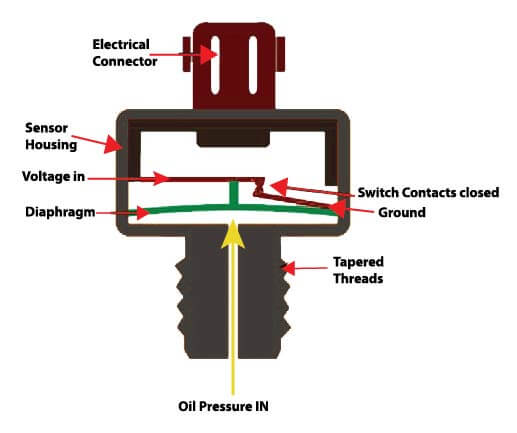
I found this on the internet to help you understand an oil pressure sensor. Let me know if you need further help.
Maybe you read something I didn't in regards to the true reason he wants to run it. I read he wants an oil pressure (sensor) gauge between the restrictor and the turbo. Gets clogged, gauge drops, you know you have a problem. Seems pretty simple and straight forward to me. Over cautious? Yes. Bad idea? Eh as long as it is the correct pressure for the turbo I don't particularly see a problem.
See below.. OP wants an oil pressure sensor between the turbo and restrictor but due to the odd-parts required to add the port for this he feels is going to be a hassle and end up unreliable, and feels the TS pressure thingy here would be better (instead of the traditional *proper* oil feed) since it boasts consistent oil pressure for the turbski.
Unless I am misreading that info and my context clues are way off.. lol
Originally Posted by piggy96
The main reason I went this route over the restrictor is more or less peace of mind/I’m over cautious I guess. A PROPER restrictor no doubt has been tested and true, my issue was setting up an oil pressure sensor between the restrictor and turbo. Currently I have a gtx3071 Gen2 and the fitting for the oil feed is the 7/16-24 inverted flare. To get adapters and fittings to make up a port for an oil pressure sensor is a pain in the *** and personally I feel unreliable.
See below.. OP wants an oil pressure sensor between the turbo and restrictor but due to the odd-parts required to add the port for this he feels is going to be a hassle and end up unreliable, and feels the TS pressure thingy here would be better (instead of the traditional *proper* oil feed) since it boasts consistent oil pressure for the turbski.
Unless I am misreading that info and my context clues are way off.. lol
Yea I'm not sure how you could add a sensor between a fitting that goes into the turbo and the turbo itself.
Yea I'm not sure how you could add a sensor between a fitting that goes into the turbo and the turbo itself.
But THAT is merely conundrum #2.. The issue at hand was the turbosmart piece in the 1st post and if any feedback could be obtained from any that may use that rather than the standard restricted oil feed setup.
I found this on the internet to help you understand an oil pressure sensor. Let me know if you need further help.
please don't try to sound like you know what you're saying. Obviously, you don't.
You're assuming the rest of us don't have any knowledge of owning and maintaining a turbo Honda.
please don't try to sound like you know what you're saying. Obviously, you don't.
You're assuming the rest of us don't have any knowledge of owning and maintaining a turbo Honda.
A oil pressure sensor will alert him if he loses oil pressure between the restrictor and turbo. You asked how it would so I figured you didn't know how a oil pressure sensor works. I'm not assuming anything except you're an ignorant person, going by your past posts and current ones. Go run around in your Del Sol though, I remember in the 90's and early 00's that was the only car teenage girls wanted. Glad to see you got yours.
The other advantage that I’ve found was with this over a restrictor is that reduces the oil pressure without restricting flow/volume like a restrictor. There is a line in, line out to turbo and a “waste line” that is plumbed back to the block/oil pan. As for the clogging though, this set up, I think, would be much more forgiving than a restrictor but no, not perfect. The screen on the filter is removable so can be cleaned. Ideally at every oil change and before and after track days. I know this is probably overkill but I didn’t chose the cheap route this time Lol.
Aside from all this, and to Txdragon‘s point, I just want to know if anyone here had any experience with these.
I've had experience with a similar device in general, but not Turbosmart's version. On my builder's twin turbo Cadillac CTS-V we found that this type of device was needed because the turbochargers themselves sat so low, that we couldn't use the proper oil drain routing in order recirculate the oil. We found it to be very useful in addition tothe proper restrictors for each turbocharger. (The CTS-V is using twin Banshee Ball-bearing turbos.)
I've had experience with a similar device in general, but not Turbosmart's version. On my builder's twin turbo Cadillac CTS-V we found that this type of device was needed because the turbochargers themselves sat so low, that we couldn't use the proper oil drain routing in order recirculate the oil. We found it to be very useful in addition tothe proper restrictors for each turbocharger. (The CTS-V is using twin Banshee Ball-bearing turbos.)
Was using both a regulator and restrictor because of the application/setup or the style of regulator? Asking because from what I understand this regulator replaces the use of a restrictor
Was using both a regulator and restrictor because of the application/setup or the style of regulator? Asking because from what I understand this regulator replaces the use of a restrictor
The use of the regulator was because of the setup itself. The .035" acts to ensure that steady supply of oil pressure was constantly at the turbocharger inlet oil galley itself, regardless of what the pressure is from the oil feed line. The oil pressure regulator helped making sure that the oil drain line configuration didn't cause an oil backup through the oil return line because of over-pressurization caused by the low-hanging configuration of the turbochargers.
This device is to be used in conjunction with the correct restrictor in order to fine tune oil pressure, not as a substitute. . So, for example, if have an oil restrictor that's too small, but can't/ don't know what size the fitting opening needs to be exactly to get the correct oil pressure at the oil galley entry way to lubricate the shaft bearings, this allows you to use a slightly larger apeture that might not be as precise, using the regulator to fine tune the overall pressure needed for the turbocharger (and subsequently the oil system).
You could try to use it as a substitute if you wanted to, but it doesn't guarantee that the device alone will allow for the proper level of oil pressure at the turbocharger without possibly sacrificing the oil pressure for the rest of the engine.
I would never use one alone. I believe in redundancy to make sure that there is precision in my oil pressure readings with the gauge.




 Product feedback inquiry: Turbosmart Oil Pressure Regulator (OPR)