


h22a no compression on #2 and #3 rings or head??


Thread Starter
Honda-Tech Member
Joined: Nov 2011
Posts: 58
Likes: 0
From: Central Kentucky
 h22a no compression on #2 and #3 rings or head??
Ok guy Bought a 1997 prelude witha H22A swap in it and it has no compression on #2 and #3 is there a good way to tell if it is the rings or the head gasket or cracked head giving me problems ?? I can push start the car but it will not start with the starter when I had it running I did not see alot of smoke.
I am a pretty good mechanic but it is on american cars mostly so not alot of head gasket experiance,But I have switched over to hondas so i need to get the old ideas out of my head LOL I have 2 accords and this prelude and a 2 acura TL.where is A good place to read up on doing head gaskets??
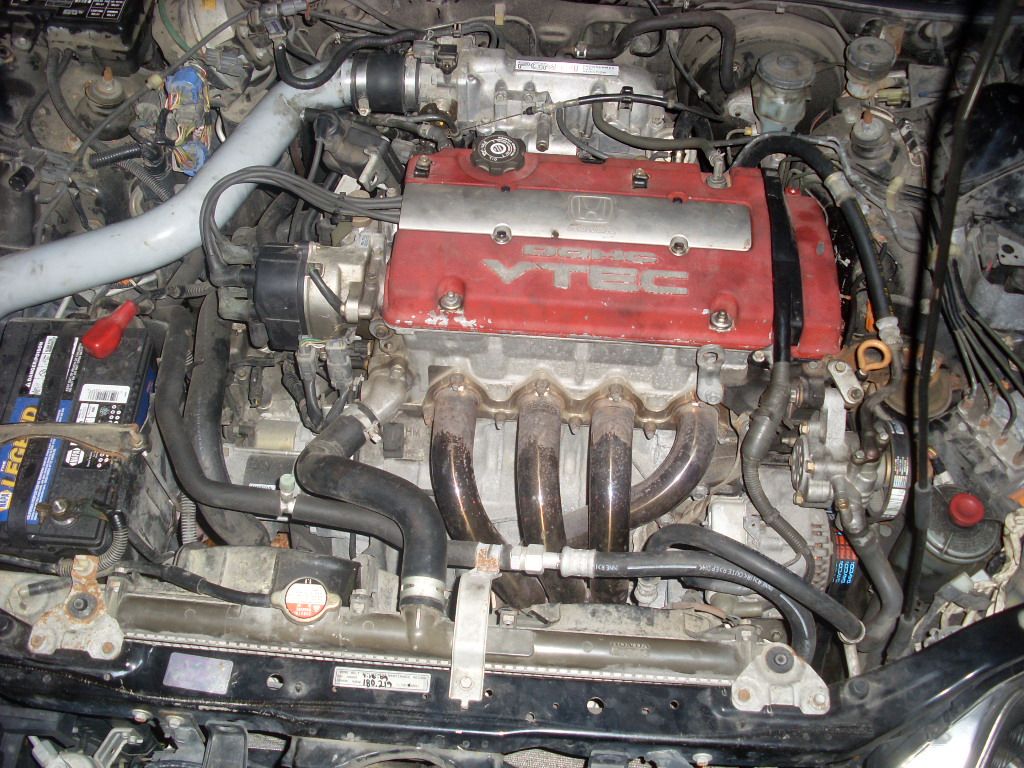 here is the motor
I am a pretty good mechanic but it is on american cars mostly so not alot of head gasket experiance,But I have switched over to hondas so i need to get the old ideas out of my head LOL I have 2 accords and this prelude and a 2 acura TL.where is A good place to read up on doing head gaskets??
 here is the motor
Last edited by bob441; Jan 24, 2014 at 04:23 PM.

Honda-Tech Member
Joined: Jan 2011
Posts: 610
Likes: 0
Re: h22a no compression on #2 and #3 rings or head??
American cars have head gaskets too.
Do wet and dry comp. test
Inspect plugs
Do leak down test
After that you should have a good idea where you are loosing comp.
It's the same theory you see in American cars.
Most likely bad rings or head gasket blown between 2/3
I've seen both. Inside cylinders are usually the first rings/wall to go (more heat)
Don't forget to inform yourselves on FRM sleeves
Do wet and dry comp. test
Inspect plugs
Do leak down test
After that you should have a good idea where you are loosing comp.
It's the same theory you see in American cars.
Most likely bad rings or head gasket blown between 2/3
I've seen both. Inside cylinders are usually the first rings/wall to go (more heat)
Don't forget to inform yourselves on FRM sleeves
Last edited by preludeNApower; Jan 25, 2014 at 06:18 PM.


Moderator
Joined: Dec 2004
Posts: 3,351
Likes: 16
From: CO
Re: h22a no compression on #2 and #3 rings or head??
Yep there are a few possibilities, and the best place to start, is up in the FAQs at the top of the page. We have links to the factory service guides, download a copy and read up on the procedures to remove and intsall the head, and measure the surfaces for any warpage.
A leakdown test may give a better idea as to where you are leaking compression from, and go from there.
Do you know if anything happened to the engine, i.e. timing belt skipped/ broke? I am sort of leaning to something like that, and maybe bent valves in 2 and 3.
A leakdown test may give a better idea as to where you are leaking compression from, and go from there.
Do you know if anything happened to the engine, i.e. timing belt skipped/ broke? I am sort of leaning to something like that, and maybe bent valves in 2 and 3.

Honda-Tech Member
Joined: Mar 2013
Posts: 1,068
Likes: 2
From: Washington State
Re: h22a no compression on #2 and #3 rings or head??
bad rings, rings may just need oil
bent valves
really bad timing, check valve lash.
bad gasket
Thats all I can think of, should be one of those.
bent valves
really bad timing, check valve lash.
bad gasket
Thats all I can think of, should be one of those.

 Re: h22a no compression on #2 and #3 rings or head??
On a naturally aspirated engine, I couldn't suspect anything piston related, especially since the dead holes are next to each other. Either blown headgasket between the two, or the mechanical timing is off. Checking the timing marks is easy, I would start there
Trending Topics


Honda-Tech Member
Joined: Jan 2014
Posts: 42
Likes: 0
From: Fulton NY
Re: h22a no compression on #2 and #3 rings or head??
I wouldn't think it to be the headgasket, you would be compressing AF in the cylinders if that was the case (Please feel free to correct me if I am wrong). I would check the rings and the head to make sure nothing is warped or the rings are stuck. I have found that if the rings are stuck you get a big build of Carbon on the Spark plugs. I would check the rings and your seals on the plugs.

Honda-Tech Member
Joined: Aug 2007
Posts: 9,865
Likes: 4
From: Oregon
Re: h22a no compression on #2 and #3 rings or head??
you can sometimes get an idea by sticking your leak down tester in the plug hole, turning the air on and listening.
regardless the head has to come off, if it's valves or the HG you can repair
if you cracked a ringland {which is actually fairly common}
the head being off makes the engine easier to pull
it's not rings, if it was just worn rings you would have some compression
most zero compression situations i've seen are bent or fragged valves or a hole in the piston
regardless the head has to come off, if it's valves or the HG you can repair
if you cracked a ringland {which is actually fairly common}
the head being off makes the engine easier to pull
it's not rings, if it was just worn rings you would have some compression
most zero compression situations i've seen are bent or fragged valves or a hole in the piston
Thread Starter
Honda-Tech Member
Joined: Nov 2011
Posts: 58
Likes: 0
From: Central Kentucky
Re: h22a no compression on #2 and #3 rings or head??
Ok guys it has been too cold here to work on it but now I am getting ready to tackle it ,where is the best place to get a head gasket and how much should a shop charge to do this?I do not feel confident enough to do this.
Re: h22a no compression on #2 and #3 rings or head??
Now the estimate: Remember that different shops charge differently, and mechanics shops always charge out the wazooo. Also if they have to buy parts, they will place an additional 25%-75% markup on them.
Without parts expect a garage to charge you around $500 for just the labor to change the head gasket. (give or take $200. I say this because tuners that work on Hondas all the time can swap these out very quickly and may charge a good deal less than a conventional mechanic. I think my tuner would probably do it for $200)
While they are in there, you should get your water pump, timing belt, timing belt idler pulley (or the tensioner bearing as some may call it), install a KS manual timing tensioner (the hydraulic one you have will fail eventually, and the KS one will never fail). These additional parts are about $270ish but are parts you should replace now since the head is already off the car.
Depending on the shop, the labor for these might only be $100 additional while other shops might try to charge you double or even triple that amount.
If you do indeed need rings, this will be another stack of cash for a shop to do it.
I know you do not feel comfortable, but you have a choice to make. Either get comfortable, or pay someone a big-ole stack of cash. I can say this: all this work is not overly complicated or difficult so long as you 1) have the proper tools, and 2) TAKE YOUR TIME. Honestly, if you have a mechanically inclined friend things will go a lot easier. If you do decide to do this yourself, just be careful and conscious of the timing marks and torque specs. Also if the car starts to get hot after this job os done do not panic... it is most likely b/c of an air bubble in the coolant system. Hondas and Toyotas are notorious for this. Just shut the car down, let it cool, and follow the coolant "burping procedure".
Also: Your symptoms may be rings, valves, and/or just a head gasket. Please be sure you are fixing the actual cause of the issues as I would hate for you to spend all that time and money replacing a head gasket when you really had bent valves. If it is rings, make sure the cylinder walls are not excessively scored before replacing. If they are excessively scored, then you either need to re-sleeve or just get another long-block.
Another consideration: There is always the option of selling your long block as "rebuildable" and just ordering a JDM one and dropping it in if you want to "do it yourself". They can easily be swapped out in one weekend. You can do all the timing belt/ water pump stuff on the "new" JDM engine while the engine is uninstalled. I know it sounds crazy, but this might actually be cheaper and easier for you depending on your comfort level. I say this might be easier b/c changing the water pump, timing belt, tensioner, and idler pulley is easy when the engine is out of the car. Heck, you do not "have" to do this on your JDM engine and alternatively may just run it with whatever used parts come on it, but I always replace this stuff on mine. This is because the old and used parts have miles on them and they have been sitting in warehouse or junkyard in Japan for a decade, and it just gives me piece of mind to do replace these general maintenance parts while the engine is out of the car. Also change the clutch, throw-out and pilot bearings, and flywheel. They are relatively inexpensive and easy to handle now that the engine is out of the car.
Removing you engine is a pice of cake. Just disconnect the harness, accessory pumps (A/C and Power steering), the shifter linkage, fuel line, throttle cable, coolant lines too the radiator and heater, you may want to remove your radiator and fans since its easy and gives you more room, exhaust manifold, remove the axles, attach the engine to a lift and support it with a jack, unbolt the mounts and it comes right out. It literally takes like 2-3 hours. If you are a novice, you can get this done in a day as long as you have the right tools. Once the engine is out you can set it on a pallet and pull the transmission off, then slide the new one on. Installation is reverse of removal.
Last edited by 1991_crxsi; Mar 14, 2014 at 05:32 AM.

 Re: h22a no compression on #2 and #3 rings or head??
I have a ported head with a fresh valve job, Supertech valve guides, and polished combustion chambers. Never been used since rebuild. LMK if you want it. Its squeaky clean.
Moderator
Joined: Dec 2004
Posts: 3,351
Likes: 16
From: CO
Re: h22a no compression on #2 and #3 rings or head??
The gasket is either a 1992-1996 style if closed deck or 97+ style if open deck. A quick google search will show you how the difference is if you have any questions.

moderator emeritus
Joined: Oct 2002
Posts: 16,357
Likes: 6
From: Cantonment, FL
Re: h22a no compression on #2 and #3 rings or head??
You need to do a leakdown test. it will give you a lot of information if you perform it correctly. No sense in doing all that leg work when you dont know whats happening. these procedures can be found on youtube for visual help.

Thread
Thread Starter
Forum
Replies
Last Post
SolScifen
Honda Civic / Del Sol (1992 - 2000)
18
Jan 7, 2012 04:49 PM