


Out of the Box Header Design



Honda-Tech Member
Joined: May 2003
Posts: 1,328
Likes: 0
From: r4, mars
 Re: Out of the Box Header Design
could be harmonic/wave tuning for 1 runner per valve...
it might be "stronger" as far as the signal is talked about...
vs having a measurement from the back of the valve to the tip of the velocity stack
only to have the last inch of the port bfor the back of the valve.. have a divider going into two valves
me thinks... (ive known to be wrong... most of the time LOL)
----------------------------------------------------------
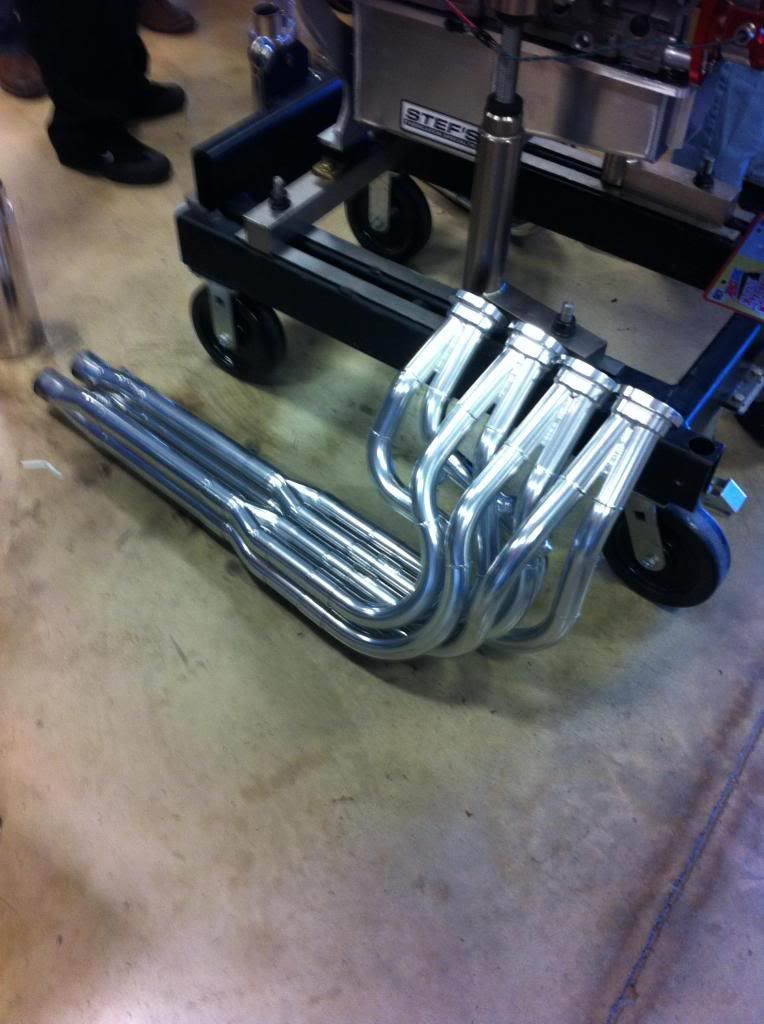
on to the first pic by the OP... could be its a better way of making the effective scavenge, work better for more power?
by looking at the per valve pairing?
it might be "stronger" as far as the signal is talked about...
vs having a measurement from the back of the valve to the tip of the velocity stack
only to have the last inch of the port bfor the back of the valve.. have a divider going into two valves
me thinks... (ive known to be wrong... most of the time LOL)
----------------------------------------------------------
on to the first pic by the OP... could be its a better way of making the effective scavenge, work better for more power?
by looking at the per valve pairing?
Last edited by d15Beta; Oct 11, 2013 at 05:23 AM. Reason: added thought
Trending Topics
Thread Starter
Honda-Tech Member
Joined: Feb 2003
Posts: 1,171
Likes: 0
From: Houston, TX
Re: Out of the Box Header Design
The engines have an RPM limit of about 7000 RPM, and points are scored for overall power with respect to displacement. The exhaust side is hyper critical since the lower RPM is so important, but right now Accufabs Ford is in 1st with a standard 421 design.
could be harmonic/wave tuning for 1 runner per valve...
it might be "stronger" as far as the signal is talked about...
vs having a measurement from the back of the valve to the tip of the velocity stack
only to have the last inch of the port bfor the back of the valve.. have a divider going into two valves
me thinks... (ive known to be wrong... most of the time LOL)
----------------------------------------------------------
on to the first pic by the OP... could be its a better way of making the effective scavenge, work better for more power?
by looking at the per valve pairing?
it might be "stronger" as far as the signal is talked about...
vs having a measurement from the back of the valve to the tip of the velocity stack
only to have the last inch of the port bfor the back of the valve.. have a divider going into two valves
me thinks... (ive known to be wrong... most of the time LOL)
----------------------------------------------------------
on to the first pic by the OP... could be its a better way of making the effective scavenge, work better for more power?
by looking at the per valve pairing?

Honda-Tech Member
Joined: Mar 2004
Posts: 1,176
Likes: 0
Re: Out of the Box Header Design
My perspective on that design is probably to target a broader rpm range. The 2 primaries per runner allows it to support the flow demand at the higher RPMs and the primary size and long length are what produces the midrange power. I can see it working/possibly working given the engine displacement being used.
That design is along the lines of the dual runner IM setup and even the variable valve timing stuff, this time its just in the header.
I have a very close friend that worked alongside Dave at PD that competed in that EMC competition as well, good stuff.
That design is along the lines of the dual runner IM setup and even the variable valve timing stuff, this time its just in the header.
I have a very close friend that worked alongside Dave at PD that competed in that EMC competition as well, good stuff.
Honda-Tech Member
Joined: May 2003
Posts: 1,328
Likes: 0
From: r4, mars
Re: Out of the Box Header Design
EG1834
im almost sure there is a divider in the port extending to the flange..
because that port size on the flange is awfully wide for an exhaust
its like the intake of a DSM intake (4g63)
my best guess is that, tuning each exh. primary (per valve) u can pair it so many ways sequencially.. to help pull a 1-2-3 sequence
+ possibly staggering the LC too.. kinda like Colt Cam's "tri flow" aproach
im almost sure there is a divider in the port extending to the flange..
because that port size on the flange is awfully wide for an exhaust
its like the intake of a DSM intake
(4g63)my best guess is that, tuning each exh. primary (per valve) u can pair it so many ways sequencially.. to help pull a 1-2-3 sequence
+ possibly staggering the LC too.. kinda like Colt Cam's "tri flow" aproach

B*a*n*n*e*d
Joined: Mar 2002
Posts: 7,765
Likes: 1
Re: Out of the Box Header Design
If it is working for Kaase, that's great.
400ci is big, and the header pipes don't look that big.
Randy made an 8-pipe header for the head pictured. He said it was choked up top, but the bottom-end was improved. He believed that it had too much surface are (and resultant drag), that hindered top-end.
400ci is big, and the header pipes don't look that big.
Randy made an 8-pipe header for the head pictured. He said it was choked up top, but the bottom-end was improved. He believed that it had too much surface are (and resultant drag), that hindered top-end.
Thread Starter
Honda-Tech Member
Joined: Feb 2003
Posts: 1,171
Likes: 0
From: Houston, TX
Re: Out of the Box Header Design
If it is working for Kaase, that's great.
400ci is big, and the header pipes don't look that big.
Randy made an 8-pipe header for the head pictured. He said it was choked up top, but the bottom-end was improved. He believed that it had too much surface are (and resultant drag), that hindered top-end.
400ci is big, and the header pipes don't look that big.
Randy made an 8-pipe header for the head pictured. He said it was choked up top, but the bottom-end was improved. He believed that it had too much surface are (and resultant drag), that hindered top-end.
Thread Starter
Honda-Tech Member
Joined: Feb 2003
Posts: 1,171
Likes: 0
From: Houston, TX
Thread Starter
Honda-Tech Member
Joined: Feb 2003
Posts: 1,171
Likes: 0
From: Houston, TX
Re: Out of the Box Header Design
"SCORING
Performance rankings for the competition pulls will be computed using
SUPERFLOW/DTS software. Flywheel diameter & thickness will be used as part of
SUPDRFLOW/DTS programming to arrive at the inertia factor. Bore/stroke figures
will be used as part of SUPERFLOW/DTS programming to arrive at the frictional
losses. The upper RPM limit will be set at 7200 rpm. Each entry’s scoring is a direct
result of a Team’s engine Dyno performance, and resulting scores are specific to the
engine. Points and scores are not transferable from a Team’s engine to another
engine entry by the same Team, nor are points and scores transferable from one
Team to another Team.
If an event is postponed for any reason prior to the start of the scheduled run,
it is necessary that any engine and Team still eligible for event competition be in
attendance at the rescheduled date and time to be eligible for all scores and any
contingency monies and/or awards. If an event is postponed and/or disrupted and
rescheduled due to weather or other conditions, natural disasters, acts of God, etc.,
participants unable to return will not be eligible for any final placement and/or
contingency monies, and will be listed as Did Not Finish (DNF) in the Event
competition postings.
Scored qualifying pulls will consist of three fast acceleration pulls starting at
3000 rpm and ending at 7000 rpm. Then, "average torque corrected to SAE specs"
(recorded to one decimal place) from each of the three scored qualifying pulls will be
added together and divided by three (the resulting average of corrected torque will
be recorded to one decimal place). The "average horsepower corrected to SAE
specs" (recorded to one decimal place) from the three scored qualifying pulls will be
added together and divided by three (the resulting average of corrected horsepower
will be recorded to one decimal place).
To compensate for the varied engine displacements, the corrected average torque
and corrected average horsepower from the three scored qualifying pulls shall be
added together then multiplied by 1000 and divided by the CLAIMED cubic inch
displacement of the engine. Corrected torque, corrected horsepower, & final quotient
numbers are recorded to one decimal place.
Example:
C. Torque #1 C. Torque #2 C. Torque #3
427.4 425.5 424.8 Avg C .torque = 425.9
C. HP #1 C. HP #2 C. HP #3
365.6 364.3 363.8 Avg C. HP = 364.6
(425.9+364.6)*1000/354 Quotient = 2233.0
Rounding of numbers will be utilizing standard rounding:
Example 2232.96 = 2233.0
Claiming a cubic inch less than actual calculated cubic inch as stated in the
ENGINE-displacement section of these rules, shall result in disqualification. Claiming
a cubic inch 5 or more cubic inches greater than actual calculations shall result in
disqualification."
http://image.automotive.com/f/445691...ch-26-2013.pdf
Thread Starter
Honda-Tech Member
Joined: Feb 2003
Posts: 1,171
Likes: 0
From: Houston, TX
Re: Out of the Box Header Design
B*a*n*n*e*d
Joined: Mar 2002
Posts: 7,765
Likes: 1
Re: Out of the Box Header Design
4-v must be the ticket. Multi-valves allow for staggered cam profiles which can be tweaked for an rpm range better--2 lobes two tweak (duration, lift, lobe center) instead of one. I found this to be the case from our experience with staggered v. non-staggered primaries on BVTEC cams.


Thread Starter
Honda-Tech Member
Joined: Feb 2003
Posts: 1,171
Likes: 0
From: Houston, TX
Re: Out of the Box Header Design
4-v must be the ticket. Multi-valves allow for staggered cam profiles which can be tweaked for an rpm range better--2 lobes two tweak (duration, lift, lobe center) instead of one. I found this to be the case from our experience with staggered v. non-staggered primaries on BVTEC cams.
The crank alone was a custom fully counterweighted billet piece from Sonny Bryant I believe. We are talking $3500 and 12 weeks to get just the crank! Over 4.5" of stroke on all those bad boys to meet me 400ci minimum!
Honda-Tech Member
Joined: May 2003
Posts: 1,328
Likes: 0
From: r4, mars
Re: Out of the Box Header Design
just to continue this.. and maybe head to a nicer "technical" discussion....
how bout this


renault sport f4RS fsr engine off the clio's
used in the formula renault series...
some things here goes quite against the "norm"
wonder wat people think
how bout this


renault sport f4RS fsr engine off the clio's
used in the formula renault series...
some things here goes quite against the "norm"
wonder wat people think

Thread
Thread Starter
Forum
Replies
Last Post
danmanh22
All Motor / Naturally Aspirated
16
Apr 12, 2004 08:01 PM