


Honda Civic B20 Vtec Turbo!


Honda-Tech Member
Joined: Dec 2006
Posts: 996
Likes: 1
From: Portland, OR, USA
 Re: Honda Civic B20 Vtec Turbo!
I'm so tempted to tig weld my own manifold.... It would be fun... call me crazy. Should be nice to see this all finished.
Do you have a jig you have made to put the beveled edges on your tubes?
I like how you have left adequate room to get a stubby torch all around your connections, I've seen some that I seriously question how they were able to accomplish it.
Do you have a jig you have made to put the beveled edges on your tubes?
I like how you have left adequate room to get a stubby torch all around your connections, I've seen some that I seriously question how they were able to accomplish it.


Honda-Tech Member
Joined: Dec 2006
Posts: 996
Likes: 1
From: Portland, OR, USA
Re: Honda Civic B20 Vtec Turbo!
Cburke -- you use a http://www.eastwood.com/media/catalo...e95/p41884.jpg
Tig torch with a smaller tungston rod. In the photo that twist on cap, you generally have to grind down the rod to ~1 inch.
Tig torch with a smaller tungston rod. In the photo that twist on cap, you generally have to grind down the rod to ~1 inch.

Thread Starter
Honda-Tech Member
Joined: Feb 2011
Posts: 238
Likes: 0
Re: Honda Civic B20 Vtec Turbo!
I'm so tempted to tig weld my own manifold.... It would be fun... call me crazy. Should be nice to see this all finished.
Do you have a jig you have made to put the beveled edges on your tubes?
I like how you have left adequate room to get a stubby torch all around your connections, I've seen some that I seriously question how they were able to accomplish it.
Do you have a jig you have made to put the beveled edges on your tubes?
I like how you have left adequate room to get a stubby torch all around your connections, I've seen some that I seriously question how they were able to accomplish it.
I have also done some really tight manifolds but is simple...because 1'st you tack everything that take it runner by runner and weld it.

Only I will merge the 2 pipes into 1 because it will have only one external gate.
Cburke -- you use a http://www.eastwood.com/media/catalo...e95/p41884.jpg
Tig torch with a smaller tungston rod. In the photo that twist on cap, you generally have to grind down the rod to ~1 inch.
Tig torch with a smaller tungston rod. In the photo that twist on cap, you generally have to grind down the rod to ~1 inch.

Honda-Tech Member
Joined: Apr 2011
Posts: 530
Likes: 0
From: Kingston, Ontario
Re: Honda Civic B20 Vtec Turbo!
You can get extended reach ceramic cups too to get down there nice and far without too much stickout, but you generally dont need those.
A small torch (wp9 or similar) is almost essential for this work.
Manifold looks good! Post up pics when its done.
A small torch (wp9 or similar) is almost essential for this work.
Manifold looks good! Post up pics when its done.
Trending Topics

Thread Starter
Honda-Tech Member
Joined: Feb 2011
Posts: 238
Likes: 0
Re: Honda Civic B20 Vtec Turbo!
If someone will need I can supply them without any problems.
They are made out of 1.9'' sch 10 seamless pipe (316L stainless).
So........I am using 3 types of torches
1. is a big 315 gas cooled torch (for aluminium and other big amp jobs)
2. a WP 17
3. a small ESAB torch (100 amps capable) which is really small and uses only EASB collets
http://tuotteet.etra.fi/en/g7163067/
And this is the collet
http://www.mscdirect.com/product/62143888
I don't know the model but this is used here in my country in Shipyards for small tight welding spots.
All coming together now...
I have made also an ''anaconda'' style downpipe to fit the requested application


Please don't be very critic with the downpipe welds
 ...they are made out of 3'' pipe with just 1.5 mm wall thickness

OG Fabricator
Joined: Feb 2005
Posts: 1,864
Likes: 1
From: Burlington, Ont., Canada
Re: Honda Civic B20 Vtec Turbo!
the overall design looks ok, but i'd keep an eye on the welds close to the head flange. i'd have rather seen you make a transition on the elbows that weld to the hf rather than a short piece as you have done it. it is an invitation for a crack adding the welds so close together at the most important structural weld on the manifold. it is a lot of weight at that point.
also, the downpipe is really going to prevent exhaust flow with the tight bend right out of the turbine. you will want to watch those pie cuts for cracking too. they will see a lot of heat and stress as the exhaust is hanging most of the downpipe weight on this joint.
aaron
also, the downpipe is really going to prevent exhaust flow with the tight bend right out of the turbine. you will want to watch those pie cuts for cracking too. they will see a lot of heat and stress as the exhaust is hanging most of the downpipe weight on this joint.
aaron
Thread Starter
Honda-Tech Member
Joined: Feb 2011
Posts: 238
Likes: 0
Re: Honda Civic B20 Vtec Turbo!
Aaron thanks alot for the positive criticism.
There are not to many these days who will give you advises and tips on how to achieve a better design or how to make better welds....because now let's be sincere, how can I be a competitor for you or for other fabricators in the USA?!
The answer is simple....I can't be a real competitor for many reasons....I don't have the skills / experience that you have, we are on different continents, etc.
Therefore....I am very grateful that you took the time to look at my thread and give a feedback and advice on how to become a better fabricator.
If everybody (I mean great fabricators like you) would have found the time to post a small feedback I think that we would see alot of really fine fabrication!
Now coming back on the manifold......in order to prevent cracking I will fabricate some braces to hold the weight of the manifold....isn't this a good idea?
There are not to many these days who will give you advises and tips on how to achieve a better design or how to make better welds....because now let's be sincere, how can I be a competitor for you or for other fabricators in the USA?!
The answer is simple....I can't be a real competitor for many reasons....I don't have the skills / experience that you have, we are on different continents, etc.
Therefore....I am very grateful that you took the time to look at my thread and give a feedback and advice on how to become a better fabricator.
If everybody (I mean great fabricators like you) would have found the time to post a small feedback I think that we would see alot of really fine fabrication!
Now coming back on the manifold......in order to prevent cracking I will fabricate some braces to hold the weight of the manifold....isn't this a good idea?

Honda-Tech Member
Joined: Jan 2005
Posts: 5,641
Likes: 0
From: Lower Right Hand Corner, PA
Re: Honda Civic B20 Vtec Turbo!
Yes, I would make a fairly heavy duty bracket that either ties the head flange to the turbo flange, or is capable of securing the head flange to another portion of the engine that will keep it from loading at the head flange welds.
Whatever you do, make sure that the bracket will attach to the engine, and NOT to the chassis, as they move independently of each other and will create more problems than solutions.
Otherwise it looks good, I really like the long bend idea!
Whatever you do, make sure that the bracket will attach to the engine, and NOT to the chassis, as they move independently of each other and will create more problems than solutions.
Otherwise it looks good, I really like the long bend idea!
Thread Starter
Honda-Tech Member
Joined: Feb 2011
Posts: 238
Likes: 0
Re: Honda Civic B20 Vtec Turbo!
Yes, I would make a fairly heavy duty bracket that either ties the head flange to the turbo flange, or is capable of securing the head flange to another portion of the engine that will keep it from loading at the head flange welds.
Whatever you do, make sure that the bracket will attach to the engine, and NOT to the chassis, as they move independently of each other and will create more problems than solutions.
Otherwise it looks good, I really like the long bend idea!
Whatever you do, make sure that the bracket will attach to the engine, and NOT to the chassis, as they move independently of each other and will create more problems than solutions.
Otherwise it looks good, I really like the long bend idea!
Thanks for the tips.
I will mount 2 brackets on the downpipe that will be bolted directly to the engine.
The long bend idea came to me after I have made some elbows just to test a pipe bender.....and I had 10 elbows which were lying around in the scrap bin
 ))))))))))))))


Honda-Tech Member
Joined: May 2013
Posts: 257
Likes: 0
From: Ohio
Re: Honda Civic B20 Vtec Turbo!
You don't necessarily need any special solvents or anything like that, acetone or denatured alcohol will work just fine. A quick polish and a large gas lens will make all the difference in the world.

Honda-Tech Member
Joined: Apr 2011
Posts: 530
Likes: 0
From: Kingston, Ontario
Re: Honda Civic B20 Vtec Turbo!
I use a 3" stainless knot brush on my angle grinder to a tacked runner. Then wipe the whole runner down with acetone and weld.
Thread Starter
Honda-Tech Member
Joined: Feb 2011
Posts: 238
Likes: 0
Re: Honda Civic B20 Vtec Turbo!
very nice colors after we have started the enginee.
Due to the Acid dipping .....look at the color after the manifold was heated!
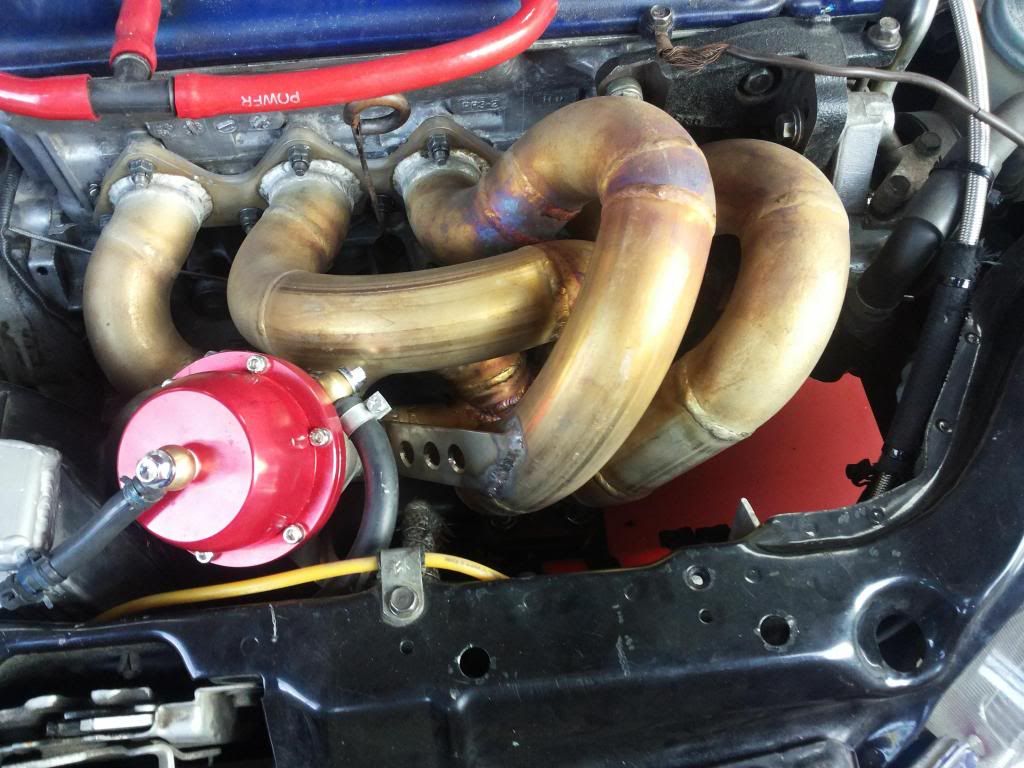


You should see it live...it looks 10 times better than in the photos.....the runners are exactly like gold!
Due to the Acid dipping .....look at the color after the manifold was heated!


You should see it live...it looks 10 times better than in the photos.....the runners are exactly like gold!
