


Tech Topic: Exhaust Flow overlooked?


Thread Starter
Honda-Tech Member
Joined: Aug 2009
Posts: 7,635
Likes: 3
From: Baton Rouge,Louisiana
 Tech Topic: Exhaust Flow overlooked?
I figured with all the other stuff flying around, we'd need a change in pace.
Something I'd like to get others take on is the Exhaust flow on our B/H/K series heads. I notice now and days people tend to overlook how important this really is.
4-valve heads ratio of exhaust flow to intake flow, is what i'm looking at.
Exhaust valves and ports are always made smaller that the intakes, because exhaust flow gets pushed first by high cylinder pressure, then by the piston on the way up, this is generally what I see to be "the Norm".. But is it really ideal for the most part?
This is a discussion generally to see what others think a Street and Drag car will like, all opinions welcomed.
I'm in the process right now of testing a theory I have, on using a beefy intake profile combined with a mild lift, but more duration exhaust. This is going on in a "stock block" h series car. User "SP Garage" is performing the test on his personal race car and its something I will be sharing with the public.
But i'm interested in seeing you guy's theories or Ideas. Is the same ol Big intake, with smaller exhaust really still the thing? Or has progress changed.
Thoughts? Ideas?
Something I'd like to get others take on is the Exhaust flow on our B/H/K series heads. I notice now and days people tend to overlook how important this really is.
4-valve heads ratio of exhaust flow to intake flow, is what i'm looking at.
Exhaust valves and ports are always made smaller that the intakes, because exhaust flow gets pushed first by high cylinder pressure, then by the piston on the way up, this is generally what I see to be "the Norm".. But is it really ideal for the most part?
This is a discussion generally to see what others think a Street and Drag car will like, all opinions welcomed.
I'm in the process right now of testing a theory I have, on using a beefy intake profile combined with a mild lift, but more duration exhaust. This is going on in a "stock block" h series car. User "SP Garage" is performing the test on his personal race car and its something I will be sharing with the public.
But i'm interested in seeing you guy's theories or Ideas. Is the same ol Big intake, with smaller exhaust really still the thing? Or has progress changed.
Thoughts? Ideas?
Thread Starter
Honda-Tech Member
Joined: Aug 2009
Posts: 7,635
Likes: 3
From: Baton Rouge,Louisiana
Re: Tech Topic: Exhaust Flow overlooked?
Not just Port size, valve size, header choice or camshaft choice, just in general, anything relating to the "EXHAUST" of the head, i'd like to hear takes on.

B*a*n*n*e*d
Joined: Dec 2001
Posts: 8,185
Likes: 3
Re: Tech Topic: Exhaust Flow overlooked?
In my opinion, for the most part exhaust ports on a head are left alone and just get cleaned up in order for the head to look ported. Exhaust ports generally do not follow the logic or principles behind the intake side of the head.
So assuming you have 5 kseries heads or 5 bseries heads that all flow 10 cfm apart on the intake side, (assuming 290 cfm, 300 cfm, 310 cfm, 320 cfm, 330 cfm) , I would not be surprised if all these heads had pretty much same exhaust flow characteristics.
So as far as exhaust flow on heads, for the most part, they are left alone. They are designed like this for a reason and most of the time any attempt to highly change them is a bad idea.
As far as exhaust side cam specs, they are usually part of overall design. Once a set of cams makes power on an engine, a set intake/exhaust ratio is what the engine sees. So if you make the intake bigger but manage to keep the same duration, gains are possible. If you can make the exhaust cam smaller and keep same duration, gains are possible. The reason for intake going bigger and exhaust going smaller is to improve the intake/exhaust ratio or at least keep it close to what worked for the engine. It is usually a good idea to only change one thing at a time and not try to test both a bigger intake cam and smaller exhaust cam at the same time.
Trying to make gains by upgrading exhaust on all motor engines is much more challenging because exhaust is what it is for a reason .. so in a way its much more easier to lose power by messing with exhaust that gain power because the intake just likes to consume air without having to worry how to get rid of it. The exhaust's job is to get rid of it so what comes in on every stroke is very important and it's really hard to separate the 2 processes when it comes to cam design, it's all about the combination of the 2.
The only area where tuners can actually do something concerning exhaust , in my opinion, is matching their exhaust system to the engine.
In simple terms, a highly efficient performance exhaust system scavenges exhaust from the cylinders and draws intake mixture into the cylinders. Careful tuning can reduce pressure in the exhaust port during overlap. At the same time atmospheric pressure forces air through the intake valves. That is the scavenging effect that needs to be optimized that directly affects Volumetric Efficiency.
The dynamics of gas flow through exhaust systems are highly complex because while exhaust gas moves out at around 250 ft/sec through the system, there are simulatneous pressure waves travelling up and down the runners at around 1600 ft/sec. The challenge is to get the low points of these pressure waves to coincide with exhaust overlap at the port. This is impossible to do without taking into consideration the specific engine in question so generalizing further would be unfair.
So what I am trying to say here is that changing headers is the only reasonable way to tune your exhaust system, assuming you have a well balanced engine running optimized cams where in theory that would mean that you already have the best possible exhaust design on the head port and the exhaust cam.. Anything else will make less power if you change it.
So how a header gets sized would be the next question to ask. There are a few different models where RPM, exhaust valve opening and closing points, exhaust valve size etc etc
In the custom header business there are a number of rules of thump for inside runner diameters, length of runners etc There is some short of basic relationship between runner volume and cylinder diameter. Generally speaking we would expect longer runners with smaller diameters to increase power at LOWER RPM, and shorter runners with larger diameter increasying power at HIGHER RPM.
Collectors and exhaust piping is the next piece of the puzzle and together a complete exhaust system come together.
The best of both worlds is when as an engine builder/tuner/header fabricator you have access to an engine dyno where an engine can run and get dynoed without being inside a car.
The key ingredient here would be an adjustable custom header that would have the ability to "change" dimensions on the fly in order for the tuner/engine builder to see what works best of the powerband they desire.
This short of approach requires patience and the ability to access and operate the engine dyno, as well as fabricating a high dollar header with adjustable lengths, but that is really the only way to nail it down as close to ideal as possible.
So finally, I believe that for the most part, exhaust flow is what it is for a reason and the only way to gain in that area is through trying different header setups. I do not see any advantage in messing with the head ports on the exhaust side. Unless of course you are making insane all motor power where everything matters, but in that case, your head porter should know better than most.
Cam wise, the only way in my opinion it would be worth to try a new exhaust cam on an existing engine that is already making acceptable power with a set of cams, would be to design a different exhaust with smaller lift and the same duration as before. Changing duration for the most part would upset the balance and you would loose tq or peak HP or both. Now, if the original cams were not ideal, I am sure its possible to make gains but if more duration works for an updated exhaust cam, that also means that there is probably more power hidden by matching the "new" duration on the intake as well. So, don't be afraid to try anything and see what it can do but I have done a lot of testing with single cams on engines running my cams and the chances of seeing a positive outcome are much greater if you are messing with the intake side. Exhaust just likes it a certain way.
Congrats on trying to push the envelope with testing and best of luck
Nikos
So assuming you have 5 kseries heads or 5 bseries heads that all flow 10 cfm apart on the intake side, (assuming 290 cfm, 300 cfm, 310 cfm, 320 cfm, 330 cfm) , I would not be surprised if all these heads had pretty much same exhaust flow characteristics.
So as far as exhaust flow on heads, for the most part, they are left alone. They are designed like this for a reason and most of the time any attempt to highly change them is a bad idea.
As far as exhaust side cam specs, they are usually part of overall design. Once a set of cams makes power on an engine, a set intake/exhaust ratio is what the engine sees. So if you make the intake bigger but manage to keep the same duration, gains are possible. If you can make the exhaust cam smaller and keep same duration, gains are possible. The reason for intake going bigger and exhaust going smaller is to improve the intake/exhaust ratio or at least keep it close to what worked for the engine. It is usually a good idea to only change one thing at a time and not try to test both a bigger intake cam and smaller exhaust cam at the same time.
Trying to make gains by upgrading exhaust on all motor engines is much more challenging because exhaust is what it is for a reason .. so in a way its much more easier to lose power by messing with exhaust that gain power because the intake just likes to consume air without having to worry how to get rid of it. The exhaust's job is to get rid of it so what comes in on every stroke is very important and it's really hard to separate the 2 processes when it comes to cam design, it's all about the combination of the 2.
The only area where tuners can actually do something concerning exhaust , in my opinion, is matching their exhaust system to the engine.
In simple terms, a highly efficient performance exhaust system scavenges exhaust from the cylinders and draws intake mixture into the cylinders. Careful tuning can reduce pressure in the exhaust port during overlap. At the same time atmospheric pressure forces air through the intake valves. That is the scavenging effect that needs to be optimized that directly affects Volumetric Efficiency.
The dynamics of gas flow through exhaust systems are highly complex because while exhaust gas moves out at around 250 ft/sec through the system, there are simulatneous pressure waves travelling up and down the runners at around 1600 ft/sec. The challenge is to get the low points of these pressure waves to coincide with exhaust overlap at the port. This is impossible to do without taking into consideration the specific engine in question so generalizing further would be unfair.
So what I am trying to say here is that changing headers is the only reasonable way to tune your exhaust system, assuming you have a well balanced engine running optimized cams where in theory that would mean that you already have the best possible exhaust design on the head port and the exhaust cam.. Anything else will make less power if you change it.
So how a header gets sized would be the next question to ask. There are a few different models where RPM, exhaust valve opening and closing points, exhaust valve size etc etc
In the custom header business there are a number of rules of thump for inside runner diameters, length of runners etc There is some short of basic relationship between runner volume and cylinder diameter. Generally speaking we would expect longer runners with smaller diameters to increase power at LOWER RPM, and shorter runners with larger diameter increasying power at HIGHER RPM.
Collectors and exhaust piping is the next piece of the puzzle and together a complete exhaust system come together.
The best of both worlds is when as an engine builder/tuner/header fabricator you have access to an engine dyno where an engine can run and get dynoed without being inside a car.
The key ingredient here would be an adjustable custom header that would have the ability to "change" dimensions on the fly in order for the tuner/engine builder to see what works best of the powerband they desire.
This short of approach requires patience and the ability to access and operate the engine dyno, as well as fabricating a high dollar header with adjustable lengths, but that is really the only way to nail it down as close to ideal as possible.
So finally, I believe that for the most part, exhaust flow is what it is for a reason and the only way to gain in that area is through trying different header setups. I do not see any advantage in messing with the head ports on the exhaust side. Unless of course you are making insane all motor power where everything matters, but in that case, your head porter should know better than most.
Cam wise, the only way in my opinion it would be worth to try a new exhaust cam on an existing engine that is already making acceptable power with a set of cams, would be to design a different exhaust with smaller lift and the same duration as before. Changing duration for the most part would upset the balance and you would loose tq or peak HP or both. Now, if the original cams were not ideal, I am sure its possible to make gains but if more duration works for an updated exhaust cam, that also means that there is probably more power hidden by matching the "new" duration on the intake as well. So, don't be afraid to try anything and see what it can do but I have done a lot of testing with single cams on engines running my cams and the chances of seeing a positive outcome are much greater if you are messing with the intake side. Exhaust just likes it a certain way.
Congrats on trying to push the envelope with testing and best of luck
Nikos
Thread Starter
Honda-Tech Member
Joined: Aug 2009
Posts: 7,635
Likes: 3
From: Baton Rouge,Louisiana
Re: Tech Topic: Exhaust Flow overlooked?
Based upon what I've read Somewhat surprisingly, the connecting rod affects intake flow. More specifically, the ratio of the center-to-center length of the connecting rod to the stroke of the engine. This is termed the "rod/stroke ratio" or just "rod ratio" and it has a significant effect on Volumetric Efficiency. It'll also differ a huge amount from say a V8 head, to a honda head.
Still reading into alot of it.. but i figured i'd get more opinions on the matter.
Thread Starter
Honda-Tech Member
Joined: Aug 2009
Posts: 7,635
Likes: 3
From: Baton Rouge,Louisiana
Re: Tech Topic: Exhaust Flow overlooked?
In my opinion, for the most part exhaust ports on a head are left alone and just get cleaned up in order for the head to look ported. Exhaust ports generally do not follow the logic or principles behind the intake side of the head.
So assuming you have 5 kseries heads or 5 bseries heads that all flow 10 cfm apart on the intake side, (assuming 290 cfm, 300 cfm, 310 cfm, 320 cfm, 330 cfm) , I would not be surprised if all these heads had pretty much same exhaust flow characteristics.
So as far as exhaust flow on heads, for the most part, they are left alone. They are designed like this for a reason and most of the time any attempt to highly change them is a bad idea.
As far as exhaust side cam specs, they are usually part of overall design. Once a set of cams makes power on an engine, a set intake/exhaust ratio is what the engine sees. So if you make the intake bigger but manage to keep the same duration, gains are possible. If you can make the exhaust cam smaller and keep same duration, gains are possible. The reason for intake going bigger and exhaust going smaller is to improve the intake/exhaust ratio or at least keep it close to what worked for the engine. It is usually a good idea to only change one thing at a time and not try to test both a bigger intake cam and smaller exhaust cam at the same time.
Trying to make gains by upgrading exhaust on all motor engines is much more challenging because exhaust is what it is for a reason .. so in a way its much more easier to lose power by messing with exhaust that gain power because the intake just likes to consume air without having to worry how to get rid of it. The exhaust's job is to get rid of it so what comes in on every stroke is very important and it's really hard to separate the 2 processes when it comes to cam design, it's all about the combination of the 2.
The only area where tuners can actually do something concerning exhaust , in my opinion, is matching their exhaust system to the engine.
In simple terms, a highly efficient performance exhaust system scavenges exhaust from the cylinders and draws intake mixture into the cylinders. Careful tuning can reduce pressure in the exhaust port during overlap. At the same time atmospheric pressure forces air through the intake valves. That is the scavenging effect that needs to be optimized that directly affects Volumetric Efficiency.
The dynamics of gas flow through exhaust systems are highly complex because while exhaust gas moves out at around 250 ft/sec through the system, there are simulatneous pressure waves travelling up and down the runners at around 1600 ft/sec. The challenge is to get the low points of these pressure waves to coincide with exhaust overlap at the port. This is impossible to do without taking into consideration the specific engine in question so generalizing further would be unfair.
So what I am trying to say here is that changing headers is the only reasonable way to tune your exhaust system, assuming you have a well balanced engine running optimized cams where in theory that would mean that you already have the best possible exhaust design on the head port and the exhaust cam.. Anything else will make less power if you change it.
So how a header gets sized would be the next question to ask. There are a few different models where RPM, exhaust valve opening and closing points, exhaust valve size etc etc
In the custom header business there are a number of rules of thump for inside runner diameters, length of runners etc There is some short of basic relationship between runner volume and cylinder diameter. Generally speaking we would expect longer runners with smaller diameters to increase power at LOWER RPM, and shorter runners with larger diameter increasying power at HIGHER RPM.
Collectors and exhaust piping is the next piece of the puzzle and together a complete exhaust system come together.
The best of both worlds is when as an engine builder/tuner/header fabricator you have access to an engine dyno where an engine can run and get dynoed without being inside a car.
The key ingredient here would be an adjustable custom header that would have the ability to "change" dimensions on the fly in order for the tuner/engine builder to see what works best of the powerband they desire.
This short of approach requires patience and the ability to access and operate the engine dyno, as well as fabricating a high dollar header with adjustable lengths, but that is really the only way to nail it down as close to ideal as possible.
So finally, I believe that for the most part, exhaust flow is what it is for a reason and the only way to gain in that area is through trying different header setups. I do not see any advantage in messing with the head ports on the exhaust side. Unless of course you are making insane all motor power where everything matters, but in that case, your head porter should know better than most.
Cam wise, the only way in my opinion it would be worth to try a new exhaust cam on an existing engine that is already making acceptable power with a set of cams, would be to design a different exhaust with smaller lift and the same duration as before. Changing duration for the most part would upset the balance and you would loose tq or peak HP or both. Now, if the original cams were not ideal, I am sure its possible to make gains but if more duration works for an updated exhaust cam, that also means that there is probably more power hidden by matching the "new" duration on the intake as well. So, don't be afraid to try anything and see what it can do but I have done a lot of testing with single cams on engines running my cams and the chances of seeing a positive outcome are much greater if you are messing with the intake side. Exhaust just likes it a certain way.
Congrats on trying to push the envelope with testing and best of luck
Nikos
So assuming you have 5 kseries heads or 5 bseries heads that all flow 10 cfm apart on the intake side, (assuming 290 cfm, 300 cfm, 310 cfm, 320 cfm, 330 cfm) , I would not be surprised if all these heads had pretty much same exhaust flow characteristics.
So as far as exhaust flow on heads, for the most part, they are left alone. They are designed like this for a reason and most of the time any attempt to highly change them is a bad idea.
As far as exhaust side cam specs, they are usually part of overall design. Once a set of cams makes power on an engine, a set intake/exhaust ratio is what the engine sees. So if you make the intake bigger but manage to keep the same duration, gains are possible. If you can make the exhaust cam smaller and keep same duration, gains are possible. The reason for intake going bigger and exhaust going smaller is to improve the intake/exhaust ratio or at least keep it close to what worked for the engine. It is usually a good idea to only change one thing at a time and not try to test both a bigger intake cam and smaller exhaust cam at the same time.
Trying to make gains by upgrading exhaust on all motor engines is much more challenging because exhaust is what it is for a reason .. so in a way its much more easier to lose power by messing with exhaust that gain power because the intake just likes to consume air without having to worry how to get rid of it. The exhaust's job is to get rid of it so what comes in on every stroke is very important and it's really hard to separate the 2 processes when it comes to cam design, it's all about the combination of the 2.
The only area where tuners can actually do something concerning exhaust , in my opinion, is matching their exhaust system to the engine.
In simple terms, a highly efficient performance exhaust system scavenges exhaust from the cylinders and draws intake mixture into the cylinders. Careful tuning can reduce pressure in the exhaust port during overlap. At the same time atmospheric pressure forces air through the intake valves. That is the scavenging effect that needs to be optimized that directly affects Volumetric Efficiency.
The dynamics of gas flow through exhaust systems are highly complex because while exhaust gas moves out at around 250 ft/sec through the system, there are simulatneous pressure waves travelling up and down the runners at around 1600 ft/sec. The challenge is to get the low points of these pressure waves to coincide with exhaust overlap at the port. This is impossible to do without taking into consideration the specific engine in question so generalizing further would be unfair.
So what I am trying to say here is that changing headers is the only reasonable way to tune your exhaust system, assuming you have a well balanced engine running optimized cams where in theory that would mean that you already have the best possible exhaust design on the head port and the exhaust cam.. Anything else will make less power if you change it.
So how a header gets sized would be the next question to ask. There are a few different models where RPM, exhaust valve opening and closing points, exhaust valve size etc etc
In the custom header business there are a number of rules of thump for inside runner diameters, length of runners etc There is some short of basic relationship between runner volume and cylinder diameter. Generally speaking we would expect longer runners with smaller diameters to increase power at LOWER RPM, and shorter runners with larger diameter increasying power at HIGHER RPM.
Collectors and exhaust piping is the next piece of the puzzle and together a complete exhaust system come together.
The best of both worlds is when as an engine builder/tuner/header fabricator you have access to an engine dyno where an engine can run and get dynoed without being inside a car.
The key ingredient here would be an adjustable custom header that would have the ability to "change" dimensions on the fly in order for the tuner/engine builder to see what works best of the powerband they desire.
This short of approach requires patience and the ability to access and operate the engine dyno, as well as fabricating a high dollar header with adjustable lengths, but that is really the only way to nail it down as close to ideal as possible.
So finally, I believe that for the most part, exhaust flow is what it is for a reason and the only way to gain in that area is through trying different header setups. I do not see any advantage in messing with the head ports on the exhaust side. Unless of course you are making insane all motor power where everything matters, but in that case, your head porter should know better than most.
Cam wise, the only way in my opinion it would be worth to try a new exhaust cam on an existing engine that is already making acceptable power with a set of cams, would be to design a different exhaust with smaller lift and the same duration as before. Changing duration for the most part would upset the balance and you would loose tq or peak HP or both. Now, if the original cams were not ideal, I am sure its possible to make gains but if more duration works for an updated exhaust cam, that also means that there is probably more power hidden by matching the "new" duration on the intake as well. So, don't be afraid to try anything and see what it can do but I have done a lot of testing with single cams on engines running my cams and the chances of seeing a positive outcome are much greater if you are messing with the intake side. Exhaust just likes it a certain way.
Congrats on trying to push the envelope with testing and best of luck
Nikos
So basically you're saying the only real way to actively and positively effect the exhaust flow on our heads really is just based around cam design, header/exhaust design and valve design..?
Custom, adjustable headers...now thats some thinking.

Honda-Tech Member
Joined: Jul 2005
Posts: 1,734
Likes: 2
From: Canada
Re: Tech Topic: Exhaust Flow overlooked?
^the combustion chamber plays a large role in the cylinder's ability to squeeze exhaust out of the valve. It seems accepted that there is a little bit of "free lunch" in cleaning up the combustion chamber around the valves, and improving the surface finish of the exhaust runner, but after that things get complicated fast. It becomes important, as always, to match the components (intake, head, cam, valves and exhaust) of the system to one another for the best results. I think Nikos is getting at the fact that there are more important areas to focus on than the exhaust port, however it is still a good topic to discuss, which I agree with. It is a difficult area to apply theory to because the real phenomena which occur during the engine operation are difficult to replicate or model due to the properties such as velocity and temperature gradients which are involved.
One topic I would love to discuss is the slight horizontal curvature in the exhaust ports. I've done a bit of welding to a head I have and I'm working on the program to open the ports back up, im just not sure how important this curvature is as information on it is scarce. I assume it serves to bias the exhaust runner towards one valve more than the other however the actual effect on exhaust flow, especially during overlap is probably not trivial.
basically I'm torn between leaving the slightest curvature in the runner towards the center of the head like factory, or straighten the port out which simplifies machining and header fab.
Any information on the effect this curvature has on efficiency or power would be greatly appreciated, although I suspect I cant find much info because it's top secret.
One topic I would love to discuss is the slight horizontal curvature in the exhaust ports. I've done a bit of welding to a head I have and I'm working on the program to open the ports back up, im just not sure how important this curvature is as information on it is scarce. I assume it serves to bias the exhaust runner towards one valve more than the other however the actual effect on exhaust flow, especially during overlap is probably not trivial.
basically I'm torn between leaving the slightest curvature in the runner towards the center of the head like factory, or straighten the port out which simplifies machining and header fab.
Any information on the effect this curvature has on efficiency or power would be greatly appreciated, although I suspect I cant find much info because it's top secret.
Trending Topics
Honda-Tech Member
Joined: Feb 2003
Posts: 1,171
Likes: 0
From: Houston, TX
Re: Tech Topic: Exhaust Flow overlooked?
Except for power adders, I don't concern myself too much with the exhaust ports but the 2V stuff I work with isn't really that bad to begin with. One of the most notoriously horrible exhaust ports was the old Cleveland Fords. In Pro Stock of that era, they would completely lop off the exhaust port after the valve and weld on their new design.
As far as getting air out, the exhaust has its work cut out for it between air naturally being able to flow better through a convergence and also having a very high pressure delta when it opens. I'll usually open the throat, get a little creative with the back cut on the valve, and worry more about the other stuff.
As far as getting air out, the exhaust has its work cut out for it between air naturally being able to flow better through a convergence and also having a very high pressure delta when it opens. I'll usually open the throat, get a little creative with the back cut on the valve, and worry more about the other stuff.

Thread Starter
Honda-Tech Member
Joined: Aug 2009
Posts: 7,635
Likes: 3
From: Baton Rouge,Louisiana
Re: Tech Topic: Exhaust Flow overlooked?
Except for power adders, I don't concern myself too much with the exhaust ports but the 2V stuff I work with isn't really that bad to begin with. One of the most notoriously horrible exhaust ports was the old Cleveland Fords. In Pro Stock of that era, they would completely lop off the exhaust port after the valve and weld on their new design.
As far as getting air out, the exhaust has its work cut out for it between air naturally being able to flow better through a convergence and also having a very high pressure delta when it opens. I'll usually open the throat, get a little creative with the back cut on the valve, and worry more about the other stuff.
As far as getting air out, the exhaust has its work cut out for it between air naturally being able to flow better through a convergence and also having a very high pressure delta when it opens. I'll usually open the throat, get a little creative with the back cut on the valve, and worry more about the other stuff.
Airflow in 2-valve heads begins slowly. So airflow through these heads responds to a long rod ratio, close to 2:1, for maximum draw after 75° ATDC.
A 4-valve engine flows a lot more air at the lower and mid lifts through its smaller valves and ports. This allows its rod ratio to be smaller without hurting power, more like 1.55:1 which is what is considered "IDEAL" for a Honda. Airflow demand in the 4-valve engine occurs closer to 70° ATDC.
In 2-valve engines the exhaust port flows between 60% and 80% of the intake. Exhaust flow in 4-valve engines is very high, somewhere in the 80% to 90% region.. EG, do you find this to be true?
I know alot of times we say, R/S ratio really isn't important as other things. I believe it should be strongly considered when building a motor but in the end, does it really have "that" big of an effect?
Thread Starter
Honda-Tech Member
Joined: Aug 2009
Posts: 7,635
Likes: 3
From: Baton Rouge,Louisiana
Re: Tech Topic: Exhaust Flow overlooked?
Thread Starter
Honda-Tech Member
Joined: Aug 2009
Posts: 7,635
Likes: 3
From: Baton Rouge,Louisiana
Re: Tech Topic: Exhaust Flow overlooked?
Maybe share "some" of the serect sauce.
I'll open up a bit more with some info , but the more information provided by those who know, will help the discuss.
B*a*n*n*e*d
Joined: Dec 2001
Posts: 8,185
Likes: 3
Re: Tech Topic: Exhaust Flow overlooked?
Good Response.. alot of what i was looking for.
So basically you're saying the only real way to actively and positively effect the exhaust flow on our heads really is just based around cam design, header/exhaust design and valve design..?
Custom, adjustable headers...now thats some thinking.
So basically you're saying the only real way to actively and positively effect the exhaust flow on our heads really is just based around cam design, header/exhaust design and valve design..?
Custom, adjustable headers...now thats some thinking.
The adjustable headers is nothing new and they have been used for many years. One of my engine builders Joe still uses his for his racing engines and I know for a fact back in the NHRA days, Ron from IPS financed a header like this for Clutchmasters team but from what I understand they just welded it to place and did not really take advantage of the "adjustable" collectors and runners. lol.
read this article to learn more about these headers http://www.nhra.net/dragster/1999/is...echnology.html
B*a*n*n*e*d
Joined: Dec 2001
Posts: 8,185
Likes: 3
Re: Tech Topic: Exhaust Flow overlooked?
One topic I would love to discuss is the slight horizontal curvature in the exhaust ports. I've done a bit of welding to a head I have and I'm working on the program to open the ports back up, im just not sure how important this curvature is as information on it is scarce. I assume it serves to bias the exhaust runner towards one valve more than the other however the actual effect on exhaust flow, especially during overlap is probably not trivial.
basically I'm torn between leaving the slightest curvature in the runner towards the center of the head like factory, or straighten the port out which simplifies machining and header fab.
Any information on the effect this curvature has on efficiency or power would be greatly appreciated, although I suspect I cant find much info because it's top secret.
basically I'm torn between leaving the slightest curvature in the runner towards the center of the head like factory, or straighten the port out which simplifies machining and header fab.
Any information on the effect this curvature has on efficiency or power would be greatly appreciated, although I suspect I cant find much info because it's top secret.
The reason why you can get away with slightly altering these ports is because the bseries heads are already flowing like competition heads. A typical bseries 1.8Liter head flows at 28 inches of water pressure at 275 CFM for intake and 195 CFM at 0.500 inch lift. These are rates that you typically will see on engines with twice the cylinder displacement.
If you want to see more about the geometry and curvature, I would read the superflow manual for basics. That's pretty much what everyone starts with and that is why you do not see any other info on this, since this is pretty much derived from experience.
http://svmcams.com/material/Superflo...structions.pdf

Honda-Tech Member
Joined: Aug 2003
Posts: 3,537
Likes: 5
From: Albany, NY
Re: Tech Topic: Exhaust Flow overlooked?
Nice thread, I have minimal experience with experimenting on the exhaust side of cams and ports. I ran a stock gsr ex cam on one of my old setups and managed 12.4. @109 in an b20 ef. This to me was a shock to see that with basics, small cam and stock ports that the exhaust side of my setup at the time was able to run hard.
I remember seeing some pictures of some k-series spoon prepared heads that had opened up the ex ports to match the gasket diameter which seemed like a huge "hog out" that could possibly slow down the flow. But like Nikos said there is a ton to be found in the header back portion of the system so I'm always keeping a clear mind about possibilities there.
I remember seeing some pictures of some k-series spoon prepared heads that had opened up the ex ports to match the gasket diameter which seemed like a huge "hog out" that could possibly slow down the flow. But like Nikos said there is a ton to be found in the header back portion of the system so I'm always keeping a clear mind about possibilities there.

Honda-Tech Member
Joined: Apr 2008
Posts: 903
Likes: 0
From: Near a River, NSW, Australia
Re: Tech Topic: Exhaust Flow overlooked?
On a B series head the combustion chamber plays a very big roll in how the exhaust port works I did alot of research into this and ended up CNCing the chambers on B series which inturn allowed me to run a much smaller exhaust cam and it then made a much better torque curve.I have noticed that companies doing CNC B heads dont do the chambers on a N/A engine they say its not needed only the ports but I know for a fact that there is 1 to 1.5cc difference in the STD chambers this is in the later 96 on heads in the OBD0 days as much as 3cc difference in each head.
Honda-Tech Member
Joined: Feb 2003
Posts: 1,171
Likes: 0
From: Houston, TX
Re: Tech Topic: Exhaust Flow overlooked?
I'd love to get your take on this. Recently as most know i've also moved into tuning V8's, mostly GM stuff specially since i now own a G8.
Airflow in 2-valve heads begins slowly. So airflow through these heads responds to a long rod ratio, close to 2:1, for maximum draw after 75° ATDC.
A 4-valve engine flows a lot more air at the lower and mid lifts through its smaller valves and ports. This allows its rod ratio to be smaller without hurting power, more like 1.55:1 which is what is considered "IDEAL" for a Honda. Airflow demand in the 4-valve engine occurs closer to 70° ATDC.
In 2-valve engines the exhaust port flows between 60% and 80% of the intake. Exhaust flow in 4-valve engines is very high, somewhere in the 80% to 90% region.. EG, do you find this to be true?
I know alot of times we say, R/S ratio really isn't important as other things. I believe it should be strongly considered when building a motor but in the end, does it really have "that" big of an effect?
Airflow in 2-valve heads begins slowly. So airflow through these heads responds to a long rod ratio, close to 2:1, for maximum draw after 75° ATDC.
A 4-valve engine flows a lot more air at the lower and mid lifts through its smaller valves and ports. This allows its rod ratio to be smaller without hurting power, more like 1.55:1 which is what is considered "IDEAL" for a Honda. Airflow demand in the 4-valve engine occurs closer to 70° ATDC.
In 2-valve engines the exhaust port flows between 60% and 80% of the intake. Exhaust flow in 4-valve engines is very high, somewhere in the 80% to 90% region.. EG, do you find this to be true?
I know alot of times we say, R/S ratio really isn't important as other things. I believe it should be strongly considered when building a motor but in the end, does it really have "that" big of an effect?
Then there's availability. Usually R/S ratio is limited by the shelf parts avaialble. It takes some dinero to have custom rods, pistons, and/or a custom stroke crank to get this ideal ratio...money that could be spent on dyno time trying different cams or manifolds and to develop the data. I don't have those funds and so I usually stick with shelf parts, or custom pistons at most.
As far as cylinder heads, there is such a huge variance in all the different types and different manufacturers that port them. The LSx stuff specifically can have the rectangle port heads with HUGE intake ports and valves which flows a lot of air relative to the exhaust, or cathedral port heads which have smaller intake ports which flows less, so the exhaust/intake ratio is closer.
I've recently gotten away from worrying too much about flow numbers, especially peak numbers, except for sales purposes. The flow numbers and exhaust/intake flow ratio only really helps me narrow down cam specs or sell a set of heads.
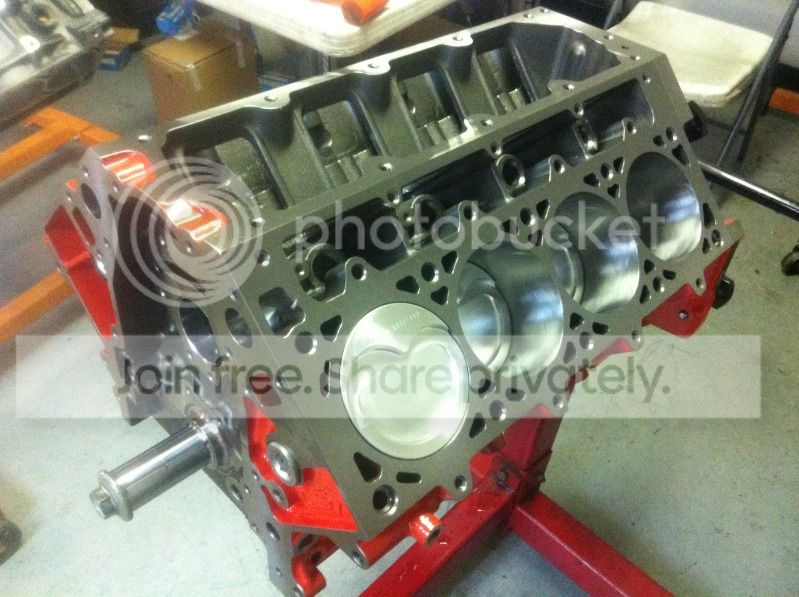
We do a lot of the LSx engines, it's pretty much all I work on lately. Here's my latest creation, a 427ci LSX. This will be going in a 2010 Camaro with twin Precision 62mm turbos. 1000whp or bust.
B*a*n*n*e*d
Joined: Dec 2001
Posts: 8,185
Likes: 3
Re: Tech Topic: Exhaust Flow overlooked?
This is tied in with the rod ratio that actually does matter when designing for a specific engine.
To summarize:
-Longer rods generate lower accelerations at the piston
-a longer rod ratio has a longer dwell at TDC and shorter at BDC
The fact is that the higher the rod ratio, the later the point in the intake stroke when the piston reaches velocity and therefore maximum pressure differential. There is a larger volume above the piston to be filled, so a larger charge is induced into the cylinder, increasing VE and Torque.
The angle varies from about 70 ATDC with a rod ratio of 1.55 to about 78 ATDC for a ratio of 2:1
tan theta max= 2 x (rod length/ stroke) = 2 x Rod Ratio
So a rod ratio if 1.52 = 71.8 ATDC , 1.83 rod ratio = 74.7 ATDC
so it depends on the rod ratio basically and can be explained through geometry

B*a*n*n*e*d
Joined: Mar 2002
Posts: 7,765
Likes: 1
Re: Tech Topic: Exhaust Flow overlooked?
I'm inclined to believe Professor Blair and Associates; they do have simulation software used by elite, high stakes, high dollar professional motorsports. I think you can "bench race" with it and draw up the valve motion file.
What is the hypothesis here?? Run more ____ duration on the EX cam than in the IN cam, and achieve more HP in the this _____ rpm range?
What is the hypothesis here?? Run more ____ duration on the EX cam than in the IN cam, and achieve more HP in the this _____ rpm range?


B*a*n*n*e*d
Joined: Mar 2002
Posts: 7,765
Likes: 1
Re: Tech Topic: Exhaust Flow overlooked?
@EG1834
Sounds interesting what you are doing with Chevy LSx motors. What cam numbers do you use on the motors for what RPM ranges? And what type of Intake (configuration and runner length and cross-section).
Sounds interesting what you are doing with Chevy LSx motors. What cam numbers do you use on the motors for what RPM ranges? And what type of Intake (configuration and runner length and cross-section).

HT White Ops


Joined: Apr 2004
Posts: 13,063
Likes: 33
From: Rochester, MN, US
Re: Tech Topic: Exhaust Flow overlooked?
Larry used to be a big advocate of this approach many years ago. For all I know, he might still be. However, I don't ever remember it producing results that were better than the more conventional approaches used by other head porters and engine builders. This was one of the explanations they gave for why the infamous H22 made so much power, before that situation blew up.
Thread Starter
Honda-Tech Member
Joined: Aug 2009
Posts: 7,635
Likes: 3
From: Baton Rouge,Louisiana
Re: Tech Topic: Exhaust Flow overlooked?
I'm inclined to believe Professor Blair and Associates; they do have simulation software used by elite, high stakes, high dollar professional motorsports. I think you can "bench race" with it and draw up the valve motion file.
What is the hypothesis here?? Run more ____ duration on the EX cam than in the IN cam, and achieve more HP in the this _____ rpm range?
What is the hypothesis here?? Run more ____ duration on the EX cam than in the IN cam, and achieve more HP in the this _____ rpm range?
I was simply trying to see what others thought on the situation. I believe that no matter how well a head is ported, or how awesome the valves are or header, that you can still never actually empty the cyl quickly enough. Which is what i wanted to see what others thought about having a longer duration exhaust camshaft that would be considered outside of the "norm"..
I've noticed on alot of camshafts now, the duration is longer by 3-8 degrees on the exhaust over the intake and i figured since i was going to "test" this theory out, i wanted to know what others thought..
I also thought it was a good topic to cover since people always want to build or run badass engines, but run headers like DC sports or some dinky 4-1 ebay header and expect the engine to breath awesomely.. I'm just waging the war on "bro" science, thats all, with all the smart people we've had here i figured it was time to work with, rather then against.
I believe its a good topic to cover, and I'm sure there will be alot more. But i'd like to have pave the way as well as others. This just isn't about camshaft design, can also include a ton of things, like others have mentioned.. The adjustable header really has caught my attention.
B*a*n*n*e*d
Joined: Mar 2002
Posts: 7,765
Likes: 1
Re: Tech Topic: Exhaust Flow overlooked?
If you are using "hard" numbers from other sources, then please cite so other with a passion for knowledge can review. That's soup de jour with good scientists.
A couple more degrees of duration? At what lift, 0.010 0.050, 0.100?
What is the desired result, a.k.a. goal. Make more power everywhere, up top, down low?
I thought everyone knew all the fast people ran RMF headers (RIP, sir). Why chose a cam to fit a shitty setup. Just run a good header. Easier to install.
A couple more degrees of duration? At what lift, 0.010 0.050, 0.100?
What is the desired result, a.k.a. goal. Make more power everywhere, up top, down low?
I thought everyone knew all the fast people ran RMF headers (RIP, sir). Why chose a cam to fit a shitty setup. Just run a good header. Easier to install.