


Putting tension on a timing belt and knowing the proper tension


Thread Starter
B*a*n*n*e*d
Joined: Oct 2011
Posts: 1,022
Likes: 0
 Putting tension on a timing belt and knowing the proper tension
I would like to know what the proper tension is for a timing belt and how to put proper tension on one. I may be having problems getting proper tension. I have new tensioners on and everthings good its just that after I tighten back up the adjuster nut (having adjusted tension) and then rotate the crank a whole 360o, the belt loses some of its tension.
I'm not saying its loose its just not as tight as it was when I had originally made the tension adjustment.
i am using the method of loosening the nut 3/4-1 turn and then going 3 teeth in the direction of rotation on the crank. I get the same results every time; tension is lost somehow when I turn it over.
But can this be a normal phenomenon? It would help to know what the proper tension for the timing belt is.
I'm not saying its loose its just not as tight as it was when I had originally made the tension adjustment.
i am using the method of loosening the nut 3/4-1 turn and then going 3 teeth in the direction of rotation on the crank. I get the same results every time; tension is lost somehow when I turn it over.
But can this be a normal phenomenon? It would help to know what the proper tension for the timing belt is.
Last edited by Mishako129; Sep 3, 2012 at 10:30 PM.

MM Gruppe B

Joined: Feb 2009
Posts: 7,025
Likes: 109
From: 94577/Gaillimh
Re: Putting tension on a timing belt and knowing the proper tension
i am using the method of loosening the nut 3/4-1 turn and then going 3 teeth in the direction of rotation on the crank. I get the same results every time; tension is lost somehow when I turn it over.
But can this be a normal phenomenon? It would help to know what the proper tension for the timing belt is.
But can this be a normal phenomenon? It would help to know what the proper tension for the timing belt is.
If not then you will lose tension in the belt.
Or are you turning the crank the wrong way and causing slop in the system rather than tension.
Thread Starter
B*a*n*n*e*d
Joined: Oct 2011
Posts: 1,022
Likes: 0
Re: Putting tension on a timing belt and knowing the proper tension
I did tighten it after setting it, and i did turn it in the direction of engine rotation, that is, counter clock wise.
MM Gruppe B
Joined: Feb 2009
Posts: 7,025
Likes: 109
From: 94577/Gaillimh
Re: Putting tension on a timing belt and knowing the proper tension
The '3 teeth' movement is to place the correct tension on the belt, but you need to verify that that is happening when removing slack.
Make sure that the belt from the crank up to the cam and down to the waterpump is taught. The spring on the tensioner will keep the lever arm pulled up...
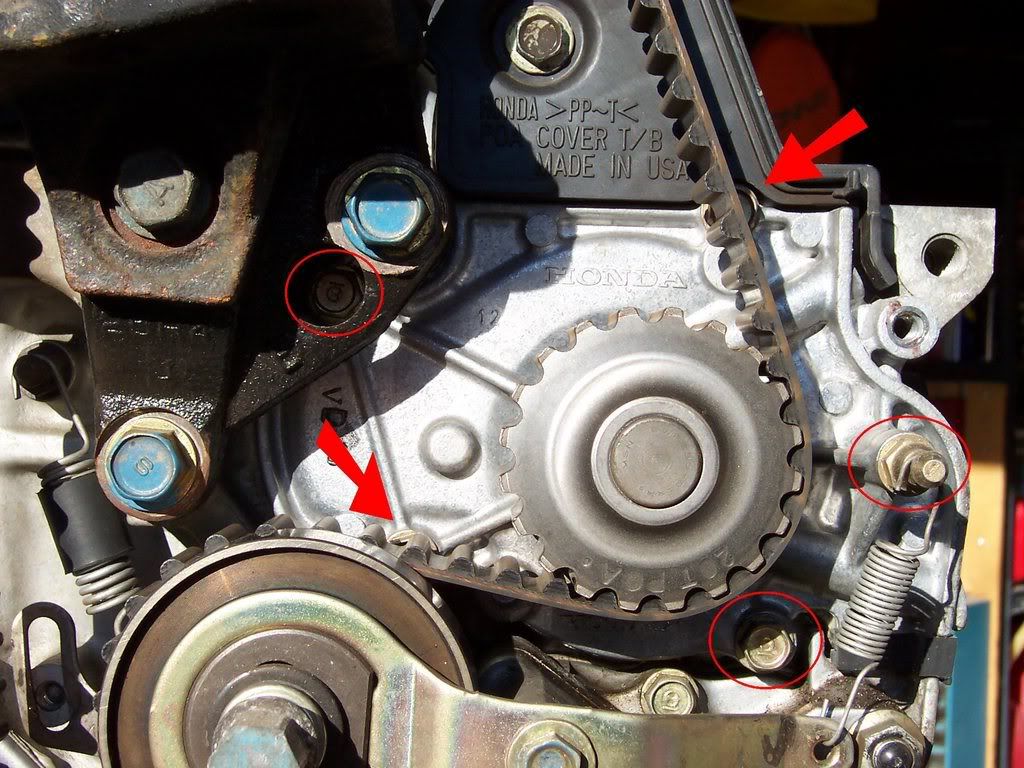
But it is just to tension the slop out of the backside of the belt. You do not want it to be overly tight as that will place side loading on the components and damage them. The cogged belt of the timing belts keeps the timing spot on. The belt will not stretch.
As long as the timing marks all line up after rotating the engine over everything should be good.
Make sure that the belt from the crank up to the cam and down to the waterpump is taught. The spring on the tensioner will keep the lever arm pulled up...
But it is just to tension the slop out of the backside of the belt. You do not want it to be overly tight as that will place side loading on the components and damage them. The cogged belt of the timing belts keeps the timing spot on. The belt will not stretch.
As long as the timing marks all line up after rotating the engine over everything should be good.
Thread Starter
B*a*n*n*e*d
Joined: Oct 2011
Posts: 1,022
Likes: 0
Re: Putting tension on a timing belt and knowing the proper tension
The '3 teeth' movement is to place the correct tension on the belt, but you need to verify that that is happening when removing slack.
Make sure that the belt from the crank up to the cam and down to the waterpump is taught. The spring on the tensioner will keep the lever arm pulled up...
Make sure that the belt from the crank up to the cam and down to the waterpump is taught. The spring on the tensioner will keep the lever arm pulled up...
Here is my video,
[youtube]nRPE5jFfQOY[/youtube]
Do you need to see the back side too?
MM Gruppe B
Joined: Feb 2009
Posts: 7,025
Likes: 109
From: 94577/Gaillimh
Re: Putting tension on a timing belt and knowing the proper tension
If the tenioner is not working or the belt is the wrong size it will never be tight. Is this a new belt? If so what was the brand/part number? If it was a Gates kit it should have been in a sealed container.
If the tensioning spring is damaged, incorrect for the application, or not properly installed, it will not provide the correct amount of tension. Same goes for the belt. Although I don't think its possible to have a belt that is just a tad too long for the non Vtec SOHC F22s.
What I did in the past was to verify that the belt is taught from crank to cam down to the WP, then gently slide the tensioner idler to remove the slack and tighten down the nut.
Now this require very little finger pressure, you are just removing the slack, not putting tension on the belts.
That does seem a tad loose. You may have to cheat the tensioing a bit if the spring is not properly removing slack.
But if all the timing marks line up, then that is probably correct, as long as it is not loosening up anymore.
I don't think you could get the correct camera angle to show all the components with the engine in car.
Just verify that the spring for the cam belt tesnioner is connected and removing slack.
Is the belt old or new?
Thread Starter
B*a*n*n*e*d
Joined: Oct 2011
Posts: 1,022
Likes: 0
Re: Putting tension on a timing belt and knowing the proper tension
The slack will be taken up by the pulley located between the WP and crank. Everywhere else it should be taught, but not tight rope tight.
If the tenioner is not working or the belt is the wrong size it will never be tight. Is this a new belt? If so what was the brand/part number? If it was a Gates kit it should have been in a sealed container.
If the tensioning spring is damaged, incorrect for the application, or not properly installed, it will not provide the correct amount of tension. Same goes for the belt. Although I don't think its possible to have a belt that is just a tad too long for the non Vtec SOHC F22s.
If the tenioner is not working or the belt is the wrong size it will never be tight. Is this a new belt? If so what was the brand/part number? If it was a Gates kit it should have been in a sealed container.
If the tensioning spring is damaged, incorrect for the application, or not properly installed, it will not provide the correct amount of tension. Same goes for the belt. Although I don't think its possible to have a belt that is just a tad too long for the non Vtec SOHC F22s.
Its a Cloyes belt and its brand new, the tensioners are new too. The springs are probably worn though.
Sometimes you have to cheat the tesnioning.
What I did in the past was to verify that the belt is taught from crank to cam down to the WP, then gently slide the tensioner idler to remove the slack and tighten down the nut.
Now this require very little finger pressure, you are just removing the slack, not putting tension on the belts.
Have you ever heard of that? Eric claims to have been a honda mechanic and he seems to know a lot of tricks. Holding the belt like that seems like a good idea.
I really don't see how the tensioner can do its job when the little 10mm bolt is holding it in place.
Trending Topics

Honda-Tech Member
Joined: Jul 2012
Posts: 67
Likes: 0
Re: Putting tension on a timing belt and knowing the proper tension
And I also bought eric the car guys video it was helpful but IMO more supplemental to this guide (this guide is boss):
https://honda-tech.com/forums/honda-accord-1990-2002-2/how-replace-timing-belt-timing-balancer-belt-water-pump-f22b1-1908944/
Protip: Make sure the tensioner is on the peg and doesnt come off when your messing with it. When I first did the timing belt the engine would vibrate at 2k rpm it wasnt too noticeable and didnt affect performance but was annoying. Redid the whole process and think the peg was the culprit. Luckily it went buy way faster the second time.
And your tension seems to be too little imo. I cant remember if we went by feeling or just followed that guide 100% when I did mine-sorry couldnt be more help on this part.
MM Gruppe B
Joined: Feb 2009
Posts: 7,025
Likes: 109
From: 94577/Gaillimh
Re: Putting tension on a timing belt and knowing the proper tension
I've seen Eric the car guy in his timing belt video (costs 7.50$ to download) hold the belt at the top of the cam gear while turning the crank over 3 teeth (with the nut loosened) to give it tension. I think I may try that because I really don't wanna take off those lower covers.
You use one of the timing belt cover bolts to hold it.
You hold the cam belt at the correct tension with the cover bolt.
Then loosen the nut so tension on the balance shaft belt can be set.
When those are set, the nut is re-tightened to the correct torq value.
The cover bolt is removed from the cam belt tensioner.
And timing is rechecked to make sure nothing moved/slipped.
Thread Starter
B*a*n*n*e*d
Joined: Oct 2011
Posts: 1,022
Likes: 0
Re: Putting tension on a timing belt and knowing the proper tension
The pulley or idler is part of the tensioner assembly. The spring is what applies tension to the lever arm which pulls up on the pulley/idler to tighten the belt.
Yeah, the spring tend to get stretched a bit.
I usually just line up the crank pulley to TDC, and then apply tension to via the cam while making sure it is also at TDC, then verify that the tesioners pulls up the slack. If it doesn't, due to a sloppy spring I just put light finger pressure on the tensioner to make sure it has taken the slack out, let it relax to where it will be and then tighten it down. I usually recheck by turning the engine over a few times usually three full engine rotations(a full rotation is 720°) and recheck timing. If it lines up I call it good and leave it.
Sounds like he just turns the crank rather than the cam, which is easier to get to, and since the engine is a reverse rotation there is no worries of loosening the cam sprocket.
If it gets the tension set and is not too tight, you will hear a whirring if it is when the engine runs, then by all means.
Yes, but its a bit tricky. I had to loosnen the power steering line bolted to the inside of the frame on the '95, dunno if that is the same on the CBs. And then lower the engine by unbolting the mount. And you have to rotate the cover clockwise to get it off IIRC. Don't recall removing any suspension parts on that side.
That bolt is just temporary.
You use one of the timing belt cover bolts to hold it.
You hold the cam belt at the correct tension with the cover bolt.
Then loosen the nut so tension on the balance shaft belt can be set.
When those are set, the nut is re-tightened to the correct torq value.
The cover bolt is removed from the cam belt tensioner.
And timing is rechecked to make sure nothing moved/slipped.
Yeah, the spring tend to get stretched a bit.
I usually just line up the crank pulley to TDC, and then apply tension to via the cam while making sure it is also at TDC, then verify that the tesioners pulls up the slack. If it doesn't, due to a sloppy spring I just put light finger pressure on the tensioner to make sure it has taken the slack out, let it relax to where it will be and then tighten it down. I usually recheck by turning the engine over a few times usually three full engine rotations(a full rotation is 720°) and recheck timing. If it lines up I call it good and leave it.
Sounds like he just turns the crank rather than the cam, which is easier to get to, and since the engine is a reverse rotation there is no worries of loosening the cam sprocket.
If it gets the tension set and is not too tight, you will hear a whirring if it is when the engine runs, then by all means.
Yes, but its a bit tricky. I had to loosnen the power steering line bolted to the inside of the frame on the '95, dunno if that is the same on the CBs. And then lower the engine by unbolting the mount. And you have to rotate the cover clockwise to get it off IIRC. Don't recall removing any suspension parts on that side.
That bolt is just temporary.
You use one of the timing belt cover bolts to hold it.
You hold the cam belt at the correct tension with the cover bolt.
Then loosen the nut so tension on the balance shaft belt can be set.
When those are set, the nut is re-tightened to the correct torq value.
The cover bolt is removed from the cam belt tensioner.
And timing is rechecked to make sure nothing moved/slipped.
Honda-Tech Member
Joined: Jul 2012
Posts: 67
Likes: 0
Re: Putting tension on a timing belt and knowing the proper tension
Yes, but its a bit tricky. I had to loosnen the power steering line bolted to the inside of the frame on the '95, dunno if that is the same on the CBs. And then lower the engine by unbolting the mount. And you have to rotate the cover clockwise to get it off IIRC. Don't recall removing any suspension parts on that side.

Thread
Thread Starter
Forum
Replies
Last Post
blufke
Tech / Misc
17
Mar 7, 2003 11:39 AM