


Water cooling after shut down

Thread Starter
Honda-Tech Member
Joined: May 2003
Posts: 343
Likes: 0
From: Denver, CO
 Water cooling after shut down
Just wondering if anyone has done this. Several factory cars come with pumps that kick on for 30 or so seconds after the motor has shut down to continue cooling the turbo. After seeing the white paper The Shodan posted the other day it got me thinking.
I don't think something like this would be too expensive to setup and might help the turbo last longer. Maybe it won't but I don't see how it could hurt.
You can get a new pump from a Porsche for about $250. Anyone know any pumps that would be optimal that cost less? I imagine due to the operating environment the pump would have to be high quality.
I don't think something like this would be too expensive to setup and might help the turbo last longer. Maybe it won't but I don't see how it could hurt.
You can get a new pump from a Porsche for about $250. Anyone know any pumps that would be optimal that cost less? I imagine due to the operating environment the pump would have to be high quality.

Honda-Tech Member
Joined: Aug 2007
Posts: 320
Likes: 0
From: TN, US
Re: Water cooling after shut down
Are you familiar with a basic turbo timer? Seems to me it'd be much easier...
Basically allows the car time to idle (i.e. cool down) for a set amount of time.
This is actuated when the key is removed from the ignition. Car runs for 30 or so seconds and then turns off automatically.
Basically allows the car time to idle (i.e. cool down) for a set amount of time.
This is actuated when the key is removed from the ignition. Car runs for 30 or so seconds and then turns off automatically.
 Re: Water cooling after shut down
I dont think additional cool down is even nessecary. Youre not doing drag runs and coasting straight into your driveway are you? The couple minutes of light load/cruise before you get home is the cool down.
Thread Starter
Honda-Tech Member
Joined: May 2003
Posts: 343
Likes: 0
From: Denver, CO
Re: Water cooling after shut down
Oh yea, none of that stuff. Also already have a turbo timer. Just looking at things some OEM cars come with in regards to reliability. Brainstorming or thinking out loud mostly.
I know the mini got recalled recently to replace their after shutdown water pumps but iirc it was simply due to the pumps catching on fire and not anything they prevent.
I know the mini got recalled recently to replace their after shutdown water pumps but iirc it was simply due to the pumps catching on fire and not anything they prevent.

Honda-Tech Member
Joined: Apr 2012
Posts: 155
Likes: 1
From: SW Ohio
Re: Water cooling after shut down
I'm likely overly interested in this. I'd like to install an electric water pump but it seems too much to manage. I haven't seen a system where I could run both the mechanical pump and an electric water pump at the same time.
Davies Craig has all the pumps and controllers. Meziere and Golden Eagle make Honda specific pumps but they're designed to replace the mechanical pump...and Davies Craig makes controllers that really are required to run an electric pump on the street.
I'd like to know if you find way to run both pumps. The idea that you could run the electric pump as a backup and after the engine is shut off is really appealing to me.
Davies Craig has all the pumps and controllers. Meziere and Golden Eagle make Honda specific pumps but they're designed to replace the mechanical pump...and Davies Craig makes controllers that really are required to run an electric pump on the street.
I'd like to know if you find way to run both pumps. The idea that you could run the electric pump as a backup and after the engine is shut off is really appealing to me.

B*a*n*n*e*d
Joined: Dec 2009
Posts: 1,371
Likes: 1
Re: Water cooling after shut down
Cooling like that just isnt necessary. Idling with a good rad/fan is more than enough to get long life out of our QUALITY equipment. Turbo timers take it one step further, anything beyond that is overkill without a purpose in my eyes.
Thread Starter
Honda-Tech Member
Joined: May 2003
Posts: 343
Likes: 0
From: Denver, CO
Re: Water cooling after shut down
Since the secondary electronic pump is an impeller type pump water can flow through it while it is off. It is essentially dedicated to the turbo and flowing water through it for a set period of time after the motor shuts off and has nothing to do with actually cooling the whole motor. The standard mechanical pump still does regular cooling during operation.
This is one that goes to a porsche 944
http://www.paragon-products.com/Turb...606.130.01.htm
Most of anything we do in this forum is overkill and without purpose to just about the rest of the planet. The Garrett white paper clearly expresses the importance of cooling the turbo after shutdown. They want you to tilt the turbo 30deg and run the lines so that the hot water can rise and bring in cooler water. My setup doesn't really allow for that. If I rotate at all in the direction I would need to go The oil line will hit the t3 flange. If I go the other way it makes the drain line very difficult to make as it will require an even tighter bend. As it stands now I have a setup that does not match what that white paper wanted in regards to line placement or turbo rotation and I am sure many of others here also do not meet the criteria specified in the white paper specifically in regards to after shutdown cooling.
This is one that goes to a porsche 944
http://www.paragon-products.com/Turb...606.130.01.htm
Most of anything we do in this forum is overkill and without purpose to just about the rest of the planet. The Garrett white paper clearly expresses the importance of cooling the turbo after shutdown. They want you to tilt the turbo 30deg and run the lines so that the hot water can rise and bring in cooler water. My setup doesn't really allow for that. If I rotate at all in the direction I would need to go The oil line will hit the t3 flange. If I go the other way it makes the drain line very difficult to make as it will require an even tighter bend. As it stands now I have a setup that does not match what that white paper wanted in regards to line placement or turbo rotation and I am sure many of others here also do not meet the criteria specified in the white paper specifically in regards to after shutdown cooling.
Last edited by TKERacer619; Jul 19, 2012 at 01:20 PM.
Trending Topics

 Re: Water cooling after shut down
Guys. the water in the turbocharger sits in the jacket like a pool. It doesn't flow through like a radiator or engine block where its exchanging water. You don't need extra pumps to work this thing correctly. Not necessary.
Thread Starter
Honda-Tech Member
Joined: May 2003
Posts: 343
Likes: 0
From: Denver, CO
Re: Water cooling after shut down
Wait what? Why would water not flow? I get my feed from the line that used to run coolant through my throttle body. It definitely moves water through the turbo at all times.
 Re: Water cooling after shut down
re-read the white paper on garrett's website. when the engine shuts down as long as the turbo is positioned correctly there is a syphoning action as the turbo cools down. its minimal its not like when the engine is running. the water jackets are for shutdown so the ball bearings dont get damaged.
Thread Starter
Honda-Tech Member
Joined: May 2003
Posts: 343
Likes: 0
From: Denver, CO
Re: Water cooling after shut down
Thats the point. My car is not setup like they want it to be setup. I cannot rotate the CHRA easily and per their article that is not desirable. The lines also are probably not ran in an optimal path to create that fluid motion.
My whole thought process on this is that if its important enough that they published the white paper I as a customer should try to do as they suggest and not simply brush it off since it doesn't fit my setup easily. I cannot easily achieve what they want so I am looking for other options that will work and some turbo cars come from the factory with an option that might work well with little time, money, or effort.

DO IT ON ALL FOURS
Joined: Sep 2007
Posts: 7,632
Likes: 15
From: IN Your Mind
Re: Water cooling after shut down
I went and got my waders on because it's starting to get deep in here...
PS - There were literally ZERO "big" words used in his posts. The intellectual side just isn't there.
PS - There were literally ZERO "big" words used in his posts. The intellectual side just isn't there.

 Re: Water cooling after shut down
Please read the whitepaper. What people are concerned about is the residual exogenric heat that is "siphoned" into the cartridge from the turbine housing after the car has been shut down. What people are forgetting in this discussion is the fact that the use of the water lines is defined after the car has been shut down, and not necessarily during operation.
I still think the idea of an extra pump is not needed for Hondas due to the design of the OEM coolant system as it naturally pulls engine coolant through the key areas of the engine, and when the water lines are tapped, inherit that same part of the system. There's really more of an "efficient" way of using these lines. But people want to spend money on extra parts, let them.
I still think the idea of an extra pump is not needed for Hondas due to the design of the OEM coolant system as it naturally pulls engine coolant through the key areas of the engine, and when the water lines are tapped, inherit that same part of the system. There's really more of an "efficient" way of using these lines. But people want to spend money on extra parts, let them.

Who is Mr Robot?
iTrader: (2)
Joined: Jul 2004
Posts: 21,474
Likes: 10
From: ATL - Where the Pimps and Players dwell
Re: Water cooling after shut down
so you think that when you shut off your car it magically drops from 180-190 to 0 right then and there? NO.... it takes hours for a car to cool off and in that time temperature differential will pull lower temperature coolant through the CHRA and absorb heat from the cartridge and put it back in the cooling system
Honda-Tech Member
Joined: Apr 2012
Posts: 155
Likes: 1
From: SW Ohio
Re: Water cooling after shut down
As I said, I would like to have additional cooling running through the engine after shutdown but making that happen without being a big pain, doesn't seem likely. It would probably involve a Meziere kit and some Craig Davies electronics.
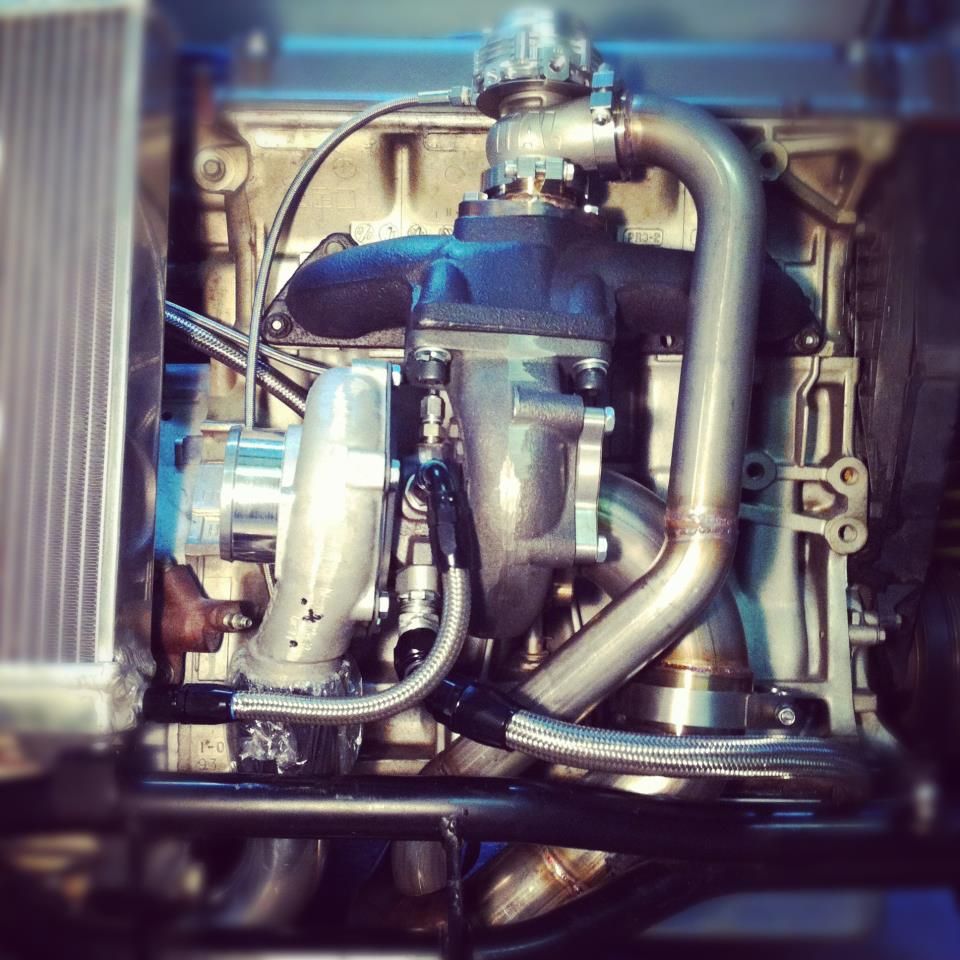
My turbo is clocked more for oil than water.
My turbo is clocked more for oil than water.

Keyboard Humorist
Joined: May 2002
Posts: 9,814
Likes: 11
From: Granada Hills, Ca, USA
Re: Water cooling after shut down
How do you clock it more for oil than water?
Just clock it for how the manufacture recommends and you don't need a pump.
Doesn't matter what anyone says anyhow, right?
You are getting a pump no mater what.
should have just started a build thread instead of this post.
Just clock it for how the manufacture recommends and you don't need a pump.
Doesn't matter what anyone says anyhow, right?
You are getting a pump no mater what.
should have just started a build thread instead of this post.
Honda-Tech Member
Joined: Apr 2012
Posts: 155
Likes: 1
From: SW Ohio
Honda-Tech Member
Joined: Apr 2012
Posts: 155
Likes: 1
From: SW Ohio
Re: Water cooling after shut down
Thanks for your support. I don't have the car. It was still being mocked up. I didn't know anything about turbo chargers but I'm learning. It's always great to criticize instead of educate.
I wrote the installer of the turbo, sent him the white paper and apparently asked the question wrong or misinterpreted his answer.
So I guess I'll go home and beat my dog so he'll learn a new trick faster.
I wrote the installer of the turbo, sent him the white paper and apparently asked the question wrong or misinterpreted his answer.
So I guess I'll go home and beat my dog so he'll learn a new trick faster.

Trial User
Joined: Jul 2012
Posts: 7
Likes: 0
Re: Water cooling after shut down
I was looking at a 2006 Lexus SUV for my wife the other day and yes, they have the cooling fans that kick in after the vehicle is stopped. I have seen them on the older Taurus police cars as well.
It gets over 100 here for weeks at a time here in Texas, so I am all for anything that will cool my car down, even if it is a slab of bacon.
I am waiting to get a response in another thread about slaving a relay to the condenser fan relay, so hopefully someone with real-world experience will answer that thread to all of our benefit. If worse comes to worse, I can program an Arduino to trigger relays or other actuators under certain sensor conditions, but that would be a project in itself.
Maybe there is a way to use a small (nine inch?) transmission cooling radiator and a pump / reservoir combo to circulate coolant through the turbo body independently. Is there an optimum turbo temp, or is it a case of "the cooler the better"? Both sides of the turbo are cast separately as far as I know, so if minimum turbo temp is best, both sides will need to be cooled to prevent stress that could lead to cracking, etc.
Hope that helps...
It gets over 100 here for weeks at a time here in Texas, so I am all for anything that will cool my car down, even if it is a slab of bacon.
I am waiting to get a response in another thread about slaving a relay to the condenser fan relay, so hopefully someone with real-world experience will answer that thread to all of our benefit. If worse comes to worse, I can program an Arduino to trigger relays or other actuators under certain sensor conditions, but that would be a project in itself.
Maybe there is a way to use a small (nine inch?) transmission cooling radiator and a pump / reservoir combo to circulate coolant through the turbo body independently. Is there an optimum turbo temp, or is it a case of "the cooler the better"? Both sides of the turbo are cast separately as far as I know, so if minimum turbo temp is best, both sides will need to be cooled to prevent stress that could lead to cracking, etc.
Hope that helps...
Re: Water cooling after shut down
You wont crack that cartridge. This is seriously getting over thought.. My word. Theres only so much the cartridge can do to have water. The heat transfer from turbine housing to cartridge is a natural chemistry effect that no pumps or relays will assist.

Honda-Tech Member
Joined: Feb 2008
Posts: 832
Likes: 1
From: Chicago, IL
Re: Water cooling after shut down
Dude, before you start designing and collecting information on an independent pump doing all
the extra unnecessary work, please wiki convection, conduction, and the basics of heat
transfer. It really isn't that difficult to comprehend.
"The white paper" posted by The Shodan describes all the necessary cooling methods
in which are related to Garrett's ball bearing cartridge. Having a pump accumulate
constant flow is of less importance. Leaving the water inside the water jackets awards
the CHRA with a principle known as convection. After shut down, the hot heat that flows
through the interior channels of the CHRA sheds it's heat to the relatively cooler neighbors
such as the water filled water jackets in which are NOT to be disturbed when this principle
is active.
the extra unnecessary work, please wiki convection, conduction, and the basics of heat
transfer. It really isn't that difficult to comprehend.
"The white paper" posted by The Shodan describes all the necessary cooling methods
in which are related to Garrett's ball bearing cartridge. Having a pump accumulate
constant flow is of less importance. Leaving the water inside the water jackets awards
the CHRA with a principle known as convection. After shut down, the hot heat that flows
through the interior channels of the CHRA sheds it's heat to the relatively cooler neighbors
such as the water filled water jackets in which are NOT to be disturbed when this principle
is active.