


Why doesn't anyone make STAINLESS STEEL Lug nuts?


Thread Starter
Honda-Tech Member
Joined: Nov 2006
Posts: 496
Likes: 0
 Why doesn't anyone make STAINLESS STEEL Lug nuts?
Hey everyone,
So I'm looking for lug nuts, and I'm seeing a bunch of Aluminum ones, some Titanium, but no Stainless steel...I'm just curious as to why? Or maybe it's just me and people do make it but I didnt see any.
Any help is appreciated!
So I'm looking for lug nuts, and I'm seeing a bunch of Aluminum ones, some Titanium, but no Stainless steel...I'm just curious as to why? Or maybe it's just me and people do make it but I didnt see any.
Any help is appreciated!
 Re: Why doesn't anyone make STAINLESS STEEL Lug nuts?
Weight, typically. Aluminum and Titanium are much lighter materials. Stainless steel is pretty heavy, and given the fact that its in constant contact with steel lug studs, it can still rust. This makes it no better than a standard steel lug nut that has been chromed.
Re: Why doesn't anyone make STAINLESS STEEL Lug nuts?
Thread Starter
Honda-Tech Member
Joined: Nov 2006
Posts: 496
Likes: 0

Honda-Tech Member
Joined: Feb 2008
Posts: 227
Likes: 0
Re: Why doesn't anyone make STAINLESS STEEL Lug nuts?
if you don't have the cool titanium or aluminum ones...you won't be considered cool on this site.
of course you'd never, ever, ever see/feel/benefit from the negligible weight difference.....but it's just not cool to have lugs made of stainless
of course you'd never, ever, ever see/feel/benefit from the negligible weight difference.....but it's just not cool to have lugs made of stainless
Trending Topics


Honda-Tech Member

Joined: Apr 2008
Posts: 880
Likes: 1
Re: Why doesn't anyone make STAINLESS STEEL Lug nuts?

Trial User
Joined: Mar 2012
Posts: 2
Likes: 0
Re: Why doesn't anyone make STAINLESS STEEL Lug nuts?
Most lug nuts are made of plated steel. Perhaps some are made of titanium, but few are made of aluminum; it's not nearly as strong as steel.
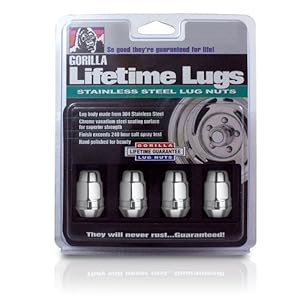
The Gorilla lug nuts are not fully stainless; they are two-part units. A full stainless steel unit would be more expensive as stainless steel is worth many times what alloy steel costs by weight, not to mention the added cost in tooling and production since stainless steel is more difficult to cut.
As far as weight goes, though, stainless steel weighs about the same as alloy steel (and again, almost all lug nuts are alloy steel).
The Gorilla lug nuts are not fully stainless; they are two-part units. A full stainless steel unit would be more expensive as stainless steel is worth many times what alloy steel costs by weight, not to mention the added cost in tooling and production since stainless steel is more difficult to cut.
As far as weight goes, though, stainless steel weighs about the same as alloy steel (and again, almost all lug nuts are alloy steel).

Honda-Tech Member
Joined: Aug 2000
Posts: 3,605
Likes: 5
From: Japan Dammit Japan
Re: Why doesn't anyone make STAINLESS STEEL Lug nuts?
Most lug nuts are made of plated steel. Perhaps some are made of titanium, but few are made of aluminum; it's not nearly as strong as steel.
The Gorilla lug nuts are not fully stainless; they are two-part units. A full stainless steel unit would be more expensive as stainless steel is worth many times what alloy steel costs by weight, not to mention the added cost in tooling and production since stainless steel is more difficult to cut.
As far as weight goes, though, stainless steel weighs about the same as alloy steel (and again, almost all lug nuts are alloy steel).
The Gorilla lug nuts are not fully stainless; they are two-part units. A full stainless steel unit would be more expensive as stainless steel is worth many times what alloy steel costs by weight, not to mention the added cost in tooling and production since stainless steel is more difficult to cut.
As far as weight goes, though, stainless steel weighs about the same as alloy steel (and again, almost all lug nuts are alloy steel).
Here's a little more of my silly input. Wheels (let it be steel, aluminum, magnesium, unobtanium or whatever) should get lugs of a similar metal. In a perfect world without cost constraints and ridiculous markups, Everybody would be running ultra light wheels made of some type of hyper alloy with, Ti alloy lugs and nuts

Honda-Tech Member
Joined: Nov 2011
Posts: 196
Likes: 0
From: Canada
Re: Why doesn't anyone make STAINLESS STEEL Lug nuts?
Weight, strength, and cost are definitely not the death of steel lug nuts.
I guess they're considerable variables, but the big reason has already been mentioned ...
BINGO!
We do not suggest stainless steel lugs because of the potential to rust. If any of the finish deteriorates, the stud and lug become susceptible to moisture. Any moisture which makes contact will eventually rust and seize. So you get the tiniest chip on the inside of your lug nut, and install your wheels ... Then 6 months later ... They're stuck on!
Removing a seized lug nut isn't impossible, but it's an unnecessary hassle.
I can think of 10 good reasons NOT to use steel lugs, but why would anyone want them? OP?
I guess they're considerable variables, but the big reason has already been mentioned ...
We do not suggest stainless steel lugs because of the potential to rust. If any of the finish deteriorates, the stud and lug become susceptible to moisture. Any moisture which makes contact will eventually rust and seize. So you get the tiniest chip on the inside of your lug nut, and install your wheels ... Then 6 months later ... They're stuck on!
Removing a seized lug nut isn't impossible, but it's an unnecessary hassle.
I can think of 10 good reasons NOT to use steel lugs, but why would anyone want them? OP?

Honda-Tech Member

Joined: Apr 2004
Posts: 6,808
Likes: 4
From: OKC,OK
Re: Why doesn't anyone make STAINLESS STEEL Lug nuts?
Anti-seize is your friend with any lugnut. I have anti-seize on damn near every thread on my car and it makes removing and re-installing all parts much easier including wheel nuts....
Trial User
Joined: Mar 2012
Posts: 2
Likes: 0
Yes, steel lug nuts dominate the OEM market but Aluminum lugs dominate the current aftermarket lug nut trend. Inch for inch aluminum is the same strength as steel or stronger. This has been proven more than a few times so please post your source(s) of information or test(s) that prove steel is outright stronger than aluminum. Fatigue is the weak point for Aluminum but the main reason why aluminum lugs were not mass produced until recently is because of the cost of manufacturing. Ti is even more expensive to manufacture and has a tendency to gall dissimilar metals which can lead to premature failure. This makes aluminum the clear winner even though it has a finite life. People will take the loss of unsprung weight with extra cost over the weight and lower costs of steel lugs. They just will not be able to use the lugs for 50 years.
I agree that titanium is expensive both in material cost and in fabrication, and is excellent for high-stress, low-mass applications. Last I heard, though, it galled strongly only to itself.
FWIW, I torque at 80 ft-lbs while my manual calls for 100 ft-lbs, after having lubed all the threads while keeping the nut bearing surfaces dry. Torquing at 100 ft-bs now causes my rotors to warp and make brushing noises.
We do not suggest stainless steel lugs because of the potential to rust. If any of the finish deteriorates, the stud and lug become susceptible to moisture. Any moisture which makes contact will eventually rust and seize. So you get the tiniest chip on the inside of your lug nut, and install your wheels ... Then 6 months later ... They're stuck on!
Removing a seized lug nut isn't impossible, but it's an unnecessary hassle.
I can think of 10 good reasons NOT to use steel lugs, but why would anyone want them? OP?
Removing a seized lug nut isn't impossible, but it's an unnecessary hassle.
I can think of 10 good reasons NOT to use steel lugs, but why would anyone want them? OP?
However, if you think about it, the same thing happens in a significant fraction of wheel installs. Nearly all aluminum wheels are installed with chrome- or zinc-plated steel lug nuts or lug bolts, and yet, even though the aluminum oxide protective layer gets ground off every time the lug nuts are installed, there is no significant corrosion after removal. Perhaps it's because after tightening, the metals actually form a hermetic seal, keeping corrosion-causing oxygen out?
Last edited by toyomatt84; Mar 12, 2012 at 06:27 PM.

Thread
Thread Starter
Forum
Replies
Last Post
