


for what reasons might YOU replace an igniter/ICM?


Thread Starter
Honda-Tech Member
Joined: Nov 2011
Posts: 159
Likes: 0
From: West Michigan
 for what reasons might YOU replace an igniter/ICM?
hi,
due to a weak spark in my 96 accord my friend/mechanic suggests I do an ignition tune up, replace plugs, wires, cap & rotor, coil, and the igniter/icm. The rest of it makes sense to me, but I can't figure why he suggests replacing the ICM when as far as I know, it either works, or it doesn't (or it works sometimes). Is this correct? Is there any reason to replace one that's never given me any trouble? If it were only a $50 part I might do it anyway, but if I get a honda OEM (and there's no way I am putting anything less in there) one its more like $200 and I just can't see throwing $200 at something that still works. Not without a really good reason.
the only explanation he really gave was to suggest that putting new stuff around an aging ICM might cause it to fail, but in that case wouldn't I just replace it if it failed? (could be a pita though)
Does anyone have any experience to support his suggestion or an explanation that might make some sense anyway?
thanks!!
due to a weak spark in my 96 accord my friend/mechanic suggests I do an ignition tune up, replace plugs, wires, cap & rotor, coil, and the igniter/icm. The rest of it makes sense to me, but I can't figure why he suggests replacing the ICM when as far as I know, it either works, or it doesn't (or it works sometimes). Is this correct? Is there any reason to replace one that's never given me any trouble? If it were only a $50 part I might do it anyway, but if I get a honda OEM (and there's no way I am putting anything less in there) one its more like $200 and I just can't see throwing $200 at something that still works. Not without a really good reason.
the only explanation he really gave was to suggest that putting new stuff around an aging ICM might cause it to fail, but in that case wouldn't I just replace it if it failed? (could be a pita though)
Does anyone have any experience to support his suggestion or an explanation that might make some sense anyway?
thanks!!

B*a*n*n*e*d
Joined: Dec 2008
Posts: 12,028
Likes: 5
Re: for what reasons might YOU replace an igniter/ICM?
From the way I understand it, I believe the igniter is more of a switch. If you're getting spark, that part should be fine. It's the coil that would be the culprit if you're getting weak spark.
Thread Starter
Honda-Tech Member
Joined: Nov 2011
Posts: 159
Likes: 0
From: West Michigan
Re: for what reasons might YOU replace an igniter/ICM?
thats what I understood too and mostly everybody I asked laughs at the idea of replacing a working ICM. I just was hoping to find some reason for his total insistence that it needs done. I'm afraid maybe he's just superstitious cause he replaced ICM and coil at the same time in his machine and it perked up immensely.
I can't imagine a reason for it myself.
Now the coil could be working, but need* replaced, correct?
*or benefit greatly from
I can't imagine a reason for it myself.
Now the coil could be working, but need* replaced, correct?
*or benefit greatly from
Thread Starter
Honda-Tech Member
Joined: Nov 2011
Posts: 159
Likes: 0
From: West Michigan
Re: for what reasons might YOU replace an igniter/ICM?
Well today I tested my coil with a multimeter, it seems to be within spec. Was about 45 deg F this afternoon when I tested it (if that makes any difference, my Haynes manual seemed to think resistances would be different depending on temperature, but offered no further insight)
Primary resistance was .5-.6 ohms (after adjusting for the 1.1 ohm resistance that the multimeter had just touching the probes together) and secondary was about 18kohms.
Honestly, the car runs fine, it just gets terrible gas mileage (22-26 mpg instead of 30+ like I am used to) when it gets cold out. Does the coil sound like something I should even bother replacing, or am I better off putting my money elsewhere?
BTW, I haven't tested the spark myself, nor did I see it tested when they were doing it. I'm just taking my friend's word for it that it was orangeish and weak.
I am planning regardless to do cap, rotor, wires, and plugs.
Primary resistance was .5-.6 ohms (after adjusting for the 1.1 ohm resistance that the multimeter had just touching the probes together) and secondary was about 18kohms.
Honestly, the car runs fine, it just gets terrible gas mileage (22-26 mpg instead of 30+ like I am used to) when it gets cold out. Does the coil sound like something I should even bother replacing, or am I better off putting my money elsewhere?
BTW, I haven't tested the spark myself, nor did I see it tested when they were doing it. I'm just taking my friend's word for it that it was orangeish and weak.
I am planning regardless to do cap, rotor, wires, and plugs.

Honda-Tech Member

Joined: Jun 2008
Posts: 310
Likes: 0
Re: for what reasons might YOU replace an igniter/ICM?
I really have no clue as to what is a "weak spark". For one to "know " that, there has to be a way to measure fire at the plug. We do know that all those claims of better power, fuel milage made by the Split Fire plugs years ago were all bogus. If you have replaced all the usual suspects with good quality, working, componates, then I would say your ignitor is not the reason for bad milage. If compression, timing,is good I would clean the EGR ports. That alone helped me with mine. Clogged or somewhat clogged air filters, catalitic converters and worn Ox sensors can also effect milage.

Honda-Tech Member
Joined: Aug 2011
Posts: 2,632
Likes: 5
Re: for what reasons might YOU replace an igniter/ICM?
Honestly, the car runs fine, it just gets terrible gas mileage (22-26 mpg instead of 30+ like I am used to) when it gets cold out. Does the coil sound like something I should even bother replacing, or am I better off putting my money elsewhere?
I am planning regardless to do cap, rotor, wires, and plugs.
I am planning regardless to do cap, rotor, wires, and plugs.
Trending Topics
Thread Starter
Honda-Tech Member
Joined: Nov 2011
Posts: 159
Likes: 0
From: West Michigan
Re: for what reasons might YOU replace an igniter/ICM?
IMHO, if the car is fine other than lower gas milage, replace tune up items if due..........be sure the ECT (sensor for the computer, two wire under dist). T-stat is not stuck (normal range on temp gauge).....other than that, are you feeling the "winter blend blues".....
Tried gas from a station that was 100% gas, no ethanol, that was my first guess as to why in mid october/early november my mileage dropped like a rock. (it did it last year too - the first winter I had the car - so it's not unusual..and it came back fine in the spring!) But I still got 22mpg on a tank of that stuff, and a big chunk of that was highway driving to my parents (otherwise I drive daily 10-15 miles each way depending on where I am headed, about 60% freeway/highway and the rest in town)
Its not a huge deal, but I just hate seeing the gauge at nearly E and only 310 miles on my trip odometer

Edit: also, would a problem with the ECT cause a CEL?
Last edited by dwllama; Jan 6, 2012 at 06:45 PM.

Honda-Tech Member


Joined: Mar 2004
Posts: 4,839
Likes: 37
From: Looking for SloMofo....

Honda-Tech Member
Joined: Jun 2011
Posts: 2,214
Likes: 3
Re: for what reasons might YOU replace an igniter/ICM?
You can test the ECT, plug off the connector, 2 prongs inside, take the multi meter test ohms, each probe on each terminal, get a cold reading, then run the car for 15 mins or so test again, should read 200 to 400.
I would not replace igition components unless needed, they should have nothing to do with fuel economy.
Also, check your mechanical timing.
I would do a basic tune up, cap rotor, plugs wires and fuel filter
I would not replace igition components unless needed, they should have nothing to do with fuel economy.
Also, check your mechanical timing.
I would do a basic tune up, cap rotor, plugs wires and fuel filter
Thread Starter
Honda-Tech Member
Joined: Nov 2011
Posts: 159
Likes: 0
From: West Michigan
Re: for what reasons might YOU replace an igniter/ICM?
Tried testing the ECT (I assume I got the right thing, my haynes seems to show the vtec engine or something, didn't look identical to mine, but close - it was on the side of the engine right where the upper radiator hose attaches) but I couldn't get any reading off the multimeter at all. It was working if I tested random things (or just put the prongs together as it has usually about .7 ohms resistance in the testing wires/probes) but I couldn't get it to read off the sensor prongs after I pulled the connector off them. Is there a trick to it? Was too cold (and I was on my lunch break at work) to spend extremely long at it but I think I was fiddling with it for 5-10 mins and just couldn't get it to read.
Edit: Anyone have any links or a quick walkthrough on testing the O2 sensor with an OBDII scanner? had someone try to do it once but had a misfire at the time (due to messed up vacuum routing) and didn't get any meaningful information about the sensor, don't know how he did it, but I have an OBDII scanner at work that I could play with and see for myself if its a one person job.
Edit: Anyone have any links or a quick walkthrough on testing the O2 sensor with an OBDII scanner? had someone try to do it once but had a misfire at the time (due to messed up vacuum routing) and didn't get any meaningful information about the sensor, don't know how he did it, but I have an OBDII scanner at work that I could play with and see for myself if its a one person job.

Honda-Tech Member

Joined: Oct 2004
Posts: 633
Likes: 17
Re: for what reasons might YOU replace an igniter/ICM?
I don't think a scanner will tell you anything meaningful about the 02 sensor unless the 02 sensor has placed a fault-code in the computer. When you scan, just document any codes that are stored (if any) and check them against the list for OBD2.
Testing 02 sensor(s) is done the old fashioned way with a resistance (ohm) test across the terminals of the sensor plug itself with it separated from the plug that goes to the car. Best tested while the sensor is very hot, meaning right after a good long drive, and far too hot to touch the sensor itself, because that is when the 02 really interacts with the computer and the resistance of the O2 really matters.
Don't forget that in winter your tires can generally take a bit more air pressure. In fact, significantly more when it stays pretty cold outside. More air pressure can snag you some MPG's, but the trade off is less traction and harsher ride, to name a couple.
Testing 02 sensor(s) is done the old fashioned way with a resistance (ohm) test across the terminals of the sensor plug itself with it separated from the plug that goes to the car. Best tested while the sensor is very hot, meaning right after a good long drive, and far too hot to touch the sensor itself, because that is when the 02 really interacts with the computer and the resistance of the O2 really matters.
Don't forget that in winter your tires can generally take a bit more air pressure. In fact, significantly more when it stays pretty cold outside. More air pressure can snag you some MPG's, but the trade off is less traction and harsher ride, to name a couple.

Honda-Tech Member
Joined: Mar 2007
Posts: 11,399
Likes: 69
From: East Coast 506, Canada
Re: for what reasons might YOU replace an igniter/ICM?
Tried testing the ECT (I assume I got the right thing, my haynes seems to show the vtec engine or something, didn't look identical to mine, but close - it was on the side of the engine right where the upper radiator hose attaches) but I couldn't get any reading off the multimeter at all. It was working if I tested random things (or just put the prongs together as it has usually about .7 ohms resistance in the testing wires/probes) but I couldn't get it to read off the sensor prongs after I pulled the connector off them. Is there a trick to it? Was too cold (and I was on my lunch break at work) to spend extremely long at it but I think I was fiddling with it for 5-10 mins and just couldn't get it to read.
You should have your Ohmmeter set to 2000Ω or 2kΩ and you should see 200-400Ω of resistance between the sensor pins.
The sensor on the upper rad hose (water neck) is actually one of the cooling system fan switches, it's the B switch IIRC. A switch is in the thermostat housing.
Honda-Tech Member
Joined: Jun 2011
Posts: 2,214
Likes: 3
Re: for what reasons might YOU replace an igniter/ICM?
You tried testing the fan switch, wrong sensor, you will not get any reading off that switch.
Look under the dizzy, there will be 2 sensors, one has one wire (sending unit) the other will have 2 terminals inside after you unplug it, you need that sensor.
Look under the dizzy, there will be 2 sensors, one has one wire (sending unit) the other will have 2 terminals inside after you unplug it, you need that sensor.
Honda-Tech Member
Joined: Mar 2007
Posts: 11,399
Likes: 69
From: East Coast 506, Canada

Thread Starter
Honda-Tech Member
Joined: Nov 2011
Posts: 159
Likes: 0
From: West Michigan
Re: for what reasons might YOU replace an igniter/ICM?
Well that explains why I couldn't get a reading if I tested the wrong thing. The multimeter I was using at work is digital and automatically switches to the appropriate range when it gets a reading. I will have to try again tomorrow or the next time I'm at work and have a bit of time to play with it.
Also, aren't you supposed to check voltage with the o2 sensor running if you're using a multimeter to check it? isn't that the more important check? From what I understand the resistance just checks if the heater is working. (obviously, if it isn't, it still needs replaced)
I think with the scanner my buddy was looking at fuel trim but that could be just where he ended up after trying to figure out that misfire. (boy was that a sound I never want to hear again) I'm sure he had something in mind. maybe I'll just have him look at it again when I get the chance to make the 15 mile drive up there.
Also, aren't you supposed to check voltage with the o2 sensor running if you're using a multimeter to check it? isn't that the more important check? From what I understand the resistance just checks if the heater is working. (obviously, if it isn't, it still needs replaced)
I think with the scanner my buddy was looking at fuel trim but that could be just where he ended up after trying to figure out that misfire. (boy was that a sound I never want to hear again) I'm sure he had something in mind. maybe I'll just have him look at it again when I get the chance to make the 15 mile drive up there.
Honda-Tech Member
Joined: Mar 2004
Posts: 4,839
Likes: 37
From: Looking for SloMofo....
Re: for what reasons might YOU replace an igniter/ICM?
Also, aren't you supposed to check voltage with the o2 sensor running if you're using a multimeter to check it? isn't that the more important check? From what I understand the resistance just checks if the heater is working. (obviously, if it isn't, it still needs replaced)
I think with the scanner my buddy was looking at fuel trim but that could be just where he ended up after trying to figure out that misfire. (boy was that a sound I never want to hear again) I'm sure he had something in mind. maybe I'll just have him look at it again when I get the chance to make the 15 mile drive up there.
Thread Starter
Honda-Tech Member
Joined: Nov 2011
Posts: 159
Likes: 0
From: West Michigan
Re: for what reasons might YOU replace an igniter/ICM?
Just an update on this thread.
I managed to check the o2 sensor from a cold start using a multimeter hooked into the (I think white) wire on the connector. Also tested resistance. Was hard to get a resistance reading for some reason, wouldn't stay at a steady number, kept jumping (??) but it seemed to mostly have about 20ohms (actually I tested this first when it was cold. not sure if that matters on that count.)
for the voltage test on the white wire, it took about 5 minutes to start doing its thing, then was jumping up and down regularly from ~.1v to ~.9v (sometimes lower than 0.1, but never as high as 1.0v) which seems about right. However from what I've read the o2 sensor should heat up in 1-2 minutes? Does it indicate any problem if it took 5 minutes to start switching like that? before that, the voltage seemed to pretty much steadily increase up to about .9v. Also, the engine noise changed (settled/lower rpm from the sound, didn't check the tach to be sure) when it started switching. I'm guessing that would be normal and that the engine is going to run more efficiently when the o2 sensor kicks in.
Re: ECT sensor. I tried, but I can't see any way to actually get at it to test it. Is there a trick to getting the connector off, or some took that makes it easier? I don't have fat hands, and can get into spaces a lot of people can't, but I couldn't get at the connector with enough force in the right angles to get it off.
(Maybe I'm just too much of a girl :D)
I managed to check the o2 sensor from a cold start using a multimeter hooked into the (I think white) wire on the connector. Also tested resistance. Was hard to get a resistance reading for some reason, wouldn't stay at a steady number, kept jumping (??) but it seemed to mostly have about 20ohms (actually I tested this first when it was cold. not sure if that matters on that count.)
for the voltage test on the white wire, it took about 5 minutes to start doing its thing, then was jumping up and down regularly from ~.1v to ~.9v (sometimes lower than 0.1, but never as high as 1.0v) which seems about right. However from what I've read the o2 sensor should heat up in 1-2 minutes? Does it indicate any problem if it took 5 minutes to start switching like that? before that, the voltage seemed to pretty much steadily increase up to about .9v. Also, the engine noise changed (settled/lower rpm from the sound, didn't check the tach to be sure) when it started switching. I'm guessing that would be normal and that the engine is going to run more efficiently when the o2 sensor kicks in.
Re: ECT sensor. I tried, but I can't see any way to actually get at it to test it. Is there a trick to getting the connector off, or some took that makes it easier? I don't have fat hands, and can get into spaces a lot of people can't, but I couldn't get at the connector with enough force in the right angles to get it off.
(Maybe I'm just too much of a girl :D)
Thread Starter
Honda-Tech Member
Joined: Nov 2011
Posts: 159
Likes: 0
From: West Michigan
Re: for what reasons might YOU replace an igniter/ICM?
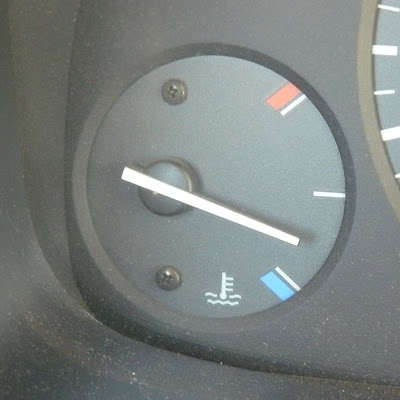
Also, this is as hot as my car ever gets. Is it normal?
Last edited by dwllama; Mar 31, 2012 at 08:27 PM. Reason: fix photo link
Honda-Tech Member
Joined: Aug 2011
Posts: 2,632
Likes: 5
Re: for what reasons might YOU replace an igniter/ICM?
My two cents...the gauge is "somewhat" low. When you drive on the hwy, does it "dip" down. could be a stuck open t-stat.
Next, I hate to "tap" into wires but if you take your time you can measure the resistance from the wires...or you can pinch with one hand and a gentle pry with something (don't break the plastic) from the other hand....of course now you have to the the volt meter leads in there.
Next, I hate to "tap" into wires but if you take your time you can measure the resistance from the wires...or you can pinch with one hand and a gentle pry with something (don't break the plastic) from the other hand....of course now you have to the the volt meter leads in there.
Thread Starter
Honda-Tech Member
Joined: Nov 2011
Posts: 159
Likes: 0
From: West Michigan
Re: for what reasons might YOU replace an igniter/ICM?
Once the gauge gets there it doesnt seem to ever move around as long as the car is running. I haven't 100% paid attention but I've never noticed it to move or in a different spot. Is there some kind of "artificial" test I can try to see if it moves, like running A/C or heater or something?
as far as the ECT, I guess I will just have to take another try at finagling my way in there. if its that tricky to get to cold I'm afraid of how tough it will be hot... although, once it's come out once, it should be easier to get the 2nd time. (can't imagine its been unplugged in many, many miles!)
thanks for the reply.
as far as the ECT, I guess I will just have to take another try at finagling my way in there. if its that tricky to get to cold I'm afraid of how tough it will be hot... although, once it's come out once, it should be easier to get the 2nd time. (can't imagine its been unplugged in many, many miles!)
thanks for the reply.
Honda-Tech Member
Joined: Jan 2011
Posts: 345
Likes: 0
From: ny
Re: for what reasons might YOU replace an igniter/ICM?
Once the gauge gets there it doesnt seem to ever move around as long as the car is running. I haven't 100% paid attention but I've never noticed it to move or in a different spot. Is there some kind of "artificial" test I can try to see if it moves, like running A/C or heater or something?
as far as the ECT, I guess I will just have to take another try at finagling my way in there. if its that tricky to get to cold I'm afraid of how tough it will be hot... although, once it's come out once, it should be easier to get the 2nd time. (can't imagine its been unplugged in many, many miles!)
thanks for the reply.
as far as the ECT, I guess I will just have to take another try at finagling my way in there. if its that tricky to get to cold I'm afraid of how tough it will be hot... although, once it's come out once, it should be easier to get the 2nd time. (can't imagine its been unplugged in many, many miles!)
thanks for the reply.
did you ever fix this issue?
Thread Starter
Honda-Tech Member
Joined: Nov 2011
Posts: 159
Likes: 0
From: West Michigan
Re: for what reasons might YOU replace an igniter/ICM?
i have not yet. it's something I need to take a try at again, especially since I've been having rough idle issues. (idle speeds are fine, but the car shakes more than it should)
