


high comp 2.1 gsr winter reliabilty


Thread Starter
Honda-Tech Member
Joined: Nov 2009
Posts: 106
Likes: 0
From: suburbs of philly
 high comp 2.1 gsr winter reliabilty
just have a quick question i have a 2.1 gsr motor. it has about 30k miles on it. this year u need to drive through the winter. is there anything i should do that will help me prolong the life and keep it safe. right now i just changed the oil with 10w30 new plugs new thermostat and anit freeze. any one have any tips on this. do you guys think it would even be a good idea to do this thanks.
motor specs:
motor specs:
Thread Starter
Honda-Tech Member
Joined: Nov 2009
Posts: 106
Likes: 0
From: suburbs of philly
Re: high comp 2.1 gsr winter reliabilty
86x89 sleeved block
12:1 COMPRESSION
wiseco forged pistons
golden eagle forged rods
acl race bearings
type r cams
type r valve springs
type r retainers
440cc injectors
255 hp warlboro fuel pump
arp head studs
cometic head gasket
12:1 COMPRESSION
wiseco forged pistons
golden eagle forged rods
acl race bearings
type r cams
type r valve springs
type r retainers
440cc injectors
255 hp warlboro fuel pump
arp head studs
cometic head gasket

Honda-Tech Member
Joined: Jan 2007
Posts: 1,202
Likes: 0
From: North Carolina


Honda-Tech Member
Joined: May 2003
Posts: 3,195
Likes: 17
From: Norwich, CT, USA
Re: high comp 2.1 gsr winter reliabilty
Honda-Tech Member
Joined: May 2003
Posts: 3,195
Likes: 17
From: Norwich, CT, USA
Re: high comp 2.1 gsr winter reliabilty
Here you go....all oem block heaters part numbers begin with "08t44'. Here's what a quick search at hondaautomotiveparts.com yielded:
http://www.hondaautomotiveparts.com/...VIN+Number+---
Any one should work as they're probably all the same pitch/thread.
http://www.hondaautomotiveparts.com/...VIN+Number+---
Any one should work as they're probably all the same pitch/thread.
Trending Topics

Honda-Tech Member
Joined: Aug 2005
Posts: 72
Likes: 0
From: VA
Re: high comp 2.1 gsr winter reliabilty
Just let the motor warm up when you first start it up. You dont need a damn block heater.. Go with 5w30 oil its a little thinner than what you are using and you will be fine.

B*a*n*n*e*d
Joined: Sep 2009
Posts: 3,875
Likes: 0
Re: high comp 2.1 gsr winter reliabilty
haha. ya mang just keep it in the garage and let it warm up until you start ripping on it. and make sure your coolant has some antifreeze in it and not all water
Thread Starter
Honda-Tech Member
Joined: Nov 2009
Posts: 106
Likes: 0
From: suburbs of philly
Re: high comp 2.1 gsr winter reliabilty
thanks people. ill def try to let it warm it up as much as possible. i uasally let it get to at least 1/4 way on the guage. is that good enough? im planning on getting a aftermarket temp guage but heard they are a p.i.t.a. to hook up.

Honda-Tech Member
Joined: Dec 2006
Posts: 2,946
Likes: 1
Re: high comp 2.1 gsr winter reliabilty
letting the motor sit an idle to warm it up is a bad idea. just drive it regularly and keep the RPM low until it warms up.
you will wear the engine MORE by letting it sit and idle for 5-10 minutes. low crank speed = less oil
you will wear the engine MORE by letting it sit and idle for 5-10 minutes. low crank speed = less oil

Honda-Tech Member
Joined: Aug 2009
Posts: 7,635
Likes: 3
From: Baton Rouge,Louisiana
Re: high comp 2.1 gsr winter reliabilty
When you first start up your car, your oil is thick, its not the "heated weight".. you'll notice on most cars that have oil psi gauges it shoots almost directly to 80+psi @ crank up.. normal motors, including race motors should have anywhere from 10-15psi of oil @ full warm/idle conditions, its factory spec..and also dependant on how tight your bearing clearences are .. but its the norm to shoot from.
Starting up your car and letting it idle until warm is fine, i've done it for years, i also recommend customers who have turbos to do the same..
@ 800rpms i have around 12-15psi at idle which is perfect.
Whats bad is directly starting up your car, and going down the road, understand oil is not @ the top of your motor yet, its probably just getting there, about 2-10 seconds into the car actually running, let your car idle for about 3-5 mins before actually moving..


Honda-Tech Member
Joined: Jul 2002
Posts: 1,590
Likes: 0
From: Dahlonega, GA
Re: high comp 2.1 gsr winter reliabilty
This , is not true in the least... if you have a oil pressure gauge you'd know you're wrong.
When you first start up your car, your oil is thick, its not the "heated weight".. you'll notice on most cars that have oil psi gauges it shoots almost directly to 80+psi @ crank up.. normal motors, including race motors should have anywhere from 10-15psi of oil @ full warm/idle conditions, its factory spec..and also dependant on how tight your bearing clearences are .. but its the norm to shoot from.
Starting up your car and letting it idle until warm is fine, i've done it for years, i also recommend customers who have turbos to do the same..
@ 800rpms i have around 12-15psi at idle which is perfect.
Whats bad is directly starting up your car, and going down the road, understand oil is not @ the top of your motor yet, its probably just getting there, about 2-10 seconds into the car actually running, let your car idle for about 3-5 mins before actually moving..
When you first start up your car, your oil is thick, its not the "heated weight".. you'll notice on most cars that have oil psi gauges it shoots almost directly to 80+psi @ crank up.. normal motors, including race motors should have anywhere from 10-15psi of oil @ full warm/idle conditions, its factory spec..and also dependant on how tight your bearing clearences are .. but its the norm to shoot from.
Starting up your car and letting it idle until warm is fine, i've done it for years, i also recommend customers who have turbos to do the same..
@ 800rpms i have around 12-15psi at idle which is perfect.
Whats bad is directly starting up your car, and going down the road, understand oil is not @ the top of your motor yet, its probably just getting there, about 2-10 seconds into the car actually running, let your car idle for about 3-5 mins before actually moving..

Honda-Tech Member
Joined: Jan 2006
Posts: 669
Likes: 0
From: Norway
Re: high comp 2.1 gsr winter reliabilty
Remember you cant meashure the oilpresshure that builds up between the bearings, the crank also work as an oilpump and the faster it spins the higher preshure it is.
oil presshure/film of 60-80psi would easy brake down from one combustion stroke.
the amount of presshure produced between the bearings are aprox to 14500+psi of oilpresshure and more. making the oil film strong enough to resist a bullet from a gun if you could shoot at it.
This illustrates the crankshaft load of one combustion stroke, not shure at what powerlevel
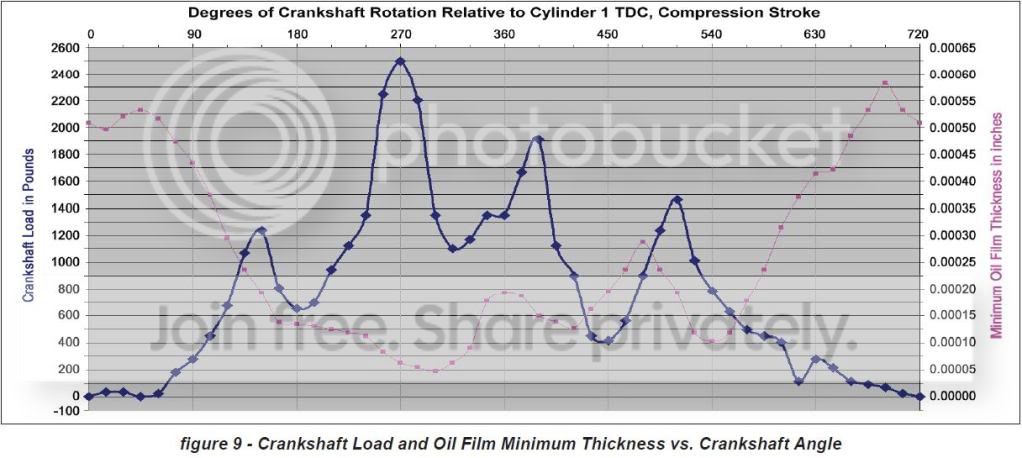
The oil presshure that you meashure is built ONLY becouse of narrow oilchannels when the pump are pumping oil to the crank, and the head for lubrication purposes.
Now what is not good, is when you LOAD the engine while having low rpm. that is something you should avoid.
Just drive the car normaly after a startup, dont load it!!! eg. using 5th gear up a hill 30mph.
Also the multigrade oil is there for the purpose of NOT beeing thicker while cold, the additives in the oil make the mulecules smaller as the temperature falls, making the oil thin when cold and the molecules "roll out", increasing the wiscosity when hot.
In the left you can see an illustration of what the additives do to the oil when cold, to the right what happens when heated:

oil presshure/film of 60-80psi would easy brake down from one combustion stroke.
the amount of presshure produced between the bearings are aprox to 14500+psi of oilpresshure and more. making the oil film strong enough to resist a bullet from a gun if you could shoot at it.
This illustrates the crankshaft load of one combustion stroke, not shure at what powerlevel
The oil presshure that you meashure is built ONLY becouse of narrow oilchannels when the pump are pumping oil to the crank, and the head for lubrication purposes.
Now what is not good, is when you LOAD the engine while having low rpm. that is something you should avoid.
Just drive the car normaly after a startup, dont load it!!! eg. using 5th gear up a hill 30mph.
Also the multigrade oil is there for the purpose of NOT beeing thicker while cold, the additives in the oil make the mulecules smaller as the temperature falls, making the oil thin when cold and the molecules "roll out", increasing the wiscosity when hot.
In the left you can see an illustration of what the additives do to the oil when cold, to the right what happens when heated:
Last edited by atec; Nov 4, 2010 at 12:33 PM.
Honda-Tech Member
Joined: Jan 2006
Posts: 669
Likes: 0
From: Norway
Re: high comp 2.1 gsr winter reliabilty
That is true, but the further the two numbers get appart the more additives are used in as a basic to make the oil molecules "roll" out when warm. I would rather run a 10w30 if you are in a hot climate or a if cold 5w30.
The best thing to run in a race engine, is a oil with a high wiscosity index 180+ as a base oil not upped by other additives that easily brake down from the cutting forces the oil are beeing put trough. but it is difficult to know if the "High spec" oils are only HWI becouse of additives or if it is a good synth baseoil though when you look at the producers spesification of the oils.

Honda-Tech Member

Joined: Sep 2003
Posts: 5,072
Likes: 2
From: Raleigh, NC
Re: high comp 2.1 gsr winter reliabilty
the only way you'll hurt hte car by letting it warm up is if you are running too rich and get a bunch of fuel in the oil.
you dont need to do anything special... its still a damn honda.
you dont need to do anything special... its still a damn honda.
Thread Starter
Honda-Tech Member
Joined: Nov 2009
Posts: 106
Likes: 0
From: suburbs of philly
Honda-Tech Member
Joined: Dec 2006
Posts: 2,946
Likes: 1
Re: high comp 2.1 gsr winter reliabilty
This , is not true in the least... if you have a oil pressure gauge you'd know you're wrong.
When you first start up your car, your oil is thick, its not the "heated weight".. you'll notice on most cars that have oil psi gauges it shoots almost directly to 80+psi @ crank up.. normal motors, including race motors should have anywhere from 10-15psi of oil @ full warm/idle conditions, its factory spec..and also dependant on how tight your bearing clearences are .. but its the norm to shoot from.
Starting up your car and letting it idle until warm is fine, i've done it for years, i also recommend customers who have turbos to do the same..
@ 800rpms i have around 12-15psi at idle which is perfect.
Whats bad is directly starting up your car, and going down the road, understand oil is not @ the top of your motor yet, its probably just getting there, about 2-10 seconds into the car actually running, let your car idle for about 3-5 mins before actually moving..
When you first start up your car, your oil is thick, its not the "heated weight".. you'll notice on most cars that have oil psi gauges it shoots almost directly to 80+psi @ crank up.. normal motors, including race motors should have anywhere from 10-15psi of oil @ full warm/idle conditions, its factory spec..and also dependant on how tight your bearing clearences are .. but its the norm to shoot from.
Starting up your car and letting it idle until warm is fine, i've done it for years, i also recommend customers who have turbos to do the same..
@ 800rpms i have around 12-15psi at idle which is perfect.
Whats bad is directly starting up your car, and going down the road, understand oil is not @ the top of your motor yet, its probably just getting there, about 2-10 seconds into the car actually running, let your car idle for about 3-5 mins before actually moving..
i wonder which scenario will see more rotations of the crank before it reaches... lets say 100f ECT's
i could sit there for 5 mins in the morning idling and the temp gauge wont budge with only luke warm air coming from the blower.

Honda-Tech Member
Joined: Aug 2008
Posts: 16
Likes: 0
From: Norway
Re: high comp 2.1 gsr winter reliabilty
interesting reading your thoughts on the subject.
i wonder which scenario will see more rotations of the crank before it reaches... lets say 100f ECT's
i could sit there for 5 mins in the morning idling and the temp gauge wont budge with only luke warm air coming from the blower.
i wonder which scenario will see more rotations of the crank before it reaches... lets say 100f ECT's
i could sit there for 5 mins in the morning idling and the temp gauge wont budge with only luke warm air coming from the blower.
So, time to put this oil pressure myth to rest once and for all;
oil pressure buildt up by the oil pump is NOT what kind of "lifts" the crankshaft off the bearing surfaces and thereby reduces friction/lubricates. The real job of the oil pump (in regards to main bearings), is simply to "refill" the clearance/gap between the bearing surfaces. in other words, the oil pressure you read out on your gauge, is simply the pressure loss experienced by the lubricant through the oil lines, and bearing clearances. the real lubricating film is produced by the bearing itself, hence the name "hydrodynamic"; it dynamically keeps itself lubricated. so what is the most important factors in this hydrodynamic bearing thingie in order to keep surfaces separated and lubricated? well, the correct oil viscosity of course, but maybe most interestingly; your rpms. given that the viscosity is correct, higher rpms will increase the strength of your lubricating film, and this is the reason why you should not strain your engine on low rpms (however, this is infact more dangerous on a hot engine than on a cold engine..)

Honda-Tech Member
Joined: Jun 2005
Posts: 634
Likes: 0
Re: high comp 2.1 gsr winter reliabilty
That is true, but the further the two numbers get appart the more additives are used in as a basic to make the oil molecules "roll" out when warm. I would rather run a 10w30 if you are in a hot climate or a if cold 5w30.
The best thing to run in a race engine, is a oil with a high wiscosity index 180+ as a base oil not upped by other additives that easily brake down from the cutting forces the oil are beeing put trough. but it is difficult to know if the "High spec" oils are only HWI becouse of additives or if it is a good synth baseoil though when you look at the producers spesification of the oils.
The best thing to run in a race engine, is a oil with a high wiscosity index 180+ as a base oil not upped by other additives that easily brake down from the cutting forces the oil are beeing put trough. but it is difficult to know if the "High spec" oils are only HWI becouse of additives or if it is a good synth baseoil though when you look at the producers spesification of the oils.