


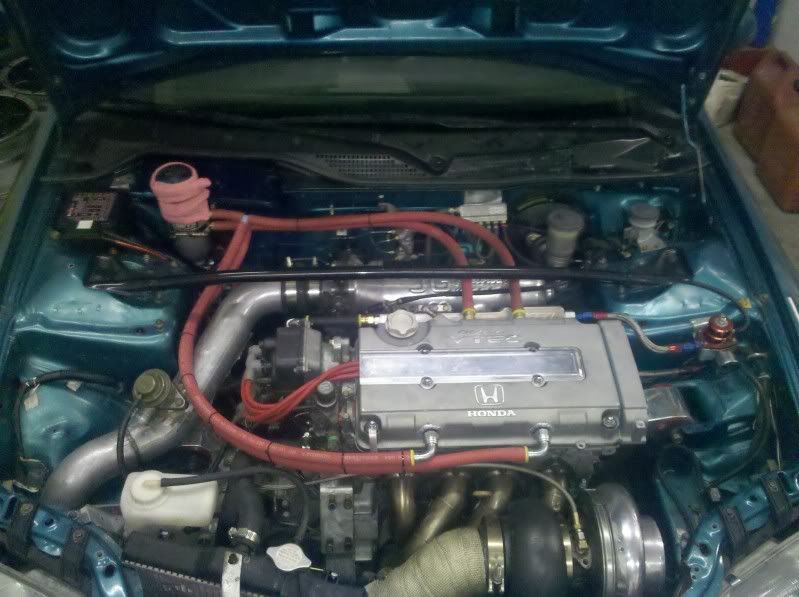
an fittings for valve cover


 an fittings for valve cover
450whp boosted application...
which would be better having (4) -10an fittings or just (2) -12an fittings.
I don't care about how it looks, but I just want to have a efficent setup & don't want to pay extra money for welling more bungs than I need to.
LMK what you guys think is most cost effective & functional.
I decided to go with 2 -10an fittings

which would be better having (4) -10an fittings or just (2) -12an fittings.
I don't care about how it looks, but I just want to have a efficent setup & don't want to pay extra money for welling more bungs than I need to.
LMK what you guys think is most cost effective & functional.
I decided to go with 2 -10an fittings
Last edited by Charlie Moua; Nov 11, 2010 at 12:16 PM.


Honda-Tech Member
Joined: Sep 2003
Posts: 7,056
Likes: 0
Re: an fittings for valve cover
we ran two -12 on the front of the valve cover and two -12 on the back of the block and pushed the motor to 931whp at 37 psi, very minimal blowby coming out the filters on the catch can. if you only plan on running two, then id definitely go with -12 for the larger volume. the filter diameters were 1", which also plays a role in the whole catch can system.



Trending Topics
Re: an fittings for valve cover
If I was just going NA I wouldn't mind using -8an, but for FI -10an should be the standard.
I'll look into getting -12an
I prefer simple & clean looking bay, less is more.
I'll look into getting -12an
I prefer simple & clean looking bay, less is more.
 Re: an fittings for valve cover
charlie, my setup is not done yet but I opted for 2 -16 on vc and 2 -12 on block. It's cheaper and less cluttered than 6 lines to the can. I built my engine very loose though

Honda-Tech Member
Joined: Apr 2004
Posts: 7,489
Likes: 0
From: Minnesota


R.I.P. Andy
Joined: Jan 2004
Posts: 1,062
Likes: 0
From: I hate Christine Gregoire...Lynnwood WA
Re: an fittings for valve cover
2 x -12's work great for me 400whp. If you're trying to cut cost then the answer is clear, buying 4 90's and 4 straights in -10 will be over $100, 2 -12 90's and 2 straights will be about $60. Plus all the extra line for 4. The fittings and hose are the expensive part, I wouldn't worry about the $6 bungs lol.

Honda-Tech Member
Joined: Apr 2004
Posts: 7,489
Likes: 0
From: Minnesota
Re: an fittings for valve cover
They are just hose and tubing clamps. I have the earls version of these things for my car.
http://www.summitracing.com/parts/EAR-167209ERL/
http://www.summitracing.com/parts/EAR-167209ERL/

Honda-Tech Member
Joined: Oct 2010
Posts: 1,286
Likes: 2
Re: an fittings for valve cover
The larger the cross sectional area, the better. This allows lower velocity and should reduce the amount of oil that is blown out. There is no detrimental effect on the motor by having larger vents than necessary.
Maybe instead of using AN fittings, welding nipples on would be more cost effective. It wouldn't be as fancy looking, but with the pressure the hoses see, AN fittings seem like overkill. Plus it would be just as fast or faster to take the valve cover off.
Now, my question is how hot the oil is going to be on a turbocharged motor. Would radiator hose be acceptable or is hydraulic hose or such required to handle the heat and not dissolve or swell? I'm trying to save a few dollars where I can when it doesn't hurt safety or reliability...for example, I bought eBay intercooler piping but got a Precision intercooler. I got a Turbonetics turbo, but I built my own turbo manifold.
Maybe instead of using AN fittings, welding nipples on would be more cost effective. It wouldn't be as fancy looking, but with the pressure the hoses see, AN fittings seem like overkill. Plus it would be just as fast or faster to take the valve cover off.
Now, my question is how hot the oil is going to be on a turbocharged motor. Would radiator hose be acceptable or is hydraulic hose or such required to handle the heat and not dissolve or swell? I'm trying to save a few dollars where I can when it doesn't hurt safety or reliability...for example, I bought eBay intercooler piping but got a Precision intercooler. I got a Turbonetics turbo, but I built my own turbo manifold.


Honda-Tech Member
Joined: Feb 2010
Posts: 394
Likes: 0
From: Bournemouth, U.K

Thread
Thread Starter
Forum
Replies
Last Post
aleks77
Forced Induction
9
May 23, 2007 06:53 AM
BoOsTiN Dc2
Forced Induction
5
Jun 16, 2005 10:03 PM
