


AWD EF sedan??!


Thread Starter
Trial User
Joined: Sep 2010
Posts: 2
Likes: 0
 AWD EF sedan??!
heY. I am new to messing around with hondas, I have recently aqquired a 1991 civic ef sedan that is my project car now. I will be installing a single v z6. anyways why I am posting to here is that I had seen a shop that swaped the wagovan awd drivetrain into an ef hatch and it was pretty cool. I am not going to do that or at least not now but I was wondering if that is possible to put that same deal into an ef sedan? I would think it should work but I dont know how much fab work was put into that hatch for it to work. but I do think that a awd ef sedan slammed on some og oldskools with good suspention would be dope but thats just me. so does anyone have any ideas on that note? would it be worth it?

Honda-Tech Member
Joined: Aug 2009
Posts: 576
Likes: 0
From: RENO, NV
Re: AWD EF sedan??!
heY. I am new to messing around with hondas, I have recently aqquired a 1991 civic ef sedan that is my project car now. I will be installing a single v z6. anyways why I am posting to here is that I had seen a shop that swaped the wagovan awd drivetrain into an ef hatch and it was pretty cool. I am not going to do that or at least not now but I was wondering if that is possible to put that same deal into an ef sedan? I would think it should work but I dont know how much fab work was put into that hatch for it to work. but I do think that a awd ef sedan slammed on some og oldskools with good suspention would be dope but thats just me. so does anyone have any ideas on that note? would it be worth it?

Honda-Tech Member
Joined: Aug 2006
Posts: 403
Likes: 0
Re: AWD EF sedan??!
It's been done in a hatch at least once that I know of, like the previous poster said, the suspension is pretty much the same. What is the wheelbase of the sedan and the RT4WD wagon? If the wheelbase is the same it would be even simpler to swap that right over to a sedan, since there might not be a need to cut/modify that drive shaft if everything can be mounted in the exact same measurements as the wagon.


Honda-Tech Member
Joined: Oct 2008
Posts: 163
Likes: 0
From: AZ
Re: AWD EF sedan??!
AAAHHH - once again the coveted RT4WD is spoke of... All joking aside. If you have ANY kind of fab-ing skills; the hardest part will be finding the parts/donor car at a price any reasonable person is willing to pay!


Honda-Tech Member
Joined: Jul 2010
Posts: 352
Likes: 0
From: Texas
Re: AWD EF sedan??!
just to clarify things, it isn't a true AWD system. It is an RT4WD which means that power is distributed to the rear wheels only when the front wheels lose traction. the more slippage there is, the more power is diverted to the rear wheels. also, the RT4WD system disengages when you hit the brakes.
so in short
AWD = power to all 4 wheels all the time
RT4WD = power diverted to the rear wheels only when front wheels slip. when there is no loss of traction it is a FWD system.
so in short
AWD = power to all 4 wheels all the time
RT4WD = power diverted to the rear wheels only when front wheels slip. when there is no loss of traction it is a FWD system.
Trending Topics

Honda-Tech Member
Joined: Aug 2009
Posts: 576
Likes: 0
From: RENO, NV
Re: AWD EF sedan??!
just to clarify things, it isn't a true AWD system. It is an RT4WD which means that power is distributed to the rear wheels only when the front wheels lose traction. the more slippage there is, the more power is diverted to the rear wheels. also, the RT4WD system disengages when you hit the brakes.
so in short
AWD = power to all 4 wheels all the time
RT4WD = power diverted to the rear wheels only when front wheels slip. when there is no loss of traction it is a FWD system.
so in short
AWD = power to all 4 wheels all the time
RT4WD = power diverted to the rear wheels only when front wheels slip. when there is no loss of traction it is a FWD system.
Honda-Tech Member
Joined: Jul 2010
Posts: 352
Likes: 0
From: Texas
Re: AWD EF sedan??!
Straight from an 89 civic manual. Information is found in the FAQ's.
https://honda-tech.com/forums/honda-crx-ef-civic-1988-1991-3/%5Bfaq%5D-real-time-4-wheel-drive-4wd-rt4wd-411318/
"Viscous Coupling
The viscous coupling unit is located on the front end of the No.2 propeller shaft. It consists of a housing that is connected to the No.1 propeller shaft by a tripod joint. Inside the housing are 79 plates, which have 0.2 mm (0.008 in.) of clearance between one another, surrounded by silicon oil. The 40 housing plates are engaged with the splines in the housing and the 39 hub plates are splined to the shaft. The plates have holes in them to aid in heat dissipation. The viscous coupling unit also contains approximately 10 % air to allow for the thermal expansion of the silicon oil.
Whenever there is any difference in the speed of rotation between the No.1 and No.2 propeller shafts, such as when the front wheels lose traction, there is friction between the housing plates (drive side) and the hub plates (driven side) .This friction is caused by the resistance of the plates sliding against the silicon oil. This resistance between the plates and the silicon oil is what begins to transmit torque from the housing plates to the hub plates and eventually to the rear wheels. This transmission of torque is proportionate to the difference in the speed of rotation of the wheels."
https://honda-tech.com/forums/honda-crx-ef-civic-1988-1991-3/%5Bfaq%5D-real-time-4-wheel-drive-4wd-rt4wd-411318/
"Viscous Coupling
The viscous coupling unit is located on the front end of the No.2 propeller shaft. It consists of a housing that is connected to the No.1 propeller shaft by a tripod joint. Inside the housing are 79 plates, which have 0.2 mm (0.008 in.) of clearance between one another, surrounded by silicon oil. The 40 housing plates are engaged with the splines in the housing and the 39 hub plates are splined to the shaft. The plates have holes in them to aid in heat dissipation. The viscous coupling unit also contains approximately 10 % air to allow for the thermal expansion of the silicon oil.
Whenever there is any difference in the speed of rotation between the No.1 and No.2 propeller shafts, such as when the front wheels lose traction, there is friction between the housing plates (drive side) and the hub plates (driven side) .This friction is caused by the resistance of the plates sliding against the silicon oil. This resistance between the plates and the silicon oil is what begins to transmit torque from the housing plates to the hub plates and eventually to the rear wheels. This transmission of torque is proportionate to the difference in the speed of rotation of the wheels."
Last edited by 75euRFE; Sep 26, 2010 at 01:36 PM.

EFB055
Joined: Dec 2005
Posts: 13,249
Likes: 14
From: Brisvegas, QLD, Australia
Re: AWD EF sedan??!
Right on the money.

The viscous coupler doesn't 'wait' for the wheels to slip, heat solidifies the gunk that's between the disks in the coupler. Even at room temperature there is enough preload to prevent you from being able to move the front wheels while the rear are on the ground.
But please, continue with the miss information, it's not like the OP is actually going to do the conversion.
O.P. Feel free to browse my build thread in my sig. Honestly though, just buy a wagon if you want a 4wd ED/EF.


Honda-Tech Member


Joined: Mar 2008
Posts: 5,474
Likes: 46
From: Salem, Or
Re: AWD EF sedan??!
I thought the viscous part of the limited slip was in the drive shaft? I remember a rt4wd converted crx that was up in washington for sale. he welded the drive shaft so it was awd no matter what.
EFB055
Joined: Dec 2005
Posts: 13,249
Likes: 14
From: Brisvegas, QLD, Australia
Re: AWD EF sedan??!
[]--o--[]
[] = differential
o = viscous coupler
--- = prop shaft.


Honda-Tech Member
Joined: Oct 2008
Posts: 9
Likes: 0
From: Cayman Islands
Re: AWD EF sedan??!
Ok ok ok NOW WILL SOMEONE TELL ME HOW STRONG THESE SYSTEMS ARE? I DRIVE ON 350HP DAILY IN MY TURBOCHARGED CR-X SIR WITH THE ABILITY TO MAKE 600+HP. IS THERE A AWD SYSTEM OUT THERE FOR MY CR-X?
EFB055
Joined: Dec 2005
Posts: 13,249
Likes: 14
From: Brisvegas, QLD, Australia
Re: AWD EF sedan??!
As far as 'An AWD system FOR your CRX', there's no such thing.
Honda-Tech Member
Joined: Jul 2010
Posts: 352
Likes: 0
From: Texas
Re: AWD EF sedan??!
Don't know if it really matters or not but I want to apologize for the incorrect information posted above on my screen name. Just to some what clarify things, it was not posted by me, the owner of this account. I have been out of town without access to the internet and was having an acquaintance of mine bump my F/S threads for me. I guess he thought it was okay to make other posts under my account even though he did not have my permission to. Luckily this seems to be the only tech thread he posted on.
Again, sorry for the above posts. Thanks to all who called out the bogus info.
Again, sorry for the above posts. Thanks to all who called out the bogus info.
 Re: AWD EF sedan??!
just to clarify things, it isn't a true AWD system. It is an RT4WD which means that power is distributed to the rear wheels only when the front wheels lose traction. the more slippage there is, the more power is diverted to the rear wheels. also, the RT4WD system disengages when you hit the brakes.
so in short
AWD = power to all 4 wheels all the time
RT4WD = power diverted to the rear wheels only when front wheels slip. when there is no loss of traction it is a FWD system.
so in short
AWD = power to all 4 wheels all the time
RT4WD = power diverted to the rear wheels only when front wheels slip. when there is no loss of traction it is a FWD system.
Honda-Tech Member
Joined: Oct 2008
Posts: 163
Likes: 0
From: AZ
Re: AWD EF sedan??!
Forgive the sarcasm - I have an open dif in my two wheel drive car. Why don't we call it one wheel drive... because it would never sell, I believe. It’s all a marketing ploys. Heck, all we need now is an argument on Acura's MDX SH-AWD (Super Handling-All Wheel Drive) actually having Super Powers!
I'm not a Mazda fan but to prove my point, in the early 90's the JDM GTX model featured 4WD, viscous limited slip differential and a turbocharged 1.8 L BP engine. In the U.S. the Protege came with the 1.8 L non-turbo flavor, with the same (marketed as) 4WD. So if it came with a 4WD viscous limited slip differential, why not call it AWD. Subaru (basically) has the same thing (starting in '93) and marketed theirs as AWD not 4WD... Or real time four wheel drive for that matter. As long as the end result is additional wheels putting power to the ground, I don’t care what they call it.
I think we’ve lost focus here the OP was asking about feasibility. Not definition.
.
I'm not a Mazda fan but to prove my point, in the early 90's the JDM GTX model featured 4WD, viscous limited slip differential and a turbocharged 1.8 L BP engine. In the U.S. the Protege came with the 1.8 L non-turbo flavor, with the same (marketed as) 4WD. So if it came with a 4WD viscous limited slip differential, why not call it AWD. Subaru (basically) has the same thing (starting in '93) and marketed theirs as AWD not 4WD... Or real time four wheel drive for that matter. As long as the end result is additional wheels putting power to the ground, I don’t care what they call it.
I think we’ve lost focus here the OP was asking about feasibility. Not definition.
.
Last edited by Tims Toy 500; Oct 1, 2010 at 08:53 PM.
Honda-Tech Member
Joined: Jul 2010
Posts: 352
Likes: 0
From: Texas
Re: AWD EF sedan??!

Honda-Tech Member
Joined: Mar 2009
Posts: 116
Likes: 0
From: Claremont NH
Re: AWD EF sedan??!
i have pondered this idea since i will be getting a ef sedan in the next week or so and i have at rt4wd wago for a donor already, i am no stranger to fab work just wondering if anyone knows if the rear trailing arms are the same lenth on the sedans and wagos, ive read that hatches and crx's are shorter, can anyone verify?
EFB055
Joined: Dec 2005
Posts: 13,249
Likes: 14
From: Brisvegas, QLD, Australia

something different
Joined: Sep 2002
Posts: 6,995
Likes: 1
From: grand rapids/chicago, usa
Re: AWD EF sedan??!
were building it for the Grassroots Motorsports 2011$ competition. we won the 2009$ competition with our CRX, gutty, which was just featured in Honda Tuning too.
this car is nearing mechanical completion, has a fully built (with used parts ) turbo D, apexi turbo setup, valvetrain/cam from crower (used , used, used, old)
we're shooting for 270 whp...these turbo setups, somehow, are known to be able to do 300 WHP..its not as small as it looks. i mgiht build a different manifold though, that stock Apexi one blows. tuned with crome, . the suspension with most likely consist of used tokicos or konis if we can find them. currently its rolling on a mix-match of stuff. it will roll on cast-off hoosier a6s. complete budget is under 2000$. luke has been collecting parts for this car for years. you cant build a car for this cheap and do it fast.
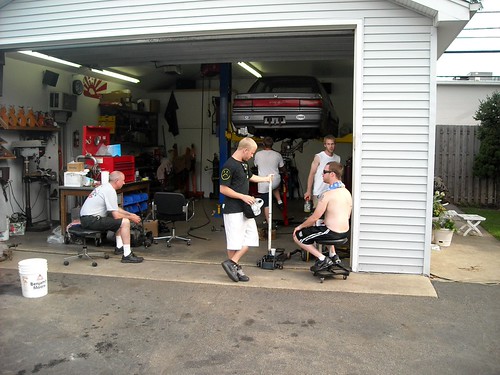
Exhaust for turbo is done

What is that driveshaft doing there?

Rear diff mounted:

Rear subframe mounted:


Trailing arms!


Positve camber! (fixed...not positive anymore)

please dont post pics anywhere else...
this car is nearing mechanical completion, has a fully built (with used parts ) turbo D, apexi turbo setup, valvetrain/cam from crower (used , used, used, old)
we're shooting for 270 whp...these turbo setups, somehow, are known to be able to do 300 WHP..its not as small as it looks. i mgiht build a different manifold though, that stock Apexi one blows. tuned with crome, . the suspension with most likely consist of used tokicos or konis if we can find them. currently its rolling on a mix-match of stuff. it will roll on cast-off hoosier a6s. complete budget is under 2000$. luke has been collecting parts for this car for years. you cant build a car for this cheap and do it fast.
Exhaust for turbo is done
What is that driveshaft doing there?
Rear diff mounted:
Rear subframe mounted:
Trailing arms!
Positve camber! (fixed...not positive anymore)
please dont post pics anywhere else...