


Titanium rods


Honda-Tech Member
Joined: Nov 2007
Posts: 48
Likes: 0
From: So, Cal, USA
 Re: Titanium rods
You have to take some special precautions with ti rods. Titanium doesnt expand as fast as steel with temperature. So you have to run more bearing clearance then traditional steel rods. I would not set up ti rods tighter then .0022" of clearance, just to be on the safe side. Make sure you properly lubricate the bolt threads also, as ti like to gall.
I havent tried eagles ti rods or obx. Titanium is notch sensitive so Ive only used higher end rod manufacturers like Crower, Cunningham, MGP, or Oliver. If your willing to fork out the money for Titanium go with one of them.
I havent tried eagles ti rods or obx. Titanium is notch sensitive so Ive only used higher end rod manufacturers like Crower, Cunningham, MGP, or Oliver. If your willing to fork out the money for Titanium go with one of them.


Honda-Tech Member
Joined: Mar 2009
Posts: 757
Likes: 2
From: NW Ohio
Re: Titanium rods
They do have less thermal expansion but I also belive they have greater thermal breakdown. The heat cycles can effect the titanium's durability more so than a good steel. I have heard that some coat the rods to dissipate heat away from the rods. Or boost, you shouldn't pair is on a boosted motor according to some. Still, they can handle quite a bit, if you plan to build an extreme motor, consider titanium, if any less though it may not be worth the cost. As a side note I would consider these way before aluiminum rods.

Honda-Tech Member
Joined: Nov 2007
Posts: 48
Likes: 0
From: So, Cal, USA
Re: Titanium rods
Titanium does burn extremely bright. The thermal cycling doesn't adversely affect ti, after all it is used in the Z07 corvettes, I think porsche uses them too. And its used extensively in aerospace.
Trending Topics



Honda-Tech Member
Joined: Aug 2004
Posts: 4,167
Likes: 2
From: Atlanta
Re: Titanium rods
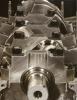
Porsche GT3/GT3RS and Carrera GT rods are titanium...Very nice pieces.Had a picture of one somewhere around here...NSX also uses Ti rods...
I thought Eagle wasnt making Ti rods anymore?
I thought Eagle wasnt making Ti rods anymore?
Honda-Tech Member
Joined: Feb 2003
Posts: 1,171
Likes: 0
From: Houston, TX
Re: Titanium rods
Regardless, I don't think there is enough heat through the rods to cause any adverse affects, however from what I've read they tend to distort more at high RPM.

Honda-Tech Member
Joined: Mar 2009
Posts: 989
Likes: 0
From: Cary, NC
Re: Titanium rods
i think titanium rods should only be used in VERY EXTREMELY serious applications. yes they have a higher strength to weight ratio than steel........BUT if you make 2 rods exactly the same, one Ti, one steel......the steel one is stronger. for a basic to moderate performance build, a street/strip car, even a weekend track car.........forged can do everything you need it to. once you start getting into extreme power ranges and continuous use is when you need to start thinking about crazy stuff like Ti rods and billet cranks.
Honda-Tech Member
Joined: Mar 2009
Posts: 989
Likes: 0
From: Cary, NC
Re: Titanium rods
It's the Z06 that uses "titanium" rods in the 427ci LS7. They are not like the titanium aftermarket rods you'd find in a real race engine.
Regardless, I don't think there is enough heat through the rods to cause any adverse affects, however from what I've read they tend to distort more at high RPM.
Regardless, I don't think there is enough heat through the rods to cause any adverse affects, however from what I've read they tend to distort more at high RPM.
the LS7 in the Z06 redlines at 7000rpm which is crazy for a big pushrod V-8. and that engine has been repeatedly tested at 8000rpm. so with a 4" stroke @ 7000rpm the average piston speed is 4666ft/min and at 8000rpm its 5333ft/min. for comparison the F20C is only at 4960ft/min @ 9000rpm. the LS7 is throwing a much bigger bore(and probably heavier) piston around too so theres going to be more inertia getting slung around inside the LS7.

Honda-Tech Member

Joined: Oct 2002
Posts: 205
Likes: 0
From: dc.va, US
Re: Titanium rods
Regardless, the benefit is realized mostly through a reduction in weight, not a significant difference in strength. The ti part, again depending on the alloy, could weigh 30 to 40% less than its steel counterpart.
Honda-Tech Member
Joined: Mar 2009
Posts: 989
Likes: 0
From: Cary, NC
Re: Titanium rods
It really depends on the specific types of alloys being compared.
Regardless, the benefit is realized mostly through a reduction in weight, not a significant difference in strength. The ti part, again depending on the alloy, could weigh 30 to 40% less than its steel counterpart.
Regardless, the benefit is realized mostly through a reduction in weight, not a significant difference in strength. The ti part, again depending on the alloy, could weigh 30 to 40% less than its steel counterpart.
also someone mentioned earlier that it tends to break down with heat..........grade 5 for instance is commonly used in temperatures below 750F..............a temperature i hope the bottom end of your engine never sees.

Thread
Thread Starter
Forum
Replies
Last Post
