


Cutting Reliefs on Head Flange


Honda-Tech Member
Joined: May 2008
Posts: 2,312
Likes: 1
From: RCautoworks, Bridgeview, Illinois
 Re: Cutting Reliefs on Head Flange
Yes, it should be one of the very last procedures you do, after milling the flanges flat. It does help, is it drastic, who knows. Some companies do it, some don't , the companies that don't do it don't seem to have a problem either.

Honda-Tech Member
Joined: Sep 2004
Posts: 1,257
Likes: 0
From: Fargo, ND, US
Re: Cutting Reliefs on Head Flange
90blackcrx pretty much nailed it. It is kinda a do it if you want thing in my mind. I have never cut a flange and don't plan on doing it any time soon. It is a looks thing in my book, and i have never had a warping issue or cracking issue from flanges pulling or warping.
my 2 cents
my 2 cents

OG Fabricator
Joined: Feb 2005
Posts: 1,864
Likes: 1
From: Burlington, Ont., Canada
Re: Cutting Reliefs on Head Flange
read maximum boost. it discusses manifold building a bit. it says to split the flange. it also says to weld only the inside of the runners at the flange. it also says not to wrap your manifold.
bottom line: everyone usually does things how best works for them. personally, i don't split the flange, and i weld inside and out at all flanges.
bottom line: everyone usually does things how best works for them. personally, i don't split the flange, and i weld inside and out at all flanges.

Honda-Tech Member
Joined: Aug 2004
Posts: 1,864
Likes: 1
Re: Cutting Reliefs on Head Flange
if your runner warped/shrunk even a little after welding it to the head flange, when you make the cut on the flange its going to misalign the flange sections.
Trending Topics
Honda-Tech Member
Joined: May 2008
Posts: 2,312
Likes: 1
From: RCautoworks, Bridgeview, Illinois
Re: Cutting Reliefs on Head Flange
Honda-Tech Member
Joined: May 2008
Posts: 2,312
Likes: 1
From: RCautoworks, Bridgeview, Illinois
Honda-Tech Member
Joined: Aug 2004
Posts: 1,864
Likes: 1
Re: Cutting Reliefs on Head Flange
not necessarily. im talking about it moving up and down to the point where it wont match up the the bolt pattern because one port is lower then the one next to it. ive seen an instance of that before.
OG Fabricator
Joined: Feb 2005
Posts: 1,864
Likes: 1
From: Burlington, Ont., Canada
Re: Cutting Reliefs on Head Flange
how about splitting the flange only half way, or say 3/8" through on a 1/2" flange? i know some of the vw flanges i sell have a slot down between the ports, but not split all the way through.
dave, can you give any particular reason why? although dated, i find some of the info in it is still applicable.
dave, can you give any particular reason why? although dated, i find some of the info in it is still applicable.


Honda-Tech Member
Joined: Jun 2006
Posts: 978
Likes: 0
From: Abbotsford, BC
Re: Cutting Reliefs on Head Flange
how about splitting the flange only half way, or say 3/8" through on a 1/2" flange? i know some of the vw flanges i sell have a slot down between the ports, but not split all the way through.
dave, can you give any particular reason why? although dated, i find some of the info in it is still applicable.
dave, can you give any particular reason why? although dated, i find some of the info in it is still applicable.
As for maximum boost, I couldn't accurately quote any text off the top of my head as its been a few years, but from what I remember virtually his entire chapter on exhaust manifold design was poor, everything pertaining to volume and flow rates down to fabrication techniques I remember being weak and in many cases flat out wrong.

Honda-Tech Member

Joined: Apr 2003
Posts: 988
Likes: 0
From: Montreal, Quebec, Canada
Re: Cutting Reliefs on Head Flange
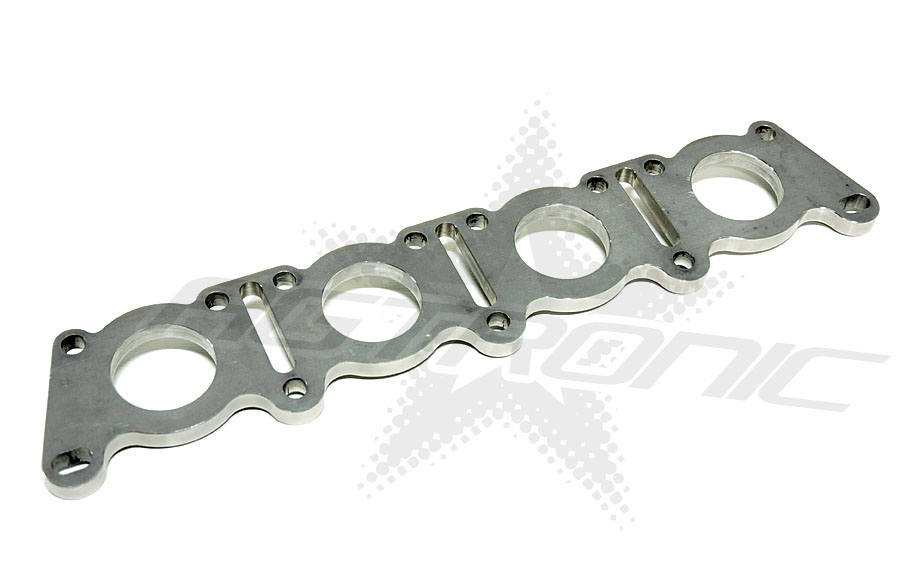
Alternatively, you could cut the flange between the runners before welding the manifold, and make sure you have a good solid fixture, but even then I don't know how straight it would stay ...
edit : changed the pic

OG Fabricator
Joined: Jan 2006
Posts: 661
Likes: 0
From: Saint Helens, OR, USA
Re: Cutting Reliefs on Head Flange
Seems to work ok if the header has been fully stress relieved. It's a complete disaster if you weld up a header, pull it out the jig and start sawing away between the runners tho.
OG Fabricator
Joined: Feb 2005
Posts: 1,864
Likes: 1
From: Burlington, Ont., Canada
Re: Cutting Reliefs on Head Flange
I do something similar, to disperse heat quickly, to help deal with thermal displacement, I would not recommend welding a manifold together using a solid head flange and than dividing the ports on the flange afterwards, you are asking for some serious mis alignment, unless of course you are dowling the flange to the head, but honestly, how many here actually do that?
As for maximum boost, I couldn't accurately quote any text off the top of my head as its been a few years, but from what I remember virtually his entire chapter on exhaust manifold design was poor, everything pertaining to volume and flow rates down to fabrication techniques I remember being weak and in many cases flat out wrong.
As for maximum boost, I couldn't accurately quote any text off the top of my head as its been a few years, but from what I remember virtually his entire chapter on exhaust manifold design was poor, everything pertaining to volume and flow rates down to fabrication techniques I remember being weak and in many cases flat out wrong.
i would appreciate your opinion/knowledge/experience that opposes someone who has published a book about the subject. i know things have changed a lot since that book was published, and i would like to know what works best for other people too. (sorry for the thread jack).
Honda-Tech Member
Joined: Jun 2006
Posts: 978
Likes: 0
From: Abbotsford, BC
Re: Cutting Reliefs on Head Flange
don't take this the wrong way, but if you can't back up a statement, why make it? please take the time to point out what you disagree with specifically, not just generally... "flat out wrong" is a pretty strong statement i think. i think much of it still holds water when designing/building a manifold.
i would appreciate your opinion/knowledge/experience that opposes someone who has published a book about the subject. i know things have changed a lot since that book was published, and i would like to know what works best for other people too. (sorry for the thread jack).
i would appreciate your opinion/knowledge/experience that opposes someone who has published a book about the subject. i know things have changed a lot since that book was published, and i would like to know what works best for other people too. (sorry for the thread jack).

Honda-Tech Member
Joined: May 2008
Posts: 39
Likes: 0
Re: Cutting Reliefs on Head Flange
It's a pretty generic book that some how became gospel over the years. I think it's a good fundamentals book if you don't have a background in the subject, but past that probably not worth the credit it's given...

Honda-Tech Member
Joined: Jul 2004
Posts: 5,463
Likes: 2
From: I'm everywhere Focker
Re: Cutting Reliefs on Head Flange
I think that with the time involved in manifold building and competitive pricing as it is, that adding another procedure that certainly hasn't proven its worth is just wasted time. Full Race did it and others that "wanted to be like Mike" did it too.
With mild flanges it certainly doesn't seem to be of any benefit, and there's more manifolds out there without it done than with. With stainless flanges, maybe there is some benefit due to the characteristics of stainless, but noone really uses stainless flanges for manifold purposes except for ching chong meows on ebay.
With mild flanges it certainly doesn't seem to be of any benefit, and there's more manifolds out there without it done than with. With stainless flanges, maybe there is some benefit due to the characteristics of stainless, but noone really uses stainless flanges for manifold purposes except for ching chong meows on ebay.
Honda-Tech Member
Joined: Jun 2006
Posts: 978
Likes: 0
From: Abbotsford, BC
OG Fabricator
Joined: Feb 2005
Posts: 1,864
Likes: 1
From: Burlington, Ont., Canada
Re: Cutting Reliefs on Head Flange
no, i don't think, just because it is in a book it is martial law or something. i just want insights as to what works for different people, and to discuss why one method has advantages over another and vice versa. i'm always trying to improve my own knowledge and skills. i don't think anyone should think they've reached a pinnacle that is unattainable by others. that is just setting yourself up for a fall. no amount of reading or research can measure up to first hand experience.
like i said in my initial response to this thread, bottom line is: everyone does what works best for them.
like i said in my initial response to this thread, bottom line is: everyone does what works best for them.

Thread Starter
Honda-Tech Member
Joined: Jun 2006
Posts: 1,371
Likes: 0
From: Macon, Ga
Re: Cutting Reliefs on Head Flange
So, what would be the best way to stress relieve the runners after welding? That would seem to be a good idea even if you dont cut the flange. Seems like it could help alieviate some stress cracking possibly.

Honda-Tech Member
Joined: Nov 2008
Posts: 177
Likes: 0
From: Tempe, Arizona
Re: Cutting Reliefs on Head Flange
I have seen many manifolds that were straight and flange cut, go through heat cycles and get completely wacked out.
But bottom line, gaps create stress and pulling, no gaps - no stress. Take some pride when tacking everything and you will find things will go 100% smoother down the whole production line.

But bottom line, gaps create stress and pulling, no gaps - no stress. Take some pride when tacking everything and you will find things will go 100% smoother down the whole production line.
Last edited by CTD-Fab; Dec 24, 2009 at 02:41 PM.