


D16 "Quick spool" manifold ....


Thread Starter
Honda-Tech Member
Joined: Sep 2004
Posts: 1,257
Likes: 0
From: Fargo, ND, US
 D16 "Quick spool" manifold ....
Well i thought i would try this out and see how it worked on my DD civic. I know i have seen a d 16 manifold using the small 1.25" runners before but figured it was worht doing. I wanted instant response from my T25. So this is what i came up with.
I'm using 1.25" sch 10 runners with a 2" collector and a garrett T25 turbo.


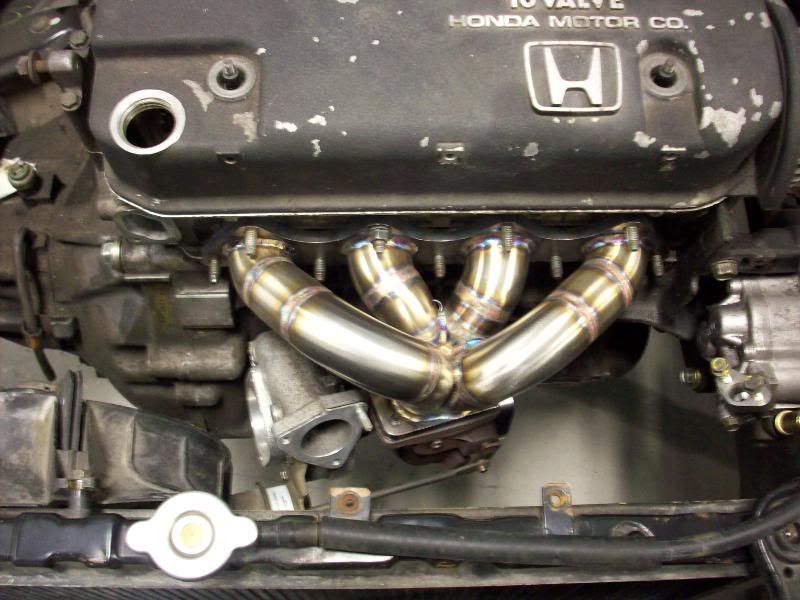


Lmk, what you think and how this will help turbo response, I think it should help quite a bit.
I'm using 1.25" sch 10 runners with a 2" collector and a garrett T25 turbo.
Lmk, what you think and how this will help turbo response, I think it should help quite a bit.


Thread Starter
Honda-Tech Member
Joined: Sep 2004
Posts: 1,257
Likes: 0
From: Fargo, ND, US

Thread Starter
Honda-Tech Member
Joined: Sep 2004
Posts: 1,257
Likes: 0
From: Fargo, ND, US
Re: D16 "Quick spool" manifold ....
haha, thats great i hope boost doesn't come on that fast.
this is going on a d16a6 with 7.1:1 comp and a delta 272 cam. we will see what happens,
this is going on a d16a6 with 7.1:1 comp and a delta 272 cam. we will see what happens,

Honda-Tech Member
Joined: Jul 2002
Posts: 5,695
Likes: 0
From: Chicagoland, usa
Re: D16 "Quick spool" manifold ....
Also very interested in the dyno results. Man it would rule to get a back to back with a 1.5 of identical design.
Probably building a 1.25" based manifold for my miata this winter.
Probably building a 1.25" based manifold for my miata this winter.
Trending Topics

OG Fabricator
Joined: Dec 2006
Posts: 1,342
Likes: 0
From: Calgary, Alberta, Canada
Re: D16 "Quick spool" manifold ....
I think the work is great, but I don't see how it would really get it to spool faster than a properly designed twinscroll. I was under the impression that turbo size, vane design, and exhaust gas pulse timing were most important. Unless the size of the runner is your major motivation, then maybe. How is the inside diameter of the pipe compared to the diameter of the exhaust port?
This is not critcism in any way, merely questions.
This is not critcism in any way, merely questions.

Honda-Tech Member
Joined: May 2002
Posts: 1,098
Likes: 2
From: Plymouth, MN
Re: D16 "Quick spool" manifold ....
The manifold looks great! I have to ask, why such low compression? That KILLS spool time. A friend of mine was running 10:1 on a ZC motor just to speed up spool, and it was a little monster. With the small turbo you're running, I'm curious what the purpose is.

FSAE
Joined: Jan 2002
Posts: 5,495
Likes: 1
From: Drinking Beer, UT
Re: D16 "Quick spool" manifold ....
Also, a properly designed twin-scroll manifold is expensive and time consuming. You have to buy two wastegates, and pair the cylinders correctly. Not to mention the added cost of a divided housing turbo (or turbine housing).
Having a short, stubby manifold with smaller cross sectioned runners will retain heat and keep gas velocities up enough to improve spool over a more conventional ‘Ram Horn’ or ‘Top Mount’ manifold. Of course this is all at the expense of high-rpm power to some degree….

Thread Starter
Honda-Tech Member
Joined: Sep 2004
Posts: 1,257
Likes: 0
From: Fargo, ND, US
Re: D16 "Quick spool" manifold ....
First, his turbo does not have a divided housing turbine section, therefore he does not have the option of building the manifold in a ‘twin-scroll’ arrangement.
Also, a properly designed twin-scroll manifold is expensive and time consuming. You have to buy two wastegates, and pair the cylinders correctly. Not to mention the added cost of a divided housing turbo (or turbine housing).
Having a short, stubby manifold with smaller cross sectioned runners will retain heat and keep gas velocities up enough to improve spool over a more conventional ‘Ram Horn’ or ‘Top Mount’ manifold. Of course this is all at the expense of high-rpm power to some degree….
Also, a properly designed twin-scroll manifold is expensive and time consuming. You have to buy two wastegates, and pair the cylinders correctly. Not to mention the added cost of a divided housing turbo (or turbine housing).
Having a short, stubby manifold with smaller cross sectioned runners will retain heat and keep gas velocities up enough to improve spool over a more conventional ‘Ram Horn’ or ‘Top Mount’ manifold. Of course this is all at the expense of high-rpm power to some degree….
The inside diameter in 1.4" i think. it is slightly smaller then the exhaust port on the flange. so it is pretty small. But i hope the collector will help a bit up top. I also am only reving to 7200 rpm. so mid range is where i'm shooting for.


Honda-Tech Member
Joined: Jun 2003
Posts: 9,555
Likes: 0
From: NYC bitchessss
Re: D16 "Quick spool" manifold ....
smaller than the opening on the exhaust flange? hmmm hope it doesn't cause a problem.
although the opening on the exhaust flange is normally slightly larger than the exhaust ports on the head, so the difference might cancel out....
hope it works out well!
although the opening on the exhaust flange is normally slightly larger than the exhaust ports on the head, so the difference might cancel out....
hope it works out well!

Honda-Tech Member
Joined: May 2009
Posts: 878
Likes: 1
Re: D16 "Quick spool" manifold ....
It wouldn't be any worse than someone using 1 5/8" tubing for building a manifold (id of pipe being smaller than id of head flange). I know that was the stuff to use about 6 years ago when not so many people nor options existed when it came to high end turbo manifolds.
I have always wanted to do the same thing (build a small pipe manifold) just haven't done it though...
BTW looks pretty snazzy. What do you prefer for getting that brushed finish on the pipe? I like to use a 120 grit 6" flapper wheel on my bench grinder but they just use up so quickly, it gets very expensive to do a manifold with. I know a 6" 3m scotchbrite wheel hard finish will do it also but they work much more slowly and are $80 vs $20 for a flapper wheel, lastly they don't do a good job at getting into the corners and what not...
I have always wanted to do the same thing (build a small pipe manifold) just haven't done it though...
BTW looks pretty snazzy. What do you prefer for getting that brushed finish on the pipe? I like to use a 120 grit 6" flapper wheel on my bench grinder but they just use up so quickly, it gets very expensive to do a manifold with. I know a 6" 3m scotchbrite wheel hard finish will do it also but they work much more slowly and are $80 vs $20 for a flapper wheel, lastly they don't do a good job at getting into the corners and what not...
Last edited by BMCRace; Dec 12, 2009 at 09:01 AM.
Thread Starter
Honda-Tech Member
Joined: Sep 2004
Posts: 1,257
Likes: 0
From: Fargo, ND, US
Re: D16 "Quick spool" manifold ....
I use the 4" 3m scotchbrite red pads. get them at any good welding supply shop. they stock to a black pad on my angle grinder. a box of ten last a while. I can do maybe 6-10 bends per pad if I'm careful about not burning off the edge.

Honda-Tech Member
Joined: Nov 2008
Posts: 177
Likes: 0
From: Tempe, Arizona
Re: D16 "Quick spool" manifold ....
nice manifold but i would be wary about using sch 10. I good friend and coworker of mine built pretty much exactly the same manifold using sch10 1.25 and it cracked a few times. He is the best welder I know also so that wasn't the issue.
Also I would have gone with a 1.25 ramhorn for the best performing manifold with the least reversion. Or at the very least place a divider plate in the collector between the 1-4, 3-2. The pipe sizing is perfect, and it doesn't really matter that the pipe is a tad smaller than the exhaust port, it should still make some good power.
I also used 1.25 but sch40 when i built my D series twinscroll setup.

Also I would have gone with a 1.25 ramhorn for the best performing manifold with the least reversion. Or at the very least place a divider plate in the collector between the 1-4, 3-2. The pipe sizing is perfect, and it doesn't really matter that the pipe is a tad smaller than the exhaust port, it should still make some good power.
I also used 1.25 but sch40 when i built my D series twinscroll setup.

Thread Starter
Honda-Tech Member
Joined: Sep 2004
Posts: 1,257
Likes: 0
From: Fargo, ND, US
Re: D16 "Quick spool" manifold ....
nice manifold but i would be wary about using sch 10. I good friend and coworker of mine built pretty much exactly the same manifold using sch10 1.25 and it cracked a few times. He is the best welder I know also so that wasn't the issue.
Also I would have gone with a 1.25 ramhorn for the best performing manifold with the least reversion. Or at the very least place a divider plate in the collector between the 1-4, 3-2. The pipe sizing is perfect, and it doesn't really matter that the pipe is a tad smaller than the exhaust port, it should still make some good power.
I also used 1.25 but sch40 when i built my D series twinscroll setup.
Also I would have gone with a 1.25 ramhorn for the best performing manifold with the least reversion. Or at the very least place a divider plate in the collector between the 1-4, 3-2. The pipe sizing is perfect, and it doesn't really matter that the pipe is a tad smaller than the exhaust port, it should still make some good power.
I also used 1.25 but sch40 when i built my D series twinscroll setup.
I do know what your saying about the design, but my main goal was not for high rpm, high hp flow. It was to build a great street car turbo set up with turbo response in mind. This is my dd so it also came down to a packaging issue, i have power steering and really like compact manifold designs.
Your link is broken btw.
I use 308L 1/16th rod 2 passes one root with no filler and one filler/cap pass.

Honda-Tech Member
Joined: Jul 2004
Posts: 5,463
Likes: 2
From: I'm everywhere Focker
Re: D16 "Quick spool" manifold ....
I think in many ways these are the best setups to build. Simple, quick spool...great for the street. I've built quite a number of setups like this...I love D's with small turbo's as dailys.

Honda-Tech Member
Joined: May 2006
Posts: 409
Likes: 0
From: Dublin or MN
Honda-Tech Member
Joined: Nov 2008
Posts: 177
Likes: 0
From: Tempe, Arizona
Re: D16 "Quick spool" manifold ....
Well I don't see how needing that thick of pipe is needed. I don't think there will be cracking issues. I guess maybe some people get used to running small beads and quite frankly welding pipe like it is thin wall tubing. Pipe needs big bevels to get penitration and that just makes the bead width larger also. I have seen to many places lately with absolutly tiny welds and it amazes me that they even hold up at all.
I do know what your saying about the design, but my main goal was not for high rpm, high hp flow. It was to build a great street car turbo set up with turbo response in mind. This is my dd so it also came down to a packaging issue, i have power steering and really like compact manifold designs.
Your link is broken btw.
I use 308L 1/16th rod 2 passes one root with no filler and one filler/cap pass.
I do know what your saying about the design, but my main goal was not for high rpm, high hp flow. It was to build a great street car turbo set up with turbo response in mind. This is my dd so it also came down to a packaging issue, i have power steering and really like compact manifold designs.
Your link is broken btw.
I use 308L 1/16th rod 2 passes one root with no filler and one filler/cap pass.
pic showing up now? Btw I love compact manifold designs also. As you can see mine is AC/PS compatable

All my welds were full beveled, no flat, but the bead really shouldn't need to get much wider than the thickness of the material. I believe in single pass though.