


Why do the Newer D series have higher compression ratio vs. older?


Thread Starter
B*a*n*n*e*d
Joined: Mar 2008
Posts: 464
Likes: 0
From: Bay Area, CA, USA
 Why do the Newer D series have higher compression ratio vs. older?
I mean this may seem like it's kind of obvious (why is the sky blue, b/c it is) but I'm looking for real specifics for the answer to this question. Why is it that the D17A6, D16Y5, D15Z1 and D15B6 has a 9.9:1, 9.4:1, 9.3:1, 9.1:1 compression ratio respectively? I understand they added in a Knock Sensor for the D16 but aside from that, I don't know of any specifics as to why they were able to increase the compression ratio on these engines. For those who are wondering, D17A6 is in 2001 HX, D16Y5 is in 1996 HX, D15Z1 is in 1992 VX, and D15B6 is in the '88 CRX HF. Apparently there are oil jets in the D15Z1 (confirm?) and newer but aside from that, I don't understand why each successive engine was able to increase its compression ratio. The most important part about all of this is that they're using 87 Octane fuel which is why I'm most interested in figuring out what exactly changed.
 Re: Why do the Newer D series have higher compression ratio vs. older?
how do you raise compression in a build? by decreasing the area between the combustion chamber and piston dome. more than likely different piston design,stroke maybe rod length is what differs in those motors. nobody cars about d-series though :-p
Thread Starter
B*a*n*n*e*d
Joined: Mar 2008
Posts: 464
Likes: 0
From: Bay Area, CA, USA
Re: Why do the Newer D series have higher compression ratio vs. older?
Well, that's not really what I meant, what I meant was, how did they raise the compression ratio without it detonating? I mean duh you can shave off the top of the block or use a thinner head gasket, but how did they do that and not require premium fuel?

Honda-Tech Member
Joined: Jan 2009
Posts: 179
Likes: 0
From: chicago IL
Re: Why do the Newer D series have higher compression ratio vs. older?
you do not need premium fuel for a compression ratio like 9.9:1, there are different ways you can avoid detonation. One way is the design of the combustion chamber, and pistons. Another is through careful ignition timing. There are more but i cant seem to think of any. Anyone else?
Thread Starter
B*a*n*n*e*d
Joined: Mar 2008
Posts: 464
Likes: 0
From: Bay Area, CA, USA
Re: Why do the Newer D series have higher compression ratio vs. older?
you do not need premium fuel for a compression ratio like 9.9:1, there are different ways you can avoid detonation. One way is the design of the combustion chamber, and pistons. Another is through careful ignition timing. There are more but i cant seem to think of any. Anyone else?
Honda-Tech Member
Joined: Jan 2009
Posts: 179
Likes: 0
From: chicago IL
Re: Why do the Newer D series have higher compression ratio vs. older?
different ecus, new found tuning capabilities.. remember.. back in 88 fuel injection was fairly new..The changeover of the obd...four wire oxygen sensors..ect.
Thread Starter
B*a*n*n*e*d
Joined: Mar 2008
Posts: 464
Likes: 0
From: Bay Area, CA, USA
Re: Why do the Newer D series have higher compression ratio vs. older?
Well one thing I just discovered is that these Honda Engines are Undersquare which seems soo odd considering that Hondas are known for their high revving ability. The D13-D17 have the exact same bore, but different strokes which is I think how they increased the displacement of these engines. Has anyone been able to prove that it's easier to have higher compression ratios in larger displacement engines vs. smaller displacement engines? Or maybe because the engine has become MORE undersquare than it was that this somehow facilitates higher compression ratios?? Thing is, I usually hear of compression ratios increasing when an engine is made LESS undersquare.
Trending Topics
Honda-Tech Member
Joined: Jan 2007
Posts: 559
Likes: 0
From: loveland co, United States
Re: Why do the Newer D series have higher compression ratio vs. older?
piston and combustion chamber design

i ♥ snails
Joined: Aug 2004
Posts: 2,293
Likes: 0
From: hmt noggs
Re: Why do the Newer D series have higher compression ratio vs. older?
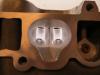
the y8 compared to other d-series heads seems to have more "quench", quench pads that is. By getting the mixture more agitated and homogeneous and closer to the flame kernel you get better flame propagation with more stability and a faster burn, faster you can burn the mixture completely the less time the mixture has to endure the pressure and heat especially the outer part of the mixture farthest away from the spark plug, dont want those areas exploding
Thread Starter
B*a*n*n*e*d
Joined: Mar 2008
Posts: 464
Likes: 0
From: Bay Area, CA, USA
Re: Why do the Newer D series have higher compression ratio vs. older?
I read somewhere that engines with a shorter stroke are much more difficult to cool compared to ones with a longer stroke. The Honda D series engines had their displacement increased by increasing the stroke, all the while maintaining the same sized bore.
I think I know why the higher displacement engines were able to have their compression ratios increased. Since the stroke was increased, there is more surface area to dissipate the heat from the piston (short stroke, small area vs. long stroke, large area) and since there is more area to dissipate the heat, this allowed for more room to increase the compression ratio of the engine. So in short, the major factor in allowing for the increase in compression ratio on these engines was due to the increase in stroke, things like knock sensors, and better computers helped (after 1996 of course) but aside from that, unless the cooling system could've been improved, increasing the stroke of the engine was a way to allow for the increase in compression ratio without doing a major overhaul of the engine.
Has it been proven that running a heavier duty water pump/radiator be enough to allow for a lot higher compression ratios? If so, it would have been a cost decision to increase the stroke vs. having a bigger, more expensive radiator.
I think I know why the higher displacement engines were able to have their compression ratios increased. Since the stroke was increased, there is more surface area to dissipate the heat from the piston (short stroke, small area vs. long stroke, large area) and since there is more area to dissipate the heat, this allowed for more room to increase the compression ratio of the engine. So in short, the major factor in allowing for the increase in compression ratio on these engines was due to the increase in stroke, things like knock sensors, and better computers helped (after 1996 of course) but aside from that, unless the cooling system could've been improved, increasing the stroke of the engine was a way to allow for the increase in compression ratio without doing a major overhaul of the engine.
Has it been proven that running a heavier duty water pump/radiator be enough to allow for a lot higher compression ratios? If so, it would have been a cost decision to increase the stroke vs. having a bigger, more expensive radiator.

Thread
Thread Starter
Forum
Replies
Last Post
