


car sits lower on one side


Thread Starter
Honda-Tech Member
Joined: Jan 2008
Posts: 5,095
Likes: 0
From: Chicago, Il, u.s.a.
 car sits lower on one side
Hey guys I realized that my car sits lower on the driver side than it does on the passenger side. I can fit two fingers in between my passenger side front tire and fender but I cant on my driver side. It is noticeably different. I have rusted tokico blues and springs, could this be the problem. I have been told I cannot assume that it is a blown strut or bad springs. It seems like it is the same in the back of the car to lower on the driver side.

Honda-Tech Member
Joined: Jun 2004
Posts: 7,539
Likes: 5
From: Sherman Oaks, CA, United States
Re: car sits lower on one side
Making an assumption here:
You have either a D or B series engine.
This makes the engine on the driver's side of the car. On a scale, I believe I ended up with a 55/45 weight distribution left/right in my GSR. The heavy side will always be lower, without setting uneven spring perch heights to compensate (which you lack).
Also, as cars age, they deform some. It could also be differences in the fenders. My car sits something like 1/2" height difference left/right (jack point measure), but the front fender gap is a larger difference (nearly 1"), so even though they look perfectly straight one of my fenders must be slightly off.
You have either a D or B series engine.
This makes the engine on the driver's side of the car. On a scale, I believe I ended up with a 55/45 weight distribution left/right in my GSR. The heavy side will always be lower, without setting uneven spring perch heights to compensate (which you lack).
Also, as cars age, they deform some. It could also be differences in the fenders. My car sits something like 1/2" height difference left/right (jack point measure), but the front fender gap is a larger difference (nearly 1"), so even though they look perfectly straight one of my fenders must be slightly off.

Honda-Tech Member
Joined: Dec 2007
Posts: 102
Likes: 0
From: Arlington/ South central LA, Texas/ Cali, USA
Re: car sits lower on one side
My ej2 sits the same way, Im a big guy though lol that could be the problem....I have Tokico blues and springs as well......


Honda-Tech Member
Joined: Sep 2005
Posts: 1,071
Likes: 0
Re: car sits lower on one side
when i had springs they were the same way on both of my hondas and i think my integra too.
pretty sure that it's uneven even with stock shocks and springs u just notice more when it's dropped.
pretty sure that it's uneven even with stock shocks and springs u just notice more when it's dropped.
Last edited by verycleanhatch; May 13, 2009 at 06:54 PM.


Joined: Jan 2002
Posts: 30,073
Likes: 59
From: Nowhere and Everywhere
Re: car sits lower on one side
Let's see here.... engine is on the left side of the car... driver is on the left side of the car.... Those two things together can be over 600 pounds oriented towards the left side of the car. Did you really expect it to sit level?
If you're really concerned about it, you'll have to get something with adjustable-height spring perches so you can fine-tune the height so that the car sits level.
Trending Topics

Junior Member
Joined: Dec 2008
Posts: 32
Likes: 0
Re: car sits lower on one side
I got it figured out. It turns out that I had not re-installed the bracket that holds the stabilizer bar bushing? It's got 3 bolts and a hole and theres a little nipple it goes through when you fasten it down.

Honda-Tech Member
Joined: Aug 2009
Posts: 8
Likes: 0
Re: car sits lower on one side
It's weight. When I set my car up for AX this year I got my ride height level from the "frame" to the ground. And I have a larger "finger" gap on one side than the other but it's level to the ground. My buddy always makes fun of me but I get even weight distribution this way so oh well.


 Re: car sits lower on one side
guy... it's weight distribution from left to right in the car. The car itself is more driver justified weight wise due to the engine. The tranny sits on the passengar side which is lighter than the engine itself, which is on the driver side.


Honda-Tech Member
Joined: Jan 2009
Posts: 173
Likes: 0
Re: car sits lower on one side
the engine does NOT weight much more than the tranny and battery weights combined. the difference is less than 20 pounds
Plus, b series axels are about the same length right? so everything inbetween them would be the middle right? now think about that.


Honda-Tech Member

Joined: Apr 2002
Posts: 18,961
Likes: 76
From: I am Tyson
Re: car sits lower on one side
Uneven ride height is normal and expected. The smaller you close the overall gap, the easier it is to see the difference. It was uneven before.
Has to do with unevenly worn bushings, weight distribution with single driver and years of use.
Has to do with unevenly worn bushings, weight distribution with single driver and years of use.

Honda-Tech Member
Joined: Jun 2004
Posts: 7,539
Likes: 5
From: Sherman Oaks, CA, United States
Re: car sits lower on one side
The axles are the same length due to an additional shaft (intermediate shaft) than transfers power to the driver's side, allowing the axle connected to it to be the same length as the passenger's side.

The transmission output is offset from the center by half the length of the intermediate shaft.
Honda-Tech Member
Joined: Jun 2004
Posts: 7,539
Likes: 5
From: Sherman Oaks, CA, United States
Re: car sits lower on one side
Ctrl-T (new tab)
tab (move from address bar to search bar)
"integra intermediate shaft"
click "images" in upper left
Less than 30 seconds total time. Took longer to type out the explanation, but I type slow for a programmer.
Anyway, back on topic...
Re: car sits lower on one side
We all have many photos readily available. Its called Google.
Ctrl-T (new tab)
tab (move from address bar to search bar)
"jenna jameson"
click "images" in upper left
Less than 30 seconds total time. Took longer to type out the explanation, but I type slow for a programmer.
Anyway, back on topic...
Ctrl-T (new tab)
tab (move from address bar to search bar)
"jenna jameson"
click "images" in upper left
Less than 30 seconds total time. Took longer to type out the explanation, but I type slow for a programmer.
Anyway, back on topic...
Honda-Tech Member
Joined: Jan 2009
Posts: 173
Likes: 0
Re: car sits lower on one side
So I am sitting here tonight looking around HT and talking in PM to people about my built H22 I just posted into FI and Prelude... and I come across yet another B VS H arguement... and people start talking about all this weight BS again... the H series I hear rumours of anywhere from 85-125lb heavier then a B swap.
Here are some pics to let everyone with a B loose one of their points. (Not that I am against the B... the B is the ****... but I love the H as well and I have a H and I am tired of the weight argument)
I own a shop, and at the moment we are building several motors. So here I bring you some good ****.
All 3 Blocks are built with stock crank, forged rods, forged pistons, and iron sleeves done by benson (H22, D16) and darton (B16). I have a bensen'd B16 here as well but its already made the voyage to the engine stand so its not getting weighed. The only thing that is not fair in these pics is that the D has the oil pan on it... wasnt gonna take it off just for this BS.
H = 123lb short block
B = 104lb short block
D = 100lb short block + oil pan
So with totaly fair comparisons... the H is 19lb heavier in the short block.
NOW lets move on... the big word that I always hear is that its the H TRANS IS SOOOO HEAVY!!! Lets take a little peak here...
H trans = 96lb
B trans = 90lb
OK.. thats 6 lb... so we have a 25lb weight increase so far with the H22.
I will post here within a day or two as I weigh the assembled cylinder heads, as the H head is definatly heavier... but I would guess 10 lb heavier.
As for the rest of the crap... who cares. Intake manifolds are light for any motor and come in different flavors, same with headers and all that BS. Accessories are up to the owner of the car. Everything else hardly applies... flywheels are up to the user, axles, clutch, aluminum or steel oilpans, etc etc all this **** is up to the owner of the car so that crap doesnt need to be part of the comparison.
So what it comes down to is unless that H head is REALLY that much heavier... we are talking about
35 LB INCREASE!! Thats about how much weight off my *** I need to loose so I would be a hypocrite to be hard on the H.
OH YEA... you might want to see this yourself... here you go:
D16 Block:

B16 Block:
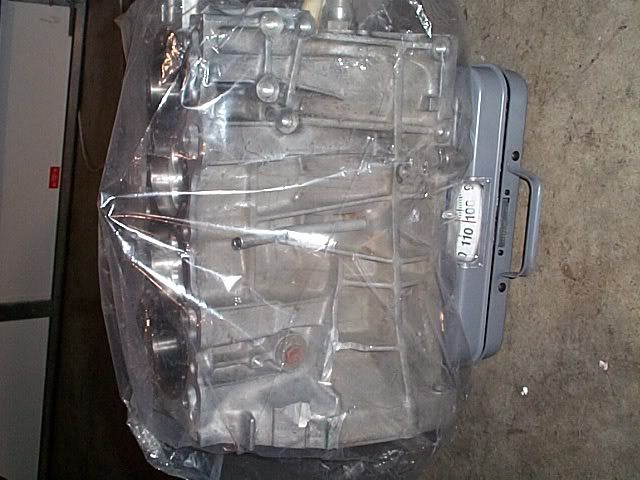
H22 Block:

B16 Trans:

H22 Trans:

-Charles
Modified by mister2racer at 3:48 AM 11/21/2003
Modified by mister2racer at 1:48 PM 5/2/2007
Here are some pics to let everyone with a B loose one of their points. (Not that I am against the B... the B is the ****... but I love the H as well and I have a H and I am tired of the weight argument)
I own a shop, and at the moment we are building several motors. So here I bring you some good ****.
All 3 Blocks are built with stock crank, forged rods, forged pistons, and iron sleeves done by benson (H22, D16) and darton (B16). I have a bensen'd B16 here as well but its already made the voyage to the engine stand so its not getting weighed. The only thing that is not fair in these pics is that the D has the oil pan on it... wasnt gonna take it off just for this BS.
H = 123lb short block
B = 104lb short block
D = 100lb short block + oil pan
So with totaly fair comparisons... the H is 19lb heavier in the short block.
NOW lets move on... the big word that I always hear is that its the H TRANS IS SOOOO HEAVY!!! Lets take a little peak here...
H trans = 96lb
B trans = 90lb
OK.. thats 6 lb... so we have a 25lb weight increase so far with the H22.
I will post here within a day or two as I weigh the assembled cylinder heads, as the H head is definatly heavier... but I would guess 10 lb heavier.
As for the rest of the crap... who cares. Intake manifolds are light for any motor and come in different flavors, same with headers and all that BS. Accessories are up to the owner of the car. Everything else hardly applies... flywheels are up to the user, axles, clutch, aluminum or steel oilpans, etc etc all this **** is up to the owner of the car so that crap doesnt need to be part of the comparison.
So what it comes down to is unless that H head is REALLY that much heavier... we are talking about
35 LB INCREASE!! Thats about how much weight off my *** I need to loose so I would be a hypocrite to be hard on the H.
OH YEA... you might want to see this yourself... here you go:
D16 Block:
B16 Block:
H22 Block:
B16 Trans:
H22 Trans:
-Charles
Modified by mister2racer at 3:48 AM 11/21/2003
Modified by mister2racer at 1:48 PM 5/2/2007

Thread
Thread Starter
Forum
Replies
Last Post
fryman
Honda Civic / Del Sol (1992 - 2000)
18
Oct 5, 2021 01:08 PM
