


is this a good ground wiring place?


Thread Starter
Junior Member
Joined: Aug 2008
Posts: 55
Likes: 0
From: Santa Ana, CA, USA
 is this a good ground wiring place?
my amp does not turn on im guessing because of the ground...
is this a bad ground? , its behind the seat in the trunk under the carpet. 94 accord coupe
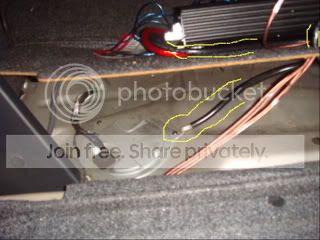
is this a bad ground? , its behind the seat in the trunk under the carpet. 94 accord coupe


Honda-Tech Member

Joined: Jan 2003
Posts: 6,565
Likes: 1
From: Herkimer, NY, USA
FV-QR
I sure as **** wouldn't be grounding my amp anywhere my fuel pump access cover... 
Let's use a seatbelt bolt or some other suitable ground location that's not a fire hazard, mmmkay?

Let's use a seatbelt bolt or some other suitable ground location that's not a fire hazard, mmmkay?

Honda-Tech Member
Joined: Nov 2007
Posts: 655
Likes: 0
From: Western Hemisphere
Re: is this a good ground wiring place? (Dask08)
That is almost the worst job of grounding that I have ever seen. 
Nevermind, I just remembered something. One time there was an amp grounded to the nut that holds in the tail light.
Look under the car for a spot where there's no fuel tank, fuel lines, brake lines etc. The frame rail is ideal. Get a wire brush attachment for a drill. Take the paint down to bare metal (this is inside the car now). Get three metal tapping screws, a star washer aka lock washer, and secure the ring terminal.
Never a bad idea to measure the resistance from your ground to the battery ground. You'll need some really long leads or you'll need to use some wire extensions.
Nevermind, I just remembered something. One time there was an amp grounded to the nut that holds in the tail light.
Look under the car for a spot where there's no fuel tank, fuel lines, brake lines etc. The frame rail is ideal. Get a wire brush attachment for a drill. Take the paint down to bare metal (this is inside the car now). Get three metal tapping screws, a star washer aka lock washer, and secure the ring terminal.
Never a bad idea to measure the resistance from your ground to the battery ground. You'll need some really long leads or you'll need to use some wire extensions.
Honda-Tech Member
Joined: Nov 2007
Posts: 655
Likes: 0
From: Western Hemisphere
Re: FV-QR (B18C_EJ8)
<TABLE WIDTH="90%" CELLSPACING=0 CELLPADDING=0 ALIGN=CENTER><TR><TD>Quote, originally posted by B18C_EJ8 »</TD></TR><TR><TD CLASS="quote">I sure as **** wouldn't be grounding my amp anywhere my fuel pump access cover...
Let's use a seatbelt bolt or some other suitable ground location that's not a fire hazard, mmmkay?
</TD></TR></TABLE>
No, do not use a seat belt bolt. Ask an MECP Advanced tech why not. Not me, I'm going to work.
Let's use a seatbelt bolt or some other suitable ground location that's not a fire hazard, mmmkay?
</TD></TR></TABLE>No, do not use a seat belt bolt. Ask an MECP Advanced tech why not. Not me, I'm going to work.
Honda-Tech Member
Joined: Jan 2003
Posts: 6,565
Likes: 1
From: Herkimer, NY, USA
Re: FV-QR (baller status)
<TABLE WIDTH="90%" CELLSPACING=0 CELLPADDING=0 ALIGN=CENTER><TR><TD>Quote, originally posted by baller status »</TD></TR><TR><TD CLASS="quote">
No, do not use a seat belt bolt. Ask an MECP Advanced tech why not. Not me, I'm going to work.</TD></TR></TABLE>
Hmmm... I guess they didn't cover that in the Basic MECP manual when I was certified...
I really don't see a problem if you clean the grime & paint away from both mating surfaces.
I mean, seatbelt bolts are usually nothing more than nuts welded to the underside of the floorpan, which technically could be construed as a "bad" or "poor" ground, but hell, it's better than what he did in that pic... :shrugs:
<TABLE WIDTH="90%" CELLSPACING=0 CELLPADDING=0 ALIGN=CENTER><TR><TD>Quote, originally posted by baller status »</TD></TR><TR><TD CLASS="quote">Get three metal tapping screws, a star washer aka lock washer, and secure the ring terminal.</TD></TR></TABLE>
Why three? I always used two.. One through they ring and one through the shank (between the ring & insulated part). Never had one loosen up.
No, do not use a seat belt bolt. Ask an MECP Advanced tech why not. Not me, I'm going to work.</TD></TR></TABLE>
Hmmm... I guess they didn't cover that in the Basic MECP manual when I was certified...
I really don't see a problem if you clean the grime & paint away from both mating surfaces.
I mean, seatbelt bolts are usually nothing more than nuts welded to the underside of the floorpan, which technically could be construed as a "bad" or "poor" ground, but hell, it's better than what he did in that pic... :shrugs:
<TABLE WIDTH="90%" CELLSPACING=0 CELLPADDING=0 ALIGN=CENTER><TR><TD>Quote, originally posted by baller status »</TD></TR><TR><TD CLASS="quote">Get three metal tapping screws, a star washer aka lock washer, and secure the ring terminal.</TD></TR></TABLE>
Why three? I always used two.. One through they ring and one through the shank (between the ring & insulated part). Never had one loosen up.
Trending Topics

Joined: Sep 2008
Posts: 10
Likes: 0
From: Bedford, Ohio, US
Re: is this a good ground wiring place? (Dask08)
that's where my ground is for my 2 12's. i just scrapped some paint off so it was a metal to metal connection. and plus it is hidden under the carpet for a clean install

Honda-Tech Member
Joined: Jan 2003
Posts: 6,565
Likes: 1
From: Herkimer, NY, USA
Re: (hueyduey)
<TABLE WIDTH="90%" CELLSPACING=0 CELLPADDING=0 ALIGN=CENTER><TR><TD>Quote, originally posted by hueyduey »</TD></TR><TR><TD CLASS="quote">drill a small hole and use a machine screw with a star washer.
</TD></TR></TABLE>
LOL... A machine screw? How are you going to get to the back side to nut the screw?
A machine screw has nowhere near an aggressive enough thread to keep from coming loose....
</TD></TR></TABLE>
LOL... A machine screw? How are you going to get to the back side to nut the screw?
A machine screw has nowhere near an aggressive enough thread to keep from coming loose....

Old Fart
Joined: May 2004
Posts: 26,173
Likes: 18
From: kelowna, bc, canada
Re: is this a good ground wiring place? (Dask08)
I will agree with the rest, that is a very poor ground.
Ground to the floor pan of the car, any bolt or stud in the floor pan will work, seat and seat belt bolts work very well, as mentioned you need to clean paint and dirt down to metal, so the ground leads ring terminal is in contact with the bare metal of floor pan.
BTW I have been using seat and seat belt bolts and studs for grounds for more then 30 years, [yes that is before you could buy a car audio amp] and have yet to have found anything better.
I would never drill a hole in a car that is not needed, drilling a hole in the floor pan breaks the rust barrier, it is the first place your car will start rusting. 94
94
Ground to the floor pan of the car, any bolt or stud in the floor pan will work, seat and seat belt bolts work very well, as mentioned you need to clean paint and dirt down to metal, so the ground leads ring terminal is in contact with the bare metal of floor pan.
BTW I have been using seat and seat belt bolts and studs for grounds for more then 30 years, [yes that is before you could buy a car audio amp] and have yet to have found anything better.
I would never drill a hole in a car that is not needed, drilling a hole in the floor pan breaks the rust barrier, it is the first place your car will start rusting.
94


Honda-Tech Member
Joined: Nov 2007
Posts: 655
Likes: 0
From: Western Hemisphere
Re: is this a good ground wiring place? (fcm)
<TABLE WIDTH="90%" CELLSPACING=0 CELLPADDING=0 ALIGN=CENTER><TR><TD>Quote, originally posted by fcm »</TD></TR><TR><TD CLASS="quote">
BTW I have been using seat and seat belt bolts and studs for grounds for more then 30 years, [yes that is before you could buy a car audio amp] and have yet to have found anything better.</TD></TR></TABLE>
I respectfully disagree. As B18C_EJ8 admitted, the seat belt bolts; like many other existing bolts, are tack welded to the sheet metal of the vehicle. The strut towers again are separate pieces of sheet metal tack welded to the rest of the chassis. Tack welds are poor conductors, and while it may give you enough of a ground for the amp to function, it's also a very likely candidate to introduce noise via a ground loop particularly in 4 channel amps. 30 years or a million years of doing it improperly doesn't make it proper procedure. A new installer that has been working with me for one week will be doing it correctly or will be shown the door.
Everywhere I have worked as an installer it has been against SOP to ground it this way. I don't think that I would accept a job at a place that found this to be acceptable. And one of the first things I do when troubleshooting someone else's second-rate work is to re-do the ground because that solves the problem half the time.
BTW I have been using seat and seat belt bolts and studs for grounds for more then 30 years, [yes that is before you could buy a car audio amp] and have yet to have found anything better.</TD></TR></TABLE>
I respectfully disagree. As B18C_EJ8 admitted, the seat belt bolts; like many other existing bolts, are tack welded to the sheet metal of the vehicle. The strut towers again are separate pieces of sheet metal tack welded to the rest of the chassis. Tack welds are poor conductors, and while it may give you enough of a ground for the amp to function, it's also a very likely candidate to introduce noise via a ground loop particularly in 4 channel amps. 30 years or a million years of doing it improperly doesn't make it proper procedure. A new installer that has been working with me for one week will be doing it correctly or will be shown the door.
Everywhere I have worked as an installer it has been against SOP to ground it this way. I don't think that I would accept a job at a place that found this to be acceptable. And one of the first things I do when troubleshooting someone else's second-rate work is to re-do the ground because that solves the problem half the time.
Old Fart
Joined: May 2004
Posts: 26,173
Likes: 18
From: kelowna, bc, canada
Re: is this a good ground wiring place? (baller status)
I respectfully disagree.
You can disagree all you want, respectfully or otherwise, the debate about using seat and seat belt bolts and studs will rage on by the naysayers even when it is shown to them first hand that it works, as I have on many occasions, I will convince you also, if you will let me.
The first thing to remember is I am by no means depending on the nut that is welded to the bottom of the floor pan to be my ground, it is the contact of the grounds ring terminal to the sheet metal of the floor pan that insures a proper ground, what the nut under the sheet metal does is allow the ring terminal to be in contact to the sheet metal with 50lb or more torque, [you can't do that with sheet metal screws, no matter how many you use].
Because of this contact the connection point will not oxidise over time and build up resistance, unlike a terminal that is held in place with less torque then it takes to strip a sheet metal screw in sheet metal.
So try this, ground two 8ga cables, [12" long] in your car, or any test car, ground one using a seat belt or seat bolt or stud, ground the other any way you want, meter continuity of both to batt. neg.(-) terminal, both should be the same, if done properly my way, at least, will have full continuity, then meter them again each month for a year, then come back and tell me I have been doing it wrong for 30 years, and drilling a hole in a customers floor pan and pounding a few sheet metal screws into it is the correct and better way.
I will bet you my way will still meter full continuity after a year, [10 years for that matter] will your way.
You are correct about audio problems almost always being a grounding issue, and over the years I have found if it is a grounding problem, more likely then not it is because of a loose sheet metal screw or corrosion, [rusting] at the ground point.
BTW SOP in my shops have always been and will always be if you drill a hole in the floor pan of a customers car for a ground you will be fired on the spot 94
94
You can disagree all you want, respectfully or otherwise, the debate about using seat and seat belt bolts and studs will rage on by the naysayers even when it is shown to them first hand that it works, as I have on many occasions, I will convince you also, if you will let me.
The first thing to remember is I am by no means depending on the nut that is welded to the bottom of the floor pan to be my ground, it is the contact of the grounds ring terminal to the sheet metal of the floor pan that insures a proper ground, what the nut under the sheet metal does is allow the ring terminal to be in contact to the sheet metal with 50lb or more torque, [you can't do that with sheet metal screws, no matter how many you use].
Because of this contact the connection point will not oxidise over time and build up resistance, unlike a terminal that is held in place with less torque then it takes to strip a sheet metal screw in sheet metal.
So try this, ground two 8ga cables, [12" long] in your car, or any test car, ground one using a seat belt or seat bolt or stud, ground the other any way you want, meter continuity of both to batt. neg.(-) terminal, both should be the same, if done properly my way, at least, will have full continuity, then meter them again each month for a year, then come back and tell me I have been doing it wrong for 30 years, and drilling a hole in a customers floor pan and pounding a few sheet metal screws into it is the correct and better way.
I will bet you my way will still meter full continuity after a year, [10 years for that matter] will your way.
You are correct about audio problems almost always being a grounding issue, and over the years I have found if it is a grounding problem, more likely then not it is because of a loose sheet metal screw or corrosion, [rusting] at the ground point.
BTW SOP in my shops have always been and will always be if you drill a hole in the floor pan of a customers car for a ground you will be fired on the spot
94
Thread Starter
Junior Member
Joined: Aug 2008
Posts: 55
Likes: 0
From: Santa Ana, CA, USA
Re: is this a good ground wiring place? (Dask08)
yea, that was a bad ground I changed it and placed it behind the seat on a 10mm bolt which actually worked better then before now my amps turn on.
Honda-Tech Member
Joined: Nov 2007
Posts: 655
Likes: 0
From: Western Hemisphere
Re: is this a good ground wiring place? (fcm)
<TABLE WIDTH="90%" CELLSPACING=0 CELLPADDING=0 ALIGN=CENTER><TR><TD>Quote, originally posted by fcm »</TD></TR><TR><TD CLASS="quote">
BTW SOP in my shops have always been and will always be if you drill a hole in the floor pan of a customers car for a ground you will be fired on the spot 94 </TD></TR></TABLE>
How do you mount your amps when doing them under a seat for instance?
A couple of metal tapping screws and star washers may not be the prettiest but it is the best. If you want a test, try this: put loctite, paint, or pour soda and let it dry out on that seat belt bolt and then tell me how good the ground is. May seem silly but many factory bolts have some kind of liquid applied to them at some point.
I've never seen any problems from a metal tapping screw used for grounding no matter how old and I no one I have asked has either. I brought it up with the shop manager who built cars for Alpine and worked for Sony and for him it was a no-brainer. "Don't believe anything on the internet."
BTW SOP in my shops have always been and will always be if you drill a hole in the floor pan of a customers car for a ground you will be fired on the spot
94 </TD></TR></TABLE>How do you mount your amps when doing them under a seat for instance?
A couple of metal tapping screws and star washers may not be the prettiest but it is the best. If you want a test, try this: put loctite, paint, or pour soda and let it dry out on that seat belt bolt and then tell me how good the ground is. May seem silly but many factory bolts have some kind of liquid applied to them at some point.
I've never seen any problems from a metal tapping screw used for grounding no matter how old and I no one I have asked has either. I brought it up with the shop manager who built cars for Alpine and worked for Sony and for him it was a no-brainer. "Don't believe anything on the internet."
Old Fart
Joined: May 2004
Posts: 26,173
Likes: 18
From: kelowna, bc, canada
Re: is this a good ground wiring place? (baller status)
OK, one more time, it is not the nut welded to the bottom of the floor pan, it is not the bolt that goes into the nut it is the contact of the ring terminal with the bare metal of the floor pan where the ground is made, the advantage of the nut and bolt is I can make that contact at 100lb of torque, not the 2lb-5lb that you can tighten a sheet metal screw in sheet metal to before it strips out.
You can spill whatever you want on one of my ground and it will make no diff. at all, my grounds do not oxidize as not even air will get in between the terminal and the floor pan at the contact point, your way, not only will air and moisture get between the terminal and floor pan from up top but because you punched a hole in the floor pan it will also get in from underneath, up through that tapered tread, you have also broken the rust barrier by exposing the inside of the sheet metal, [that you punched a hole in] to the environment.
I would fire your shop manager also, one of the first things I learned at Alpine install school, more then 20 years ago is never drill a hole in a customers car if you did not have to and never one that ends up outside.
Amps under seats, simple, first you glue down, [sub floor adhesive] a sheet of wood then mount the amp to the wood, sometimes it's just different length wood blocks at the amps mounting points, [3 will work] to compensate for the uneven mounting surface. [also glued down with sub floor adhesive, maybe a couple "L" brackets to the seats mounting cross member.
There are more then a few ways to do it without punching holes in the floor pan.
You can argue the point till your blue in the face and you will win the argument on one point only, it's easier and faster, and like anything that is done the easy fast way, it is never as good as doing it the right way.
Ask yourself this, why does Honda use machine screws into nuts welded to the other side of sheet metal for their dash harness grounds, or bolts through brackets with nuts welded to the bracket for bigger grounds, why is a nut and bolt used on a batt. cable clamps instead of just a screws.
BTW, I have also built more then a few Alpine demo cars, also Sony ES demo cars, Nakamichi demo car, Boston Acoustic and Soundstreem demo cars to name a few and not counting competition cars, take my word for it, not one of them used sheet metal screws for grounds. nuf said 94
94
You can spill whatever you want on one of my ground and it will make no diff. at all, my grounds do not oxidize as not even air will get in between the terminal and the floor pan at the contact point, your way, not only will air and moisture get between the terminal and floor pan from up top but because you punched a hole in the floor pan it will also get in from underneath, up through that tapered tread, you have also broken the rust barrier by exposing the inside of the sheet metal, [that you punched a hole in] to the environment.
I would fire your shop manager also, one of the first things I learned at Alpine install school, more then 20 years ago is never drill a hole in a customers car if you did not have to and never one that ends up outside.
Amps under seats, simple, first you glue down, [sub floor adhesive] a sheet of wood then mount the amp to the wood, sometimes it's just different length wood blocks at the amps mounting points, [3 will work] to compensate for the uneven mounting surface. [also glued down with sub floor adhesive, maybe a couple "L" brackets to the seats mounting cross member.
There are more then a few ways to do it without punching holes in the floor pan.
You can argue the point till your blue in the face and you will win the argument on one point only, it's easier and faster, and like anything that is done the easy fast way, it is never as good as doing it the right way.
Ask yourself this, why does Honda use machine screws into nuts welded to the other side of sheet metal for their dash harness grounds, or bolts through brackets with nuts welded to the bracket for bigger grounds, why is a nut and bolt used on a batt. cable clamps instead of just a screws.
BTW, I have also built more then a few Alpine demo cars, also Sony ES demo cars, Nakamichi demo car, Boston Acoustic and Soundstreem demo cars to name a few and not counting competition cars, take my word for it, not one of them used sheet metal screws for grounds. nuf said
94


Thread
Thread Starter
Forum
Replies
Last Post
davidluko
Audio / Security / Video
21
Feb 25, 2009 11:38 PM
