


Need help Casters off!!!!! Please!


Thread Starter
Honda-Tech Member
Joined: Mar 2006
Posts: 999
Likes: 0
From: joplin, mo, us
 Need help Casters off!!!!! Please!
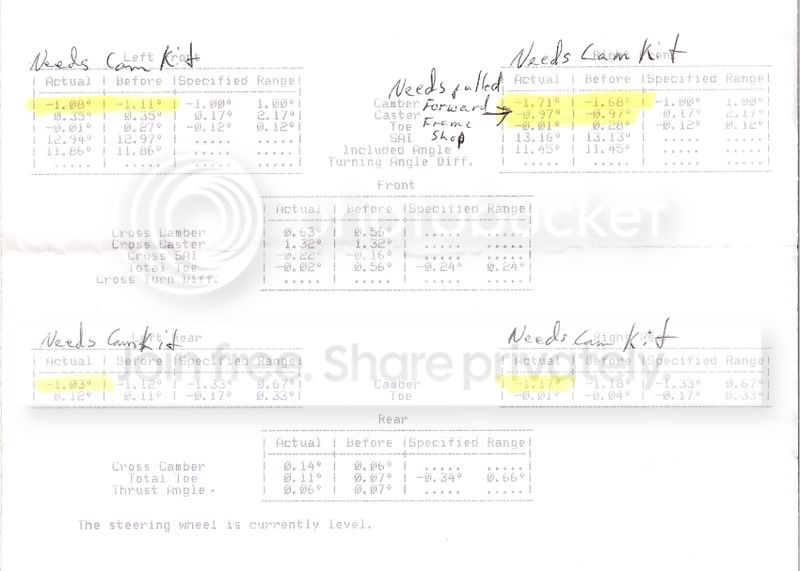
ok so i got new tires on my new 94 civic dx..... one tie rod was bad on the right side, replaced it. got the car aligned and the caster is off almost -1deg. the car pulles to the left hard but only when throttle is aplied. i have the alignment sheet here....[IMG]IMG]http://i68.photobucket.com/albums/i8/si90rex/align.jpg[/IMG][/IMG]
the car has been lowered 1.5" i ordered a camber kit yestarday so camber wont be an issue...what can i do to fix this? the car hasn't been wrecked that i know of... the only thing i can think of is the knuckle is bent or something to do with the frame. any help would be great!!!!
thanks
the car has been lowered 1.5" i ordered a camber kit yestarday so camber wont be an issue...what can i do to fix this? the car hasn't been wrecked that i know of... the only thing i can think of is the knuckle is bent or something to do with the frame. any help would be great!!!!
thanks


Banned
Joined: Jan 2008
Posts: 526
Likes: 0
From: strathcedar, nsw, australia
Re: Need help Casters off!!!!! Please! (Tyson)
<TABLE WIDTH="90%" CELLSPACING=0 CELLPADDING=0 ALIGN=CENTER><TR><TD>Quote, originally posted by Tyson »</TD></TR><TR><TD CLASS="quote">you can shim the radius rod to get more caster. </TD></TR></TABLE>
Shimming the radius rod will decrease caster, not increase it (if shims are already fitted then removing them will increase caster, but only slightly unless the shims are very thick or there are a number of them at a single radius rod). To increase caster the radius rod would need to be shortened.
si90rex,
I think your Civic almost definitely has accident damage on the right side. It would be interesting to see a measurement of the side to side wheelbase, I'll bet it's shorter on the right hand side. My CB7 Accord had similar issues when I bought it, but not quite as severe as you have.
My caster was different each side by about 1°, but at least it was still positive on both sides! My camber was also about 1° different side o side. I cured the caster problem by shortening one of the radius rods by 1cm, and the camber problem by 'slotting' the chassis mounting holes on one of the upper wishbones which allowed me to move the wisbone inward, i.e. this effectively shortened the upper wishbone by about 1cm, increasing neg camber (this would be more easily fixed with a camber adjuster).
A bent 'knuckle' couldn't cause the caster to be out of spec, for the caster to be off in the manner in which your right caster is, the upper ball joint would have to forward of it's design position or the lower ball joint rearward of it's design position (which is more likely). What the knuckle does in between the ball joints will have no affect on caster, though a bent knuckle could cause camber to be out.
As stated above, you'll need to shorten the right side radius rod to get the caster closer side to side (increase right side caster), and you'll need at least one camber adjuster (I'd be inclined to increase camber on the undamaged left side to match the higher neg camber on the right, which isn't excessive even if it is out of Honda spec).
It may be possible to pull the right side of the chassis forward to equalise caster (a smash repairer job), or the front subframe might move a bit forward on the right if the subframe bolts are loosened (then retightened of course!). You might also be able to move the left side of the subframe backward a bit to help equalise caster, but I'd be inlined not to decrease any caster in an attempt to get it equal, only to increase caster if possible, because even your 'good' caster on the left is quite minimal.
Increasing caster as much as possible is a very good thing for steering, handling and front grip in tighter corners, decreasing it is not a good thing. I'll bet the car steers terribly with so little caster?
Modified by johnlear at 2:41 AM 2/20/2008
Shimming the radius rod will decrease caster, not increase it (if shims are already fitted then removing them will increase caster, but only slightly unless the shims are very thick or there are a number of them at a single radius rod). To increase caster the radius rod would need to be shortened.
si90rex,
I think your Civic almost definitely has accident damage on the right side. It would be interesting to see a measurement of the side to side wheelbase, I'll bet it's shorter on the right hand side. My CB7 Accord had similar issues when I bought it, but not quite as severe as you have.
My caster was different each side by about 1°, but at least it was still positive on both sides! My camber was also about 1° different side o side. I cured the caster problem by shortening one of the radius rods by 1cm, and the camber problem by 'slotting' the chassis mounting holes on one of the upper wishbones which allowed me to move the wisbone inward, i.e. this effectively shortened the upper wishbone by about 1cm, increasing neg camber (this would be more easily fixed with a camber adjuster).
A bent 'knuckle' couldn't cause the caster to be out of spec, for the caster to be off in the manner in which your right caster is, the upper ball joint would have to forward of it's design position or the lower ball joint rearward of it's design position (which is more likely). What the knuckle does in between the ball joints will have no affect on caster, though a bent knuckle could cause camber to be out.
As stated above, you'll need to shorten the right side radius rod to get the caster closer side to side (increase right side caster), and you'll need at least one camber adjuster (I'd be inclined to increase camber on the undamaged left side to match the higher neg camber on the right, which isn't excessive even if it is out of Honda spec).
It may be possible to pull the right side of the chassis forward to equalise caster (a smash repairer job), or the front subframe might move a bit forward on the right if the subframe bolts are loosened (then retightened of course!). You might also be able to move the left side of the subframe backward a bit to help equalise caster, but I'd be inlined not to decrease any caster in an attempt to get it equal, only to increase caster if possible, because even your 'good' caster on the left is quite minimal.
Increasing caster as much as possible is a very good thing for steering, handling and front grip in tighter corners, decreasing it is not a good thing. I'll bet the car steers terribly with so little caster?
Modified by johnlear at 2:41 AM 2/20/2008

Honda-Tech Member
Joined: Apr 2003
Posts: 1,877
Likes: 1
From: PinaColadaBurgh, Id, USA
Re: Need help Casters off!!!!! Please! (Tyson)
<TABLE WIDTH="90%" CELLSPACING=0 CELLPADDING=0 ALIGN=CENTER><TR><TD>Quote, originally posted by Tyson »</TD></TR><TR><TD CLASS="quote">you can shim the radius rod to get more caster.
your left rear toe is still excessive causing thrust angle.
</TD></TR></TABLE>This is total horse ****. First off, there are no radius rods on a '94 DX. Left rear toe is not excessive. It's damn near perfect where it sits.
From your SAI readings, you most likely have a bent knuckle. It CAN affect your caster reading. Not very likely, and it's probably in conjunction with a bent lower control arm, but it can. Also, your numbers indicate to me that you shouldn't be pulling hard. What kind of condition are your tires in? If you said it's not pulling until you accelerate, I would be willing to bet without seeing it, that your right tire has far more tread than your left.
your left rear toe is still excessive causing thrust angle.
</TD></TR></TABLE>This is total horse ****. First off, there are no radius rods on a '94 DX. Left rear toe is not excessive. It's damn near perfect where it sits.
From your SAI readings, you most likely have a bent knuckle. It CAN affect your caster reading. Not very likely, and it's probably in conjunction with a bent lower control arm, but it can. Also, your numbers indicate to me that you shouldn't be pulling hard. What kind of condition are your tires in? If you said it's not pulling until you accelerate, I would be willing to bet without seeing it, that your right tire has far more tread than your left.
Thread Starter
Honda-Tech Member
Joined: Mar 2006
Posts: 999
Likes: 0
From: joplin, mo, us
Re: Need help Casters off!!!!! Please! (hatchling37)
The tires are BRAND new....Just got them 2 days a go. got the car aligned an hour after i got the tires. it wasn't pulling this hard until i got the car aligned. the body shops around here want 300 bucks to pull the frame...tryin to avoid that... o if this helps i put a b16 in the car the crx i have never had issues with this swap.

Honda-Tech Member

Joined: Apr 2002
Posts: 18,961
Likes: 76
From: I am Tyson
Re: Need help Casters off!!!!! Please! (hatchling37)
<TABLE WIDTH="90%" CELLSPACING=0 CELLPADDING=0 ALIGN=CENTER><TR><TD>Quote, originally posted by hatchling37 »</TD></TR><TR><TD CLASS="quote">This is total horse ****. First off, there are no radius rods on a '94 DX. Left rear toe is not excessive. It's damn near perfect where it sits.
</TD></TR></TABLE>
i read "si90rex". my bad. the toe is still excessive.
</TD></TR></TABLE>
i read "si90rex". my bad. the toe is still excessive.
Trending Topics

Honda-Tech Member
Joined: Jun 2004
Posts: 7,539
Likes: 5
From: Sherman Oaks, CA, United States
Re: Need help Casters off!!!!! Please! (Tyson)
<TABLE WIDTH="90%" CELLSPACING=0 CELLPADDING=0 ALIGN=CENTER><TR><TD>Quote, originally posted by Tyson »</TD></TR><TR><TD CLASS="quote">
the toe is still excessive.</TD></TR></TABLE>
I agree.
+0.12 and -.0.01 means the tail won't exactly follow the nose in a straight line either.
the toe is still excessive.</TD></TR></TABLE>
I agree.
+0.12 and -.0.01 means the tail won't exactly follow the nose in a straight line either.
Thread Starter
Honda-Tech Member
Joined: Mar 2006
Posts: 999
Likes: 0
From: joplin, mo, us
Re: Need help Casters off!!!!! Please! (TunerN00b)
Ok well i've decided to wait until my camber kit gets here and hopeful friday put it on. then on monday i'm goin straight to the frame shop and get everything straighted out. and report the alignment sheet. this is probably a stupid question but would bad ball joints cuz bad cast?
Honda-Tech Member
Joined: Jun 2004
Posts: 7,539
Likes: 5
From: Sherman Oaks, CA, United States
Re: Need help Casters off!!!!! Please! (si90rex)
<TABLE WIDTH="90%" CELLSPACING=0 CELLPADDING=0 ALIGN=CENTER><TR><TD>Quote, originally posted by si90rex »</TD></TR><TR><TD CLASS="quote">Ok well i've decided to wait until my camber kit gets here and hopeful friday put it on. then on monday i'm goin straight to the frame shop and get everything straighted out. and report the alignment sheet. this is probably a stupid question but would bad ball joints cuz bad cast? </TD></TR></TABLE>
I would check the frame straightness, long before buying a camber kit for your car. You don't need one, at all really...
I would check the frame straightness, long before buying a camber kit for your car. You don't need one, at all really...
Banned
Joined: Jan 2008
Posts: 526
Likes: 0
From: strathcedar, nsw, australia
Re: Need help Casters off!!!!! Please! (TunerN00b)
<TABLE WIDTH="90%" CELLSPACING=0 CELLPADDING=0 ALIGN=CENTER><TR><TD>Quote, originally posted by TunerN00b »</TD></TR><TR><TD CLASS="quote"> I would check the frame straightness, long before buying a camber kit for your car. You don't need one, at all really...</TD></TR></TABLE>
The difference in front camber is 0.63°. Rule of thumb is that a 0.5° difference is enough to cause a noticable pull. I think the lesser camber should be increased to match the higher camber, which would require at least one adjuster.
Rear camber difference is only 0.14°, I wouldn't be worried.
The difference in front camber is 0.63°. Rule of thumb is that a 0.5° difference is enough to cause a noticable pull. I think the lesser camber should be increased to match the higher camber, which would require at least one adjuster.
Rear camber difference is only 0.14°, I wouldn't be worried.
Thread Starter
Honda-Tech Member
Joined: Mar 2006
Posts: 999
Likes: 0
From: joplin, mo, us
Re: Need help Casters off!!!!! Please! (TunerN00b)
<TABLE WIDTH="90%" CELLSPACING=0 CELLPADDING=0 ALIGN=CENTER><TR><TD>Quote, originally posted by TunerN00b »</TD></TR><TR><TD CLASS="quote">
I would check the frame straightness, long before buying a camber kit for your car. You don't need one, at all really...</TD></TR></TABLE>
Well the car has been lowered 1.5 inches.... i have yet to see a honda that doesn't need some type of camber kit after its been lowered or even bigger wheels. I'm not saying anyones wrong here, but its to late i already bought the camber kit on monday.lol
I would check the frame straightness, long before buying a camber kit for your car. You don't need one, at all really...</TD></TR></TABLE>
Well the car has been lowered 1.5 inches.... i have yet to see a honda that doesn't need some type of camber kit after its been lowered or even bigger wheels. I'm not saying anyones wrong here, but its to late i already bought the camber kit on monday.lol
Banned
Joined: Jan 2008
Posts: 526
Likes: 0
From: strathcedar, nsw, australia
Re: Need help Casters off!!!!! Please! (si90rex)
<TABLE WIDTH="90%" CELLSPACING=0 CELLPADDING=0 ALIGN=CENTER><TR><TD>Quote, originally posted by si90rex »</TD></TR><TR><TD CLASS="quote"> Well the car has been lowered 1.5 inches.... i have yet to see a honda that doesn't need some type of camber kit after its been lowered or even bigger wheels. I'm not saying anyones wrong here, but its to late i already bought the camber kit on monday.lol</TD></TR></TABLE>
The issue wouldn't be whether the car had been lowered or not, but how much camber actually exists after it's been lowered. Your camber kit isn't a waste of money though, you need to adjust the camber to be equal side to side, regardless of what camber angle you choose to set it to.
1.7° of neg camber on the front wheels is a pretty good place to be for a road car if you're interested in increasing front end grip. It's not enough to cause significant front tyre wear issues (unles the toe is also wrong, i.e. not at or near to zero toe), but will assist in keeping the outside wheel more upright to the road when cornering and the chassis is rolling to some degree.
The issue wouldn't be whether the car had been lowered or not, but how much camber actually exists after it's been lowered. Your camber kit isn't a waste of money though, you need to adjust the camber to be equal side to side, regardless of what camber angle you choose to set it to.
1.7° of neg camber on the front wheels is a pretty good place to be for a road car if you're interested in increasing front end grip. It's not enough to cause significant front tyre wear issues (unles the toe is also wrong, i.e. not at or near to zero toe), but will assist in keeping the outside wheel more upright to the road when cornering and the chassis is rolling to some degree.
Honda-Tech Member
Joined: Apr 2003
Posts: 1,877
Likes: 1
From: PinaColadaBurgh, Id, USA
Re: Need help Casters off!!!!! Please! (TunerN00b)
<TABLE WIDTH="90%" CELLSPACING=0 CELLPADDING=0 ALIGN=CENTER><TR><TD>Quote, originally posted by TunerN00b »</TD></TR><TR><TD CLASS="quote">I agree.
+0.12 and -.0.01 means the tail won't exactly follow the nose in a straight line either.</TD></TR></TABLE>
It's definitely within factory recommended specifications. That little variation of toe in the rear is not going to make it pull. It's barely over 1/10th of a degree difference. Especially when you figure in what he said, "it only pulls under acceleration."
When they install the camber kit, make sure they equalize the toe in the rear (they should have done that **** in the first place) and then fix the camber on the right side. Not to factory spec, but enough so you stop pulling. Have a nice day!
+0.12 and -.0.01 means the tail won't exactly follow the nose in a straight line either.</TD></TR></TABLE>
It's definitely within factory recommended specifications. That little variation of toe in the rear is not going to make it pull. It's barely over 1/10th of a degree difference. Especially when you figure in what he said, "it only pulls under acceleration."
When they install the camber kit, make sure they equalize the toe in the rear (they should have done that **** in the first place) and then fix the camber on the right side. Not to factory spec, but enough so you stop pulling. Have a nice day!
Honda-Tech Member
Joined: Jun 2004
Posts: 7,539
Likes: 5
From: Sherman Oaks, CA, United States
Re: Need help Casters off!!!!! Please! (si90rex)
*delete: apparently I was in a mood earlier...
<TABLE WIDTH="90%" CELLSPACING=0 CELLPADDING=0 ALIGN=CENTER><TR><TD>Quote, originally posted by johnlear »</TD></TR><TR><TD CLASS="quote">
The difference in front camber is 0.63°. Rule of thumb is that a 0.5° difference is enough to cause a noticable pull. I think the lesser camber should be increased to match the higher camber, which would require at least one adjuster.
</TD></TR></TABLE>
I still think replacing the bent parts with straight ones is a much better solution than trying to "band aid" it with a camber kit.
*edited for spelling errors.
Modified by TunerN00b at 12:13 AM 2/23/2008
<TABLE WIDTH="90%" CELLSPACING=0 CELLPADDING=0 ALIGN=CENTER><TR><TD>Quote, originally posted by johnlear »</TD></TR><TR><TD CLASS="quote">
The difference in front camber is 0.63°. Rule of thumb is that a 0.5° difference is enough to cause a noticable pull. I think the lesser camber should be increased to match the higher camber, which would require at least one adjuster.
</TD></TR></TABLE>
I still think replacing the bent parts with straight ones is a much better solution than trying to "band aid" it with a camber kit.
*edited for spelling errors.
Modified by TunerN00b at 12:13 AM 2/23/2008
Banned
Joined: Jan 2008
Posts: 526
Likes: 0
From: strathcedar, nsw, australia
Re: Need help Casters off!!!!! Please! (TunerN00b)
<TABLE WIDTH="90%" CELLSPACING=0 CELLPADDING=0 ALIGN=CENTER><TR><TD>Quote, originally posted by TunerN00b »</TD></TR><TR><TD CLASS="quote">
I still think replacing the bent parts with straight ones is a much better solution than trying to "band aid" it with a camber kit. </TD></TR></TABLE>
I don't disagree. A camber kit is something of a 'cheat' for equalising camber, and not as good as finding the real cause, and fixing at source if possible.
If the upright / knuckle is bent, then even if you get the camber equal side to side the KPI (i.e. king pin inclination, aka steering axis) will be different side to side, and this will also cause the scrub radius to differ side to side.
Different KPI angles will cause steered camber change to be different side to side (car may then handle / grip differently in left vs right hand corners), and different scrub radius will tend to cause the steering to pull, particularly when accelerating or braking hard, and this will be worse still if the unequal scrub radius is accompanied by unequal caster angle...
It is possible to measure a knuckle for being bent with reasonable accuracy (because all components will be machined to pretty tight tolerances). The most likely place for a bend to exist is in the upper longer and more slender part of the knuckle (between the robust bearing housing section of the knuckle and the upper ball joint). The section below the bearing section to the lower ball joint is much more robustly forged and IMO much less likely to be damaged, though it can't be utterly ruled out.
If we assume this (the upper part) is where any bend is most likely to exist, then we can hold / clamp a straight edge against the hub face (where the wheel attaches) so that the straight edge extends upwards past and to the outside of the upper ball joint. Now measure with a ruler from the the straight edge to the machined area on the upper part of the knuckle where the little dust cover bolts on to hide the upper ball joint nut, making sure to keep the ruler at right angles to the straight edge.
It would be better if we could measure directly to the centre of the ball in the joint, but we can't, so this machined flat area is the best we can do and is very likely to be accurately machined relative to the tapered ball joint hole in the upright.
We now have a measurement from one side that we can compare to the other side. If the measurements on both sides are identical (within say 1mm, as my uprights measured) then damage is unlikely. If the measurement on the 'good' side (i.e the side not suspected to be damaged) is significantly more than that on the side that we suspect is damaged, then at least some of the camber difference is coming from a damaged upright / knuckle. Also, the KPI and scrub radius will be different side to side.
I still think replacing the bent parts with straight ones is a much better solution than trying to "band aid" it with a camber kit. </TD></TR></TABLE>
I don't disagree. A camber kit is something of a 'cheat' for equalising camber, and not as good as finding the real cause, and fixing at source if possible.
If the upright / knuckle is bent, then even if you get the camber equal side to side the KPI (i.e. king pin inclination, aka steering axis) will be different side to side, and this will also cause the scrub radius to differ side to side.
Different KPI angles will cause steered camber change to be different side to side (car may then handle / grip differently in left vs right hand corners), and different scrub radius will tend to cause the steering to pull, particularly when accelerating or braking hard, and this will be worse still if the unequal scrub radius is accompanied by unequal caster angle...
It is possible to measure a knuckle for being bent with reasonable accuracy (because all components will be machined to pretty tight tolerances). The most likely place for a bend to exist is in the upper longer and more slender part of the knuckle (between the robust bearing housing section of the knuckle and the upper ball joint). The section below the bearing section to the lower ball joint is much more robustly forged and IMO much less likely to be damaged, though it can't be utterly ruled out.
If we assume this (the upper part) is where any bend is most likely to exist, then we can hold / clamp a straight edge against the hub face (where the wheel attaches) so that the straight edge extends upwards past and to the outside of the upper ball joint. Now measure with a ruler from the the straight edge to the machined area on the upper part of the knuckle where the little dust cover bolts on to hide the upper ball joint nut, making sure to keep the ruler at right angles to the straight edge.
It would be better if we could measure directly to the centre of the ball in the joint, but we can't, so this machined flat area is the best we can do and is very likely to be accurately machined relative to the tapered ball joint hole in the upright.
We now have a measurement from one side that we can compare to the other side. If the measurements on both sides are identical (within say 1mm, as my uprights measured) then damage is unlikely. If the measurement on the 'good' side (i.e the side not suspected to be damaged) is significantly more than that on the side that we suspect is damaged, then at least some of the camber difference is coming from a damaged upright / knuckle. Also, the KPI and scrub radius will be different side to side.
Thread Starter
Honda-Tech Member
Joined: Mar 2006
Posts: 999
Likes: 0
From: joplin, mo, us
Re: Need help Casters off!!!!! Please! (johnlear)
<TABLE WIDTH="90%" CELLSPACING=0 CELLPADDING=0 ALIGN=CENTER><TR><TD>Quote, originally posted by johnlear »</TD></TR><TR><TD CLASS="quote">
I don't disagree. A camber kit is something of a 'cheat' for equalising camber, and not as good as finding the real cause, and fixing at source if possible. </TD></TR></TABLE>
Lets get something straight here.....i'm not using the chamber kit as a cheat. I'm taking the car to the frame shop to have it fixed right. I replacing the brakes and putting the camber kit on tomorrow. while in the proccess i'm goin to take the time to measure the spindles and control arms. thanks for the help i'll post any measurements that seem off tomorrow.
I don't disagree. A camber kit is something of a 'cheat' for equalising camber, and not as good as finding the real cause, and fixing at source if possible. </TD></TR></TABLE>
Lets get something straight here.....i'm not using the chamber kit as a cheat. I'm taking the car to the frame shop to have it fixed right. I replacing the brakes and putting the camber kit on tomorrow. while in the proccess i'm goin to take the time to measure the spindles and control arms. thanks for the help i'll post any measurements that seem off tomorrow.
Banned
Joined: Jan 2008
Posts: 526
Likes: 0
From: strathcedar, nsw, australia
Re: Need help Casters off!!!!! Please! (si90rex)
<TABLE WIDTH="90%" CELLSPACING=0 CELLPADDING=0 ALIGN=CENTER><TR><TD>Quote, originally posted by si90rex »</TD></TR><TR><TD CLASS="quote"> Lets get something straight here.....i'm not using the chamber kit as a cheat. I'm taking the car to the frame shop to have it fixed right. I replacing the brakes and putting the camber kit on tomorrow. while in the proccess i'm goin to take the time to measure the spindles and control arms. thanks for the help i'll post any measurements that seem off tomorrow. </TD></TR></TABLE>
With my car I had to adust camber on one side to equalise it side to side. I did this by 'slotting' the inner mounting holes on one of the upper wishbones to allow the wishbone to be moved inward by 10mm (increasing neg camber by 1° on the undamaged side to match that on the damaged side). This was in effect the same thing as equalising the camber using a camber adjuster. This worked perfectly well, even if it was a 'cheat'.
Since my knuckles measured out straight, the only affect this had was to alter the camber curve on one side, i.e. as that wheel rises in bump, it gains a little more negative camber than it does with the stock length upper wishbone. The change in camber change was only slight, i.e. plotted with a reasonably accurate schematic of the suspension using an arbitrary 10cm of bump travel the plotted camber gain is only an additional 0.1° of neg camber, not nearly enough to make any real difference.
Caster would I think be a big issue for your suspension. You have only a slight positive caster on one side but a greater negative caster on the other. Negatve caster will create negative 'trail' (a virtual line drawn through the upper and lower ball joints will intersect the ground behind the centre of the contact patch instead of in front), and make the steering constantly want to move away from the straight ahead and become very unstable (like driving in reverse at high speed, the steering will always 'want' to swing to one side or the other).
Shopping trolley wheels have positive 'trail' which is what makes them travel straight when you push the trolley, and you know what the wheels do if they are facing backwards (effectively then with negative trail) when you start pushing the trolley. The same thing will be happening if you have negative caster (creating negative trail) on one of your front wheels, and the steering will be twichty and directionally unstable (take your hands off the steering wheel at your peril!).
I think the caster is likely to be your most significant problem as it could be making the steering characteristics somewhat dangerous, whereas the camber is only going to make it pull a bit to one side in an irritating manner.
With my car I had to adust camber on one side to equalise it side to side. I did this by 'slotting' the inner mounting holes on one of the upper wishbones to allow the wishbone to be moved inward by 10mm (increasing neg camber by 1° on the undamaged side to match that on the damaged side). This was in effect the same thing as equalising the camber using a camber adjuster. This worked perfectly well, even if it was a 'cheat'.
Since my knuckles measured out straight, the only affect this had was to alter the camber curve on one side, i.e. as that wheel rises in bump, it gains a little more negative camber than it does with the stock length upper wishbone. The change in camber change was only slight, i.e. plotted with a reasonably accurate schematic of the suspension using an arbitrary 10cm of bump travel the plotted camber gain is only an additional 0.1° of neg camber, not nearly enough to make any real difference.
Caster would I think be a big issue for your suspension. You have only a slight positive caster on one side but a greater negative caster on the other. Negatve caster will create negative 'trail' (a virtual line drawn through the upper and lower ball joints will intersect the ground behind the centre of the contact patch instead of in front), and make the steering constantly want to move away from the straight ahead and become very unstable (like driving in reverse at high speed, the steering will always 'want' to swing to one side or the other).
Shopping trolley wheels have positive 'trail' which is what makes them travel straight when you push the trolley, and you know what the wheels do if they are facing backwards (effectively then with negative trail) when you start pushing the trolley. The same thing will be happening if you have negative caster (creating negative trail) on one of your front wheels, and the steering will be twichty and directionally unstable (take your hands off the steering wheel at your peril!).
I think the caster is likely to be your most significant problem as it could be making the steering characteristics somewhat dangerous, whereas the camber is only going to make it pull a bit to one side in an irritating manner.
Thread Starter
Honda-Tech Member
Joined: Mar 2006
Posts: 999
Likes: 0
From: joplin, mo, us
Re: Need help Casters off!!!!! Please! (johnlear)
ok i got so measurements.....the right side of the car is off by alittle over an 1/8inch. the knuckle is pushed back closer to the spiring. i can fit my fingers behide the left side and have to force them in on the right side. my car is all ready to go to the frame shop tomorrow. i haven't driven it yet so i don't know if the camber kit helped.
thanks for the input
thanks for the input
Banned
Joined: Jan 2008
Posts: 526
Likes: 0
From: strathcedar, nsw, australia
Re: Need help Casters off!!!!! Please! (si90rex)
<TABLE WIDTH="90%" CELLSPACING=0 CELLPADDING=0 ALIGN=CENTER><TR><TD>Quote, originally posted by si90rex »</TD></TR><TR><TD CLASS="quote">ok i got so measurements.....the right side of the car is off by alittle over an 1/8inch. the knuckle is pushed back closer to the spiring. i can fit my fingers behide the left side and have to force them in on the right side. my car is all ready to go to the frame shop tomorrow. i haven't driven it yet so i don't know if the camber kit helped. </TD></TR></TABLE>
Well if I'm interpreting your post correctly, that sounds like the upper part of one of the knuckles is bent and needs to be replaced.
Well if I'm interpreting your post correctly, that sounds like the upper part of one of the knuckles is bent and needs to be replaced.
Thread Starter
Honda-Tech Member
Joined: Mar 2006
Posts: 999
Likes: 0
From: joplin, mo, us
Re: Need help Casters off!!!!! Please! (johnlear)
yes thats what i'm sayin but that part of the frame could be bent too. we'll see what i find out tomorrow. i drove the car, no change on the pulling.
Thread Starter
Honda-Tech Member
Joined: Mar 2006
Posts: 999
Likes: 0
From: joplin, mo, us
Re: Need help Casters off!!!!! Please! (si90rex)
ok i got my car back from the shop.....i have a bent knuckle and lower control arm. i repalcing them both and getting a new alignment, thanks for all u help!!!
