


GT2860RS oil orfice


Thread Starter
Junior Member
Joined: Feb 2003
Posts: 297
Likes: 0
From: US
 GT2860RS oil orfice
Quick question on oiling for a GT28RS... My bearing section has what looks to me like an oil orfice built into it. I've heard mention of adding an external orfice to prevent overpressurizing the turbo. Here is a pic of the oil inlet & assumed orfice...
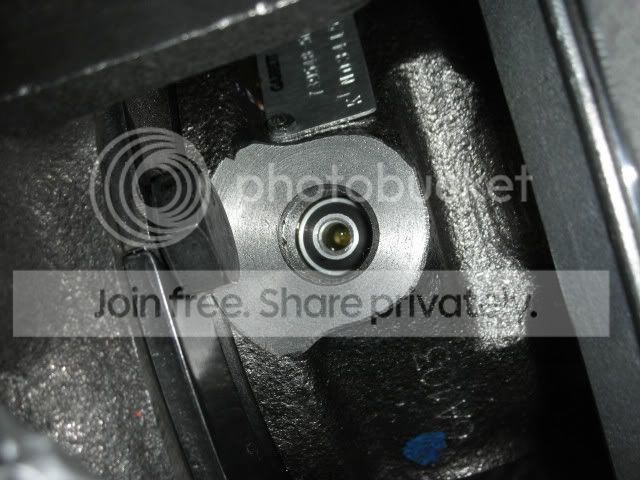
Is this sufficient for oil pressure reduction on the bearings or do I need an external orfice? I will most likely be using a GE sandwich plate as a source. Thanks for the help!
Is this sufficient for oil pressure reduction on the bearings or do I need an external orfice? I will most likely be using a GE sandwich plate as a source. Thanks for the help!

Junior Member
Joined: Mar 2002
Posts: 372
Likes: 0
From: V8 Land, State of, USA
Re: GT2860RS oil orfice (Servo)
I've heard the same thing on this board, can't remember where though. I ran a -3AN line from the GE adapter (no orifice)... no problems, I think. Did not get a drop in pressure.
The turbo is NOT cooled by oil, so the oil requirement is a lot less. Yes, I hooked up the water jacket.

The turbo is NOT cooled by oil, so the oil requirement is a lot less. Yes, I hooked up the water jacket.

Junior Member
Joined: Sep 2002
Posts: 654
Likes: 0
From: usa
Re: GT2860RS oil orfice (hybridsol)
I didnt run a restrictor on my gt28r and use -4an and its been fine. From all the info I could find after I got my turbo was the orifice is a built in restrictor.
Non restricted fitting:
http://www.full-race.com/catal...a220b
Restricted fitting:
http://www.full-race.com/catal...a220b
Non restricted fitting:
http://www.full-race.com/catal...a220b
Restricted fitting:
http://www.full-race.com/catal...a220b

Thread Starter
Junior Member
Joined: Feb 2003
Posts: 297
Likes: 0
From: US
Ok, I'm a little confused, now. Where can I find how large the restrictor should be? .05? .035? Will it depend on oil pressure applied? I'll bring my micrometer home to measure this thing and see if a restrictor is needed. But I need to know the proper restrictor size, first.

Trending Topics
Thread Starter
Junior Member
Joined: Feb 2003
Posts: 297
Likes: 0
From: US
I've been digging a little deeper... Orifice size is going to depend on maximum engine oil pressure. I found this on Garrett's site...
<TABLE WIDTH="90%" CELLSPACING=0 CELLPADDING=0 ALIGN=CENTER><TR><TD>Quote »</TD></TR><TR><TD CLASS="quote">
Question:"Does my turbocharger require an oil restrictor?"
Answer: Maybe. A more appropriate question might be: "Does my engine require an oil restrictor for my turbo?"
Oil requirements depend on the turbo's bearing system type. Garrett has two types of bearing systems; traditional journal bearing; and ball bearing.
The journal bearing system in a turbo functions very similarly to the rod or crank bearings in an engine. These bearings require enough oil pressure to keep the components separated by a hydrodynamic film. If the oil pressure is too low, the metal components will come in contact causing premature wear and ultimately failure. If the oil pressure is too high, leakage may occur from the turbocharger seals. With that as background, an oil restrictor is generally not needed for a journal-bearing turbocharger except for those applications with oil-pressure-induced seal leakage. Remember to address all other potential causes of leakage first (e.g., inadequate/improper oil drain out of the turbocharger, excessive crankcase pressure, turbocharger past its useful service life, etc.) and use a restrictor as a last resort. Garrett distributors can tell you the recommended range of acceptable oil pressures for your particular turbo. Restrictor size will always depend on how much oil pressure your engine is generating-there is no single restrictor size suited for all engines.
Ball-bearing turbochargers can benefit from the addition of an oil restrictor, as most engines deliver more pressure than a ball bearing turbo requires. The benefit is seen in improved boost response due to less windage of oil in the bearing. In addition, lower oil flow further reduces the risk of oil leakage compared to journal-bearing turbochargers. Oil pressure entering a ball-bearing turbocharger needs to be between 40 psi and 45 psi at the maximum engine operating speed. For many common passenger vehicle engines, this generally translates into a restrictor with a minimum of 0.040" diameter orifice upstream of the oil inlet on the turbocharger center section. Again, it is imperative that the restrictor be sized according to the oil pressure characteristics of the engine to which the turbo is attached. Always verify that the appropriate oil pressure is reaching the turbo.
The use of an oil restrictor can (but not always) help ensure that you have the proper oil flow/pressure entering the turbocharger, as well as extract the maximum performance. Thanks for listening and have a TURBOIFIC day!
</TD></TR></TABLE>
So, now my question is, how much oil pressure does an A6/Z6 Mini-me make @ WOT? I'll probably have to find an oil pressure gauge...
<TABLE WIDTH="90%" CELLSPACING=0 CELLPADDING=0 ALIGN=CENTER><TR><TD>Quote »</TD></TR><TR><TD CLASS="quote">
Question:"Does my turbocharger require an oil restrictor?"
Answer: Maybe. A more appropriate question might be: "Does my engine require an oil restrictor for my turbo?"
Oil requirements depend on the turbo's bearing system type. Garrett has two types of bearing systems; traditional journal bearing; and ball bearing.
The journal bearing system in a turbo functions very similarly to the rod or crank bearings in an engine. These bearings require enough oil pressure to keep the components separated by a hydrodynamic film. If the oil pressure is too low, the metal components will come in contact causing premature wear and ultimately failure. If the oil pressure is too high, leakage may occur from the turbocharger seals. With that as background, an oil restrictor is generally not needed for a journal-bearing turbocharger except for those applications with oil-pressure-induced seal leakage. Remember to address all other potential causes of leakage first (e.g., inadequate/improper oil drain out of the turbocharger, excessive crankcase pressure, turbocharger past its useful service life, etc.) and use a restrictor as a last resort. Garrett distributors can tell you the recommended range of acceptable oil pressures for your particular turbo. Restrictor size will always depend on how much oil pressure your engine is generating-there is no single restrictor size suited for all engines.
Ball-bearing turbochargers can benefit from the addition of an oil restrictor, as most engines deliver more pressure than a ball bearing turbo requires. The benefit is seen in improved boost response due to less windage of oil in the bearing. In addition, lower oil flow further reduces the risk of oil leakage compared to journal-bearing turbochargers. Oil pressure entering a ball-bearing turbocharger needs to be between 40 psi and 45 psi at the maximum engine operating speed. For many common passenger vehicle engines, this generally translates into a restrictor with a minimum of 0.040" diameter orifice upstream of the oil inlet on the turbocharger center section. Again, it is imperative that the restrictor be sized according to the oil pressure characteristics of the engine to which the turbo is attached. Always verify that the appropriate oil pressure is reaching the turbo.
The use of an oil restrictor can (but not always) help ensure that you have the proper oil flow/pressure entering the turbocharger, as well as extract the maximum performance. Thanks for listening and have a TURBOIFIC day!
</TD></TR></TABLE>
So, now my question is, how much oil pressure does an A6/Z6 Mini-me make @ WOT? I'll probably have to find an oil pressure gauge...

Honda-Tech Member
Joined: Jan 2006
Posts: 527
Likes: 0
From: Star, NC, USA
Re: GT2860RS oil orfice (Servo)
I run a .035 Fast-Turbo 3AN restrictor on my disco potato. I bought it here on honda-tech just search for it. I have heard to many bad things about blowing seals w/o running a restrictor!


 Re: GT2860RS oil orfice (stealthmode62)
Most honda engines run a bit higher oil pressure than most other I4s that utilize a turbocharger. the -3AN line in addition to a .035" restrictor for the engine that you have will be fine. Please make sure that you place the restrictor ONLY at the turbo, and not at the back of the block. Yes, there is a restricted orifice in the cartrdige, but as Garrett stated, its there depending upon the oil pressure of the car.
Thread Starter
Junior Member
Joined: Feb 2003
Posts: 297
Likes: 0
From: US
Thank you for the responses, guys. TheShodan, what is the significance of running the restrictor at the turbo? I was thinking of running an oil pressure sender after the restrictor so I can see the actual pressure the turbo is receiving.

Thread
Thread Starter
Forum
Replies
Last Post
RTW DC2R
Forced Induction
6
May 21, 2006 01:50 PM
Nisif
Forced Induction
1
May 15, 2006 12:03 AM
wade
Forced Induction
1
May 17, 2004 08:24 PM
