


carbing strut bar.


Honda-Tech Member
Joined: Sep 2005
Posts: 1,071
Likes: 0
 Re: carbing strut bar. (BMRALR)
i havn't seen many white carbing bars. i think those are made of steel. i seen alot of aluminum one's though. which car do you want for it.
i would love a carbing but damn they cost alot. they cost more then gc's.
i would love a carbing but damn they cost alot. they cost more then gc's.
Honda-Tech Member
Joined: Sep 2005
Posts: 1,071
Likes: 0
Re: carbing strut bar. (BMRALR)

Banned
Joined: Jan 2008
Posts: 526
Likes: 0
From: strathcedar, nsw, australia
Re: carbing strut bar. (verycleanhatch)
<TABLE WIDTH="90%" CELLSPACING=0 CELLPADDING=0 ALIGN=CENTER><TR><TD>Quote, originally posted by verycleanhatch »</TD></TR><TR><TD CLASS="quote">http://www.optionimports.com/ca6412230lt.html </TD></TR></TABLE>
That bar looks quite flimsy to me. Not only does the tubing look very 'flat' but it has a substantial kink in it, which are both features that will allow a lot of flexure under load. For the bars themselves to be adequately rigid in compression and tension (especially with a bend in the tubing) they need to have a decently thick dimension in both width and depth, and also a decently thick wall thickness unless the tube has a substantially large OD.
Those bars look inadequate even if they were solid and not tubular. If a tower brace must be made with a kink or bend in the bar to clear components such as the plenum etc, then the bar itself MUST be very substantial in order to be adequately rigid in compression and tension.
From what I can see in the photo the attachment brackets look to be made from quite thin plate, so despite the manner in which the 'tower' part of the brackets are braced to the 'base plate ring' part, the base plate is unlikely to be rigid enough to resist forces fed into without flexure. This is especailly so considering just how high above the top of the strut tower the actual bars look to be mounted to the brackets (i.e. looks to be a lot of leverage on the brackets there, especially on the base plate ring).
That bar looks quite flimsy to me. Not only does the tubing look very 'flat' but it has a substantial kink in it, which are both features that will allow a lot of flexure under load. For the bars themselves to be adequately rigid in compression and tension (especially with a bend in the tubing) they need to have a decently thick dimension in both width and depth, and also a decently thick wall thickness unless the tube has a substantially large OD.
Those bars look inadequate even if they were solid and not tubular. If a tower brace must be made with a kink or bend in the bar to clear components such as the plenum etc, then the bar itself MUST be very substantial in order to be adequately rigid in compression and tension.
From what I can see in the photo the attachment brackets look to be made from quite thin plate, so despite the manner in which the 'tower' part of the brackets are braced to the 'base plate ring' part, the base plate is unlikely to be rigid enough to resist forces fed into without flexure. This is especailly so considering just how high above the top of the strut tower the actual bars look to be mounted to the brackets (i.e. looks to be a lot of leverage on the brackets there, especially on the base plate ring).
Trending Topics
Banned
Joined: Jan 2008
Posts: 526
Likes: 0
From: strathcedar, nsw, australia
Re: carbing strut bar. (sir2k)
<TABLE WIDTH="90%" CELLSPACING=0 CELLPADDING=0 ALIGN=CENTER><TR><TD>Quote, originally posted by sir2k »</TD></TR><TR><TD CLASS="quote">the one i got for sale is made of steel
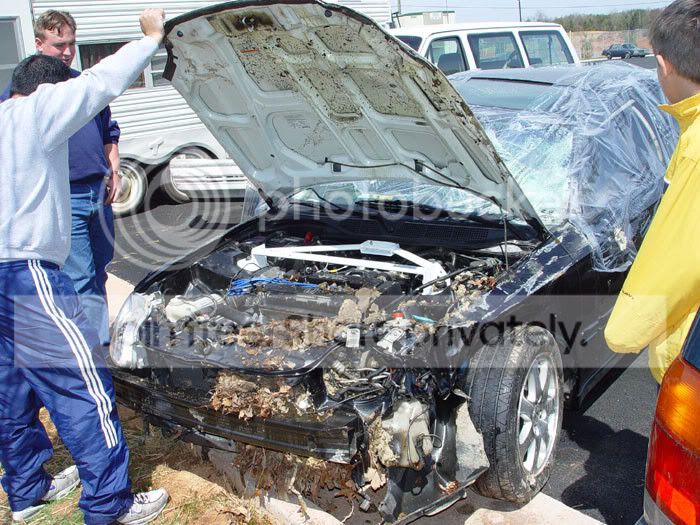
I found a pic of this guy that had the same one when he rolled his civic
looks pretty strong to me </TD></TR></TABLE>
Looks stong because he didn't damage it in the rollover? That's not really indicative of it's rigididity.
Steel or not, tubular or solid, IMO the bars are too 'flat' to be adequately rigid, they are likely to elastically flex (but not to plastically bend) up or down when placed under significant compressive loading (especially the longer member between the towers). It's good that none of the bars have any bends in them as this would make them much more flimsy. Tri-angulation to the firewall is worthwhile, so long as the firewall where the bar attaches is reasonably stiff (at that point on my CB7 the steel is very thin, unsupported and quite flimsy).
I can't see the brackets very clearly in your photo, but from what I can see on that bar the bracing in the brackets themselves does look to be an improvement on the brackets in the photo of the other bar on the website photo (the rear 'web' appears to extend farther back on the base plate, but it would be better if the front 'web' did too, as well as being higher as on the rear web). How thick is the steel plate from which the brackets are made, especially the base plate?
I found a pic of this guy that had the same one when he rolled his civic
looks pretty strong to me </TD></TR></TABLE>
Looks stong because he didn't damage it in the rollover? That's not really indicative of it's rigididity.
Steel or not, tubular or solid, IMO the bars are too 'flat' to be adequately rigid, they are likely to elastically flex (but not to plastically bend) up or down when placed under significant compressive loading (especially the longer member between the towers). It's good that none of the bars have any bends in them as this would make them much more flimsy. Tri-angulation to the firewall is worthwhile, so long as the firewall where the bar attaches is reasonably stiff (at that point on my CB7 the steel is very thin, unsupported and quite flimsy).
I can't see the brackets very clearly in your photo, but from what I can see on that bar the bracing in the brackets themselves does look to be an improvement on the brackets in the photo of the other bar on the website photo (the rear 'web' appears to extend farther back on the base plate, but it would be better if the front 'web' did too, as well as being higher as on the rear web). How thick is the steel plate from which the brackets are made, especially the base plate?

Member
Joined: Oct 2002
Posts: 1,333
Likes: 0
Re: carbing strut bar. (johnlear)
not sure how thick it is but i did take some pics to show you guys
IMO i think it's as good as you can get with a bolt on strut bar, unless you weld a bar on your struts
this bar and my comptech sway & tie combo (which is also for sale) are the only two bolt on bars that i felt a significant difference


IMO i think it's as good as you can get with a bolt on strut bar, unless you weld a bar on your struts
this bar and my comptech sway & tie combo (which is also for sale) are the only two bolt on bars that i felt a significant difference
Banned
Joined: Jan 2008
Posts: 526
Likes: 0
From: strathcedar, nsw, australia
Re: carbing strut bar. (sir2k)
<TABLE WIDTH="90%" CELLSPACING=0 CELLPADDING=0 ALIGN=CENTER><TR><TD>Quote, originally posted by sir2k »</TD></TR><TR><TD CLASS="quote">not sure how thick it is but i did take some pics to show you guys
IMO i think it's as good as you can get with a bolt on strut bar, unless you weld a bar on your struts
this bar and my comptech sway & tie combo (which is also for sale) are the only two bolt on bars that i felt a significant difference </TD></TR></TABLE>
OK, that looks a lot better than it did in the other photos, and certainly much better than the other white bar with the bend. I still think the bar itself would be more rigid if made from round rather than the flatter oval tubing, though it's not as 'flat' as it looked in the other shots and if the wall thickness is reasonably thick should be stiff enough.
If it were my tower bar I'd increase the height of the front bracing 'webs' to match the height of the rear 'webs', which would mean you're not relying so much simply on the thickness of the plate to which the bars are welded for rigidity. I'd say my home made tower braces (both front and rear) would be more rigid than your Carbing brace, definitely improved the dynamics on my car!
IMO i think it's as good as you can get with a bolt on strut bar, unless you weld a bar on your struts
this bar and my comptech sway & tie combo (which is also for sale) are the only two bolt on bars that i felt a significant difference </TD></TR></TABLE>
OK, that looks a lot better than it did in the other photos, and certainly much better than the other white bar with the bend. I still think the bar itself would be more rigid if made from round rather than the flatter oval tubing, though it's not as 'flat' as it looked in the other shots and if the wall thickness is reasonably thick should be stiff enough.
If it were my tower bar I'd increase the height of the front bracing 'webs' to match the height of the rear 'webs', which would mean you're not relying so much simply on the thickness of the plate to which the bars are welded for rigidity. I'd say my home made tower braces (both front and rear) would be more rigid than your Carbing brace, definitely improved the dynamics on my car!

Banned
Joined: Jan 2008
Posts: 526
Likes: 0
From: strathcedar, nsw, australia
Re: carbing strut bar. (sir2k)
<TABLE WIDTH="90%" CELLSPACING=0 CELLPADDING=0 ALIGN=CENTER><TR><TD>Quote, originally posted by sir2k »</TD></TR><TR><TD CLASS="quote">but mine looks cooler  </TD></TR></TABLE>
But I don't care how cool it looks, only whether or not it actually works!
Having said that, my home made tower bars are really works of engineering art if I do say so myself, and they're painted black which is so much sexier than white!
The Carbing bar is good having the triangulation to the firewall, as I said though it does depend on how rigid the body is where the triangulation attaches. I can't find anywhere on the CB7 firewall where attaching a tirangulating member would be both strong enough and easy enough. There are strong places that could be used, but it's going to involve a lot of work to use them.
Modified by johnlear at 5:05 AM 2/14/2008
Modified by johnlear at 5:07 AM 2/14/2008
</TD></TR></TABLE>But I don't care how cool it looks, only whether or not it actually works!
Having said that, my home made tower bars are really works of engineering art if I do say so myself, and they're painted black which is so much sexier than white!
The Carbing bar is good having the triangulation to the firewall, as I said though it does depend on how rigid the body is where the triangulation attaches. I can't find anywhere on the CB7 firewall where attaching a tirangulating member would be both strong enough and easy enough. There are strong places that could be used, but it's going to involve a lot of work to use them.
Modified by johnlear at 5:05 AM 2/14/2008
Modified by johnlear at 5:07 AM 2/14/2008


Honda-Tech Member
Joined: Jul 2004
Posts: 886
Likes: 0
From: Loudoun County, VA
Re: carbing strut bar. (sir2k)
<TABLE WIDTH="90%" CELLSPACING=0 CELLPADDING=0 ALIGN=CENTER><TR><TD>Quote, originally posted by sir2k »</TD></TR><TR><TD CLASS="quote">like what? a turbo for your d series
HA!</TD></TR></TABLE>
yeah. if you want a light car for autocross why not??
built engine 250hp/230+wtq , for less then $2500 fully built with turbo setup. can't beat that. GSR swap costs more then that. weighs more too. of course i do all the work myself so costs are skewed.
Can't spend $7k on K series. saving up for Grad school.
powerband and price of Turbo D was my best choice for autocross/time attack car.
anyone the talks crap about what other people do for engine choice is a Tool in my book.
D's vs B's vs K's
dude, just get it over with and get the ***** enlargement now!
Modified by hybridmoments at 11:18 AM 2/15/2008
HA!</TD></TR></TABLE>
yeah. if you want a light car for autocross why not??
built engine 250hp/230+wtq , for less then $2500 fully built with turbo setup. can't beat that. GSR swap costs more then that. weighs more too. of course i do all the work myself so costs are skewed.
Can't spend $7k on K series. saving up for Grad school.
powerband and price of Turbo D was my best choice for autocross/time attack car.
anyone the talks crap about what other people do for engine choice is a Tool in my book.
D's vs B's vs K's
dude, just get it over with and get the ***** enlargement now!
Modified by hybridmoments at 11:18 AM 2/15/2008

Honda-Tech Member
Joined: Feb 2002
Posts: 1,210
Likes: 4
From: MIAMI
Re: carbing strut bar. (johnlear)
<TABLE WIDTH="90%" CELLSPACING=0 CELLPADDING=0 ALIGN=CENTER><TR><TD>Quote, originally posted by johnlear »</TD></TR><TR><TD CLASS="quote">
But I don't care how cool it looks, only whether or not it actually works!
Having said that, my home made tower bars are really works of engineering art if I do say so myself, and they're painted black which is so much sexier than white!
</TD></TR></TABLE>
please post some pics, I would love to see the homemade bars.
But I don't care how cool it looks, only whether or not it actually works!
Having said that, my home made tower bars are really works of engineering art if I do say so myself, and they're painted black which is so much sexier than white!
</TD></TR></TABLE>
please post some pics, I would love to see the homemade bars.
Banned
Joined: Jan 2008
Posts: 526
Likes: 0
From: strathcedar, nsw, australia
Re: carbing strut bar. (gringo7718)
<TABLE WIDTH="90%" CELLSPACING=0 CELLPADDING=0 ALIGN=CENTER><TR><TD>Quote, originally posted by gringo7718 »</TD></TR><TR><TD CLASS="quote">please post some pics, I would love to see the homemade bars.</TD></TR></TABLE>
Don't know how!
Besides, I think I need a lead to connect the camera to the computer, and I don't have one...
I'll attempt a description instead:
Each of the two front tower bar attachment brackets is made with a triangular plate (5mm thick with rounded corners) that fit on top of the towers with the damper bushes etc protruding through a large hole in the plate (strut studs through holes in the corners of the triangles).
Each of these plates have a short length (about 3") of round pipe (60mm OD with 3.2mm thick wall) welded to the triangular plate at 90° to the plate, over the damper hole. The top of the damper protrudes up into this tube and the adjuster is accessible from the top of the tube (Koni dampers). This tube creates a well braced structure that transfers force to all parts of the base plate.
Each tube is cut at the top at an oblique angle so that the opening at the top of the tube is oval in shape, with the outer end of the oval being low down near the base plate and the other end of the oval 3" high on the inner side (engine side). The higher side of the tube is to the engine side and has a 5mm thick vertical tab welded to the outside of the tube with it's edge facing the other tower, and a hole drilled in the tab.
The bar itself is simply a straight 1" OD (but thick walled) tube that is flattened at each end with a hole drilled in each flattened end, and is bolted to the brackets via the holes drilled in the tabs on the brackets. The bar itself isd quite stiff, you can push and pull in the middle of it as hard as you can with no noticable flex.
I hope this description paints a reasonably accurate picture. It looks quite smart and of course the welds are nice and all the rough edges are rounded off etc.
The rear tower brace is a much simpler affair, being only a 1.25" OD thick walled round tube flattened at each end and drilled with a hole at each end that is slightly larger than the strut stud diameter. The brace fits between the towers attaching only to the rear strut studs. Each flattened end of the tube is angled upward to suit the angles at the top of the towers. This might sound too simple to be true, but it works very well.
Both braces individually made a very noticable difference to handling response, and the rear bar in partricular assisted noticably in reducing understeer.
Modified by johnlear at 9:57 PM 2/15/2008
Don't know how!
Besides, I think I need a lead to connect the camera to the computer, and I don't have one...
I'll attempt a description instead:
Each of the two front tower bar attachment brackets is made with a triangular plate (5mm thick with rounded corners) that fit on top of the towers with the damper bushes etc protruding through a large hole in the plate (strut studs through holes in the corners of the triangles).
Each of these plates have a short length (about 3") of round pipe (60mm OD with 3.2mm thick wall) welded to the triangular plate at 90° to the plate, over the damper hole. The top of the damper protrudes up into this tube and the adjuster is accessible from the top of the tube (Koni dampers). This tube creates a well braced structure that transfers force to all parts of the base plate.
Each tube is cut at the top at an oblique angle so that the opening at the top of the tube is oval in shape, with the outer end of the oval being low down near the base plate and the other end of the oval 3" high on the inner side (engine side). The higher side of the tube is to the engine side and has a 5mm thick vertical tab welded to the outside of the tube with it's edge facing the other tower, and a hole drilled in the tab.
The bar itself is simply a straight 1" OD (but thick walled) tube that is flattened at each end with a hole drilled in each flattened end, and is bolted to the brackets via the holes drilled in the tabs on the brackets. The bar itself isd quite stiff, you can push and pull in the middle of it as hard as you can with no noticable flex.
I hope this description paints a reasonably accurate picture. It looks quite smart and of course the welds are nice and all the rough edges are rounded off etc.
The rear tower brace is a much simpler affair, being only a 1.25" OD thick walled round tube flattened at each end and drilled with a hole at each end that is slightly larger than the strut stud diameter. The brace fits between the towers attaching only to the rear strut studs. Each flattened end of the tube is angled upward to suit the angles at the top of the towers. This might sound too simple to be true, but it works very well.
Both braces individually made a very noticable difference to handling response, and the rear bar in partricular assisted noticably in reducing understeer.
Modified by johnlear at 9:57 PM 2/15/2008

Thread
Thread Starter
Forum
Replies
Last Post
EvasiveMotorsports.com
Wheels, Tires, Brakes, and Suspension
73
Apr 10, 2006 03:49 AM
