


Designing an intake system like a header?


Thread Starter
Junior Member
Joined: Feb 2006
Posts: 422
Likes: 0
 Designing an intake system like a header?
OK this is a purely theological question and I have no proof to support any ideas that this is better then the conventional intake arm + plenum method.
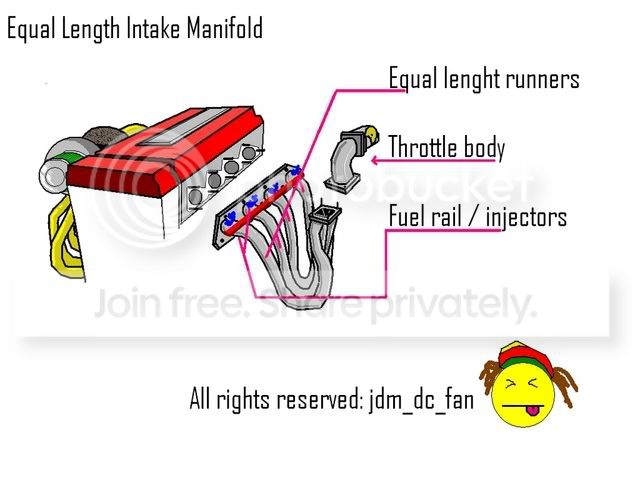
But would there be any type of benefit to say eliminating the intake plenum and manifold and replacing it with an intake setup that resembled a 4-2-1 header?
like have pipes used as runners then have them pair up then finally into the intake arm for a CAI?
basically replacing the plenum with 2 Y pipes?
The only benefit I could see would more equal airflow but I'm not entirely sure that vacuum works like that.
I know it's an off the wall question so please keep the flames to a minimum just asking because I've been wondering about that for most of the day figured I'd ask on here see if anyone had any insight to that.
But would there be any type of benefit to say eliminating the intake plenum and manifold and replacing it with an intake setup that resembled a 4-2-1 header?
like have pipes used as runners then have them pair up then finally into the intake arm for a CAI?
basically replacing the plenum with 2 Y pipes?
The only benefit I could see would more equal airflow but I'm not entirely sure that vacuum works like that.
I know it's an off the wall question so please keep the flames to a minimum just asking because I've been wondering about that for most of the day figured I'd ask on here see if anyone had any insight to that.

All Motor Mentor
Joined: Aug 2004
Posts: 6,987
Likes: 1
From: 902, Nova Scotia, Canada
Re: Designing an intake system like a header? (DCxMagus)
While intake and exhaust systems both incorporate velocity and pulse wave tuning principles, they are still very different in how they are applied. I'm no expert here but from what I understand, an intake system (cai) helps create velocity in the incoming air which helps pressurize the intake manifold slightly. The plenum (IM) acts like an air reservoir so that air can be instantly available for quick throttle openings etc. The runners deliver that air to the intake valves but it's the diameter and length of those runners that help determine where in the RPM range you'll make power based on volumetric efficiency.
Headers are designed to maintain velocity so the exhaust will leave the combustion chambers, help pull in a fresh new intake charge and continue out without reversion (returning back up the pipe into the cylinder). When hot exhaust gas leaves the exhaust port it is moving very fast but as it expands into a larger area and starts to cool, it's velocity slows down. Pairing up the pipes in a 4-2-1 configuration helps maintain velocity in the pipes by using other cylinder exhaust pulses to help pull/push cylinders firing behind it, out of the pipe.
This is a very basic description of what is actually happening but I am not really qualified to go into the real science of how everything works. I think you get the idea though.
Your idea of a 1-2-4 intake system would probably make great low end power and be very responsive off idle but it would have poor mid-range and no top end. A reversed 4-2-1 intake system is basically a cai (1 pipe), plenum which is actually one big reservoir or pipe (your system would have 2 smaller pipes), and then it splits into the 4 runner pipes which is what yours would so as well. So the main difference between your 4-2-1 intake and an actual one is really only the plenum. At higher RPM there would be little air reserve (2 very small plenums) so the power curve would start out strong and then fall off as the RPM's go up.
It's probably possible to construct/engineer an intake system like you describe and have it function very well and make good power but you'd run into a final problem that every engineer has to face at some point and that is packaging (fitting it into the available space). In my own opinion I doubt it would be very practical if possible to build such a large complex intake setup and have it fit in there with everything else. The current intake system design isn't the ultimate design for power but like most things on a car, it is the best compromise between cost, complexity, packaging and performance for its intended use.
Nice to see that someone's at least thinking outside the box
Headers are designed to maintain velocity so the exhaust will leave the combustion chambers, help pull in a fresh new intake charge and continue out without reversion (returning back up the pipe into the cylinder). When hot exhaust gas leaves the exhaust port it is moving very fast but as it expands into a larger area and starts to cool, it's velocity slows down. Pairing up the pipes in a 4-2-1 configuration helps maintain velocity in the pipes by using other cylinder exhaust pulses to help pull/push cylinders firing behind it, out of the pipe.
This is a very basic description of what is actually happening but I am not really qualified to go into the real science of how everything works. I think you get the idea though.
Your idea of a 1-2-4 intake system would probably make great low end power and be very responsive off idle but it would have poor mid-range and no top end. A reversed 4-2-1 intake system is basically a cai (1 pipe), plenum which is actually one big reservoir or pipe (your system would have 2 smaller pipes), and then it splits into the 4 runner pipes which is what yours would so as well. So the main difference between your 4-2-1 intake and an actual one is really only the plenum. At higher RPM there would be little air reserve (2 very small plenums) so the power curve would start out strong and then fall off as the RPM's go up.
It's probably possible to construct/engineer an intake system like you describe and have it function very well and make good power but you'd run into a final problem that every engineer has to face at some point and that is packaging (fitting it into the available space). In my own opinion I doubt it would be very practical if possible to build such a large complex intake setup and have it fit in there with everything else. The current intake system design isn't the ultimate design for power but like most things on a car, it is the best compromise between cost, complexity, packaging and performance for its intended use.
Nice to see that someone's at least thinking outside the box

Honda-Tech Member

Joined: Sep 2005
Posts: 579
Likes: 3
From: Long Island, NY
Re: Designing an intake system like a header? (DCxMagus)
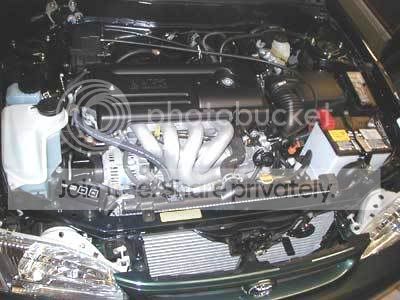
I know this isn't a 4-2-1 design but the toyota corolla intake manifold looks very similar to what your are saying. Its basically a 4-1 right into a throttle body.
Thread Starter
Junior Member
Joined: Feb 2006
Posts: 422
Likes: 0
Re: Designing an intake system like a header? (00Red_SiR)
yeah thats something that I was kinda thinking about as well, the amount of space to work with barely fits the plenum let alone 2 Y pipes, but from whats explained above, if you could make it fit seems like an optimal type of set up for road racing/auto X since most likely that low-mid to mid range would be very strong.
Anyway thanks for the input guys.
Anyway thanks for the input guys.



Thread
Thread Starter
Forum
Replies
Last Post
