


The reason shocks blow. Mechanics help, interesting argument.


Thread Starter
Honda-Tech Member
Joined: Mar 2007
Posts: 830
Likes: 0
From: branford, ct, usa
 The reason shocks blow. Mechanics help, interesting argument.
Okay, so my buddy was arguing with me on the subject and we have 2 opposing views, he happens to be a mechanic. He plans on buying lowering spings -2" and running them with BRAND NEW OEM shocks.
He claims that the OEM shocks will handle the lowering springs, and will not blow out. As long as they are brand new. He claims that the stock shocks and stock springs develop a pre-set "surface of travel" inside the shock. He says once you switch to lowering springs and keep the old OEM shocks, that regular travel area changes which causes the shock to start leaking and losing pressure.
He claims that when you take a NEW shock and stick it on a lowering spring, after a certain period of time the shocks get used to the springs that are on them (and create that "surface of travel" inside the shock). And everything will be fine. He claims that installing new OEM shocks and new performance shocks will give the same results, depending on driving conditions. He says the seals are what blow.
My friend claims that if you install lowering springs on performance shocks, and the car is being driven on bumpy roads alot, the performance shocks will actually blow FASTER than OEM shocks. I ROFL on this one.
Okay, so heres my perdicament and following are MY views on the subject:
When you have a stock, original, OEM suspension assembly. The spring takes the most grunt of the impact, which compresses and rebounds. The shock is in place to control the impact of the spring, to basically slow it down.
When you lower the car on lowering springs, the ride gets rougher and the spring rate needs to be higher. When the spring rate is higher, it can handle more unsprung weight which makes it go more crazy when it hits a bump (opposed to an OEM spring).
Since the spring is compressing and rebounding faster than stock, a performance shock needs to be used to control the spring. A performance shock will be able to more effectively handle the spring based on the higher damping forces of the shock. The higher damping force will ensure that the shock has less of a chance of bottoming out and less of a chance of blowing altogether.
Now correct me if I am wrong, but the damping force is the ability of the piston to actively displace a mass of gas/fluid from one part of the shock to another. Isn't this achieved through a hole in the piston, the bigger the hole the more effectively the gas can be displaced?
The shocks blow becuase the pressure on one side of the piston builds up (because the damping force is no great enough, the gas has nowhere to go) and the piston seal blows?
Since my friend claims that the performance shock will blow faster than OEM under bumpy/harsh conditions, doesn't that defeat the whole purpose of a performance shock, to NOT blow?! More specifically, he claims that putting regular new struts on lowering springs will not effect the life of the struts. And that the performance shock will blow because it is not designed to handle the bumps, which is kind of contradictory to the whole prupose of the performance shock (to outhandle OEM and NOT blow).
He claims that a shock is a sealed unit, and the pressure inside never changes.
Now, who sounds more correct? He ended up basically calling me an idiot because I was in doubt of his theory. He is about to be ASE certified as he claims and that this knowledge comes from his experience and learning from his superiors.
When you guys respond, also let me know how much experience you've had and if you are a mechanic or not. He specifically said that your responses would probably not be valid (if different than his theory) because you are backyard mechanics.
Also, if you could provide me with any clear-cut links about the reason for shocks blowing, that would be MARVELOUS. I can't seem to find any.
Thanks for your input and I can't wait to study the subject some more!
He claims that the OEM shocks will handle the lowering springs, and will not blow out. As long as they are brand new. He claims that the stock shocks and stock springs develop a pre-set "surface of travel" inside the shock. He says once you switch to lowering springs and keep the old OEM shocks, that regular travel area changes which causes the shock to start leaking and losing pressure.
He claims that when you take a NEW shock and stick it on a lowering spring, after a certain period of time the shocks get used to the springs that are on them (and create that "surface of travel" inside the shock). And everything will be fine. He claims that installing new OEM shocks and new performance shocks will give the same results, depending on driving conditions. He says the seals are what blow.
My friend claims that if you install lowering springs on performance shocks, and the car is being driven on bumpy roads alot, the performance shocks will actually blow FASTER than OEM shocks. I ROFL on this one.
Okay, so heres my perdicament and following are MY views on the subject:
When you have a stock, original, OEM suspension assembly. The spring takes the most grunt of the impact, which compresses and rebounds. The shock is in place to control the impact of the spring, to basically slow it down.
When you lower the car on lowering springs, the ride gets rougher and the spring rate needs to be higher. When the spring rate is higher, it can handle more unsprung weight which makes it go more crazy when it hits a bump (opposed to an OEM spring).
Since the spring is compressing and rebounding faster than stock, a performance shock needs to be used to control the spring. A performance shock will be able to more effectively handle the spring based on the higher damping forces of the shock. The higher damping force will ensure that the shock has less of a chance of bottoming out and less of a chance of blowing altogether.
Now correct me if I am wrong, but the damping force is the ability of the piston to actively displace a mass of gas/fluid from one part of the shock to another. Isn't this achieved through a hole in the piston, the bigger the hole the more effectively the gas can be displaced?
The shocks blow becuase the pressure on one side of the piston builds up (because the damping force is no great enough, the gas has nowhere to go) and the piston seal blows?
Since my friend claims that the performance shock will blow faster than OEM under bumpy/harsh conditions, doesn't that defeat the whole purpose of a performance shock, to NOT blow?! More specifically, he claims that putting regular new struts on lowering springs will not effect the life of the struts. And that the performance shock will blow because it is not designed to handle the bumps, which is kind of contradictory to the whole prupose of the performance shock (to outhandle OEM and NOT blow).
He claims that a shock is a sealed unit, and the pressure inside never changes.
Now, who sounds more correct? He ended up basically calling me an idiot because I was in doubt of his theory. He is about to be ASE certified as he claims and that this knowledge comes from his experience and learning from his superiors.
When you guys respond, also let me know how much experience you've had and if you are a mechanic or not. He specifically said that your responses would probably not be valid (if different than his theory) because you are backyard mechanics.
Also, if you could provide me with any clear-cut links about the reason for shocks blowing, that would be MARVELOUS. I can't seem to find any.
Thanks for your input and I can't wait to study the subject some more!

Honda-Tech Member
Joined: Jul 2004
Posts: 399
Likes: 0
From: NorCal
Re: The reason shocks blow. Mechanics help, interesting argument. (portaman03)
i read this entire post and i have no answer for you. haha sorry. but.. i think youd get more responses in the suspension forum. so if you havent posted this there... post it in the suspension forum. good luck. 

Honda-Tech Member
Joined: May 2007
Posts: 5,773
Likes: 1
From: killafornia
hmm well this kinda relates to tokico shocks. if u have the wrong springs with the wrong shock the shock will blow really soon.. trust me i know lol but ummm... both you guys are right to a certain extent?? hahahaaa suspension forum might provide better answers like the guy above said

B*a*n*n*e*d
Joined: Apr 2006
Posts: 844
Likes: 0
From: Lewisvill, Texas, United States
Re: The reason shocks blow. Mechanics help, interesting argument. (portaman03)
I am way to drunk to read your whole post but from the part I did read all I can say is, stock shocks will blow faster with lowering springs.

your friend is wrong, im a mechanic too, ASE cert'ed and all. dont have any links for you, but ive seen someone do the exact same thing and completely destroy a perfectly good set of oem shocks in a matter of weeks. although he's right about the operational range thats created during a break in, the oem shock is designed to work at a specific vehicle ride height and suspension travel distance. also, the shock is internally designed differently to increase comfort by dampening long suspension jounce (stroke). aftermarket shocks can use pretty much the same design, but the travel range and ride height are more flexible because most of the valving inside the shock are moved down. this causes an immediate change in ride quality because the travel becomes shorter. even an inch in suspension travel can completely change a cars handling and comfort characteristics. thats why it's impossible to lower a car and have "stock" comfort. however, the benefit is that you end up with a, for lack of a better word i will use the following word very loosely, 'matched' shock for the spring you are using. so, i guess my point is; you're right, he's wrong.

I said I don't want a title!
Joined: Jan 2000
Posts: 11,506
Likes: 2
From: OH
Re: (skipbarber)
<TABLE WIDTH="90%" CELLSPACING=0 CELLPADDING=0 ALIGN=CENTER><TR><TD>Quote »</TD></TR><TR><TD CLASS="quote">the oem shock is designed to work at a specific vehicle ride height and suspension travel distance</TD></TR></TABLE>
This is the key item your mechanic friend is missing. An OEM shock is designed to handle the oem springrate and oem spring height.
Once you stick lowering springs on an oem shock, you have introduced more springrate and you are now making the shock work, on every bump, outside of it's designed range of travel (or at an extreme end).
Some shocks are designed to work in a broader range. The OEM shocks on the 01-05 Civics are, IMO, some of the worst Honda has ever put on a car.
This is the key item your mechanic friend is missing. An OEM shock is designed to handle the oem springrate and oem spring height.
Once you stick lowering springs on an oem shock, you have introduced more springrate and you are now making the shock work, on every bump, outside of it's designed range of travel (or at an extreme end).
Some shocks are designed to work in a broader range. The OEM shocks on the 01-05 Civics are, IMO, some of the worst Honda has ever put on a car.

Junior Member
Joined: Mar 2006
Posts: 560
Likes: 0
From: Chicago South Subs, IL
Re: (Todd00)
As far as links go, I remember reading something in GRM (Grassroots Motorsports) detailing why OEM shocks don't work well with aftermarket lowering springs. I think it was in one of the project car buildups. If I find it, I'll post the link here.
Trending Topics
Junior Member
Joined: Mar 2006
Posts: 560
Likes: 0
From: Chicago South Subs, IL
Re: (InanimateCarbonRod)
Ok, I think I found it. Nothing earth shattering.
http://grassrootsmotorsports.c...age/2/
Scroll down to the Recipe part, Shocks/Springs/Coilovers section.
<TABLE WIDTH="90%" CELLSPACING=0 CELLPADDING=0 ALIGN=CENTER><TR><TD>Quote »</TD></TR><TR><TD CLASS="quote">In short, stiffer springs require stiffer shocks to control them</TD></TR></TABLE>
http://grassrootsmotorsports.c...age/2/
Scroll down to the Recipe part, Shocks/Springs/Coilovers section.
<TABLE WIDTH="90%" CELLSPACING=0 CELLPADDING=0 ALIGN=CENTER><TR><TD>Quote »</TD></TR><TR><TD CLASS="quote">In short, stiffer springs require stiffer shocks to control them</TD></TR></TABLE>

Grace Under Pressure
Joined: May 2006
Posts: 2,519
Likes: 0
From: The Fugitive Motel
Re: (skipbarber)
<TABLE WIDTH="90%" CELLSPACING=0 CELLPADDING=0 ALIGN=CENTER><TR><TD>Quote, originally posted by skipbarber »</TD></TR><TR><TD CLASS="quote">the oem shock is designed to work at a specific vehicle ride height and suspension travel distance. </TD></TR></TABLE>
Exactly the part that i was going to quote.
Todd, Skipbarber and Brjhnson are all correct, as are you. You're buddy is wrong.
Exactly the part that i was going to quote.
Todd, Skipbarber and Brjhnson are all correct, as are you. You're buddy is wrong.

Joined: Jun 2007
Posts: 127
Likes: 0
From: ROCHESTER, NY, USA
Re: The reason shocks blow. Mechanics help, interesting argument. (portaman03)
If oem shocks could be used, then why would performance company's even market there products???? Oem shocks have a designed lenth to them when they were developed and that length was developed to be used with the oem spring that was also developed for the car they were to be built on. The two peices work hand in hand, no when u have a shorter spring you are not using the designed suspension travel designed for the oem shock. I have a good idea on how suspension works, back when i used to bracket race my mustang gt i would dial in preload and reload pressure, but if an oem shock could magically handle all that then why the hell did i waste my money on performance shocks, lol.

Honda-Tech Member
Joined: Nov 2006
Posts: 629
Likes: 0
From: vineland, nj, usa
Re: The reason shocks blow. Mechanics help, interesting argument. (portaman03)
im not sure about any of this but i have 3" drop spings on my EM2 and havent had a problem since day one and they were put on the weekend i drove the car off the lot and its 3 years old now
I said I don't want a title!
Joined: Jan 2000
Posts: 11,506
Likes: 2
From: OH
Re: The reason shocks blow. Mechanics help, interesting argument. (homelessEm2)
<TABLE WIDTH="90%" CELLSPACING=0 CELLPADDING=0 ALIGN=CENTER><TR><TD>Quote, originally posted by homelessEm2 »</TD></TR><TR><TD CLASS="quote">im not sure about any of this but i have 3" drop spings on my EM2 and havent had a problem since day one and they were put on the weekend i drove the car off the lot and its 3 years old now </TD></TR></TABLE>
$50 says that if you took those shocks off, they'd be completely worn. Actually, there is no doubt in my mind.
What makes you think that you don't have a problem--just because you don't see a puddle of oil under the shock when you park the car?
</TD></TR></TABLE>$50 says that if you took those shocks off, they'd be completely worn. Actually, there is no doubt in my mind.
What makes you think that you don't have a problem--just because you don't see a puddle of oil under the shock when you park the car?

Joined: Apr 2006
Posts: 604
Likes: 0
From: Desmoines, IA, Us
Re: The reason shocks blow. Mechanics help, interesting argument. (Todd00)
you can tell if you have a blown shock just by looking tat the shock.. when i had my tein S techs with tokico blues within a month my shocks blew out and the car dropped prolly another inch lower. and rode like ****.. worse than anything ive ridden in before..
I said I don't want a title!
Joined: Jan 2000
Posts: 11,506
Likes: 2
From: OH
Re: The reason shocks blow. Mechanics help, interesting argument. (Sean DM)
<TABLE WIDTH="90%" CELLSPACING=0 CELLPADDING=0 ALIGN=CENTER><TR><TD>Quote, originally posted by Sean DM »</TD></TR><TR><TD CLASS="quote">you can tell if you have a blown shock just by looking tat the shock.. when i had my tein S techs with tokico blues within a month my shocks blew out and the car dropped prolly another inch lower. and rode like ****.. worse than anything ive ridden in before..</TD></TR></TABLE>
Worn and blown are completely different things.
Worn and blown are completely different things.
Honda-Tech Member
Joined: Nov 2006
Posts: 629
Likes: 0
From: vineland, nj, usa
Re: The reason shocks blow. Mechanics help, interesting argument. (Todd00)
i actually had my car inspected by honda recently and everything is in order...car rides beautiful...so if they were worn or blown id proly notice a physical change in hadling correct? my car rides beautiful as the day i got it. i think the shock thing is on a case to case basis and every set of shocks although built the same are different.
not only is there no oil ( fluid) leaking under my car but there isnt a drop on the shock or anywhere on the under carriage for that matter un less these guys at honda are tools my car is in perfect workin order in and out
blown shock FTW
not only is there no oil ( fluid) leaking under my car but there isnt a drop on the shock or anywhere on the under carriage for that matter un less these guys at honda are tools my car is in perfect workin order in and out
blown shock FTW


Thread Starter
Honda-Tech Member
Joined: Mar 2007
Posts: 830
Likes: 0
From: branford, ct, usa
Re: (Killtodie)
<TABLE WIDTH="90%" CELLSPACING=0 CELLPADDING=0 ALIGN=CENTER><TR><TD>Quote, originally posted by Killtodie »</TD></TR><TR><TD CLASS="quote">dont be cheap and get new shocks too
i agree with the mechanich</TD></TR></TABLE>
My mechanic friend is stating that the lowering spring can be handled by STOCK shocks. Not any new shocks, specifically stock new shocks.
One of the main points I was stressing was that lowering springs are not (by any means) engineered or meant to be used on a stock OEM shock or strut (which is mechanically designed for a specific, pre-determined OEM spring).
Although I'm only a backyard mechanic on the weekends, I've modded the suspension on 2 cars so far and both times I had initially ran stock shocks on lowering springs until they blew (or were "worn"). Although there are some cases where stock shocks will not blow (at least for quite some time), it's pretty safe to say that the majority of stock shocks will indeed fail. They are basically being forced to do something they don't want to do, put in a LOT more work then they are capable of doing.
Performance aftermarket shocks (such as Koni Sport shocks, KYB AGX, Tokico Illumina, or my beloved D-Specs) are manufactured to be able to handle the work involved with higher spring rate. They are adjustable to compensate for both rebound and compression dampening, hence the "adjustable stiffness" that you might feel when testing out different dampening settings (by twisting the adjuster). Righty tighty lefty loosey, specifically engineered and superior to the OEM shock in terms of the application we are discussing (modding suspension in conjunction with lowering springs).
As for NEW performance shocks blowing out at a faster rate then NEW OEM shocks, I still find that point to be completely confusing. By turning the dampening adjuster, you are making the valves on the piston more open or more closed (apeture dialation), thus allowing for greater ability in oil displacement. Most performance adjustable shocks are pressurized twin tube (as illustrated below) and offer greater oil displacement capabilities; aren't the majority of OEM shocks monotube (which would have a harder time displacing oil, leading to a blown shock)?
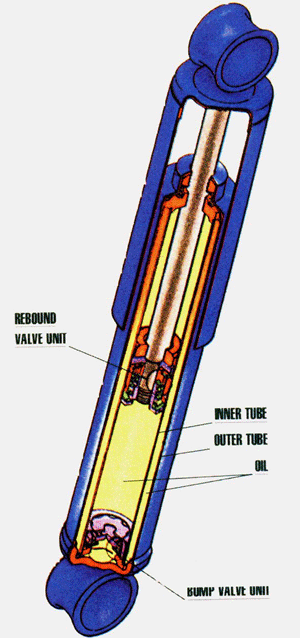
I found the following links to be EXTREMELY helpful on my quest, I encourage all those interested in learning more about this (and even those who already know) to read this stuff, its great.
Here is the basic layouts and functions of different types of shock absorbers.
http://www.minimania.com/Artic...=1047
Here's a slideshow on how to read shock dyno/graph and compare shock performance between designs/brands..
http://www.koni-na.com/presentations/civic/
^which is necessary to understand the following link on shock dynos.
https://honda-tech.com/zero...age=1
Tokico's take on the matter..
http://www.hitachi-hap-la.com/...logy/
Evaluate your stock shocks.
http://www.hitachi-hap-la.com/...uate/
Tokico FAQ, "Can I use lowering springs with my original shocks?"
http://www.hitachi-hap-la.com/TokicoGasShocks/faq/
Look forward to your guys input!!
Modified by portaman03 at 10:37 PM 6/4/2007
i agree with the mechanich</TD></TR></TABLE>
My mechanic friend is stating that the lowering spring can be handled by STOCK shocks. Not any new shocks, specifically stock new shocks.
One of the main points I was stressing was that lowering springs are not (by any means) engineered or meant to be used on a stock OEM shock or strut (which is mechanically designed for a specific, pre-determined OEM spring).
Although I'm only a backyard mechanic on the weekends, I've modded the suspension on 2 cars so far and both times I had initially ran stock shocks on lowering springs until they blew (or were "worn"). Although there are some cases where stock shocks will not blow (at least for quite some time), it's pretty safe to say that the majority of stock shocks will indeed fail. They are basically being forced to do something they don't want to do, put in a LOT more work then they are capable of doing.
Performance aftermarket shocks (such as Koni Sport shocks, KYB AGX, Tokico Illumina, or my beloved D-Specs) are manufactured to be able to handle the work involved with higher spring rate. They are adjustable to compensate for both rebound and compression dampening, hence the "adjustable stiffness" that you might feel when testing out different dampening settings (by twisting the adjuster). Righty tighty lefty loosey, specifically engineered and superior to the OEM shock in terms of the application we are discussing (modding suspension in conjunction with lowering springs).
As for NEW performance shocks blowing out at a faster rate then NEW OEM shocks, I still find that point to be completely confusing. By turning the dampening adjuster, you are making the valves on the piston more open or more closed (apeture dialation), thus allowing for greater ability in oil displacement. Most performance adjustable shocks are pressurized twin tube (as illustrated below) and offer greater oil displacement capabilities; aren't the majority of OEM shocks monotube (which would have a harder time displacing oil, leading to a blown shock)?
I found the following links to be EXTREMELY helpful on my quest, I encourage all those interested in learning more about this (and even those who already know) to read this stuff, its great.
Here is the basic layouts and functions of different types of shock absorbers.
http://www.minimania.com/Artic...=1047
Here's a slideshow on how to read shock dyno/graph and compare shock performance between designs/brands..
http://www.koni-na.com/presentations/civic/
^which is necessary to understand the following link on shock dynos.
https://honda-tech.com/zero...age=1
Tokico's take on the matter..
http://www.hitachi-hap-la.com/...logy/
Evaluate your stock shocks.
http://www.hitachi-hap-la.com/...uate/
Tokico FAQ, "Can I use lowering springs with my original shocks?"
http://www.hitachi-hap-la.com/TokicoGasShocks/faq/
Look forward to your guys input!!
Modified by portaman03 at 10:37 PM 6/4/2007
Honda-Tech Member
Joined: May 2007
Posts: 5,773
Likes: 1
From: killafornia
Re: (Todd00)
<TABLE WIDTH="90%" CELLSPACING=0 CELLPADDING=0 ALIGN=CENTER><TR><TD>Quote, originally posted by Todd00 »</TD></TR><TR><TD CLASS="quote">
The OEM shocks on the 01-05 Civics are, IMO, some of the worst Honda has ever put on a car.</TD></TR></TABLE> i agree!!
The OEM shocks on the 01-05 Civics are, IMO, some of the worst Honda has ever put on a car.</TD></TR></TABLE> i agree!!

Thread
Thread Starter
Forum
Replies
Last Post
khronicboy420
Honda Prelude
8
Jan 30, 2009 04:36 AM
portaman03
Suspension & Brakes
2
Jun 1, 2007 10:12 AM
