


GSR block with Type R internals


Thread Starter
Joined: Apr 2007
Posts: 144
Likes: 0
From: Port Charlotte, FL
 GSR block with Type R internals
My buddy wants to buy a motor off some guy we met at a hangout. Its got a GSR block with Type R internals, head, and tranny. Correct me if Im wrong but arent the GSR and Type R blocks the same? Is it safe to call this a Type R motor? Fact and opinion please 
Thread Starter
Joined: Apr 2007
Posts: 144
Likes: 0
From: Port Charlotte, FL
Re: GSR block with Type R internals (migs)
Thanks  Thats what I thought. One person was ignorant enough to say yea thats garbage because its a GSR block. And even though it has Type R internals, its not really a Type R. I had to dispute with him on that. Now I know I was right
Thats what I thought. One person was ignorant enough to say yea thats garbage because its a GSR block. And even though it has Type R internals, its not really a Type R. I had to dispute with him on that. Now I know I was right


Honda-Tech Member
Joined: Jul 2004
Posts: 1,023
Likes: 0
From: Charlotte, NC, USA
Re: GSR block with Type R internals (JDM Boy)
it's good to come and ask, but you shouldn't be arguing if you didn't know the answer... what if you were wrong? Good luck on the buy though.
Thread Starter
Joined: Apr 2007
Posts: 144
Likes: 0
From: Port Charlotte, FL
Re: GSR block with Type R internals (Nataku)
Yes you are completely right. I thought that before the argue but at the same time I was 95% percent sure so I said the hell with it. And the other 5% was just clarified. lol thanx I'll keep you updated with the buying situation

Honda-Tech Member
Joined: Mar 2003
Posts: 11,834
Likes: 0
From: san diego, ca, usa
Re: GSR block with Type R internals (JDM Boy)
i wouldn't call it a ITR motor since it's not authentic...it will probaly perform just as well but it sounds more like a good ol "poor man's itr" motor
Trending Topics
Thread Starter
Joined: Apr 2007
Posts: 144
Likes: 0
From: Port Charlotte, FL
Re: GSR block with Type R internals (ekay_jeremy)
I guess they had a GSR block lying around and didnt see the need to go through looking for an ITR block since... like you said... same performance I mean... thats what counts the most right. Thanx for the reply.

official honda whore
Joined: Nov 2002
Posts: 8,454
Likes: 0
From: not tellin you where, pa, usa
Re: GSR block with Type R internals (JDM Boy)
a gsr shortblock and a type r shortblock are the exact same price brand new.. i was just checking it out myself earlier today on http://www.baroncoacuraparts.com

Honda-Tech Member
Joined: Oct 2001
Posts: 3,310
Likes: 5
From: ILM, NC
Re: GSR block with Type R internals (JDM Boy)
<TABLE WIDTH="90%" CELLSPACING=0 CELLPADDING=0 ALIGN=CENTER><TR><TD>Quote, originally posted by JDM Boy »</TD></TR><TR><TD CLASS="quote">OK quick question, see the above picture with the white CTR rims... Enkei makes them?!?!?!! hmmmmmm</TD></TR></TABLE>
yep
yep

Joined: Apr 2007
Posts: 75
Likes: 0
From: Athens, pa, usa
Re: GSR block with Type R internals (JDM Boy)
Read this out good!!!
The Type R's B18C5 engine contained more key differences than just some manual assembly steps and an increased redline. The B16A's cylinder head returned, with differently shaped combustion chambers and intake ports compared to the regular B18C in the GS-R. Molybdenum-coated, high compression pistons and stronger-but-lighter connecting rods strengthened the reciprocating assembly. Two extra counterweights on the crankshaft altered its vibration modes to enhance durability at high RPM. The intake valves were reshaped with a thinner stem and crown that reduced weight and improved flow. The intake ports were given a minor port and polish. Stiffer valve springs resisted float on more aggressive camshafts. Intake air was now drawn from inside the fender well, for a colder, denser charge. That intake fed a short-runner intake manifold with a larger throttle body for better breathing. An improved stainless steel exhaust collector with more gentle merge angles, a change to a larger, consistent piping diameter, flared internal piping in the muffler allowed easier exit of gases. A retuned engine computer also contributed to improve power output.
The Type R's B18C5 engine contained more key differences than just some manual assembly steps and an increased redline. The B16A's cylinder head returned, with differently shaped combustion chambers and intake ports compared to the regular B18C in the GS-R. Molybdenum-coated, high compression pistons and stronger-but-lighter connecting rods strengthened the reciprocating assembly. Two extra counterweights on the crankshaft altered its vibration modes to enhance durability at high RPM. The intake valves were reshaped with a thinner stem and crown that reduced weight and improved flow. The intake ports were given a minor port and polish. Stiffer valve springs resisted float on more aggressive camshafts. Intake air was now drawn from inside the fender well, for a colder, denser charge. That intake fed a short-runner intake manifold with a larger throttle body for better breathing. An improved stainless steel exhaust collector with more gentle merge angles, a change to a larger, consistent piping diameter, flared internal piping in the muffler allowed easier exit of gases. A retuned engine computer also contributed to improve power output.

Thread Starter
Joined: Apr 2007
Posts: 144
Likes: 0
From: Port Charlotte, FL
Re: GSR block with Type R internals (94Hatchd15b7)
Thats understandable completely when it comes to comparison, but if it really does have Type R internals then performance wise will be pretty much the same right
 Re: GSR block with Type R internals (94Hatchd15b7)
<TABLE WIDTH="90%" CELLSPACING=0 CELLPADDING=0 ALIGN=CENTER><TR><TD>Quote, originally posted by 94Hatchd15b7 »</TD></TR><TR><TD CLASS="quote">Read this out good!!!
The Type R's B18C5 engine contained more key differences than just some manual assembly steps and an increased redline. The B16A's cylinder head returned, with differently shaped combustion chambers and intake ports compared to the regular B18C in the GS-R. Molybdenum-coated, high compression pistons and stronger-but-lighter connecting rods strengthened the reciprocating assembly. Two extra counterweights on the crankshaft altered its vibration modes to enhance durability at high RPM. The intake valves were reshaped with a thinner stem and crown that reduced weight and improved flow. The intake ports were given a minor port and polish. Stiffer valve springs resisted float on more aggressive camshafts. Intake air was now drawn from inside the fender well, for a colder, denser charge. That intake fed a short-runner intake manifold with a larger throttle body for better breathing. An improved stainless steel exhaust collector with more gentle merge angles, a change to a larger, consistent piping diameter, flared internal piping in the muffler allowed easier exit of gases. A retuned engine computer also contributed to improve power output.
</TD></TR></TABLE>
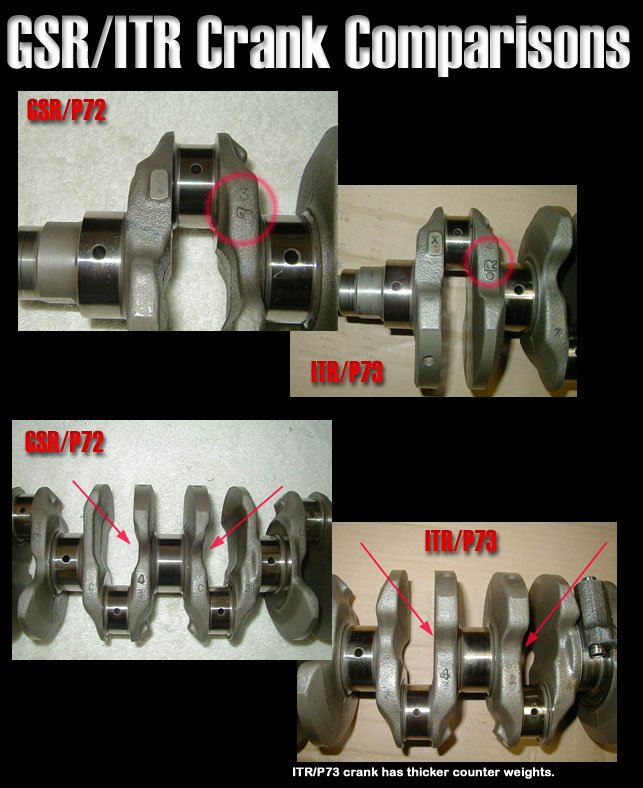
that's wrong. itr and gsr cranks have the same number of counterweights. itr cranks are just heavier.
The Type R's B18C5 engine contained more key differences than just some manual assembly steps and an increased redline. The B16A's cylinder head returned, with differently shaped combustion chambers and intake ports compared to the regular B18C in the GS-R. Molybdenum-coated, high compression pistons and stronger-but-lighter connecting rods strengthened the reciprocating assembly. Two extra counterweights on the crankshaft altered its vibration modes to enhance durability at high RPM. The intake valves were reshaped with a thinner stem and crown that reduced weight and improved flow. The intake ports were given a minor port and polish. Stiffer valve springs resisted float on more aggressive camshafts. Intake air was now drawn from inside the fender well, for a colder, denser charge. That intake fed a short-runner intake manifold with a larger throttle body for better breathing. An improved stainless steel exhaust collector with more gentle merge angles, a change to a larger, consistent piping diameter, flared internal piping in the muffler allowed easier exit of gases. A retuned engine computer also contributed to improve power output.
</TD></TR></TABLE>that's wrong. itr and gsr cranks have the same number of counterweights. itr cranks are just heavier.
Thread Starter
Joined: Apr 2007
Posts: 144
Likes: 0
From: Port Charlotte, FL
Re: GSR block with Type R internals (doood)
so my understanding from all the feedback you guys have givin me, thanx for that, is that the performance between a gsr block with type r internals and a straight type r are the same, hence gsr and type r have same block and the INTERNALS is all the difference correct?

Honda-Tech Member
Joined: May 2002
Posts: 7,812
Likes: 1
Re: GSR block with Type R internals (doood)
<TABLE WIDTH="90%" CELLSPACING=0 CELLPADDING=0 ALIGN=CENTER><TR><TD>Quote, originally posted by doood »</TD></TR><TR><TD CLASS="quote">
that's wrong. itr and gsr cranks have the same number of counterweights. itr cranks are just heavier.</TD></TR></TABLE>
I believe you are wrong sir.
that's wrong. itr and gsr cranks have the same number of counterweights. itr cranks are just heavier.</TD></TR></TABLE>
I believe you are wrong sir.


 Re: GSR block with Type R internals (JDM Boy)
<TABLE WIDTH="90%" CELLSPACING=0 CELLPADDING=0 ALIGN=CENTER><TR><TD>Quote, originally posted by JDM Boy »</TD></TR><TR><TD CLASS="quote">so my understanding from all the feedback you guys have givin me, thanx for that, is that the performance between a gsr block with type r internals and a straight type r are the same, hence gsr and type r have same block and the INTERNALS is all the difference correct?</TD></TR></TABLE>
Yes that's correct. You will notice that the JDM GSR and ITR blocks both use the exact same stamp on them (both say B18C). The extra numbers (ie B18c1 or B18c5) are simply to identifying different setups for different international markets...
When it comes to the bottom end, the difference between a GSR and ITR are as follows:
- crank
- pistons (and these will vary between international markets as well)
- rods (but not rod caps)
- rod bolts
- flywheel
- harmonic balancer
Yes that's correct. You will notice that the JDM GSR and ITR blocks both use the exact same stamp on them (both say B18C). The extra numbers (ie B18c1 or B18c5) are simply to identifying different setups for different international markets...
When it comes to the bottom end, the difference between a GSR and ITR are as follows:
- crank
- pistons (and these will vary between international markets as well)
- rods (but not rod caps
)- rod bolts
- flywheel
- harmonic balancer
Re: GSR block with Type R internals (migs)
<TABLE WIDTH="90%" CELLSPACING=0 CELLPADDING=0 ALIGN=CENTER><TR><TD>Quote, originally posted by migs »</TD></TR><TR><TD CLASS="quote">
I believe you are wrong sir.</TD></TR></TABLE>
I found this. It shows the same number of weights, but the ITR weights are bigger...
I believe you are wrong sir.</TD></TR></TABLE>
I found this. It shows the same number of weights, but the ITR weights are bigger...
