


99 4cyl (CAI vs. SRI)


Thread Starter
Joined: Sep 2006
Posts: 198
Likes: 0
From: MN
 99 4cyl (CAI vs. SRI)
i have a 99 accord sedan 4cyl with a cheap intake put on it. it's a full CAI that i
have recently switched over to SRI mode. here's my thoughts:
just to compare sound here's a vid before with the whole cold air intake (CAI):

and here's after i converted to short ram (SRI):

i don't know if you can tell, but the CAI is very loud/deep and the sound peaks at
about 4-4.5k (which is also where it feels like torque peaks).
the SRI is very loud above 5.5k but quieter everywhere else. also, the torque
feels much flatter on the high end.
i greatly prefer the driving feel and sound of the SRI. if i'm going around town
it's totally un-noticeable sound-wise (unlike the CAI which would get loud if i
accelerated much at all), but if i rev it out it pulls all the way to redline.
with the CAI it actually would feel like i let off the throttle above about 4.5k!
it was very strange. the SRI is smooth all the way through.
here's my thoughts on why my torque "feels" different than the general consensus:
<TABLE WIDTH="90%" CELLSPACING=0 CELLPADDING=0 ALIGN=CENTER><TR><TD>Quote »</TD></TR><TR><TD CLASS="quote">SRI's would be good for mid range while CAI's are good for up top</TD></TR></TABLE>
here's a torque chart AEM made for their CAI. i have added in my
"theoretical" SRI torque in green
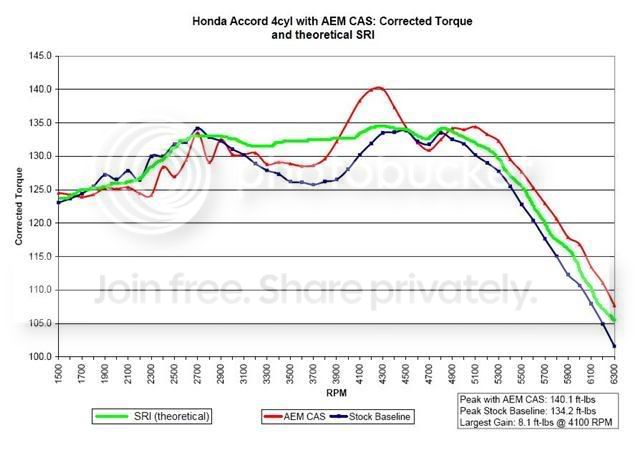
as you can see i've made it look quite nice (flat) and my butt dyno probably
isn't very accurate, but this is similar to what i "feel" when driving.
it seems that, due to the vtec engagement point the torque curve is highly
bi-modal (two peaks) and if something could add torque in the mid range (like
i feel the SRI does), it would be most beneficial (in my mind).
as i represented it here, i may or may not, have actually gained much peak
torque, but the mean value should be much higher and a flat torque curve is
better for most driving.
i think i was feeling that huge peak and drop off (at around 4.1k), that the
CAI produces. that's why i "felt" the top end was worse. it wasn't actually
worse, just a lot lower than that peak.
now, with the SRI, i think the dip in the 3.5-4k range is pulled up a bit and the
big peak around 4.1k is lowered closer to stock.
while i'm probably getting less peak torque than the CAI, i believe my torque curve
is more linear now. this seems much better under the driving conditions i face.
could this be happening? or am i an idiot/dreaming? feel free to leave your
comments either way
have recently switched over to SRI mode. here's my thoughts:
just to compare sound here's a vid before with the whole cold air intake (CAI):
and here's after i converted to short ram (SRI):
i don't know if you can tell, but the CAI is very loud/deep and the sound peaks at
about 4-4.5k (which is also where it feels like torque peaks).
the SRI is very loud above 5.5k but quieter everywhere else. also, the torque
feels much flatter on the high end.
i greatly prefer the driving feel and sound of the SRI. if i'm going around town
it's totally un-noticeable sound-wise (unlike the CAI which would get loud if i
accelerated much at all), but if i rev it out it pulls all the way to redline.
with the CAI it actually would feel like i let off the throttle above about 4.5k!
it was very strange. the SRI is smooth all the way through.
here's my thoughts on why my torque "feels" different than the general consensus:
<TABLE WIDTH="90%" CELLSPACING=0 CELLPADDING=0 ALIGN=CENTER><TR><TD>Quote »</TD></TR><TR><TD CLASS="quote">SRI's would be good for mid range while CAI's are good for up top</TD></TR></TABLE>
here's a torque chart AEM made for their CAI. i have added in my
"theoretical" SRI torque in green
as you can see i've made it look quite nice (flat) and my butt dyno probably
isn't very accurate, but this is similar to what i "feel" when driving.
it seems that, due to the vtec engagement point the torque curve is highly
bi-modal (two peaks) and if something could add torque in the mid range (like
i feel the SRI does), it would be most beneficial (in my mind).
as i represented it here, i may or may not, have actually gained much peak
torque, but the mean value should be much higher and a flat torque curve is
better for most driving.
i think i was feeling that huge peak and drop off (at around 4.1k), that the
CAI produces. that's why i "felt" the top end was worse. it wasn't actually
worse, just a lot lower than that peak.
now, with the SRI, i think the dip in the 3.5-4k range is pulled up a bit and the
big peak around 4.1k is lowered closer to stock.
while i'm probably getting less peak torque than the CAI, i believe my torque curve
is more linear now. this seems much better under the driving conditions i face.
could this be happening? or am i an idiot/dreaming? feel free to leave your
comments either way

Thread Starter
Joined: Sep 2006
Posts: 198
Likes: 0
From: MN
Re: (The-Kid)
maybe the sounds clips, but the rest is basically just my opinions and other speculation.
EDIT:
i'm really bored, so i analyzed the audio from those vid clips.
i'll list the dB level (set from an arbitrary refernce so the loudest is -1dB), the
frequency of the sound and the rpm's at which it occurs.
CAI:
130Hz (-1dB) @ 4,000 rpm's
200Hz (-1dB) @ 4,500 rpm's
400Hz (-3dB) @ 6,000 rpm's
SRI:
200Hz (-1dB) @ 6,000 rpm's
300Hz (-1dB) @ 4,500 rpm's
these are just the PEAKS. between the peaks the levels are much lower.
-as you can see, the CAI peaks at 4,000 rpm's with quite a low tone.
-then they both have a very quick peak at 4,500 rpm's, but they are at
different tones.
-they both show another peak at redline, and once again at a different tone,
but at this rpm, the SRI's peak is much louder.
for some reason the peaks aren't very apparent in the vids, but when actually
in the car they are recognizable.
to my ears the CAI's 4k rpm peak is the loudest and most annoying, because
it is the lowest tone and it actually occurs (occasionally) during my normal
driving.
at half throttle and taking it up to about 4.5k, the SRI sounds quite good and
the car actually feels fairly quick :thumbsup:
PS: i still think i like the modded airbox sound the best you can tell it's
there, but it's not too loud, even WOT at redline. plus no whistle from the
filter (this occurs at minimal throttle, between ~2-3k, but it's not very loud).
Modified by xluben at 10:38 PM 3/12/2007
EDIT:
i'm really bored, so i analyzed the audio from those vid clips.
i'll list the dB level (set from an arbitrary refernce so the loudest is -1dB), the
frequency of the sound and the rpm's at which it occurs.
CAI:
130Hz (-1dB) @ 4,000 rpm's
200Hz (-1dB) @ 4,500 rpm's
400Hz (-3dB) @ 6,000 rpm's
SRI:
200Hz (-1dB) @ 6,000 rpm's
300Hz (-1dB) @ 4,500 rpm's
these are just the PEAKS. between the peaks the levels are much lower.
-as you can see, the CAI peaks at 4,000 rpm's with quite a low tone.
-then they both have a very quick peak at 4,500 rpm's, but they are at
different tones.
-they both show another peak at redline, and once again at a different tone,
but at this rpm, the SRI's peak is much louder.
for some reason the peaks aren't very apparent in the vids, but when actually
in the car they are recognizable.
to my ears the CAI's 4k rpm peak is the loudest and most annoying, because
it is the lowest tone and it actually occurs (occasionally) during my normal
driving.
at half throttle and taking it up to about 4.5k, the SRI sounds quite good and
the car actually feels fairly quick :thumbsup:
PS: i still think i like the modded airbox sound the best
you can tell it's there, but it's not too loud, even WOT at redline. plus no whistle from the
filter (this occurs at minimal throttle, between ~2-3k, but it's not very loud).
Modified by xluben at 10:38 PM 3/12/2007
Honda-Tech Member
Joined: Sep 2004
Posts: 3,878
Likes: 2
From: Fontanafredda, IT
Re: (xluben)
The changes you're feeling are due to the resonant frequencies of the different tube lengths.
Basically, the CAI has a longer tube right? The resonant frequency of that tube is lower, providing better low-end response.
The SRI is shorter, meaning its resonant frequency is higher, so its gains can be felt at higher RPMs.
The same theory as musical instruments, ie. the slide on a trombone. Extending the slide makes the trombone longer, and the frequency lower.
After many dyno runs and vehicle dynamics processors, here are my observations...
The CAI's lower rpm response seems to emphasize the torque curve at the engine's natural peak, 3.7K to 4.3K rpms. This is where the dyno reads the highest torque curve, and also where the dynamics processor reads the greatest accelleration. After all, torque = push.
When using the SRI, the dyno flattens out greatly, but only because of a reduction in torque between 3.3K and 4.7K rpms. basically eliminating the torque peak around 4200rpms. This may feel smoother in response, since the pull does not drop off after 4.5K~ rpms, but it's not really a beneficial effect.
The F23 with its long stroke and torquey response just seems to work better with a lower resonance intake like most cool air intakes. Besides, with a 6500ish rpm redline, they don't zing quite high enough to take advantage of a SRI. Hence the reason why ITB's are not a good choice.
Just my two cents.
Basically, the CAI has a longer tube right? The resonant frequency of that tube is lower, providing better low-end response.
The SRI is shorter, meaning its resonant frequency is higher, so its gains can be felt at higher RPMs.
The same theory as musical instruments, ie. the slide on a trombone. Extending the slide makes the trombone longer, and the frequency lower.
After many dyno runs and vehicle dynamics processors, here are my observations...
The CAI's lower rpm response seems to emphasize the torque curve at the engine's natural peak, 3.7K to 4.3K rpms. This is where the dyno reads the highest torque curve, and also where the dynamics processor reads the greatest accelleration. After all, torque = push.
When using the SRI, the dyno flattens out greatly, but only because of a reduction in torque between 3.3K and 4.7K rpms. basically eliminating the torque peak around 4200rpms. This may feel smoother in response, since the pull does not drop off after 4.5K~ rpms, but it's not really a beneficial effect.
The F23 with its long stroke and torquey response just seems to work better with a lower resonance intake like most cool air intakes. Besides, with a 6500ish rpm redline, they don't zing quite high enough to take advantage of a SRI. Hence the reason why ITB's are not a good choice.
Just my two cents.
Honda-Tech Member
Joined: Sep 2004
Posts: 3,878
Likes: 2
From: Fontanafredda, IT
Re: 99 4cyl (xluben)
<TABLE WIDTH="90%" CELLSPACING=0 CELLPADDING=0 ALIGN=CENTER><TR><TD>Quote, originally posted by xluben »</TD></TR><TR><TD CLASS="quote">i think i was feeling that huge peak and drop off (at around 4.1k), that the CAI produces. that's why i "felt" the top end was worse. it wasn't actually worse, just a lot lower than that peak.</TD></TR></TABLE>
Bingo!
Bingo!

Thread Starter
Joined: Sep 2006
Posts: 198
Likes: 0
From: MN
Re: (AFAccord)
<TABLE WIDTH="90%" CELLSPACING=0 CELLPADDING=0 ALIGN=CENTER><TR><TD>Quote, originally posted by AFAccord »</TD></TR><TR><TD CLASS="quote">The changes you're feeling are due to the resonant frequencies of the different tube lengths.
Basically, the CAI has a longer tube right? The resonant frequency of that tube is lower, providing better low-end response.
The SRI is shorter, meaning its resonant frequency is higher, so its gains can be felt at higher RPMs.
The same theory as musical instruments, ie. the slide on a trombone. Extending the slide makes the trombone longer, and the frequency lower. </TD></TR></TABLE>
so resonance = power
i'm not sure why that would be true, but if the dyno backs it up i'll agree.
<TABLE WIDTH="90%" CELLSPACING=0 CELLPADDING=0 ALIGN=CENTER><TR><TD>Quote, originally posted by AFAccord »</TD></TR><TR><TD CLASS="quote">After many dyno runs and vehicle dynamics processors, here are my observations...
The CAI's lower rpm response seems to emphasize the torque curve at the engine's natural peak, 3.7K to 4.3K rpms. This is where the dyno reads the highest torque curve, and also where the dynamics processor reads the greatest accelleration. After all, torque = push.
When using the SRI, the dyno flattens out greatly, but only because of a reduction in torque between 3.3K and 4.7K rpms. basically eliminating the torque peak around 4200rpms. This may feel smoother in response, since the pull does not drop off after 4.5K~ rpms, but it's not really a beneficial effect.
The F23 with its long stroke and torquey response just seems to work better with a lower resonance intake like most cool air intakes. Besides, with a 6500ish rpm redline, they don't zing quite high enough to take advantage of a SRI. Hence the reason why ITB's are not a good choice.
Just my two cents. </TD></TR></TABLE>
just wondering, why you don't consider the flatter torque curve to be better?
Basically, the CAI has a longer tube right? The resonant frequency of that tube is lower, providing better low-end response.
The SRI is shorter, meaning its resonant frequency is higher, so its gains can be felt at higher RPMs.
The same theory as musical instruments, ie. the slide on a trombone. Extending the slide makes the trombone longer, and the frequency lower. </TD></TR></TABLE>
so resonance = power
i'm not sure why that would be true, but if the dyno backs it up i'll agree.
<TABLE WIDTH="90%" CELLSPACING=0 CELLPADDING=0 ALIGN=CENTER><TR><TD>Quote, originally posted by AFAccord »</TD></TR><TR><TD CLASS="quote">After many dyno runs and vehicle dynamics processors, here are my observations...
The CAI's lower rpm response seems to emphasize the torque curve at the engine's natural peak, 3.7K to 4.3K rpms. This is where the dyno reads the highest torque curve, and also where the dynamics processor reads the greatest accelleration. After all, torque = push.
When using the SRI, the dyno flattens out greatly, but only because of a reduction in torque between 3.3K and 4.7K rpms. basically eliminating the torque peak around 4200rpms. This may feel smoother in response, since the pull does not drop off after 4.5K~ rpms, but it's not really a beneficial effect.
The F23 with its long stroke and torquey response just seems to work better with a lower resonance intake like most cool air intakes. Besides, with a 6500ish rpm redline, they don't zing quite high enough to take advantage of a SRI. Hence the reason why ITB's are not a good choice.
Just my two cents.
</TD></TR></TABLE>just wondering, why you don't consider the flatter torque curve to be better?
Trending Topics
Honda-Tech Member
Joined: Sep 2004
Posts: 3,878
Likes: 2
From: Fontanafredda, IT
Re: (xluben)
<TABLE WIDTH="90%" CELLSPACING=0 CELLPADDING=0 ALIGN=CENTER><TR><TD>Quote, originally posted by xluben »</TD></TR><TR><TD CLASS="quote">so resonance = power</TD></TR></TABLE>
Resonance tuning is what well established intake makers use to achieve optimal results from the products they make. Matching the right frequency for the motor is the key in intake design and development.
<TABLE WIDTH="90%" CELLSPACING=0 CELLPADDING=0 ALIGN=CENTER><TR><TD>Quote, originally posted by Jim MacFarland »</TD></TR><TR><TD CLASS="quote">Changing the pipe's dimension, given the same amount of input air, could produce another resonant point or tone.
With regard to an engine's intake {or exhaust} system, it is possible to dimension a passage to accommodate specific cylinder displacements and engine speed so that a "resonant" condition helps produce an increase in total air flow {intake or exhaust}. In it's simplest form, this amounts to "tuning" an inlet {or exhaust} passage. Physical dimensions of the passage are constructed to provide a resonant tuning point {particularly relative to rpm and valve timing} at which a "boost" in flow is produced. This results in an increase in cylinder filling {volumetric efficiency} and potential gains in torque.</TD></TR></TABLE>
This article will give you more info on resonance tuning if you're interested.
http://www.team-integra.net/se...D=466
<TABLE WIDTH="90%" CELLSPACING=0 CELLPADDING=0 ALIGN=CENTER><TR><TD>Quote, originally posted by xluben »</TD></TR><TR><TD CLASS="quote">just wondering, why you don't consider the flatter torque curve to be better?</TD></TR></TABLE>
With this n/a motor, i'm not concerned about a flat torque curve. If anything, this motor already has a relatively flat torque curve when compared to other motors.
Where I would begin to be concerned is if the torque were to suddenly jump a great amount within a couple hundred rpms, as with a FI setup, and only if it were a daily driver at that.
Have you considered the fact that when you take the car to redline, then shift, that the next gear lands right in that torque peak??
Resonance tuning is what well established intake makers use to achieve optimal results from the products they make. Matching the right frequency for the motor is the key in intake design and development.
<TABLE WIDTH="90%" CELLSPACING=0 CELLPADDING=0 ALIGN=CENTER><TR><TD>Quote, originally posted by Jim MacFarland »</TD></TR><TR><TD CLASS="quote">Changing the pipe's dimension, given the same amount of input air, could produce another resonant point or tone.
With regard to an engine's intake {or exhaust} system, it is possible to dimension a passage to accommodate specific cylinder displacements and engine speed so that a "resonant" condition helps produce an increase in total air flow {intake or exhaust}. In it's simplest form, this amounts to "tuning" an inlet {or exhaust} passage. Physical dimensions of the passage are constructed to provide a resonant tuning point {particularly relative to rpm and valve timing} at which a "boost" in flow is produced. This results in an increase in cylinder filling {volumetric efficiency} and potential gains in torque.</TD></TR></TABLE>
This article will give you more info on resonance tuning if you're interested.
http://www.team-integra.net/se...D=466
<TABLE WIDTH="90%" CELLSPACING=0 CELLPADDING=0 ALIGN=CENTER><TR><TD>Quote, originally posted by xluben »</TD></TR><TR><TD CLASS="quote">just wondering, why you don't consider the flatter torque curve to be better?</TD></TR></TABLE>
With this n/a motor, i'm not concerned about a flat torque curve. If anything, this motor already has a relatively flat torque curve when compared to other motors.
Where I would begin to be concerned is if the torque were to suddenly jump a great amount within a couple hundred rpms, as with a FI setup, and only if it were a daily driver at that.
Have you considered the fact that when you take the car to redline, then shift, that the next gear lands right in that torque peak??
Thread Starter
Joined: Sep 2006
Posts: 198
Likes: 0
From: MN
Re: (AFAccord)
<TABLE WIDTH="90%" CELLSPACING=0 CELLPADDING=0 ALIGN=CENTER><TR><TD>Quote, originally posted by AFAccord »</TD></TR><TR><TD CLASS="quote">
Resonance tuning is what well established intake makers use to achieve optimal results from the products they make. Matching the right frequency for the motor is the key in intake design and development.
This article will give you more info on resonance tuning if you're interested.
http://www.team-integra.net/se...D=466
With this n/a motor, i'm not concerned about a flat torque curve. If anything, this motor already has a relatively flat torque curve when compared to other motors.
Where I would begin to be concerned is if the torque were to suddenly jump a great amount within a couple hundred rpms, as with a FI setup, and only if it were a daily driver at that.
Have you considered the fact that when you take the car to redline, then shift, that the next gear lands right in that torque peak??
</TD></TR></TABLE>
that link looks like a great read, i'll have to check it out later.
and, yes, i did think that shifts land right on top of the peak torque, which seems very good, but i just don't like how the drop off "feels" while driving.
the CAI made it so noticeable it actually felt like i'd let off the gas at about 4.5k (when i was WOT the whole time).
i think i agree that for all out speed/drag racing the CAI is much better, higher peak and it's peaks at just the right time for our gearing.
but for my daily use i still prefer the smooth response of the SRI.
thanks for all the help. i hop that article will help me understand resonance a bit more.
Resonance tuning is what well established intake makers use to achieve optimal results from the products they make. Matching the right frequency for the motor is the key in intake design and development.
This article will give you more info on resonance tuning if you're interested.
http://www.team-integra.net/se...D=466
With this n/a motor, i'm not concerned about a flat torque curve. If anything, this motor already has a relatively flat torque curve when compared to other motors.
Where I would begin to be concerned is if the torque were to suddenly jump a great amount within a couple hundred rpms, as with a FI setup, and only if it were a daily driver at that.
Have you considered the fact that when you take the car to redline, then shift, that the next gear lands right in that torque peak??
</TD></TR></TABLE>
that link looks like a great read, i'll have to check it out later.
and, yes, i did think that shifts land right on top of the peak torque, which seems very good, but i just don't like how the drop off "feels" while driving.
the CAI made it so noticeable it actually felt like i'd let off the gas at about 4.5k (when i was WOT the whole time).
i think i agree that for all out speed/drag racing the CAI is much better, higher peak and it's peaks at just the right time for our gearing.
but for my daily use i still prefer the smooth response of the SRI.
thanks for all the help. i hop that article will help me understand resonance a bit more.
Thread Starter
Joined: Sep 2006
Posts: 198
Likes: 0
From: MN
that write up was excellent! (as well as the articles it linked to)
i love the idea of "tuning" the intake to actually "boost" the engine
but a lot of the calculations seem very generalized, and i'm guessing don't do that well in real life.
but with time, money, and a dyno or boost gauge i think it would be possible to "tune" your intake for small amount of boost.
too bad the link to his write up on intakes (SRI vs CAI) was dead
anyone have a login to automotivetech v2?
http://www.automotivetech.org/...ber=1
if you could repost that i'd greatly appreciate it!
i love the idea of "tuning" the intake to actually "boost" the engine
but a lot of the calculations seem very generalized, and i'm guessing don't do that well in real life.
but with time, money, and a dyno or boost gauge i think it would be possible to "tune" your intake for small amount of boost.
too bad the link to his write up on intakes (SRI vs CAI) was dead
anyone have a login to automotivetech v2?
http://www.automotivetech.org/...ber=1
if you could repost that i'd greatly appreciate it!

Thread
Thread Starter
Forum
Replies
Last Post
oneluv408
Honda Accord (1990 - 2002)
7
Apr 2, 2003 10:22 AM
