


Installing oil pressure sender/gauge


Thread Starter
Junior Member
Joined: May 2006
Posts: 196
Likes: 0
From: Irvine, CA, USA
 Installing oil pressure sender/gauge
Im about to install an electric autometer oil pressure gauge and im trying to decide where I should install the sender unit.
People have recommended me to use this hole in the cylinder head.

and I was informed that I need a 1/8" BSPT adapter to be able to thread the sender into that hole. However, im debating if I should just thread the sender directly into that hole or thread a steel braided line in the hole and then put the sender on the line...
What's recommended? do I even have a good spot for a oil pressure sending unti?
Thanks.
People have recommended me to use this hole in the cylinder head.
and I was informed that I need a 1/8" BSPT adapter to be able to thread the sender into that hole. However, im debating if I should just thread the sender directly into that hole or thread a steel braided line in the hole and then put the sender on the line...
What's recommended? do I even have a good spot for a oil pressure sending unti?
Thanks.

moderator emeritus
Joined: Oct 2002
Posts: 16,357
Likes: 6
From: Cantonment, FL
Re: Installing oil pressure sender/gauge (ZXRider)
did your gauge come with its own sending unit?
my apexi came with its own and i just put it in place of the stock sending unit.
putting an oil pressure gauge there will only be giving you the oil pressure in the head.
my apexi came with its own and i just put it in place of the stock sending unit.
putting an oil pressure gauge there will only be giving you the oil pressure in the head.
Thread Starter
Junior Member
Joined: May 2006
Posts: 196
Likes: 0
From: Irvine, CA, USA
Re: Installing oil pressure sender/gauge (B.Rabbit)
Yes the gauge came with it's own sending unit.
If I remove the stock unit wouldn't that mean my oil light in the gauge cluster not work anymore?
If I remove the stock unit wouldn't that mean my oil light in the gauge cluster not work anymore?
Thread Starter
Junior Member
Joined: May 2006
Posts: 196
Likes: 0
From: Irvine, CA, USA
Re: Installing oil pressure sender/gauge (B.Rabbit)
I'm looking at my helms manual right now, and I got a couple of questions.
Would even the aftermarket unti fit in that spoit? it seems pretty tight there.
Wouldn't disconnecting that yollow/red wire from the stock unit make the stock oil light in the gauge cluster always be on? I doubt that wire is going to be used so it's just gong to be left there.
Also would the aftermarket unit thread in? The sender unit it'self is a 1/8" NPT male fitting and came with a 1/4" NPT adapter, I also bought another adapter which is a 1/8" BSPT...so which one of those would I need to use?
Thanks.
Would even the aftermarket unti fit in that spoit? it seems pretty tight there.
Wouldn't disconnecting that yollow/red wire from the stock unit make the stock oil light in the gauge cluster always be on? I doubt that wire is going to be used so it's just gong to be left there.
Also would the aftermarket unit thread in? The sender unit it'self is a 1/8" NPT male fitting and came with a 1/4" NPT adapter, I also bought another adapter which is a 1/8" BSPT...so which one of those would I need to use?
Thanks.

Honda-Tech Member
Joined: Dec 2003
Posts: 2,336
Likes: 1
From: DFW Area, TX
1. You *can* thread a 1/8" NPT fitting into a 1/8 BSPT port, but I wouldn't suggest it. The thread pitch is off by 1 TPI, so it will fit, but you'll need to use a lot of sealer to get it to not leak. If you put it on too tight, you run the risk of damaging the head casting.
2. You should isolate the pressure sender from vibration, if at all possible. That being said, I installed a 1/8 BSPT to -4AN fitting on the head, ran a -4 SS line to a -4 to NPT bulkhead fitting to mount the sending unit. I've had zero problems with this setup.
3. You can disconnect the sensor for the stock oil light. It's ground sensing, so if there is no ground, it won't come on. The sensor works by grounding the wire when oil pressure drops below 7.5 PSI (IIRC).
4. It's true that the sending unit being plumbed into the head only gives the oil pressure reading in the head, but putting the sending unit where the stock oil pressure sending unit is only gives the oil pressure at the input into the bottom end. IMO, if you're getting good pressure in the head, you're probably getting good pressure in the bottom end, unless you have a galley that's plugged.
I have pictures of the fitting on the head somewhere....
Here's a picture of the sending unit:

2. You should isolate the pressure sender from vibration, if at all possible. That being said, I installed a 1/8 BSPT to -4AN fitting on the head, ran a -4 SS line to a -4 to NPT bulkhead fitting to mount the sending unit. I've had zero problems with this setup.
3. You can disconnect the sensor for the stock oil light. It's ground sensing, so if there is no ground, it won't come on. The sensor works by grounding the wire when oil pressure drops below 7.5 PSI (IIRC).
4. It's true that the sending unit being plumbed into the head only gives the oil pressure reading in the head, but putting the sending unit where the stock oil pressure sending unit is only gives the oil pressure at the input into the bottom end. IMO, if you're getting good pressure in the head, you're probably getting good pressure in the bottom end, unless you have a galley that's plugged.
I have pictures of the fitting on the head somewhere....
Here's a picture of the sending unit:
Trending Topics

Honda-Tech Member
Joined: Oct 2002
Posts: 597
Likes: 1
From: Raleigh, NC, USA
Re: Installing oil pressure sender/gauge (ZXRider)
What you want to do is go to http://www.mcmaster.com/ or similar and get the following
1. 1/8" bspt to 1/8"npt adapter (preferably brass)
2. 1/8" ss line (say 2 feet or so) with (tapered ends)
3. 1/8" T fitting
4. 1/8" npt to 1/8" bspt adapter
So, you take 1 and screw it into the block where the stock Oil pressure sensor/dummy light is. Next you take two and screw it into 1.
Then screw the other side of 2 into the 3. Next, screw the oem oil pressure sensor into the "T", then screw the new gauge sender into the T.
Next, secure the T to something with zip ties or whatever, and wire up your gauge.
Be sure to leave enough slack in the SS line for the engine to move a little.
***Disclaimer... it's been two years since I purchased my pieces, so double check the ends of those pieces I described above to make sure the fit.***
Questions?
1. 1/8" bspt to 1/8"npt adapter (preferably brass)
2. 1/8" ss line (say 2 feet or so) with (tapered ends)
3. 1/8" T fitting
4. 1/8" npt to 1/8" bspt adapter
So, you take 1 and screw it into the block where the stock Oil pressure sensor/dummy light is. Next you take two and screw it into 1.
Then screw the other side of 2 into the 3. Next, screw the oem oil pressure sensor into the "T", then screw the new gauge sender into the T.
Next, secure the T to something with zip ties or whatever, and wire up your gauge.
Be sure to leave enough slack in the SS line for the engine to move a little.
***Disclaimer... it's been two years since I purchased my pieces, so double check the ends of those pieces I described above to make sure the fit.***
Questions?
Honda-Tech Member
Joined: Oct 2002
Posts: 597
Likes: 1
From: Raleigh, NC, USA
Re: (117)
Out of curiosity... what type of oil pressure do you see there 117?
I've got mine in the bottom end as described above and I see
~15 at idle
~60 at 3000-3500
~75 at WOT
all of these are warmed up, during normal city driving.
curious if you see different in the head.
Haven't taken it on track yet. Do you see pressure drop on track?
I've got mine in the bottom end as described above and I see
~15 at idle
~60 at 3000-3500
~75 at WOT
all of these are warmed up, during normal city driving.
curious if you see different in the head.
Haven't taken it on track yet. Do you see pressure drop on track?

Thread Starter
Junior Member
Joined: May 2006
Posts: 196
Likes: 0
From: Irvine, CA, USA
Re: Installing oil pressure sender/gauge (95PreludeSi)
<TABLE WIDTH="90%" CELLSPACING=0 CELLPADDING=0 ALIGN=CENTER><TR><TD>Quote, originally posted by 95PreludeSi »</TD></TR><TR><TD CLASS="quote">What you want to do is go to http://www.mcmaster.com/ or similar and get the following
1. 1/8" bspt to 1/8"npt adapter (preferably brass)
2. 1/8" ss line (say 2 feet or so) with (tapered ends)
3. 1/8" T fitting
4. 1/8" npt to 1/8" bspt adapter
So, you take 1 and screw it into the block where the stock Oil pressure sensor/dummy light is. Next you take two and screw it into 1.
Then screw the other side of 2 into the 3. Next, screw the oem oil pressure sensor into the "T", then screw the new gauge sender into the T.
Next, secure the T to something with zip ties or whatever, and wire up your gauge.
Be sure to leave enough slack in the SS line for the engine to move a little.
***Disclaimer... it's been two years since I purchased my pieces, so double check the ends of those pieces I described above to make sure the fit.***
Questions?</TD></TR></TABLE>
Are you using the T so that you keep the stock sending unit/light also?
1. 1/8" bspt to 1/8"npt adapter (preferably brass)
2. 1/8" ss line (say 2 feet or so) with (tapered ends)
3. 1/8" T fitting
4. 1/8" npt to 1/8" bspt adapter
So, you take 1 and screw it into the block where the stock Oil pressure sensor/dummy light is. Next you take two and screw it into 1.
Then screw the other side of 2 into the 3. Next, screw the oem oil pressure sensor into the "T", then screw the new gauge sender into the T.
Next, secure the T to something with zip ties or whatever, and wire up your gauge.
Be sure to leave enough slack in the SS line for the engine to move a little.
***Disclaimer... it's been two years since I purchased my pieces, so double check the ends of those pieces I described above to make sure the fit.***
Questions?</TD></TR></TABLE>
Are you using the T so that you keep the stock sending unit/light also?
Honda-Tech Member
Joined: Dec 2003
Posts: 2,336
Likes: 1
From: DFW Area, TX
All the more reason NOT to install it directly on the engine. Vibration would kill that sending unit in short order, IMO.
It's a sending unit for a Defi oil pressure gauge. It is rather small.
My oil pressure is very high, almost too high. I have a modified oil pump and no balance shafts (bearings are turned 90 degrees). IIRC, I see:
~20 PSI at idle
70+ PSI in the middle RPM range
~100 PSI close to fuel cut
This is without an oil cooler. I will probably see a 2 to 3 PSI drop from an oil cooler, but I'm using very large plumbing (-12), with smaller plumbing, you'll see a slightly larger loss.
It's a sending unit for a Defi oil pressure gauge. It is rather small.
My oil pressure is very high, almost too high. I have a modified oil pump and no balance shafts (bearings are turned 90 degrees). IIRC, I see:
~20 PSI at idle
70+ PSI in the middle RPM range
~100 PSI close to fuel cut
This is without an oil cooler. I will probably see a 2 to 3 PSI drop from an oil cooler, but I'm using very large plumbing (-12), with smaller plumbing, you'll see a slightly larger loss.
Thread Starter
Junior Member
Joined: May 2006
Posts: 196
Likes: 0
From: Irvine, CA, USA
Re: (117)
To answer your question about the head...I'm not sure if it was bead blasted or painted. I asked the machine shop how they clean it and he said he bead blasts it and paints it but im not sure if he actually did that since I don't know the difference. Some parts of the head, it feels like it's been painted and some parts are not.
Anyways, I'm trying to figure out if I should just use the hole on the head or do what 95preludeSi mentioned. Using the head seems like less work and more convinient...
Anyways, I'm trying to figure out if I should just use the hole on the head or do what 95preludeSi mentioned. Using the head seems like less work and more convinient...
Honda-Tech Member
Joined: Oct 2002
Posts: 597
Likes: 1
From: Raleigh, NC, USA
Re: (117)
<TABLE WIDTH="90%" CELLSPACING=0 CELLPADDING=0 ALIGN=CENTER><TR><TD>Quote, originally posted by ZXRider »</TD></TR><TR><TD CLASS="quote">
Are you using the T so that you keep the stock sending unit/light also? </TD></TR></TABLE>
Well, why not keep it. As 117 said you shouldn't run it right of the block anyways. Also why I said get a brass fitting so it will break before the block does. Might as well get a T and keep it. My autometer's sender is big like that too.
Although the OEM peice is not the greatest, it might save your *** when racing though. When at an AX or on track it's hard to read your gauges all the time. Dummy lights are good.
<TABLE WIDTH="90%" CELLSPACING=0 CELLPADDING=0 ALIGN=CENTER><TR><TD>Quote, originally posted by 117 »</TD></TR><TR><TD CLASS="quote"> IIRC, I see:
~20 PSI at idle
70+ PSI in the middle RPM range
~100 PSI close to fuel cut
This is without an oil cooler. I will probably see a 2 to 3 PSI drop from an oil cooler, but I'm using very large plumbing (-12), with smaller plumbing, you'll see a slightly larger loss.</TD></TR></TABLE>
Thanks for the info. No problem with blowing out seals?
Are you using the T so that you keep the stock sending unit/light also? </TD></TR></TABLE>
Well, why not keep it. As 117 said you shouldn't run it right of the block anyways. Also why I said get a brass fitting so it will break before the block does. Might as well get a T and keep it. My autometer's sender is big like that too.
Although the OEM peice is not the greatest, it might save your *** when racing though. When at an AX or on track it's hard to read your gauges all the time. Dummy lights are good.
<TABLE WIDTH="90%" CELLSPACING=0 CELLPADDING=0 ALIGN=CENTER><TR><TD>Quote, originally posted by 117 »</TD></TR><TR><TD CLASS="quote"> IIRC, I see:
~20 PSI at idle
70+ PSI in the middle RPM range
~100 PSI close to fuel cut
This is without an oil cooler. I will probably see a 2 to 3 PSI drop from an oil cooler, but I'm using very large plumbing (-12), with smaller plumbing, you'll see a slightly larger loss.</TD></TR></TABLE>
Thanks for the info. No problem with blowing out seals?
Honda-Tech Member
Joined: Dec 2003
Posts: 2,336
Likes: 1
From: DFW Area, TX
If you're going to rely on an oil pressure light while doing any type of track event, I'd suggest using a much higher pressure switch. The one I'm going to install is around 30 or 40 PSI. It'll come on at idle, but that's no big deal. If you're running your engine hard, and the oil pressure gets down low enough to activate the stock oil light with the stock switch (7.5 PSI or so) you're in deep dookie.
My oil pan is stock. The Moroso pan doesn't help with track driving. I have the stuff to baffle a stock pan, but I have too many other projects going on at the moment.
If that head is painted, be careful that none of it flakes off into the engine when you're installing the head. Why do shops paint the damn things!?!?!
My oil pan is stock. The Moroso pan doesn't help with track driving. I have the stuff to baffle a stock pan, but I have too many other projects going on at the moment.
If that head is painted, be careful that none of it flakes off into the engine when you're installing the head. Why do shops paint the damn things!?!?!
Thread Starter
Junior Member
Joined: May 2006
Posts: 196
Likes: 0
From: Irvine, CA, USA
Re: (95PreludeSi)
Could I purchase all the necessary hardware from a local hardware store? Hoping I can get started on this today.
I think I'll just go with the set up 95PreludeSI mentioned.
The list you gave me all the hardware I need to pick up? I don't need extra wire to be able to make the ground wire from the stock unit reach correct?
doesn't matter which set up to me, just that im having a difficult time figuring out everything that I need. The sender unit I have is a 1/8" NPT male fitting and I have 2 adapters for it. One is a 1/4" NPT adapter which is probably useless here, and I also have one that is a 1/8" BSPT which is the adapter I bought to use it with the port.
Also before I forget, what kind of a sealent do I need to use on a the threads?
PS. I'm not going to do any tracking or anything serious, just installing an oil pressure gauge cause I was used to having one in my prior car and well just as a measure of safety.
I think I'll just go with the set up 95PreludeSI mentioned.
The list you gave me all the hardware I need to pick up? I don't need extra wire to be able to make the ground wire from the stock unit reach correct?
doesn't matter which set up to me, just that im having a difficult time figuring out everything that I need. The sender unit I have is a 1/8" NPT male fitting and I have 2 adapters for it. One is a 1/4" NPT adapter which is probably useless here, and I also have one that is a 1/8" BSPT which is the adapter I bought to use it with the port.
Also before I forget, what kind of a sealent do I need to use on a the threads?
PS. I'm not going to do any tracking or anything serious, just installing an oil pressure gauge cause I was used to having one in my prior car and well just as a measure of safety.
Honda-Tech Member
Joined: Oct 2002
Posts: 597
Likes: 1
From: Raleigh, NC, USA
Re: (ZXRider)
<TABLE WIDTH="90%" CELLSPACING=0 CELLPADDING=0 ALIGN=CENTER><TR><TD>Quote, originally posted by 117 »</TD></TR><TR><TD CLASS="quote">If you're going to rely on an oil pressure light while doing any type of track event, I'd suggest using a much higher pressure switch. The one I'm going to install is around 30 or 40 PSI. It'll come on at idle, but that's no big deal. If you're running your engine hard, and the oil pressure gets down low enough to activate the stock oil light with the stock switch (7.5 PSI or so) you're in deep dookie.</TD></TR></TABLE>
Very true... Could make a switch to turn it off for the street? If you still drive yours there.
<TABLE WIDTH="90%" CELLSPACING=0 CELLPADDING=0 ALIGN=CENTER><TR><TD>Quote, originally posted by 117 »</TD></TR><TR><TD CLASS="quote">
My oil pan is stock. The Moroso pan doesn't help with track driving. I have the stuff to baffle a stock pan, but I have too many other projects going on at the moment.
</TD></TR></TABLE> They didn't baffle the moroso one... that sucks. The b-series guys always luck out.
<TABLE WIDTH="90%" CELLSPACING=0 CELLPADDING=0 ALIGN=CENTER><TR><TD>Quote, originally posted by ZXRider »</TD></TR><TR><TD CLASS="quote">Could I purchase all the necessary hardware from a local hardware store? Hoping I can get started on this today.
I think I'll just go with the set up 95PreludeSI mentioned.
The list you gave me all the hardware I need to pick up? I don't need extra wire to be able to make the ground wire from the stock unit reach correct?</TD></TR></TABLE>
It is more or less all you need. You just need to make sure all the ends match for the pieces to all fit together. Not sure if a local place would carry it. I think it ran me around 25$-30$ though... the SS line was most of it.
<TABLE WIDTH="90%" CELLSPACING=0 CELLPADDING=0 ALIGN=CENTER><TR><TD>Quote, originally posted by ZXRider »</TD></TR><TR><TD CLASS="quote">
Also before I forget, what kind of a sealent do I need to use on a the threads?
PS. I'm not going to do any tracking or anything serious, just installing an oil pressure gauge cause I was used to having one in my prior car and well just as a measure of safety. </TD></TR></TABLE>
I just used thread tape. Be sure to not have any hanging loose inside though. Don't want a piece tearing free and plugging up an oil line.
Yeah, np... an oil pressure gauge is a good thing to have, even if just for the street.
Very true... Could make a switch to turn it off for the street? If you still drive yours there.
<TABLE WIDTH="90%" CELLSPACING=0 CELLPADDING=0 ALIGN=CENTER><TR><TD>Quote, originally posted by 117 »</TD></TR><TR><TD CLASS="quote">
My oil pan is stock. The Moroso pan doesn't help with track driving. I have the stuff to baffle a stock pan, but I have too many other projects going on at the moment.
</TD></TR></TABLE> They didn't baffle the moroso one... that sucks. The b-series guys always luck out.
<TABLE WIDTH="90%" CELLSPACING=0 CELLPADDING=0 ALIGN=CENTER><TR><TD>Quote, originally posted by ZXRider »</TD></TR><TR><TD CLASS="quote">Could I purchase all the necessary hardware from a local hardware store? Hoping I can get started on this today.
I think I'll just go with the set up 95PreludeSI mentioned.
The list you gave me all the hardware I need to pick up? I don't need extra wire to be able to make the ground wire from the stock unit reach correct?</TD></TR></TABLE>
It is more or less all you need. You just need to make sure all the ends match for the pieces to all fit together. Not sure if a local place would carry it. I think it ran me around 25$-30$ though... the SS line was most of it.
<TABLE WIDTH="90%" CELLSPACING=0 CELLPADDING=0 ALIGN=CENTER><TR><TD>Quote, originally posted by ZXRider »</TD></TR><TR><TD CLASS="quote">
Also before I forget, what kind of a sealent do I need to use on a the threads?
PS. I'm not going to do any tracking or anything serious, just installing an oil pressure gauge cause I was used to having one in my prior car and well just as a measure of safety. </TD></TR></TABLE>
I just used thread tape. Be sure to not have any hanging loose inside though. Don't want a piece tearing free and plugging up an oil line.
Yeah, np... an oil pressure gauge is a good thing to have, even if just for the street.
Honda-Tech Member
Joined: Dec 2003
Posts: 2,336
Likes: 1
From: DFW Area, TX
You'll need to go to a race shop for the stainless line. A hardware store isn't going to have something that will work on a car (due to the oil pressure). At least, I wouldn't trust anything from a hardware store on my car. 
I prefer teflon paste to tape. Actually what I've been using lately is Hondabond. I find it works even better than tape or paste.
My car sees 0 street miles. It's totally non-street legal. So for you, a switch would probably be a good idea.
The Moroso pan is slightly baffled with a trap door. Not enough to work on a track car, though, only drag.
I prefer teflon paste to tape. Actually what I've been using lately is Hondabond. I find it works even better than tape or paste.
My car sees 0 street miles. It's totally non-street legal. So for you, a switch would probably be a good idea.
The Moroso pan is slightly baffled with a trap door. Not enough to work on a track car, though, only drag.
Honda-Tech Member
Joined: Dec 2003
Posts: 2,336
Likes: 1
From: DFW Area, TX
Re: (95PreludeSi)
<TABLE WIDTH="90%" CELLSPACING=0 CELLPADDING=0 ALIGN=CENTER><TR><TD>Quote, originally posted by 95PreludeSi »</TD></TR><TR><TD CLASS="quote">Thanks for the info. No problem with blowing out seals?</TD></TR></TABLE>
No problem with seals. There are very few seals in the engine that see the full oil pressure "load" anyway.
No problem with seals. There are very few seals in the engine that see the full oil pressure "load" anyway.
Thread Starter
Junior Member
Joined: May 2006
Posts: 196
Likes: 0
From: Irvine, CA, USA
Re: (95PreludeSi)
Questoin:
1. 1/8" bspt to 1/8"npt adapter (preferably brass)
2. 1/8" ss line (say 2 feet or so) with (tapered ends)
3. 1/8" T fitting
4. 1/8" npt to 1/8" bspt adapter
Mostly regarding about number 1. Isn't the stock port a 1/8" BSPT? Your saying take that and put it in the stock port but as mentioned above the 1/8" NPT isn't the "correct" thread for the port. Wouldn't I need a 1/8" BSPT adapter to go in the stock port?
Than the SS line on the adapter,
the 1/8" T on the end of the line?
Or am I missing something here....
1. 1/8" bspt to 1/8"npt adapter (preferably brass)
2. 1/8" ss line (say 2 feet or so) with (tapered ends)
3. 1/8" T fitting
4. 1/8" npt to 1/8" bspt adapter
Mostly regarding about number 1. Isn't the stock port a 1/8" BSPT? Your saying take that and put it in the stock port but as mentioned above the 1/8" NPT isn't the "correct" thread for the port. Wouldn't I need a 1/8" BSPT adapter to go in the stock port?
Than the SS line on the adapter,
the 1/8" T on the end of the line?
Or am I missing something here....
Honda-Tech Member
Joined: Oct 2002
Posts: 597
Likes: 1
From: Raleigh, NC, USA
Re: (ZXRider)
This is the goal ZX
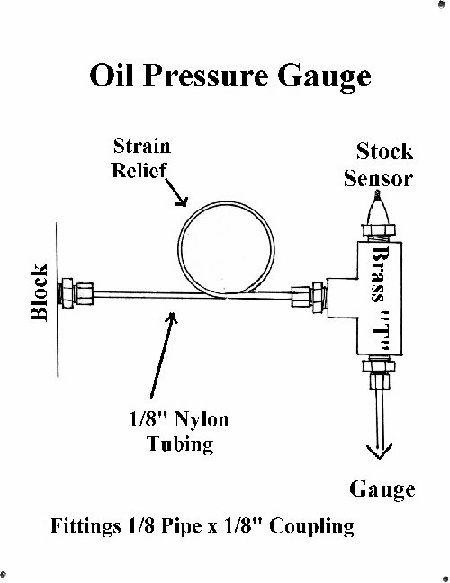
http://www.theoldone.com/articles/oilpressure
btw- my stock sensor did not need to be extended....
http://www.theoldone.com/articles/oilpressure
btw- my stock sensor did not need to be extended....