


Pipe Beveling Tool


Thread Starter
Honda-Tech Member
Joined: Jul 2003
Posts: 1,544
Likes: 0
From: Portland, Oregon, USA
 Pipe Beveling Tool
Well, after 2 days of putting a bevel on 1.5" sch40 ss by hand, I am looking for a tool to do this and make my life easier. After cleaning and beveling about 20 side of pipe, I was having trouble welding. My hand torch hand was shaking all over the place. I was using a hand grinder with a sanding flaper disc wheel.
Anyway, what tool would you guys recommend for me to put a bevel on the end of piping?
Regards,
Justin
Anyway, what tool would you guys recommend for me to put a bevel on the end of piping?
Regards,
Justin


Joined: Jan 2003
Posts: 73
Likes: 0
From: Victoria, BC, Canada
I think a 5" Mini grinder is best for beveling pipe under 6". With a 1/4" thick disk lay it flat on the pipe while holding it at the angle of the bevel while moving back and forth in a faning motion. pice of cake.
Trending Topics


Honda-Tech Member
Joined: May 2002
Posts: 3,599
Likes: 0
From: BeLlInGhAm, Wa
Re: (fabnewb)
<TABLE WIDTH="90%" CELLSPACING=0 CELLPADDING=0 ALIGN=CENTER><TR><TD>Quote, originally posted by fabnewb »</TD></TR><TR><TD CLASS="quote">thats what i do. Roll the pipe on teh table back and forth while holding the grinder on the edge. i have no problems beveling pipe. </TD></TR></TABLE>
dito. I usually put it vertical in a vice and use my 4.5" angle grinder and go around it.
dito. I usually put it vertical in a vice and use my 4.5" angle grinder and go around it.

Member
Joined: Feb 2002
Posts: 1,088
Likes: 0
From: Centerville, oh, 45459
Re: (Eric@HorsepowerFreaks)
they make pipe beveling machines but they are $$$ ive looked in to them but using a carbide insert and build special fixture you can build one your self for a few hundred bucks


Honda-Tech Member

Joined: Nov 2003
Posts: 5,986
Likes: 2
From: Kitchener, Ontario, CANADA
Re: Pipe Beveling Tool (y7turbo)
<TABLE WIDTH="90%" CELLSPACING=0 CELLPADDING=0 ALIGN=CENTER><TR><TD>Quote, originally posted by y7turbo »</TD></TR><TR><TD CLASS="quote">  </TD></TR></TABLE>
the bigger the better.
</TD></TR></TABLE>the bigger the better.


Member
Joined: Dec 2004
Posts: 1,852
Likes: 0
From: Houston, Texas, USA
Re: Pipe Beveling Tool (TurboSI56)
I am hardcore use my rigid 4.5" angle grinder with 40 grit zerconiam flap disc
The disc last about 100-150 bevels each and I knock out each bevel in about 10 seconds, the discs dont heat up the metal and dont leave any burrs at all eather so there is no clean up when finished
-James
The disc last about 100-150 bevels each and I knock out each bevel in about 10 seconds, the discs dont heat up the metal and dont leave any burrs at all eather so there is no clean up when finished
-James

Thread Starter
Honda-Tech Member
Joined: Jul 2003
Posts: 1,544
Likes: 0
From: Portland, Oregon, USA
Re: Pipe Beveling Tool (RC000E)
The problem for me using the angle grinder to make a bevel is that it fatigues the muscles in my wrist and I have trouble being steady when welding after beveling 20 ends.
I'm going to look into a belt sander. That sounds good to me.
Justin
I'm going to look into a belt sander. That sounds good to me.
Justin
Thread Starter
Honda-Tech Member
Joined: Jul 2003
Posts: 1,544
Likes: 0
From: Portland, Oregon, USA
Re: Pipe Beveling Tool (el chupa nibre)
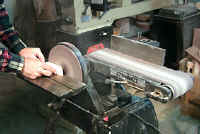
<TABLE WIDTH="90%" CELLSPACING=0 CELLPADDING=0 ALIGN=CENTER><TR><TD>Quote, originally posted by el chupa nibre »</TD></TR><TR><TD CLASS="quote">i use my belt sander and a 40 grit disk. takes 4 secs
my sander has a 52.5x4 belt and a verticle circular disc.
i use the disc. cmpared to the bench grinder its a walk in the park.
 </TD></TR></TABLE>
What brand belt sander is that? Looks really nice
Ideally, I would buy a horizontal belt sander big enough to surface my head flanges after I've welded up the turbo manifolds.
Justin
Modified by Justin Olson at 9:33 AM 10/12/2006
my sander has a 52.5x4 belt and a verticle circular disc.
i use the disc. cmpared to the bench grinder its a walk in the park.
</TD></TR></TABLE>What brand belt sander is that? Looks really nice
Ideally, I would buy a horizontal belt sander big enough to surface my head flanges after I've welded up the turbo manifolds.
Justin
Modified by Justin Olson at 9:33 AM 10/12/2006
Honda-Tech Member
Joined: Nov 2003
Posts: 5,986
Likes: 2
From: Kitchener, Ontario, CANADA
Re: Pipe Beveling Tool (el chupa nibre)
<TABLE WIDTH="90%" CELLSPACING=0 CELLPADDING=0 ALIGN=CENTER><TR><TD>Quote, originally posted by el chupa nibre »</TD></TR><TR><TD CLASS="quote">i use my belt sander and a 40 grit disk. takes 4 secs</TD></TR></TABLE>
that's actually what I use.. (the 'disk sander')..
I have a 10" disk sanding attachment for my lathe and built a table for it. 40 grit is surprisingly smooth and it doesnt roll the edges over as bad as my bench grinder.
The bonus to having a disk/belt sander is that you can tweak and square the angles on the els easily and accurately. With a fresh sanding disk you can take 1/8" off in a decent amount of time but you better have a bucket of water around to dip the 'pipe' in every so often.
<TABLE WIDTH="90%" CELLSPACING=0 CELLPADDING=0 ALIGN=CENTER><TR><TD>Quote, originally posted by Howitt »</TD></TR><TR><TD CLASS="quote">horizontal belt sander is not the right tool to surface flange</TD></TR></TABLE>
It's the right tool if you want to screw up a head flange in a hurry.
that's actually what I use.. (the 'disk sander')..
I have a 10" disk sanding attachment for my lathe and built a table for it. 40 grit is surprisingly smooth and it doesnt roll the edges over as bad as my bench grinder.
The bonus to having a disk/belt sander is that you can tweak and square the angles on the els easily and accurately. With a fresh sanding disk you can take 1/8" off in a decent amount of time but you better have a bucket of water around to dip the 'pipe' in every so often.
<TABLE WIDTH="90%" CELLSPACING=0 CELLPADDING=0 ALIGN=CENTER><TR><TD>Quote, originally posted by Howitt »</TD></TR><TR><TD CLASS="quote">horizontal belt sander is not the right tool to surface flange</TD></TR></TABLE>
It's the right tool if you want to screw up a head flange in a hurry.

Joined: Feb 2005
Posts: 422
Likes: 0
From: usa
Re: Pipe Beveling Tool (2point2)
<TABLE WIDTH="90%" CELLSPACING=0 CELLPADDING=0 ALIGN=CENTER><TR><TD>Quote, originally posted by 2point2 »</TD></TR><TR><TD CLASS="quote">
It's the right tool if you want to screw up a head flange in a hurry. </TD></TR></TABLE>
can you elaborate on this please?
It's the right tool if you want to screw up a head flange in a hurry. </TD></TR></TABLE>
can you elaborate on this please?

Honda-Tech Member
Joined: Nov 2003
Posts: 5,986
Likes: 2
From: Kitchener, Ontario, CANADA
Re: Pipe Beveling Tool (GeeGee)
<TABLE WIDTH="90%" CELLSPACING=0 CELLPADDING=0 ALIGN=CENTER><TR><TD>Quote, originally posted by GeeGee »</TD></TR><TR><TD CLASS="quote">can you elaborate on this please?</TD></TR></TABLE>
ok.
A flange may become warped after the welding process.
A belt sander is not the right tool for surfacing a head flange (making the head flange 'flat' so it mates with the head without leaking). A belt sander is meant for sanding.. after sanding the surface may look flat but I'll bet my left nut that it wont be.
A mill and a 'surface grinder' are what you should use to make surfaces flat and true. A surface grinder is the best method (but way overboard) and a mill does the job perfectly and is probably used in the factory.
If your manifold flange is not perfectly flat, pay a machine shop to "mill it". Dont be a douchebag and tighten is flat to the head - this can only increase your chances of getting a crack.
ok.
A flange may become warped after the welding process.
A belt sander is not the right tool for surfacing a head flange (making the head flange 'flat' so it mates with the head without leaking). A belt sander is meant for sanding.. after sanding the surface may look flat but I'll bet my left nut that it wont be.
A mill and a 'surface grinder' are what you should use to make surfaces flat and true. A surface grinder is the best method (but way overboard) and a mill does the job perfectly and is probably used in the factory.
If your manifold flange is not perfectly flat, pay a machine shop to "mill it". Dont be a douchebag and tighten is flat to the head - this can only increase your chances of getting a crack.